
Written using peer-reviewed research including Ricketts et al. (2017) in the Journal of Obsessive-Compulsive and Related Disorders, Murphy et al. (2007) in the Journal of Clinical Sleep Medicine, and Cavic et al. (2021) in Comprehensive Psychiatry.
One survey has measured the bedtime window in trichotillomania properly, and its numbers are larger than most people expect. Of 259 adults who met diagnostic criteria for hair pulling disorder, just over four in five had pulled after getting into bed but before falling asleep at some point in the past month. More than a third did it every night.
That makes the bed the most reliable pulling location most people have, and it is also the one that resists the standard advice hardest. Turning off lights, covering mirrors, moving tweezers into another room: these are the headline fixes for night-time body-focused behaviors, and they are built around a search your eyes perform. Pulling in bed is a search your fingertips perform, lying flat, with the lights already off.
This guide covers what changes when you treat bedtime pulling as a tactile problem instead of a visual one: which barriers survive a whole night, what to do about the third of people for whom pulling is genuinely helping them fall asleep, and how to read what ends up on the pillow.
Why the bed is a different problem for pulling than for picking
Skin picking and hair pulling get grouped together for good reasons, and at bedtime they come apart.
Picking mostly needs a target you can see. That's why so much night-picking advice is about the bathroom: the overhead light, the magnifying mirror, the ten minutes of standing close to your own face with a legitimate reason to touch it. Take away the light and you take away a real part of the mechanism. The picking version of this problem is largely solved in the bathroom.
Pulling doesn't need any of that. The scalp was the primary site for 66.8% of the people in that survey, and your scalp is available to you lying flat on your back with your eyes closed and the room completely dark. There's no posture to change, no distance to a mirror, no lamp to switch off. A coarse hair, a wiry one, a strand that sits differently from the rest: your fingertips find those in the dark as well as they do in daylight, arguably better.
Two other things are specific to pulling in bed.
The first is posture. Lying down puts one or both hands within easy reach of your head with no effort at all. Reading, scrolling, or waiting for sleep leaves a hand idle at exactly head height, which is not true of any other position you spend an hour in.
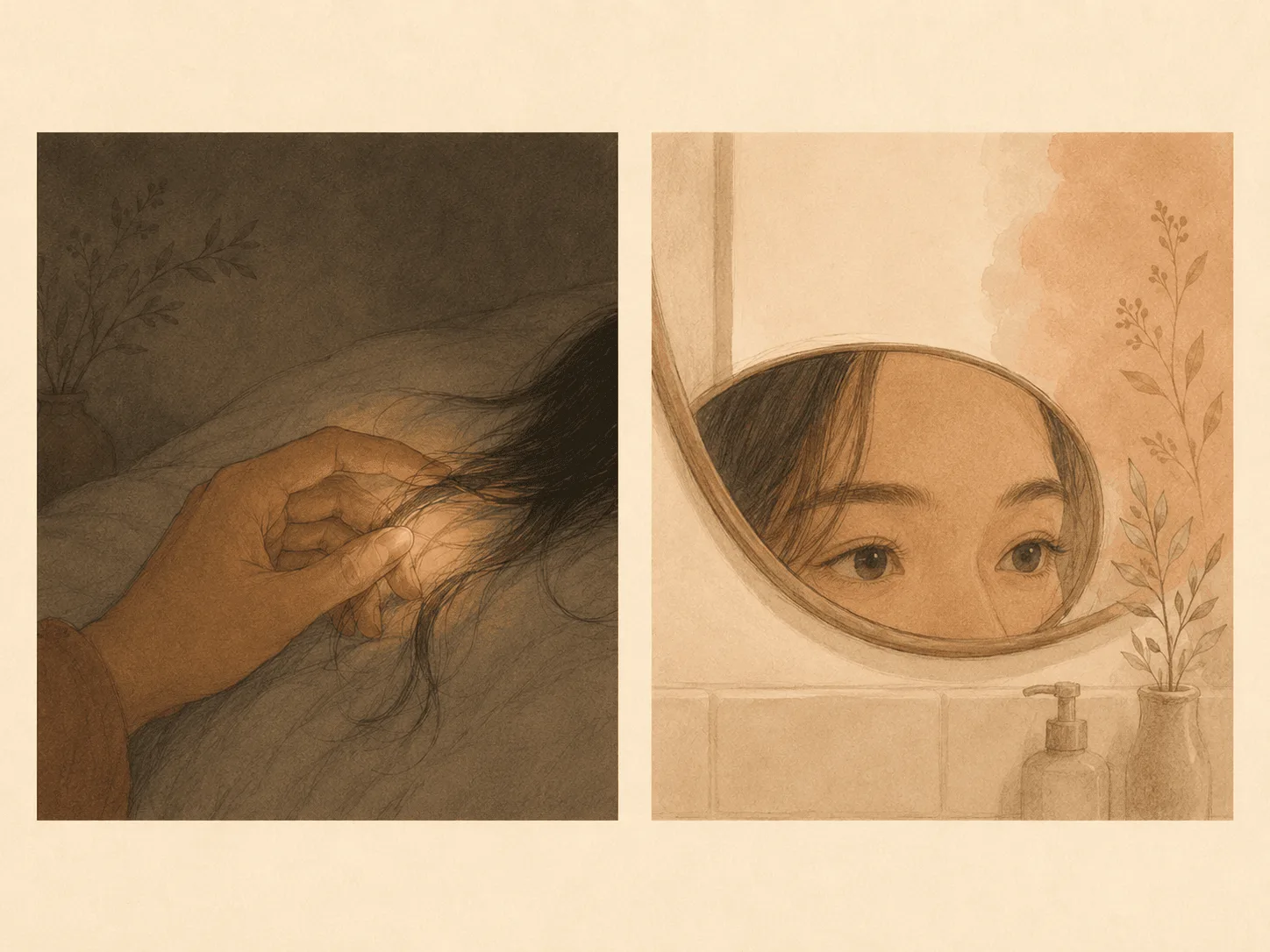
The second is evidence. Picking damage stays on your body, where you can avoid looking at it. Pulled hair lands on the pillow, on the sheets, on the floor beside the bed, and it can be counted. That is genuinely harder to wake up to, and it is also the best free information about your own behavior that anyone with this condition gets. More on using it further down.
Four different things get called night pulling
The same survey asked the people who pull in bed what made it hard to stop. They could pick more than one answer, and the pattern that came back is the most practically useful part of the whole study.
| What makes it hard to stop | Share of people who pull in bed |
|---|---|
| Zoning out and pulling without thinking about it | 77.4% |
| Pulling while worrying about things before falling asleep | 61.1% |
| Pulling out of boredom while waiting to fall asleep | 40.4% |
| Pulling because it relaxes them and helps them fall asleep | 32.7% |
Most people recognize more than one of those, and they do not respond to the same thing.
Zoning out is an awareness problem. It needs a physical interruption, because there is no moment of decision to appeal to. This is the one barriers are actually for.
Worrying is an arousal problem. Barriers will not touch it. If your hand goes up while you're running tomorrow's difficult conversation, removing the hand's target leaves the worry intact and your hand looking for something else to do. What tends to help here is giving the worry somewhere to go before you get in: writing the loop down, or a wind-down that isn't lying in the dark thinking.
Boredom is an occupancy problem. It responds to having something in both hands, which is the cheapest fix on this list and the one people skip because it sounds too simple.
Relaxation is a replacement problem, and it's the one that quietly wrecks plans. Section below.
When pulling is doing a job
Roughly a third of people who pull in bed said the pulling relaxes them and helps them fall asleep. In the skin picking arm of the same survey, that answer came back from 20%. It's the sharpest difference between the two conditions in the whole bedtime dataset, and it changes what a plan has to include.
If pulling is part of how you get to sleep, then a bonnet, a pair of gloves, or a promise to yourself is not removing a bad habit. It's removing a sleep-onset ritual and putting nothing in its place. What follows is a worse night, then a worse next day, then a night where the ritual comes back with the barrier pushed to one side. That sequence gets read as weak willpower. It isn't. It's an unreplaced function.
The fix is to build the replacement first and only then add the barrier. Whatever goes in has to do the same job the pulling was doing: rhythmic, repetitive, requiring no decisions, tolerable in the dark, and available lying down.
Things that meet that description:
- Slow scalp massage with the pads of the fingers, no fingernails involved. It hits a similar sensory target with none of the damage.
- A textured object kept under the pillow. Weighted, ridged, or fuzzy tends to hold attention better than smooth.
- Running fingers through a small piece of fake fur, a tassel, or a length of yarn. Several people find hair-like textures work where non-hair textures don't.
- Progressive muscle relaxation or a paced breathing count, which occupies attention instead of hands and works for the worry row too.
Changing what your fingers find
This is where the tactile framing pays off. There are two levers: what sits between your fingers and your hair, and what your hair feels like when they get there. Neither has been tested in a randomized trial. Both are standard practical guidance from BFRB clinicians and the community, and both are cheap enough to test on yourself in a week.
Coverings that survive a whole night
The bar for an overnight barrier is low and specific. It has to still be on at 3am, and it has to interrupt an unaware hand rather than defeat a determined one.
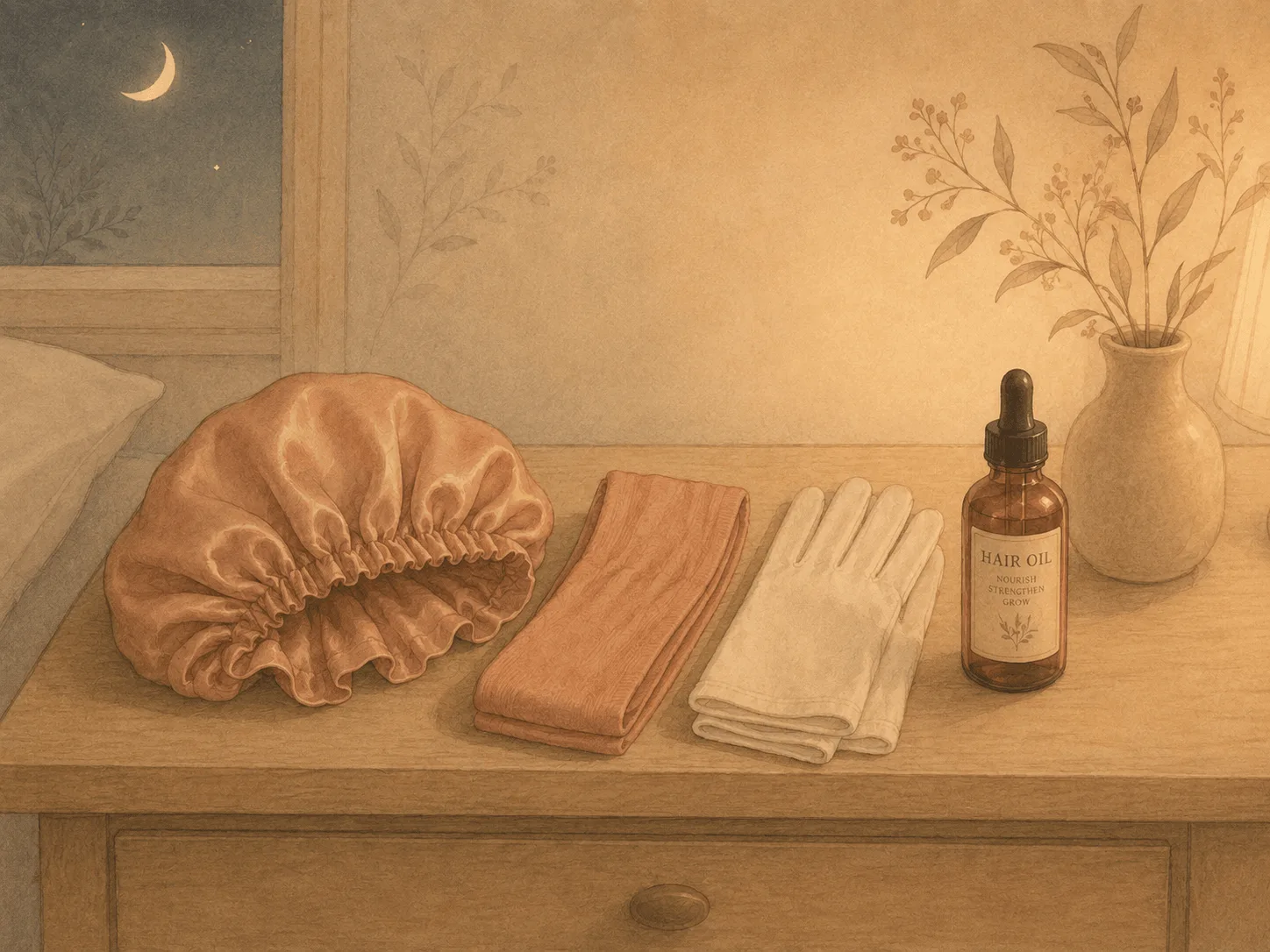
Satin or silk bonnets are the most commonly reported thing that actually stays on, partly because they were designed for sleeping in and partly because they're kind to the hair underneath. They also fail in a way worth knowing about: many people simply push them back off the hairline in their sleep, so the crown stays protected and the front doesn't.
A wide soft headband or a bandana covers the frontal hairline and temples, which is exactly the strip a bonnet tends to give up. Some people wear both.
Thin cotton gloves work on the hand rather than the head, which makes them the better choice if you pull from eyebrows or lashes, where nothing can be covered. They are also the least tolerated item on this list. If gloves keep coming off, cloth medical tape or a fabric plaster wrapped around the pads of the thumb and index finger does a similar job with a fraction of the discomfort.
A hood, or long sleeves you pull over your hands is the improvised version, and it is genuinely worth trying on a night when nothing else is in reach.
Making the hair itself uncooperative
If a hair won't grip, the search fails before the pull starts, and this half of the work costs nothing.
- Leave conditioner or hair oil in overnight. Slippery hair is difficult to pinch. This is the single most-recommended trick in the community, and the mechanism is honest: it doesn't reduce the urge, it reduces the success rate, which buys you the second of awareness you need.
- Go to bed with damp hair, or shower right before. Same principle, no product needed.
- Braid it, or tie it up. Loose strands are what fingers hunt for. A braid removes most of them, and a tight one changes the feel of the whole scalp enough to register as unfamiliar.
- Keep nails short and filed smooth. A filed nail is much worse at pinching a single strand than a squared one. This is the change with the best effort-to-effect ratio for pulling that happens while you're barely awake.
The hour before you get in
Most of what happens in bed is decided before you're in it.
Put the barrier on early. Bonnet, headband, oil, braid: all of it goes on while you still care about the plan, ideally before you sit down for the evening. Nobody gets up at midnight to put on a bonnet, and the ones who plan to are describing the night the plan failed.
Give the last stretch of the evening to your hands. Anything that occupies both of them works, and it works better than anything that occupies your attention alone. Knitting, a physical book held in two hands, cooking tomorrow's lunch, a puzzle. The specific activity matters far less than the number of hands committed to it.
Get in when you're sleepy rather than when the clock says to. Every extra minute lying awake is unoccupied time in the highest-risk position you'll be in all day. If you're routinely lying there for forty minutes, that's forty minutes of raw material.
Deal with the phone. Scrolling in bed is a one-handed activity by design, which leaves the other hand with nothing to do and a scalp within reach. If the phone is staying, both hands on it is a real intervention.
Practice your competing response somewhere calm first. Lie on the bed at three in the afternoon, no urge in sight, and run the replacement for a minute. A motor pattern you have never rehearsed will not turn up at eleven at night when you need it. Habit reversal training covers how to build one that fits the position you actually pull in.
Hair on the pillow: pulling during sleep
Finding hair on the pillow and having no memory of pulling it is frightening in a way that daytime pulling isn't, so it's worth being precise about what the evidence supports.
In the survey, 12.9% of the trichotillomania group reported pulling at some point during sleep in the past month. Daily occurrence was rare. Of the 33 people who reported it, exactly one pulled only during sleep and never while awake. For everyone else it sat alongside waking pulling rather than replacing it.
How people knew it had happened is its own small piece of data: 54.5% found strands when they woke up, the same share had woken up mid-episode, 18.2% woke with pain in the area they pull from, and 15.2% were told by someone else.
Genuinely sleep-isolated hair pulling, where someone pulls only while asleep and never awake, is a real but rare entity. When 807 dermatologists were surveyed, 11% of the 107 who responded said they had seen a patient whose pulling occurred solely during sleep, and 20% had suspected it in cases of unexplained hair loss. In the individual cases documented with sleep studies, it has been described as an NREM parasomnia in one patient and as part of a sleep-related dissociative disorder in another. The published case that started this line of work was a 24-year-old woman who pulled her brows and lashes only in her sleep and knew about it solely because of what she found on her pillow.
The practical response is short, because awareness work cannot reach you while you're unconscious:
- Barriers do nearly all the work here. Bonnet, headband, gloves, taped fingertips, whichever you tolerate.
- Short, smoothly filed nails. Cheap, and it reduces damage per movement rather than movements per night.
- Note it in the morning: which area, roughly how much, what the evening before looked like.
When to raise it with a doctor
Most night pulling is ordinary trichotillomania in an unhelpful setting and doesn't need a referral. A few situations do.
Bring it up if you have no waking urge to pull at all and are still losing hair overnight, which is the pattern that points toward sleep-isolated pulling rather than a body-focused repetitive behavior. Bring it up if the overnight pulling arrives alongside other sleep behaviors: sleepwalking, sleep-talking, acting out dreams, or long gaps you can't account for. Bring it up if your scalp is getting sore or infected, or if you're regularly not sleeping.
One more thing worth knowing about the sleep side. In a study of 87 adults with hair pulling or skin picking, poor sleep quality was associated with worse hair pulling severity but not with worse skin picking severity. It's cross-sectional, so it can't tell you which direction the arrow runs, and the authors say so. It does mean that for pulling specifically, sleep is not a side topic. Treating a run of short nights as a higher-risk week, with barriers going on earlier, is a reasonable thing to do with that finding.
Two weeks of pillow data
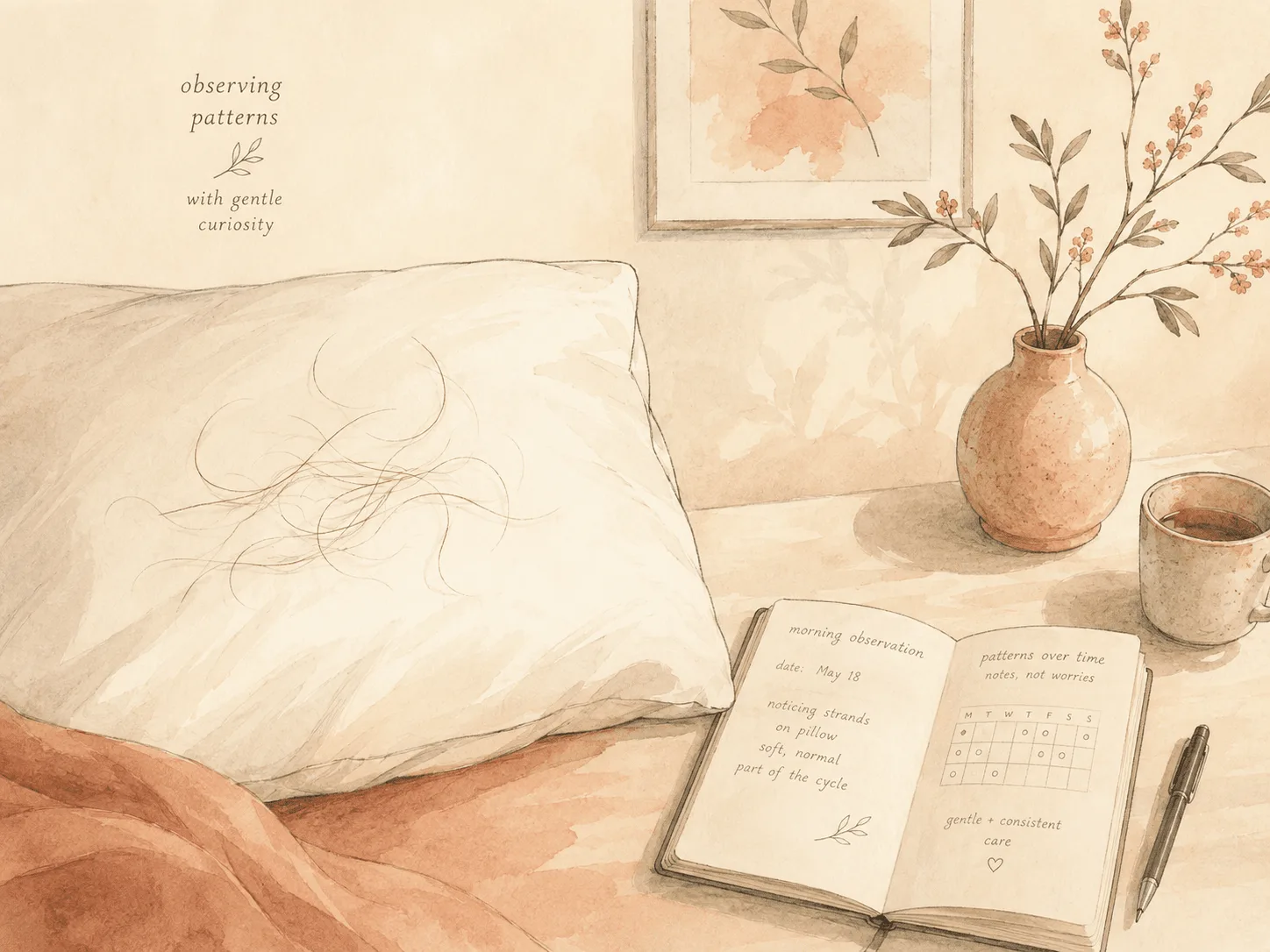
Night pulling feels formless from the inside and is usually far more patterned than it feels. Two weeks of light recording finds the pattern, and for this behavior the recording is easier than usual because the evidence collects itself while you sleep.
Each morning, note four things: roughly how much came out, which area, whether you remember any of it, and what the previous evening looked like. That last one carries most of the signal. What tends to surface is unglamorous and actionable. Pulling that only happens on nights you got in more than twenty minutes before you were sleepy. A cluster after late shifts. Nothing on the nights you fell asleep to an audiobook. Boring patterns are the ones you can build a barrier around.
If you'd rather not keep a paper log at eleven at night, this is the sort of thing an app handles better than memory does. The full behavioral approach and the wider trigger map are worth reading once you know which nights are yours.
Find your night pattern
SkinAware logs pulling episodes with time and location, tracks the urges you resisted without acting on them, and surfaces the pattern across a couple of weeks. It also includes a habit reversal course for building the competing response.
Frequently Asked Questions
Because lying down puts your hands at head height with nothing else to do, in the dark, alone, with no one to notice and nothing to end the episode. Pulling doesn't need light or a mirror the way picking does, so none of the usual night-time protections apply. It's the majority experience in this condition rather than an unusual one: just over four in five adults with trichotillomania in one survey had pulled in bed in the past month, and 34.2% did it daily.
Some people do. In that survey, 12.9% reported pulling during sleep at least once in the past month, though only one person out of 259 pulled exclusively while asleep. Sleep-isolated hair pulling exists as its own rare entity, documented in individual cases as an NREM parasomnia. Reassuringly, people who pulled during sleep didn't differ from those who didn't on severity, anxiety, depression, or sleep quality.
It helps with the unaware kind, which is the most common kind in bed, because a hand that arrives without your knowledge meets fabric instead of hair. It won't touch pulling driven by worry or by needing the sensation to fall asleep. Bonnets also tend to ride back off the hairline overnight, so if you pull from the front, add a wide headband or a bandana underneath. There are no randomized trials on any of this; it's practical guidance, and it's cheap to test.
Something rhythmic, repetitive, doable lying down in the dark, and requiring no decisions. Scalp massage with the finger pads rather than the nails, a textured object under the pillow, running your fingers through a piece of fake fur or yarn, or a paced breathing count. Build the replacement first and add the barrier afterwards. Roughly a third of people who pull in bed say it relaxes them and helps them get to sleep, and removing that without a substitute is why barrier-only plans tend to collapse in the second week.
Both make hair too slippery to pinch reliably, which is the point. It doesn't reduce the urge, it reduces the success rate, and that gap is where awareness gets a chance. Frequent wet-hair sleeping isn't ideal for hair health, so most people alternate it with an overnight oil or a leave-in conditioner instead.
Start with barriers and short filed nails, and note what you find each morning for two weeks. See a doctor if you have no waking urge to pull at all, or if it comes with sleepwalking, sleep-talking, or acting out dreams. Say specifically that you think you may be pulling during sleep, because in one survey of dermatologists only about a quarter of those who ask about hair pulling at all would follow up with that question.
It's more relevant for pulling than it is for picking. One study of 87 adults found poor sleep quality tracked with worse hair pulling severity but not worse skin picking severity, and people with trichotillomania reported more sleep disturbance than unaffected comparison groups even after accounting for anxiety and depression. All of it is cross-sectional, so nobody can say which causes which. Treating a stretch of short nights as a higher-risk week is a fair use of the finding; expecting better sleep to work as a treatment on its own isn't.