
Written using the Comprehensive Behavioral (ComB) model of trichotillomania treatment developed by Mansueto and colleagues, and peer-reviewed literature on the phenomenology of hair pulling.
Ask someone what triggers their hair pulling and the answer usually comes back in one word. Stress. Boredom. Anxiety. Those answers are true, and they're close to useless, because there's nothing you can do with them. You can't schedule less stress. You can't catch boredom early enough to stop your hand.
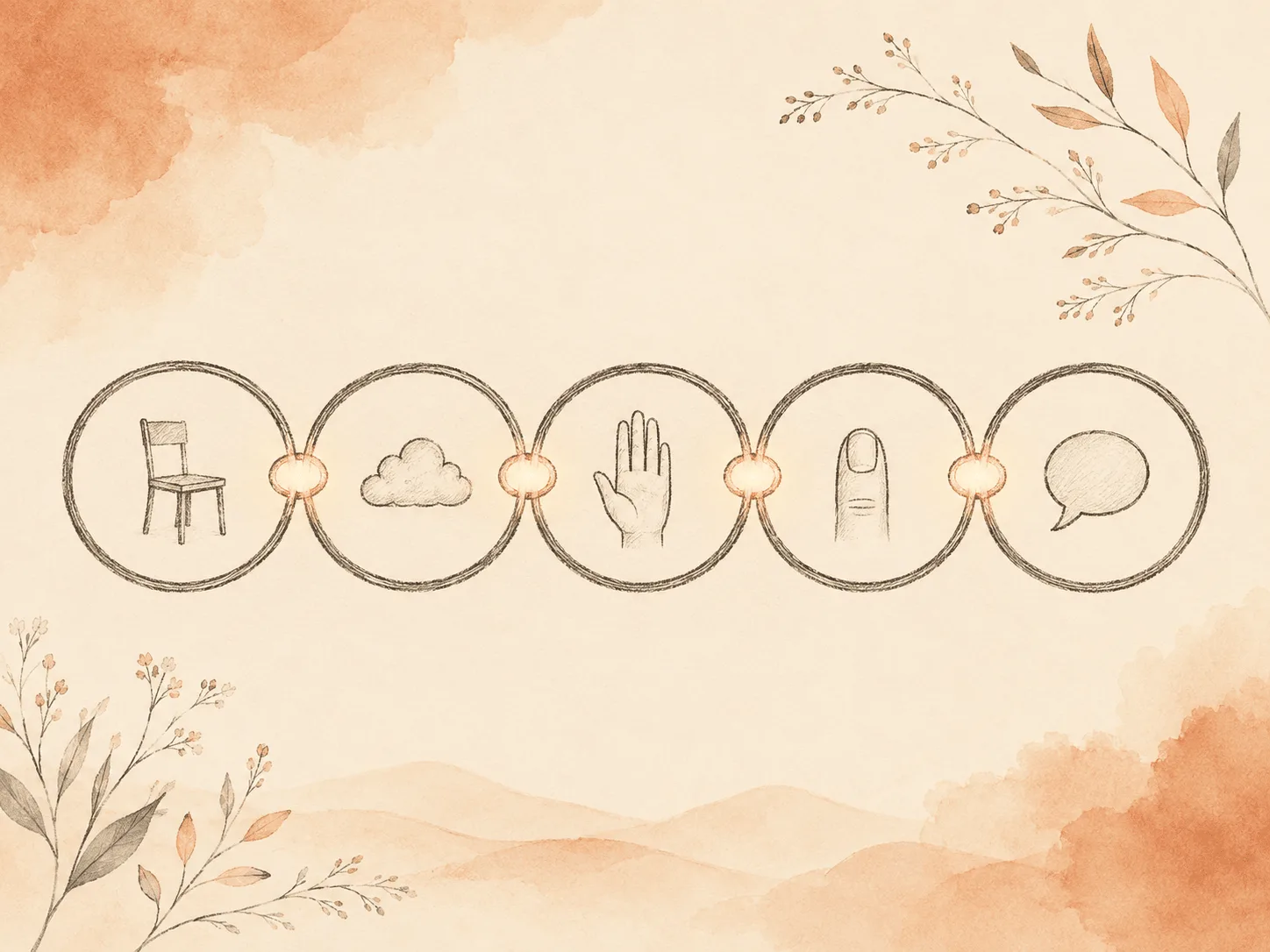
A pull is not one event with one cause. It's a short chain, usually four or five links long, and by the time you notice you're pulling you're already standing at the end of it. The useful triggers live further back: the room you were in, the way you were sitting, the particular hair your fingers found, the thought that handed you permission. Those are specific enough to change.
What follows is a way to find yours. Not a list of triggers that apply to people in general, but a method for reading your own.
A pull has more than one trigger
Take an ordinary evening pull and walk it backwards.
It's around nine. You're on the sofa, laptop shut, nobody else home. You're not anxious exactly, just flat, the particular flatness that comes after a day of talking to people. Your left elbow is on the armrest and your hand is resting against your temple, which means your fingers are already in your hair. They didn't get there on purpose. Somewhere in there a fingertip finds a hair that's coarser than the ones around it, slightly wiry, standing a little proud of the rest. And then: just that one, it doesn't even match.
Ask this person what triggered it and they'll say stress, or boredom. Neither is wrong. Neither is the answer that helps, because by the time the feeling had a name the hand had already arrived.
Look at how many separate things had to line up. A setting. A state. A posture. A sensation. A permission thought. Each one is a place you could intervene, and they are nowhere near equally easy. You can't reliably prevent a flat mood at nine in the evening. You can absolutely change which chair you sit in, what your elbow rests on, and how findable a wiry hair is.
That's why identifying which links are yours matters more than naming the emotion. The emotion is real. It's just rarely the link with a handle on it.
Clinicians describe two styles of pulling, and most people do both.
So you're not hunting one chain. You're looking for the two or three that repeat.
The five kinds of hair pulling trigger
BFRB clinicians sort pulling cues using the Comprehensive Behavioral model, usually shortened to ComB, developed by Charles Mansueto and colleagues. It organizes everything that feeds a pull into five modalities, which spell SCAMP: sensory, cognitive, affective, motor, place. It's the frame our own HRT course uses to build a trigger map, and it's the frame worth borrowing here.
One caveat before the list. Researchers were still working on a validated, standardized way to measure the SCAMP domains as recently as the last few years, so treat this as a sorting box rather than a test with a score. Its job is to stop you filing everything under "stress."
Sensory: what the hair or scalp is doing. A hair that feels coarse or wiry under the fingertips. One that sticks up out of line with the rest. A different color, gray or darker or lighter. A different texture, curlier or thicker or more brittle. Asymmetry between two sides, which brows are especially prone to. A patch of scalp that feels sore, tingly, or itchy. Stubble and regrowth, which is exactly why the weeks after a good stretch are so risky. And the after-sensations that keep the loop going: the root between finger and thumb, the hair run across the lip.
Cognitive: the thoughts that grant permission. Just one more. That one needs to go. I can't leave it like that. I've already started, so. I'm only checking. One won't make a difference. I'll even it out. Nobody's going to notice this spot. I'll deal with it later. These aren't causes. They're the negotiation your brain runs to get past its own objection, and they show up near the end of the chain. That's still useful, because they're the loudest link and the easiest one to hear yourself say.
Affective: the state you're in. Stress and overwhelm. Anxiety and worry. Boredom or understimulation. Frustration. Sadness, loneliness, anger. Feeling numb or disconnected from things. Shame, or a run of self-criticism. Excitement and anticipation, which surprises people. And fatigue, which is the most underrated entry on this list by a distance. Pulling shows up at both ends of arousal, which is why it can be described as calming by one person and stimulating by another, or by the same person on different days.
Motor: what your body does before you decide anything. Your hand traveling to your head when you're propped up. Fingers finding brows or lashes. Twirling. Lying down with your hands near your head. Head resting in one hand while you read or take a call. Running fingers through your hair in a grooming pass that quietly doesn't end. Close-up inspection in a mirror.
Place: the settings that stack the odds. Locations first, and the usual suspects are the bathroom, the bedroom, the car, a desk, the sofa, any mirror, classrooms, public restrooms. Then times: the morning routine, the hour after work, late evening, the stretch right before sleep, waking in the night. Then situations: alone, watching TV, scrolling, reading or studying, working, on a phone call, in a meeting, falling asleep. And then tools, which get forgotten: tweezers, a magnifying mirror, one particular lighting setup, one specific spot on your head you always return to.
Seven days to find yours
Three parts. All of them are short on purpose, because a tracking system you abandon on day three tells you nothing.
One: the five-second tag. When you notice you're pulling, or have just finished, don't try to reconstruct anything. Write down four things and get on with your day: where you are, what your body is doing, what you're feeling, and what the hair was. Ten words is plenty. Sofa, hand on temple, flat, wiry one. The analysis happens later. If you try to do it in the moment you'll stop doing it by Wednesday.
Two: the hands check. This is the part a plain end-of-day journal can't reach. If you never registered the episode starting, you can't recall it at bedtime, which means automatic pulling stays invisible in your own data. So set three or four alarms across your highest-risk window, and when one goes off, record one thing only: where your hands are. Not whether you were pulling. Just where your hands were. After a week you'll have a map of the postures that put your fingers in your hair, and that's the motor link you could not otherwise see.
Three: the reconstruction, five minutes before bed. Take the day's tags and walk each one backwards. What was I doing right before that? Where was I? What was the last thing that happened before my hand went up? You're always looking for the link before the link you noticed.
Log the urges you didn't act on, too. A resisted urge has the same chain as a completed one minus the ending, and it quietly tells you which links you're already able to interrupt.
Paper works fine for this. The reason a lot of people move to an app is the five-second tag: if logging takes longer than the pull did, it stops happening. SkinAware records an episode or a resisted urge in a few taps, with fields for trigger, feeling, body part, environment, duration, and urge intensity. Its HRT course also has a trigger-mapping module that walks you through the five SCAMP domains question by question and shows you which ones came out on top.
Log the chain, not just the pull
SkinAware captures episodes and resisted urges in seconds, and its HRT course builds a SCAMP trigger map from your answers.
Reading a week of your own data
You now have a pile of tags. Getting a decision out of them takes three passes.
Sort every entry into a domain. Plenty will fit two, and that's fine, put them in both. Then count. Two domains are usually well ahead of the others, and those two are what you work on.
Then split the count two ways, because frequency and severity are not the same trigger. Some cues show up constantly and cost you very little: the daily understimulated pull while a video plays, three hairs, over in a minute. Others show up rarely and take an hour out of your evening, usually the ones attached to shame or anger. Both are worth addressing. They need completely different tools, and if you rank purely by frequency you'll build a plan around the small one and leave the damaging one untouched.
For your worst sessions specifically, look further back than the same day. Sleep the night before. A conversation that afternoon. A deadline landing. Where you are in your cycle, if you have one. Some triggers fire hours ahead of the pull and never appear in a log that only records the moment.
Watch for one predictable distortion. Cognitive triggers are easy to notice because they arrive as words, and motor triggers are hard to notice because they arrive as nothing at all. Almost everyone's first map over-counts C and under-counts M. If your motor column is empty after a week, the likely reading is that the hands check didn't happen, not that posture plays no part.
Where trigger-hunting goes wrong
Stopping at the emotion. "Anxiety" is a category, not a trigger. "The twenty minutes after I shut my laptop, before I've decided what I'm doing with my evening" is a trigger. You can put something in that gap.
Treating the permission thought as the cause. It's the loudest link, and it arrives last. Arguing with just one more while your fingers are already in your hair is a fight you'll lose most nights. Change the link before it instead.
Trying to work on all five domains. The whole point of sorting cues by modality is to match what you do to what actually drives your pulling. Five interventions at once means none of them get run properly, and when the week goes badly you won't know which part failed.
Letting discovery become the avoidance. Mapping feels productive and costs almost nothing emotionally. If you're six weeks in and haven't changed a single thing about your evenings, the map is finished. The tracking has become the thing you do instead of the harder part.
What to do once you know
Your trigger map isn't the treatment. It's what makes the treatment specific instead of generic, and that's the difference between a plan built for people who pull and a plan built for the way you pull.
Broadly: sensory-dominant pulling responds to substitutes that deliver something close to the same physical experience. Motor-dominant pulling responds to barriers and posture changes, because there's no thought to intervene on. Place-dominant pulling responds to changing the setting, which is usually the fastest win available to anyone. Affective-dominant pulling needs something that actually handles the feeling. Cognitive-dominant pulling is the one that responds to the classic thought work.
The full ladder of what to do with each is in our guide on how to stop pulling hair, and the structured version of the protocol, including competing responses and the awareness training that sits underneath all of this, is in the habit reversal training walkthrough. If you're earlier than that and still working out what this is, start with what trichotillomania actually is.
Frequently Asked Questions
It can certainly feel that way, and that feeling is the clearest sign you're dealing with automatic pulling rather than an absence of triggers. The chain still ran. You just weren't present for the first three links. Posture and setting are almost always doing the work in these episodes, which is why the hands check matters more than trying harder to remember.
Regrowth is a sensory trigger in its own right. New hair comes in blunt, coarse, and a different texture from the hair around it, so it's exactly what fingers are scanning for. This catches a lot of people out after a good stretch, and it's worth planning for rather than reading as a personal failure.
Stress is a real and well-documented contributor, particularly for focused pulling, which tends to arrive in response to negative emotional states. It's just too broad to act on directly. Most people find that when they break a stressful evening into its parts, what actually made pulling likely was being alone, having free hands, and a specific posture, all of which are far more changeable than the stress itself.
Yes, and often more than people expect. Hair length, seasons, a new desk setup, a change in medication, a house move, life getting harder or easier. If your plan stops working after months of it working fine, re-running a week of tracking is usually more useful than concluding the plan was wrong.
Log it in the morning with whatever you have, even if that's only that you woke up with hairs on the pillow. Night pulling is nearly always place- and motor-driven, so the useful details are position, what your hands were near, and what the room was like. That's enough to work with, and it points straight at the interventions that suit it.
A week gives you a usable first map, and it will be incomplete. Two to four weeks gives you something you can trust, mostly because it catches the rarer, worse episodes that a single week misses. You don't need to wait for perfect data. Start acting on your top two domains as soon as they're visible.