
Written using peer-reviewed research including Farhat et al. (2020) in Depression and Anxiety and Grant, Dougherty & Chamberlain (2020) in Psychiatry Research, alongside clinical guidance from Cleveland Clinic and the Child and Family Institute at Columbia.
Habit reversal training is a behavioral treatment that replaces hair pulling with a physical action you can't pull while doing. It was built for trichotillomania specifically, in the 1970s, and it remains the treatment with the strongest evidence behind it. A 2020 meta-analysis of 24 randomized trials covering 857 people found behavioral therapy with habit reversal outperformed every drug studied, including N-acetylcysteine and clomipramine.
That's the headline most articles give you. What they don't give you is the protocol. Below is each component of HRT written as something you can actually run: the skill, the drill, and the thing that usually goes wrong.
What HRT actually is
Pulling has a chain to it. You sit down somewhere familiar, your hand travels to your scalp or your brow, your fingertips search for a hair with a particular texture, you isolate it, you pull. By the time you notice, you're usually at link four.
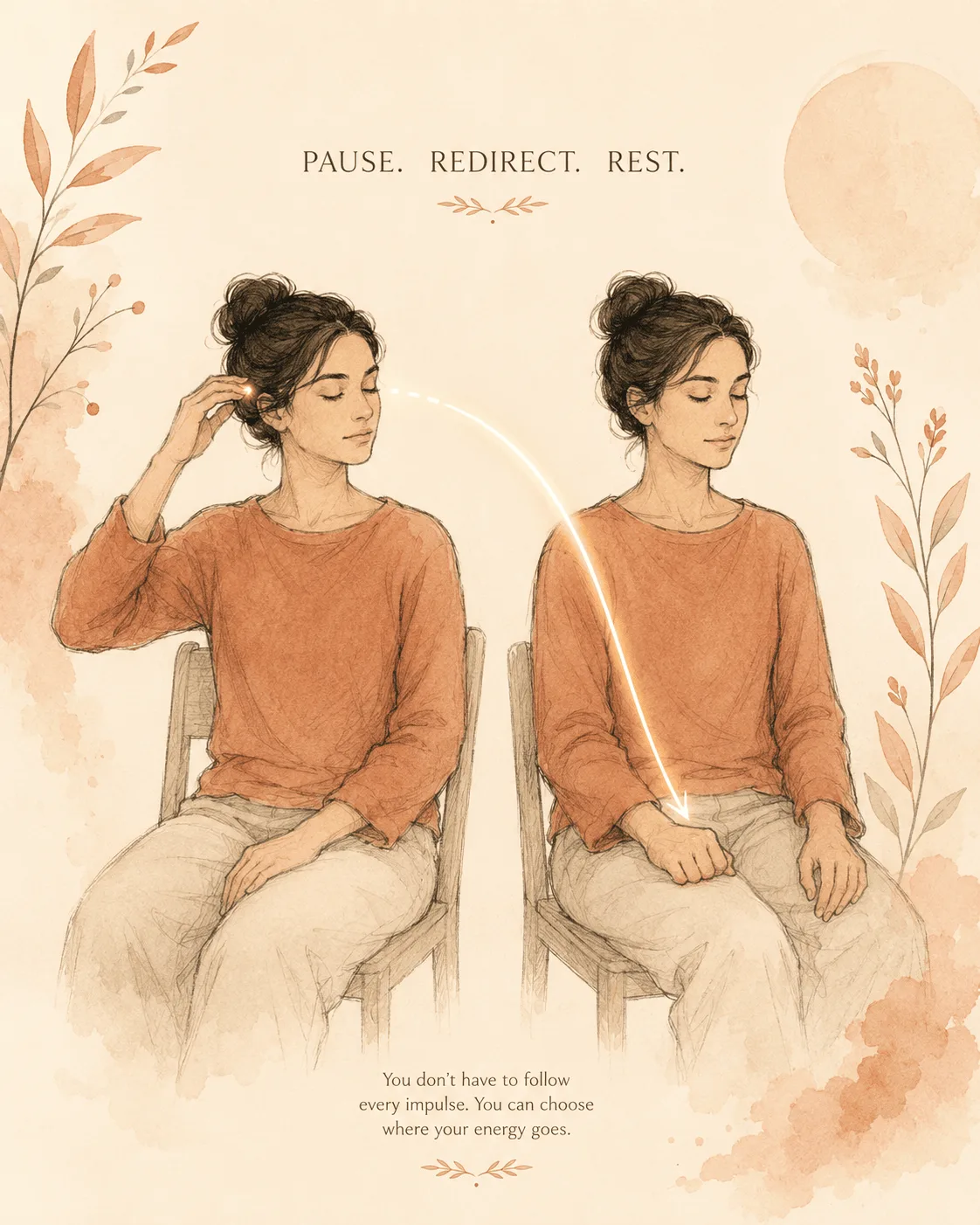
HRT doesn't ask you to fight the urge at link four. It moves the intervention earlier, to the reach, and gives your hand somewhere else to go.
The full clinical package has five parts:
- Awareness training: learning to catch the chain earlier than you currently do
- Competing response training: a physical action that makes pulling impossible, practiced until it's automatic
- Stimulus control: changing the environment so the chain starts less often
- Social support: one person who reinforces the new behavior instead of policing the old one
- Generalization: deliberately rehearsing the skill in every context where you pull
Most self-help versions teach one or two of these and skip the rest. The two that get skipped most often are generalization and social support, which is a problem, because those are the two that decide whether the skill survives past week three.
If trichotillomania itself is new territory for you, the full picture of what hair pulling disorder is is worth reading alongside this.
Before step one: get a baseline
Give yourself seven days before you change anything.
This feels like wasted time. It isn't. You cannot interrupt a chain you haven't seen, and almost nobody knows their own pulling pattern as well as they think. Most people can name one trigger. Most people have five.
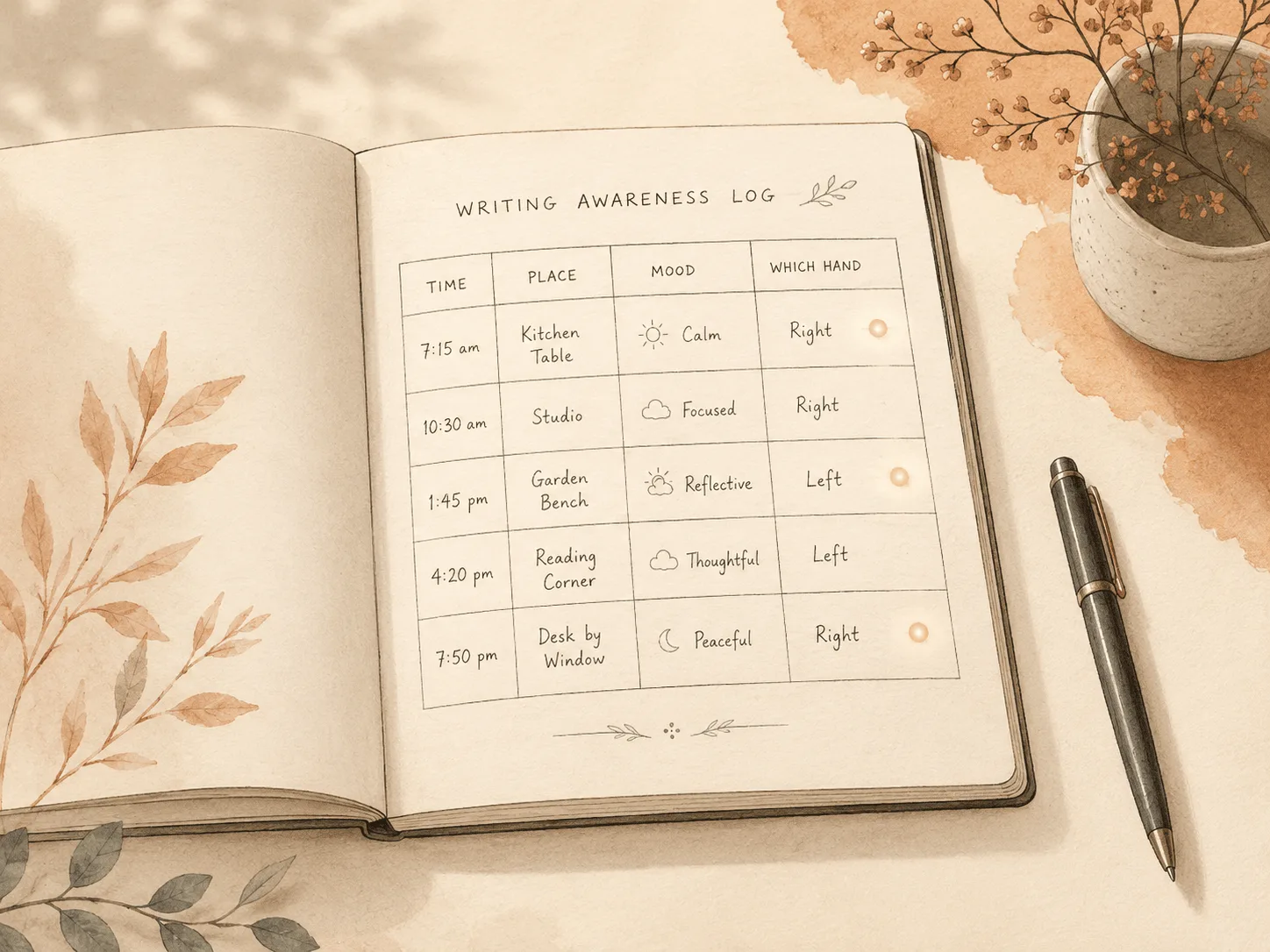
For one week, log every episode with five fields: what time it was, where you were, what your hands were doing beforehand, which site you pulled from, and how you felt in the ten minutes before. Add one column for whether you noticed at the time or only afterward.
1. Awareness training
Stop counting pulls. Count every single time your hand travels up to your scalp, your brow, your lashes, or wherever you pull from, whether or not you pull anything. Touching your head counts. Scratching counts. Searching counts.
The number is almost always several times higher than the pull count. That gap is where the whole treatment lives, because every one of those reaches was a moment you could have intervened, and you didn't see any of them.
Once you're counting reaches, work backward one more step and find the postural tell. Most people have one. It might be an elbow going up onto the armrest, a specific slouch on the couch, propping your head on your hand at your desk, or resting an arm on the car window. That posture is your earliest catchable link, and it usually happens ten or twenty seconds before the reach.
Then describe the pulling itself out loud, in the kind of detail that feels excessive. Which hand. Which fingers. Whether you use your nails, your fingertips, or tweezers. Whether you're looking for a coarse hair, a gray one, a short regrowth stub. What you do with the hair after. People often skip this because it feels grim and pointless. It isn't. The specificity is what makes the next component work, because a competing response has to physically block your pulling motion, not a generic one.
Working out which situations set the chain going is its own piece of work, and the common trichotillomania triggers are a useful checklist to hold your log against.
2. Competing response training
A competing response has to meet four conditions. It has to be physically incompatible with pulling. It has to be holdable for at least a minute. It has to be inconspicuous enough to use in a meeting or on a train. And it has to need no equipment, because the urge will find you when your fidget toy is in your other coat.
For hair pulling, the responses that meet all four tend to be:
- Clenched fists with your arms straight down at your sides
- Palms pressed flat on your thighs, fingers spread
- Both hands gripping the arms of your chair
- Fingers interlocked in your lap, thumbs pressed together
- Both hands wrapped around a mug or a glass
- Sitting on your hands, which is unglamorous and extremely effective in bed
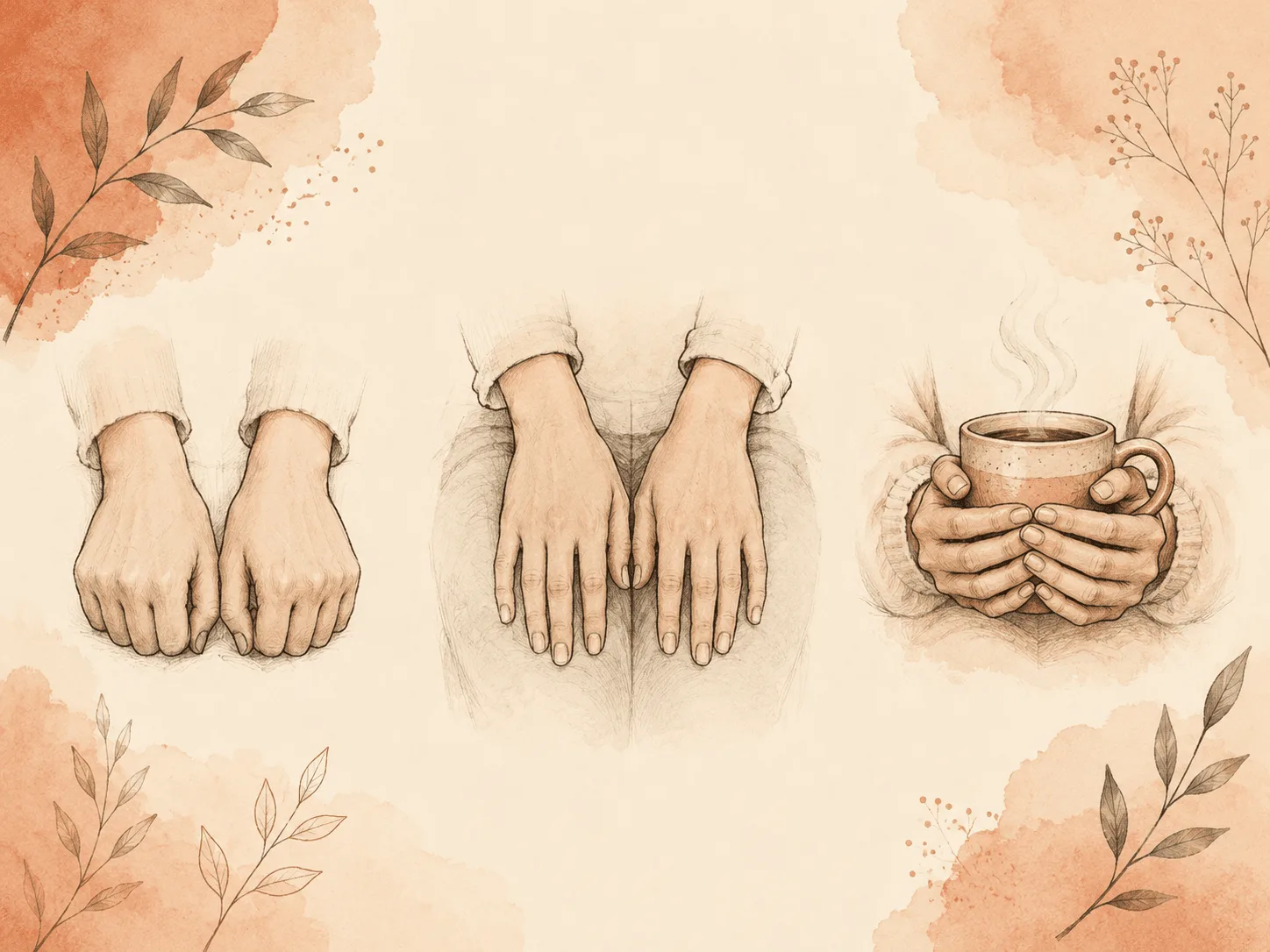
Pick one that suits the position you're usually in when you pull. If you pull while reading in bed, "hands at your sides" is useless to you. Holding the book with both hands is the response that works there.
Hold it for a full sixty seconds, or until the urge drops, whichever is longer. Sixty seconds sounds arbitrary and it isn't magic, but it's long enough for an urge to crest and start falling, and short enough that you'll actually do it.
Three failure modes account for most of the cases where a competing response stops working.
A response that's really a substitute pull. Twirling your hair, stroking your eyebrow, running your fingers over your scalp, rubbing your lashes. These feel like progress because they aren't pulling. They keep your hand inside the target zone, and the hand almost always finishes the job.
A one-handed response when you pull with either hand. Both hands need somewhere to be.
Deploying it too late. Once you've got a hair between your fingers, the response is a tug-of-war you'll lose most nights. Deploy at the reach, ideally at the posture.
3. Stimulus control
Stimulus control buys you time while the competing response is still being learned. It's not the treatment, and treating it as the treatment is why so many people plateau. Barriers reduce opportunity. They don't teach a skill.
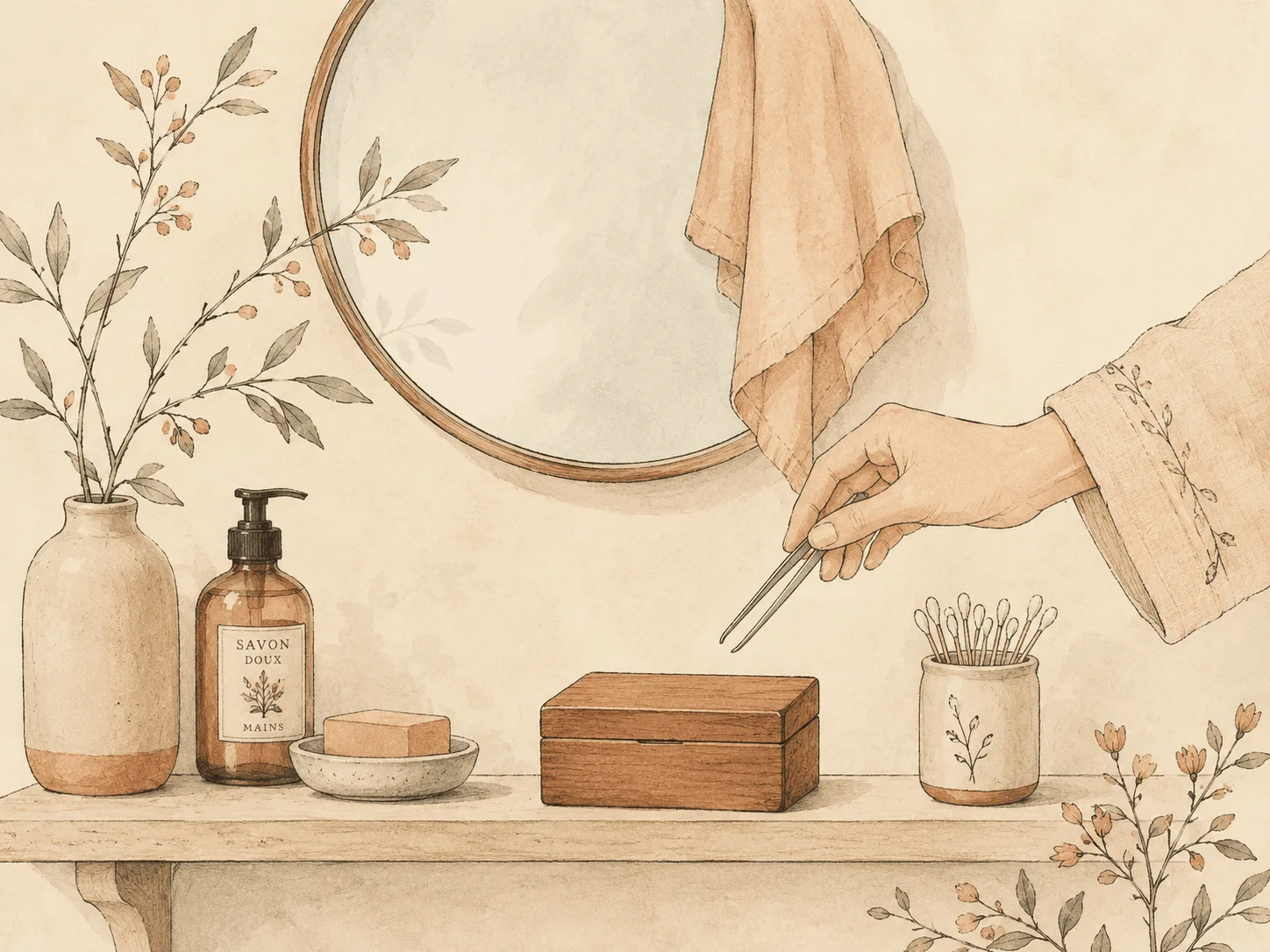
Remove the tools. Tweezers out of the bathroom entirely, into a box, in a drawer, in another room. The extra thirty seconds it takes to retrieve them is often enough.
Fix the lighting and the mirror. Magnifying mirrors make every regrowth stub look like a problem to solve. Get rid of it or cover it. Dim the bathroom light. If you pull at brows or lashes, a lot of that behavior starts as inspection, and inspection needs light.
Put something between your fingers and your hair. Bandages on the pads of the two fingers you pinch with. Silicone finger cots. Cotton gloves for reading, TV, and bed. These work best scheduled during known high-risk hours rather than worn all day, because worn constantly they stop registering.
Make the hair harder to grip. Hair tied up or braided. A soft beanie or bandana during your worst hours. A little oil or leave-in conditioner so fingertips slide instead of catching. For lash and brow pulling, glasses are a genuinely effective physical barrier.
Change the situation, not just the setup. Driving, scrolling in bed, and long solo work sessions are three of the most common pulling contexts, and each has a fix. Both hands on the wheel. Phone charging across the room. A timer that makes you stand up every twenty-five minutes.
5. Generalization
A competing response you've only ever practiced on the couch is a competing response that exists on the couch. This step separates people who get three good weeks from people who get a year.
Write down the five situations where you pull most. For most people that's some combination of: in bed before sleep, at your desk, in the car, on the phone, and in front of the bathroom mirror. Go to each one on purpose, when you're calm and not urging, and run the response there. Sit in the driver's seat and practice. Lie in bed at 3pm and practice. Stand at the bathroom mirror and practice.
Then keep going for longer than feels necessary. Habit reversal isn't finished when pulling stops. It's finished when the competing response happens without you deciding to do it, and that takes months, not weeks.
What a full course actually looks like
Delivered by a therapist, HRT for trichotillomania typically runs 8 to 14 sessions. Sessions one and two are usually assessment and awareness training, three and four build the competing response, and the rest is stimulus control, generalization, and troubleshooting the parts that aren't holding.
Timelines vary a lot. Cleveland Clinic puts it plainly: for some people, HRT takes a couple of months, and for others it takes a year or more. People with long-standing trichotillomania often keep occasional maintenance sessions going indefinitely, the same way you'd keep up physiotherapy exercises after the injury heals.
Set the expectation now: reduction, then plateau, then a slip, then reduction again. A slip after four good weeks is the most common point at which people abandon the protocol, and it's the least justified. The tools didn't stop working. You stopped being in the situation you'd rehearsed for. The wider set of tactics for stopping hair pulling covers what to do in the days right after a slip.
When HRT isn't enough on its own
HRT has the best evidence of any single treatment for hair pulling, and it still doesn't get everyone to zero. That's worth saying plainly rather than overselling the protocol.
Comorbidity is the norm. In a survey of 10,169 US adults, 79% of people with trichotillomania had at least one other mental health condition, most commonly anxiety and depressive disorders, OCD, PTSD, and ADHD. If untreated anxiety is driving your pulling, HRT alone will fight uphill.
Emotion-driven pulling often needs more than a motor response. Where pulling is regulating a feeling rather than scratching an itch, clinicians usually add acceptance-based work or the ComB model, which sorts triggers into sensory, cognitive, affective, motor, and place categories and matches a different strategy to each. That's a more complete map than "have a competing response ready."
Medication is a real adjunct. In the same 2020 meta-analysis, N-acetylcysteine showed a moderate effect (standardized mean difference -0.75), as did clomipramine and olanzapine. None are cures, all belong in a conversation with a prescriber, and none replace the behavioral work.
Doing this without a therapist
Self-directed HRT is a legitimate option, and often the only available one given how few therapists are trained in BFRBs. Two things decide whether it works or quietly fizzles out.
The first is a logging habit that survives past week one. Paper works. So does anything you'll actually open at 11pm.
The second is structure, because the failure mode of self-directed HRT is doing the first component and none of the other four.
SkinAware has the protocol built in as a course: four modules and 21 lessons covering the habit loop and the two types of episode, a trigger map based on the SCAMP framework (sensory, cognitive, affective, motor, place), competing responses and urge management, and a final module on slips and long-term maintenance. It adapts to hair pulling, so the lessons talk about pulling rather than making you translate skin-picking examples. Alongside it you can log episodes and urges, which is the awareness drill above, and add an accountability friend, which is the social support component. There's also a moderated community, which for a lot of people is the more realistic version of a support person.
Run the protocol with structure
SkinAware's HRT course walks through all five components in hair-pulling language, with episode and urge logging built in.
Frequently Asked Questions
Most people see some reduction within two to four weeks of consistent practice, but consistent means doing the drills daily, not just knowing them. A course of therapy usually runs 8 to 14 sessions, and full automaticity of the competing response takes months rather than weeks.
The same four criteria apply: incompatible with pulling, holdable for a minute, discreet, and needing no equipment. Palms flat on thighs and interlocked fingers both work well. Glasses add a useful physical barrier for lashes. Avoid anything that keeps your hand near your face, including smoothing the brow.
Yes, and automatic pulling is exactly what awareness training exists for. The reach-counting drill is designed for it. Expect awareness training to take longer if most of your pulling is automatic rather than focused.
HRT is a behavioral treatment usually delivered within a CBT framework. In practice a therapist will often combine HRT with cognitive work on the thoughts that precede pulling, and with acceptance-based strategies for emotional triggers.
Yes. It's more effective with a trained therapist, but the components are learnable independently and self-directed programs do help people. The most common reason self-directed HRT fails is running only the awareness component and never building the competing response properly.
Check three things. Are you deploying it at the reach or after you've already got a hair? Are you practicing it when you're not urging? And is it genuinely incompatible with pulling, or is it a softer version of the same hand movement?
4. Social support
This component gets left out of nearly every self-help version of HRT, and it's in the clinical protocol for a reason. It isn't accountability in the punitive sense. The job of your support person is specific and narrow:
Write those three lines down and give them to the person. Unbriefed support people default to "stop it," or to concerned commentary about how much has grown back, and both increase shame. Shame increases pulling. If the only person available would police rather than reinforce, an online peer group is a better choice than a badly briefed partner.