
Reviewed using peer-reviewed research including Farhat et al. (2020) in Depression & Anxiety, Grant et al. (2009) in Archives of General Psychiatry, and the Carlson et al. (2021) ComB trial in Behavior Therapy.
Four things reduce hair pulling, and they work best in this order. First, you learn to catch the pull earlier than you catch it now. Second, map which kind of pull you're actually having, since most people are having two or three different ones and treating them as one problem. Third, your hands get something that delivers what pulling was delivering. Last comes the environment: the rooms, mirrors, lighting, and tools that make pulling easy.
That's the answer. The rest of this page is how to run each part, and what to expect while you do.
If you've already tried the beanie, the short haircut, the rubber band on your wrist, and found that each one held for about a week before it stopped working, nothing is wrong with you. Those tips fail for a predictable reason: hair pulling isn't one behavior. The pull you do at your desk with your eyes on a screen and the pull you do in the bathroom hunting for a specific coarse hair are two different behaviors that happen to use the same hand. A tactic that interrupts one will often do nothing to the other.
The clinical name for this is trichotillomania, and it sits in the DSM-5 alongside skin picking, OCD, and body dysmorphic disorder. If you want the full picture of what trichotillomania is and how it's diagnosed, start here.
Why generic tips stop working
Habit reversal training is the treatment with the strongest evidence behind it, and almost every page you'll find will tell you so. What those pages rarely tell you is that HRT is not a fixed set of instructions. It's a frame you fill in with your own data.
The reason the generic version underperforms is that it's aimed at an average puller who doesn't exist. The bandana helps if your pulling is mostly a hand-drift toward the scalp while you read. It does nothing if your pulling starts with a visual search in a bright mirror for the one hair that feels wrong. Same disorder, opposite intervention.
So before you buy anything or commit to a technique, you need about a week of information about yourself.
Week one: collect data, not willpower
The instruction for the first seven days is to change nothing and record everything. This feels like the opposite of progress. It's the step people skip, and it's the step that decides whether anything after it works.
For each pull, note six things: the time, where you were, what your hands were doing right before, which site you pulled from, whether you were aware of starting, and what the pull gave you. That last one matters most and is the one people leave blank. Relief. Satisfaction. A feeling of evenness. The specific texture of the root. Boredom relief. Write down whatever is true, even if it sounds strange.
Two things usually happen during this week. Your recorded numbers come out higher than you expected, which is normal and not a sign of getting worse. And you start catching pulls closer to the beginning, because attention alone shifts the timing. That shift is the actual skill. Everything else in this guide needs a gap between the urge and the hand, and week one is where the gap opens.
The five pulls: mapping with SCAMP
This is the part almost no consumer guide covers, and it's the part that makes the rest of the work specific to you.
BFRB clinicians use a framework called ComB, the Comprehensive Behavioral model, which sorts what drives a pull into five domains. The acronym is SCAMP: Sensory, Cognitive, Affective, Motor, and Place. You go through your week of logs, tag each pull with the domain that fits, and find your dominant two. Then you only run the interventions matched to those two.
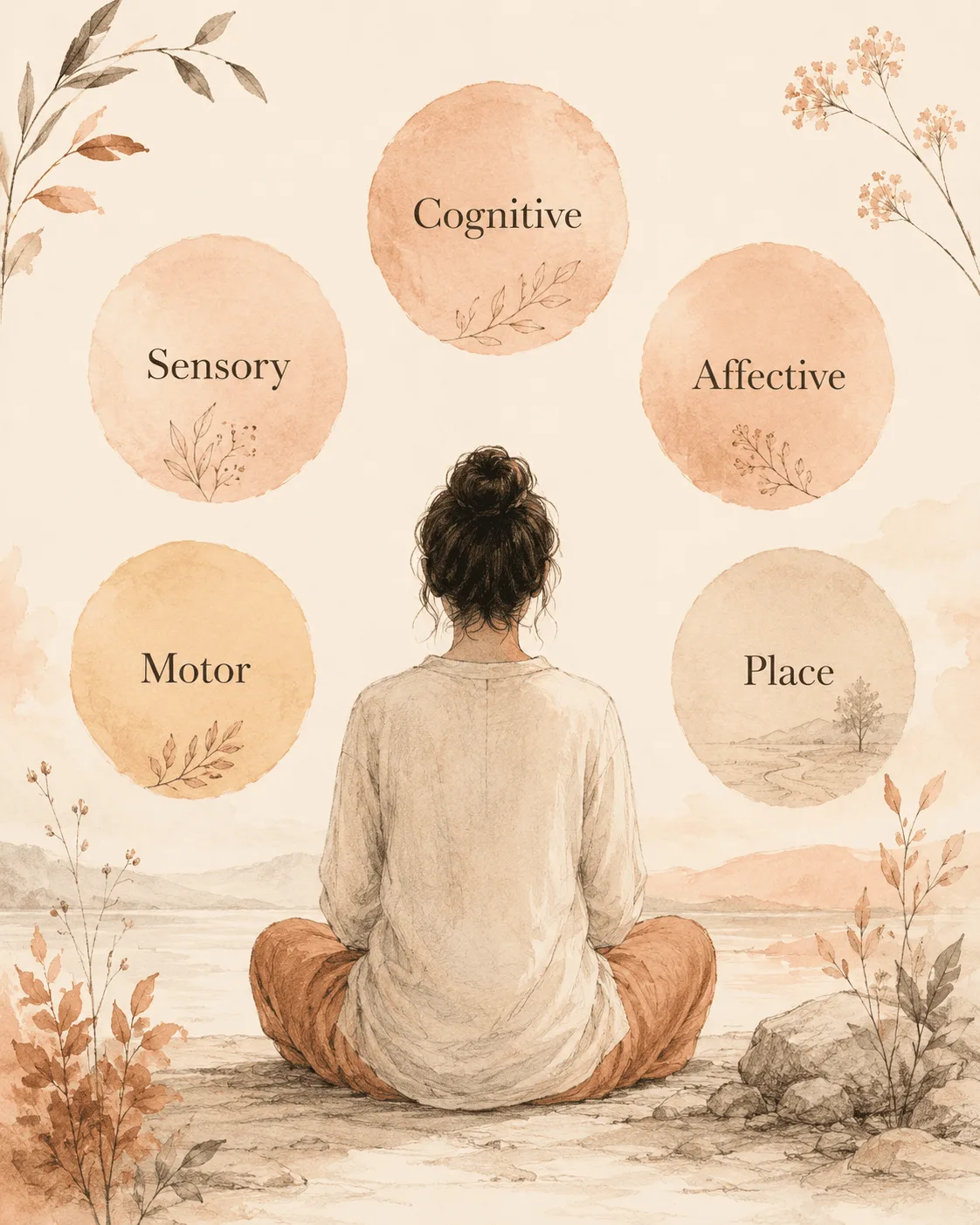
Sensory. The pull is about physical experience. A hair that feels coarse, wiry, or wrong to your fingertips. The tug at the root. The texture of the bulb between your fingers afterward. Some people run the hair across their lips or teeth. If you'd struggle to explain why the specific hair mattered but you knew exactly which one it was, this is your domain.
Cognitive. The pull is licensed by a thought. "Just this one and I'll stop." "That one's grey." "It's uneven on this side." "I've already ruined it, so it doesn't matter now." Perfectionism lives here, and so does the all-or-nothing thinking that turns one pull into a forty-minute session.
Affective. The pull regulates a feeling. Anxiety coming down. Boredom coming up. Anger, overwhelm, or the strange flat feeling after a hard conversation. Pulling works on both ends of arousal, which is why people report it as both calming and stimulating.
Motor. The pull is a hand habit with no content. Your hand drifts to your scalp during a meeting, in the car, while reading. You genuinely do not notice starting. Automatic pulling of this kind is more common in children, while over 75% of adults report at least some focused pulling.
Place. The pull is tied to a location or setup. The bathroom mirror. Your desk chair. Bed, in the dark, before sleep. The passenger seat. If your log clusters hard around two or three physical spots, you have a place-dominant pattern and environment work will move faster than anything else.
Most people find two dominant domains. A very common pairing is Sensory plus Place: focused pulling for texture, in a specific mirror, under specific light. Another is Motor plus Affective: unaware hand-drift that spikes when you're stressed or bored. Each pairing points at a different set of tools.
A closer look at how to identify and work with specific hair-pulling triggers is here.Building a competing response that holds
A competing response is what your hands do instead. It's the mechanical core of habit reversal training, and most people build one that quietly fails because the criteria are narrower than they look.
A competing response needs to be physically incompatible with pulling, sustainable for at least sixty seconds, socially invisible so you'll actually use it in a meeting, and, critically, it has to deliver something close to what pulling delivered. That last requirement is the one generic advice drops. Squeezing a stress ball satisfies a motor-domain pull reasonably well. It does almost nothing for a sensory-domain pull, because a smooth rubber ball has nothing in common with the tug of a root.
Match the response to your dominant domain:
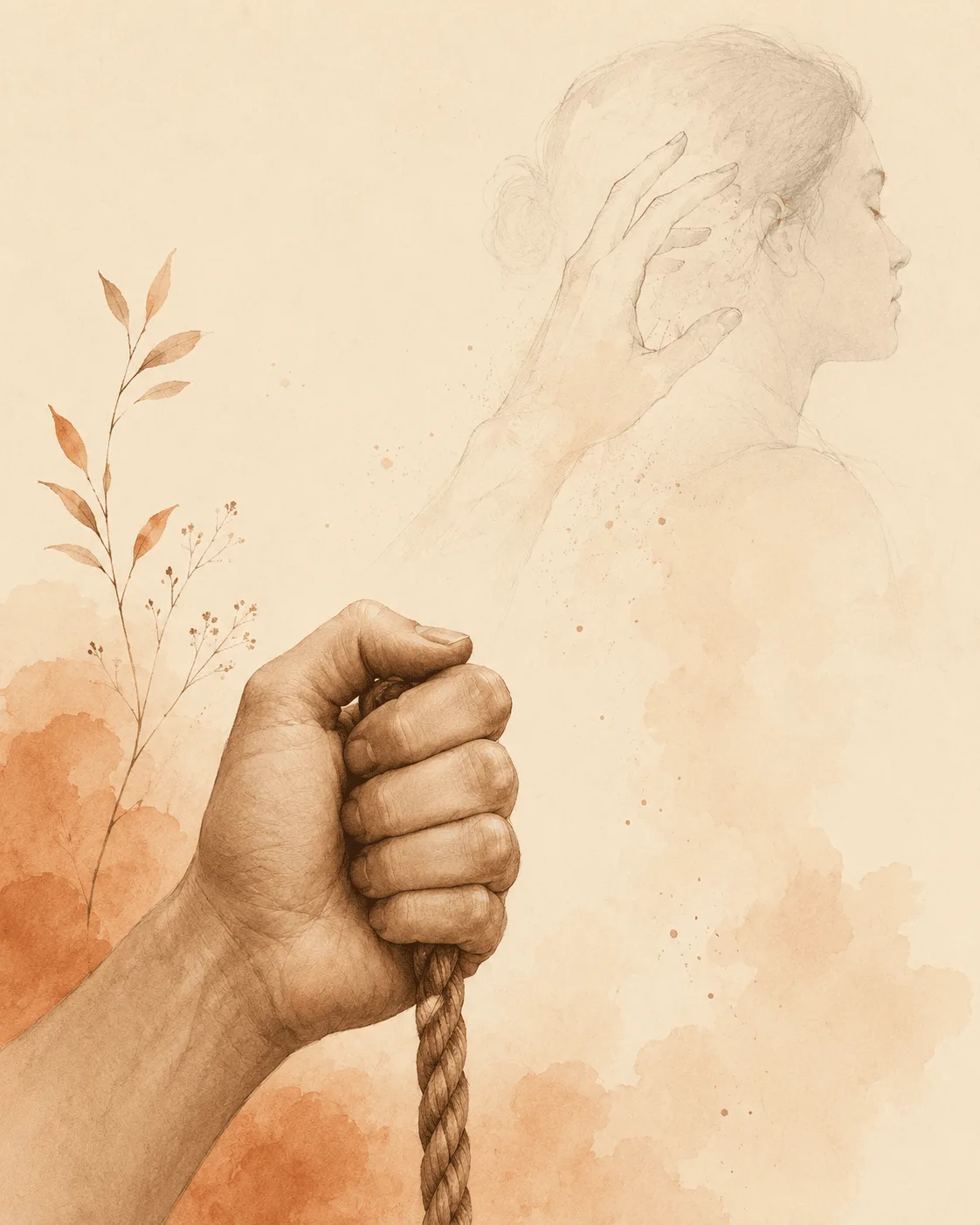
If you're Motor-dominant, you need occupation, not sensation. Clenched fists with thumbs tucked, held for sixty seconds. Hands flat and still on your thighs. Knitting, crochet, or anything that keeps both hands committed while you watch something. The goal is that the hand physically cannot make the trip.
If you're Sensory-dominant, you need a texture match. This is where most substitutes fail because they're too smooth. Look for things with a comparable pull-resistance: a length of thick yarn or embroidery floss you can draw slowly between two fingers, a hairbrush with firm bristles run across your palm, a soft-bristle brush against your scalp, a doll's hair or a fiber fidget. If part of the ritual involved running the hair across your lips, some people find a piece of dental floss or a smooth cord does more than any fidget cube.
If you're Cognitive-dominant, the response is partly verbal. Write the thought down as it appears, in your log, exactly as it arrived. "Just one more." Seeing your own permission slip in writing takes most of the force out of it after a couple of weeks, because the sentence is always the same sentence.
If you're Affective-dominant, you need something that shifts arousal in the right direction. Coming down: slow exhale-heavy breathing with a hand on your ribs, cold water on the wrists, a two-minute walk. Coming up: standing, music, a short set of push-ups, anything with intensity. The competing response has to solve the same regulation problem.
If you're Place-dominant, the response is mostly leaving. Standing up and moving to another room is a legitimate competing response and often the strongest one.
The full habit reversal training protocol for hair pulling, step by step, is covered here.Making pulling physically harder
Stimulus control is unglamorous and produces the fastest visible change. The principle is that every second of friction between the urge and the hand is a second in which awareness can arrive.
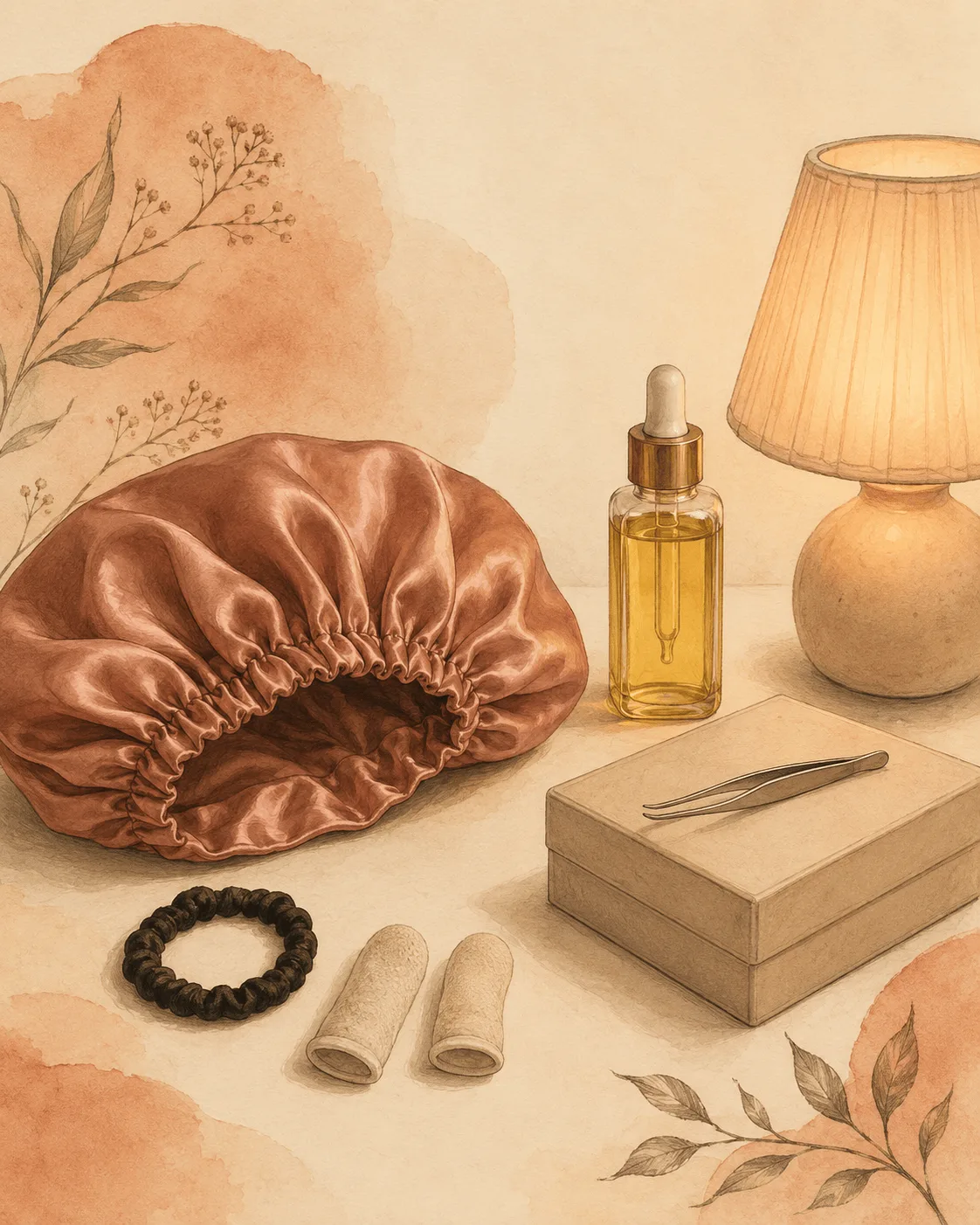
Change the light before you change anything else. Bright overhead bathroom light and any magnifying mirror are the two most reliable setups for focused pulling. Warm bulbs, a dimmer, or a soft cloth over the magnifier removes the search conditions that most sessions start with.
Put the tweezers away. If tweezers are part of your ritual, they belong in a drawer in a different room, or in a box that takes effort to open. Not because you'll never have them again, but because most urges don't survive a walk down the hall.
Cover the site, not your whole head. Finger cots or a thin plaster on your dominant index finger and thumb kill the grip you need for a fine hair, and they're far less conspicuous than gloves. For eyebrows and eyelashes, a light layer of petroleum jelly or a brow gel makes individual hairs almost impossible to isolate.
Make the hair itself uncooperative. Damp hair is slippery and hard to grip. Conditioner or hair oil left in overnight does the same job. A tight braid, a satin bonnet, or hair tied back removes the loose strands your fingers hunt for.
Move the chair. If your log clusters around one seat, one side of the bed, or one desk position, changing the physical setup does more work than any willpower-based plan. Some people find that simply sitting on their non-dominant hand while reading solves a third of their episodes.
When the pull is about texture
Sensory-dominant pulling is the pattern that generic advice serves worst, and it's extremely common in adults. If your pull is a search for a specific hair, ends at the root, and involves what happens after the hair is out, willpower advice will feel irrelevant to you because it is.
The workable approach is substitution rather than removal. You're not trying to want less sensation. You're trying to get that sensation somewhere that doesn't cost you hair.
Things that work for different people: pulling fibers from a fabric square or a piece of felt, drawing embroidery floss slowly through a closed fist, a fine-tooth comb dragged across the fingertips, scalp massage with firm pressure, a scalp massage brush, or an old makeup brush run along the lash line when the urge is about eyelashes specifically. If the root bulb was part of it, some people use small seed beads or knotted thread, which give a similar catch-and-release under the fingers.
Trial these deliberately, one at a time, for a few days each, and log which ones actually reduce the urge rather than which ones seem like they should. Sensory matching is trial and error, and the winners are usually surprising.
Eyelash and eyebrow pulling have their own mechanics and their own substitutes, covered separately here.What regrowth actually looks like
Almost nothing written for this search covers regrowth, and the uncertainty about it drives a lot of relapse. The timeline is more predictable than it feels.
Scalp hair grows roughly a centimetre a month, a bit under half an inch. That means a patch you stopped pulling in January is showing about six centimetres by July. Regrowth does not come back looking like the hair around it. It comes in blunt, short, and often coarser or wirier than the surrounding hair, standing up rather than lying flat.
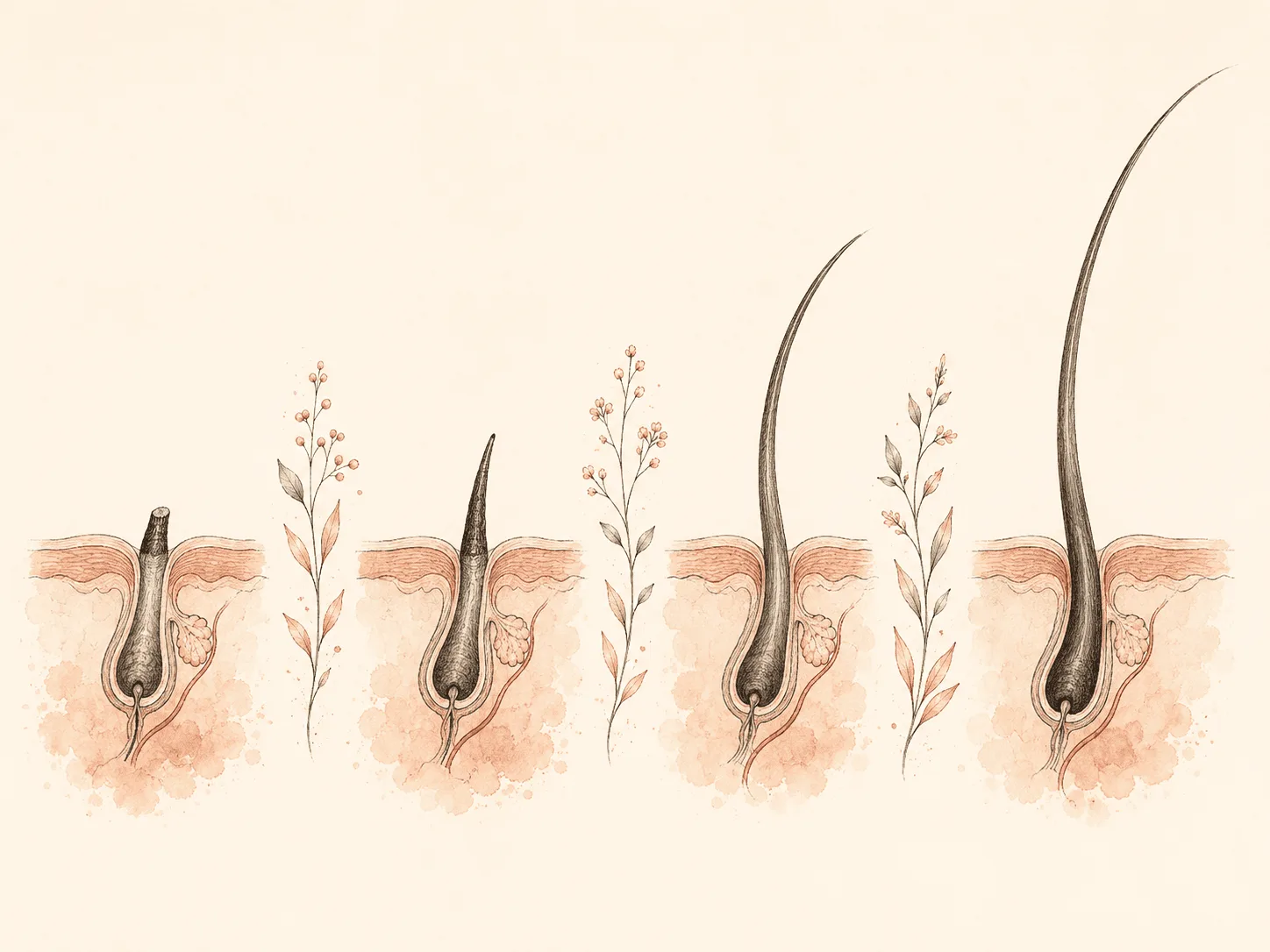
This stage is where a lot of people relapse, because those new hairs feel exactly like the hairs that trigger sensory pulling. If you know it's coming, you can plan for it: keep the area conditioned, wear it under a bonnet or braid at night, and treat the first three months of regrowth as a high-risk window that needs extra stimulus control, not less.
Eyebrows and eyelashes work on a different clock. Both have much shorter growth cycles than scalp hair, so a fully rested follicle usually produces visible growth within weeks rather than months, though filling in completely can take considerably longer.
When you pull anyway
You will pull again. That isn't pessimism, it's the shape of the process, and the single biggest predictor of a long relapse is what happens in the ten minutes after a slip rather than the slip itself.
The pattern to interrupt goes like this: you pull, you feel awful, you decide the whole effort was pointless, you stop logging, and two weeks later the entire structure is gone. The slip cost you a few hairs. The spiral cost you the month.
What to do instead is small and unsatisfying. Log it. Note which domain it came from and what changed that day. Keep your tools in place tomorrow. That's it. The slip becomes information instead of a verdict.
Judge yourself on the trend across weeks, not on today. If you pulled four times this week and you used to pull daily, that's real progress even if this evening felt like failure. The felt sense of "I always pull" almost never matches the logged numbers, which is one of the quieter arguments for keeping a log at all.
If you're mid-urge right now and need something for the next sixty seconds rather than the next month, this one is shorter and more immediate.Therapy, medication, and what the evidence says
Self-directed work gets a lot of people a long way. It's not always enough, and adding support isn't a failure of the self-directed version.
Therapy. Look for a therapist trained specifically in BFRBs, ideally in HRT or ComB. Generic talk therapy can help with what sits underneath the pulling but rarely changes the pulling itself. The International OCD Foundation (iocdf.org) maintains a provider directory and now hosts the TLC Foundation's BFRB resources; bfrb.org itself is only online through Summer 2026. Acceptance and commitment therapy has growing evidence as an addition, particularly for the shame layer.
N-acetylcysteine (NAC). An over-the-counter amino acid derivative that acts on glutamate signalling. A later trial in children found no benefit. One proposed explanation is that children pull more automatically, and NAC may act more on the urge itself, which matters more in focused pulling.
SSRIs. Commonly prescribed, weak evidence for pulling specifically. They tend to help when anxiety or depression is driving the pattern rather than when the pulling is habitual. Clomipramine has better trial data than the SSRIs but a heavier side effect load.
ADHD treatment. If your pulling spikes during understimulated stretches and you have ADHD, treating the ADHD sometimes moves the pulling more than anything aimed at pulling directly. It can also make it worse in some people. The overlap between ADHD and hair pulling is covered in more detail here.
See a doctor sooner rather than later if you're swallowing pulled hair, if a patch has stopped regrowing, if you're avoiding work, swimming, dating, or photographs because of it, or if you're losing hours a day. Swallowing hair in particular is worth raising promptly, since it can cause blockages that need treatment.
Frequently asked questions
Night pulling is usually Place-dominant, which makes it one of the more tractable patterns. Change the setup rather than relying on resolve: read somewhere other than bed, put a satin bonnet or a loose braid in before you get in, keep both hands committed to something (a book held in two hands works), and move any lamp that lights your scalp well. If you pull in the bathroom before bed, brush your teeth in the kitchen for a month. Conditioner or oil left in overnight makes hair too slippery to grip, which buys you the second of awareness you need.
Usually, yes. Scalp hair grows about a centimetre a month, so a patch left alone shows real change within a few months, though it comes back blunt and often coarser before it blends in. Eyebrows and eyelashes have shorter growth cycles and typically show movement within weeks. The exception is a spot that's been pulled repeatedly over many years, where scarring can permanently damage the follicle. A dermatologist can tell you which situation you're in by looking, and it's more often the recoverable one than people expect.
It sits in the same DSM-5 chapter as OCD, alongside skin picking, hoarding, and body dysmorphic disorder, but it isn't the same condition. OCD compulsions are usually performed to neutralize an intrusive thought or prevent a feared outcome. Hair pulling more often runs on sensory reward or automatic habit, with no feared outcome attached. That's why treatments differ: exposure and response prevention is the standard for OCD, while habit reversal training is the standard here.
The adult evidence is genuinely positive and the child evidence isn't. In a 2009 randomized trial of 50 adults at 1,200 to 2,400 mg a day, 56% were much or very much improved compared with 16% on placebo. A later trial in children found no benefit. A 2020 meta-analysis found NAC beat placebo overall, but with a smaller effect than behavioral therapy. It's best thought of as something that can support the behavioral work rather than replace it, and it's worth clearing with a doctor first because it interacts with some medications.
Most people see the first measurable change within two to four weeks of consistent tracking plus one matched competing response, mostly in automatic episodes. Bigger reductions typically take three to six months. Complete abstinence is less common than people assume: in the controlled ComB trial, 27% of the treatment group were fully abstinent at 12 weeks. A sharp drop in frequency, plus the ability to recover from a slip within a day, is a more realistic and more useful target than zero.
Because a lot of pulling has nothing to do with stress. Motor-domain pulling runs on hand habit and gets triggered by posture and setting, not emotion. Sensory-domain pulling is triggered by a hair that feels wrong to your fingertips. Both are extremely common in people who report no distress at the time. If your log keeps showing calm, focused, or bored states before a pull, aim your tools at awareness and texture substitution rather than at stress management.
Sometimes, briefly. Short hair removes the grip length that focused pulling needs, which is why it often works for a week or two. It tends to stop working once regrowth reaches the length your fingers can catch, and for sensory-dominant pullers that short bristly stage can actively increase the urge. It's a reasonable temporary barrier while you build the rest of the plan. It isn't a plan on its own, and it's not worth doing if the haircut itself would cost you more than it buys.
Duration matters less for outcome than most people fear. The trials showing benefit from habit reversal training enrolled adults with long-standing pulling, and the average participant in the ComB trial was in their mid-thirties. What changes with duration is the environment: the rituals are more established and the sites are more specific, which actually makes the mapping work easier. The one thing worth checking early is whether any long-pulled patch has stopped regrowing, which a dermatologist can assess.
Your first move
Pick one thing, not five. For most people the highest-value first move is seven days of logging with no attempt to stop, because it's what makes every later choice specific instead of generic.
If having that log somewhere structured would help, that's what SkinAware does. Logging a pull or a resisted urge takes a few taps, with the site (scalp, eyebrows, eyelashes) and what you were feeling before and after. It tracks your pull-free days, walks you through habit reversal training module by module, and there's a moderated community of people running the same experiments.
Get support for picking, pulling and biting
SkinAware helps you log episodes, identify patterns, and see real progress over time.
Available on iOS, Android and in your browser.
What you're attempting is genuinely hard, and the tries that didn't hold weren't wasted. They're where the awareness came from. Start with the week of data. The rest gets easier to aim once you can see what you're aiming at.
Continue Reading
References
- Farhat, L. C., Olfson, E., Nasir, M., Levine, J. L. S., Li, F., Miguel, E. C., & Bloch, M. H. (2020). Pharmacological and behavioral treatment for trichotillomania: An updated systematic review with meta-analysis. Depression and Anxiety, 37(8), 715–727.
- Grant, J. E., Odlaug, B. L., & Kim, S. W. (2009). N-acetylcysteine, a glutamate modulator, in the treatment of trichotillomania: A double-blind, placebo-controlled study. Archives of General Psychiatry, 66(7), 756–763.
- Carlson, E. J., Malloy, E. J., Brauer, L., Golomb, R. G., Grant, J. E., Mansueto, C. S., & Haaga, D. A. F. (2021). Comprehensive Behavioral (ComB) treatment of trichotillomania: A randomized clinical trial. Behavior Therapy, 52(6), 1543–1557.
- Bloch, M. H., Panza, K. E., Grant, J. E., Pittenger, C., & Leckman, J. F. (2013). N-acetylcysteine in the treatment of pediatric trichotillomania: A randomized, double-blind, placebo-controlled add-on trial. Journal of the American Academy of Child & Adolescent Psychiatry, 52(3), 231–240.
- Melo, D. F., Lima, C. D. S., Piraccini, B. M., & Tosti, A. (2022). Trichotillomania: What do we know so far? Skin Appendage Disorders, 8(1), 1–7.
- American Psychiatric Association. (2013). Diagnostic and Statistical Manual of Mental Disorders (5th ed.).