
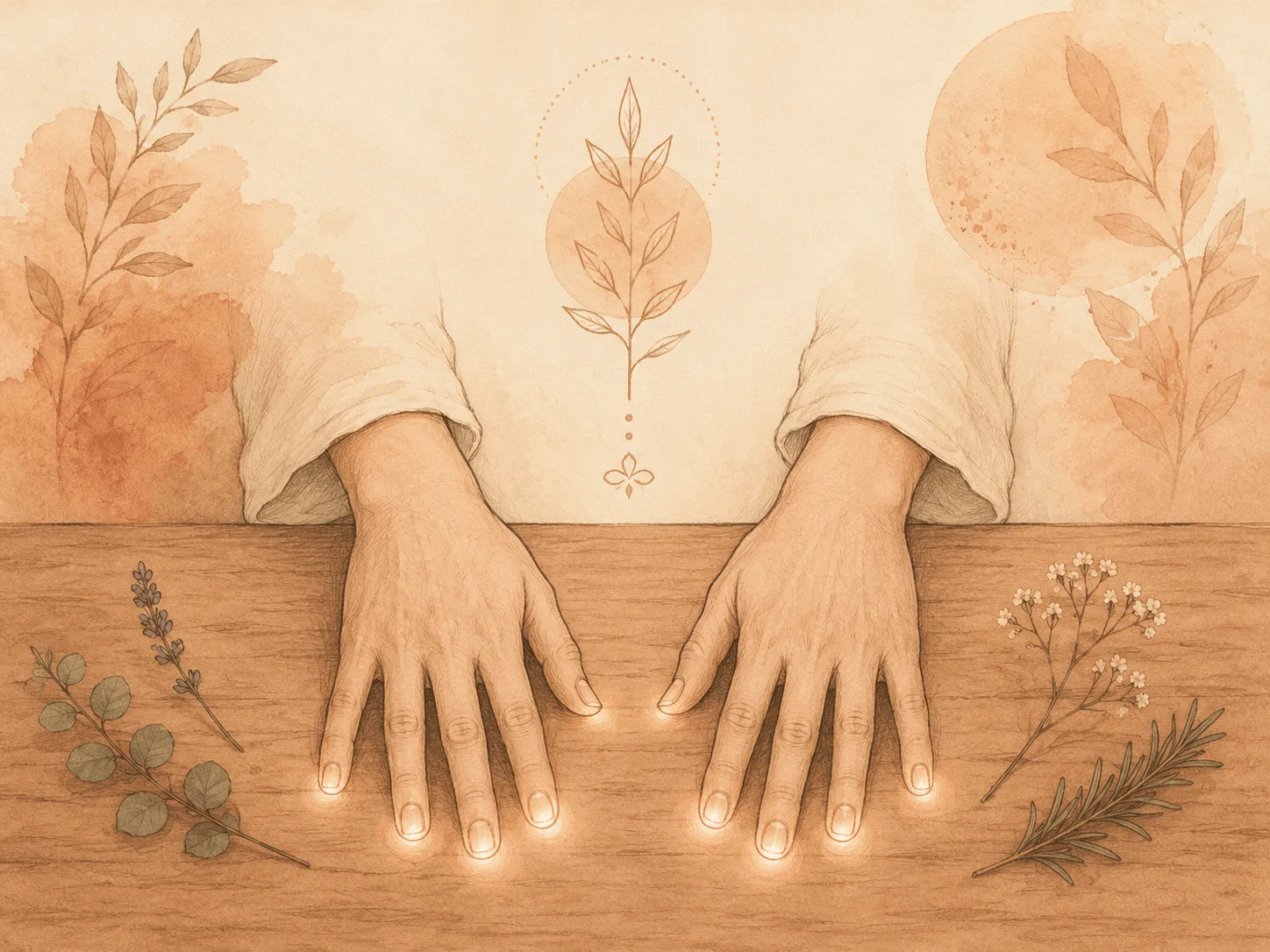
Bring both hands down below your shoulders and put them somewhere they can rest flat. A table, your thighs, the mattress. Palms down, fingers spread, weight through them. Hold that for a slow count of ten and keep reading while you do it.
That's the whole first move. Not because flat hands are magic, but because your fingers cannot grip a hair while they're spread and loaded, and getting them out of range buys you the thirty seconds you need to decide anything at all.
Now answer one question
Which of these two things was happening just before you opened this page?
A. Your hand was already up there and you don't quite know when it went. You were scrolling, driving, on a call, reading, half-watching something. You noticed your fingers in your hair rather than deciding to put them there.
B. You were looking for a specific hair. A coarse one. A wiry one. One that felt wrong against your fingertip, or one you could see in the mirror and could not leave alone. You knew exactly what you were doing.
Clinicians call these automatic and focused pulling, and most people do both at different times of day. It matters right now because the move that works for one barely touches the other.
If it was A, change the setup
Automatic pulling runs on position and opportunity, so take those away rather than trying to out-concentrate it.
Stand up and move to a different chair or a different room. Then break the arm position: if your elbow was propped on a desk or an armrest with your hand near your temple, that posture alone is enough to restart the whole thing within a couple of minutes, even after you've reset. Sit somewhere your elbows have nothing to rest on.
Then put something in the pulling hand. Not a token gesture, something with real texture that takes a bit of grip: a chunky knitted cuff, putty, a bristle brush, a pet if you have one. Your hand is looking for a job. Give it a worse-paying one.
If it was B, the hunt is the episode
The search is not the run-up to pulling. It is pulling. As long as your fingers are sweeping your scalp or your brow looking for the one that feels wrong, the episode is still running, and "I'm only checking" is the sentence that carries almost every focused episode over the line.
And get your fingers wet. Water, hand cream, hair oil, conditioner, anything slippery. Slick fingertips can't isolate a single hair, and they can't feel texture properly either, which removes the thing the hunt is actually hunting for. This is the most reliably underrated move in hair pulling, and it takes eleven seconds at a sink.
The friction fix, in more detail
If you only remember one thing from this page, make it this one. Pulling needs three conditions: dry fingers, accessible hair, and enough tactile feedback to find a "wrong" one. Take away any single condition and the episode stalls out on its own, without you having to win an argument with yourself.
If you already pulled
The episode has a second half, and it's the half that keeps most people going for another twenty minutes: inspecting the root, rolling the hair between your fingers, running it along your lip. That ritual is where a lot of the reinforcement lives. Skipping it is often easier than skipping the pull itself, and it does more to end the session.
So put whatever's in your hand down and out of sight. Bin, tissue, sink. Don't look at the root.
Leave the audit for another day, too. Counting the strands, parting your hair to see how thin the spot has got, holding your phone camera up to your lash line: all of that reads as information-gathering and functions as a fresh trigger, usually within the hour. Nothing you learn from it in the next ten minutes will change what you do next.
The next few minutes, and the shame that shows up in them
There's usually a gap of thirty seconds or so between stopping and the shame arriving, and then it lands all at once. That drop is not a moral event, it's the tail end of the same nervous-system spike, and it's dangerous mainly because it feels like proof that you may as well continue.
Then, if you can, write down one line about what was happening in the half hour before it started. Tired, bored, on a deadline, on hold, alone for too long, hungry. You're not solving it tonight. A pattern you can name is a pattern you can plan for, and the triggers behind pulling tend to be far more repetitive than they feel from the inside.
When this isn't enough
If tonight is the first time you've read anything about this, what trichotillomania actually is is the place to start once you're calm. If you've been at this for years and want the full behavioral approach rather than emergency moves, the longer guide to stopping covers habit reversal training properly.
When the urge passes, the useful work shifts from interrupting episodes to making tomorrow's easier to see coming. That's what SkinAware is for: logging pulls and resisted urges in a few taps, the HRT course in short modules you can do on a bus, and trigger and time-of-day breakdowns that show you the patterns you can't spot in the moment. Download it later, when your hands are still.