
Written using StatPearls reviews of trichotillomania and hair physiology, a 2021 systematic review of trichoscopy in Acta Dermato-Venereologica, histopathology reported in the International Journal of Trichology, a 2024 evidence review of biotin in the Journal of Clinical and Aesthetic Dermatology, and FDA safety communications on biotin interference in laboratory tests.
The short answer
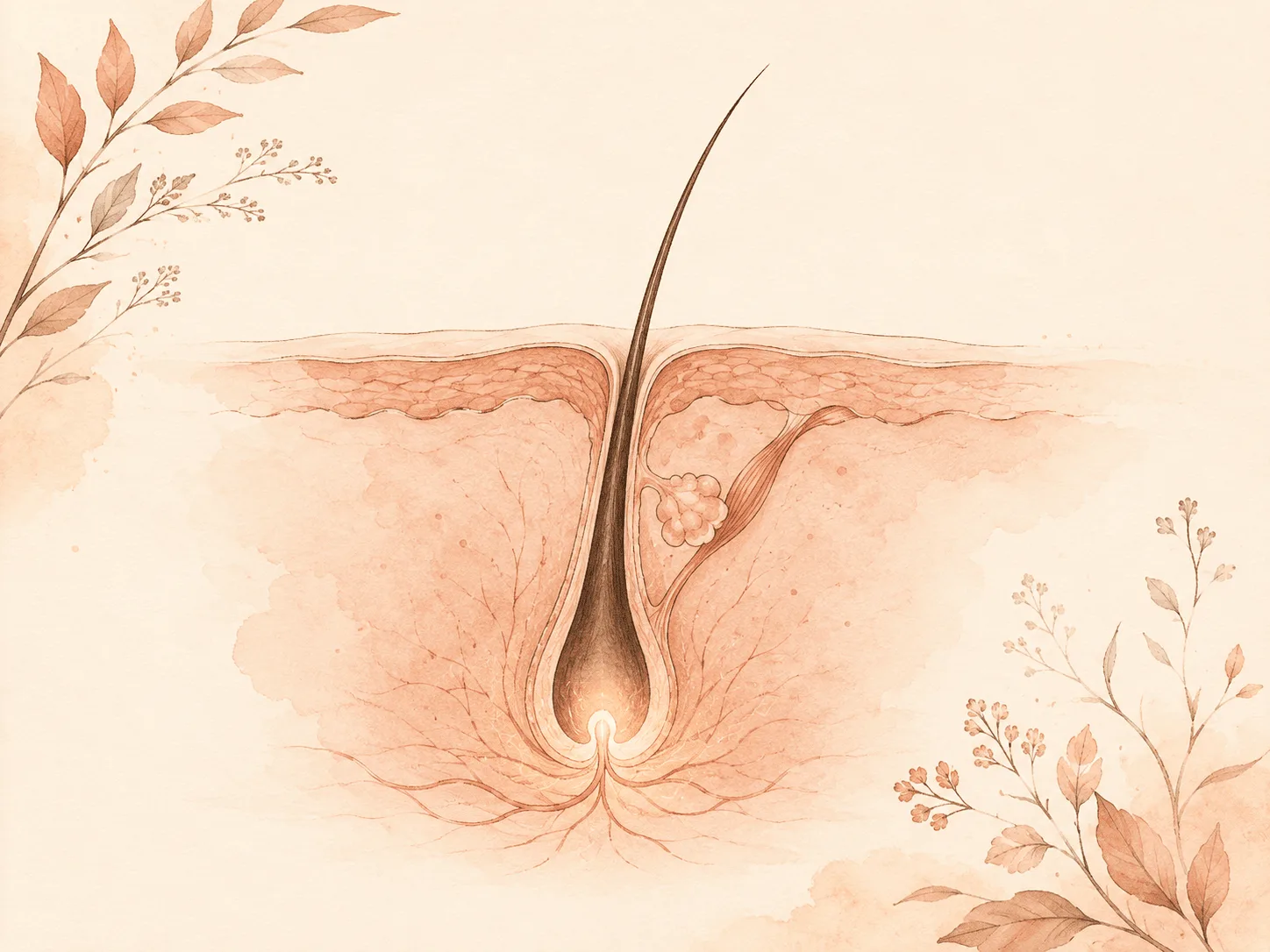
Usually, yes. Pulling takes the hair out and leaves the follicle behind, and a follicle that's still intact goes on making hair whether or not you believe it will.
What changes that answer is repetition. A follicle pulled a handful of times is almost certainly fine. The same follicle pulled thousands of times across years can eventually be damaged badly enough that the structure scars over, and scarred follicles don't come back.
So the real question isn't whether hair grows back. It's which of those two situations you're in, how long the wait is, and what shortens it.
Why the wait is so long even when nothing is wrong
The most common reason people conclude their hair is gone is that they stopped pulling, watched a patch for six weeks, saw very little, and drew the obvious conclusion. The obvious conclusion is usually wrong, and the reason is timing.
Every follicle runs on a three-part loop. Anagen is the growth phase, and on the scalp it lasts years. Catagen is a short transition. Telogen is a rest phase, and for scalp hair it runs close to a year before the follicle wakes up and starts a new hair. At any given moment, 10 to 15 percent of the hairs on your body are sitting in that resting phase doing nothing at all.
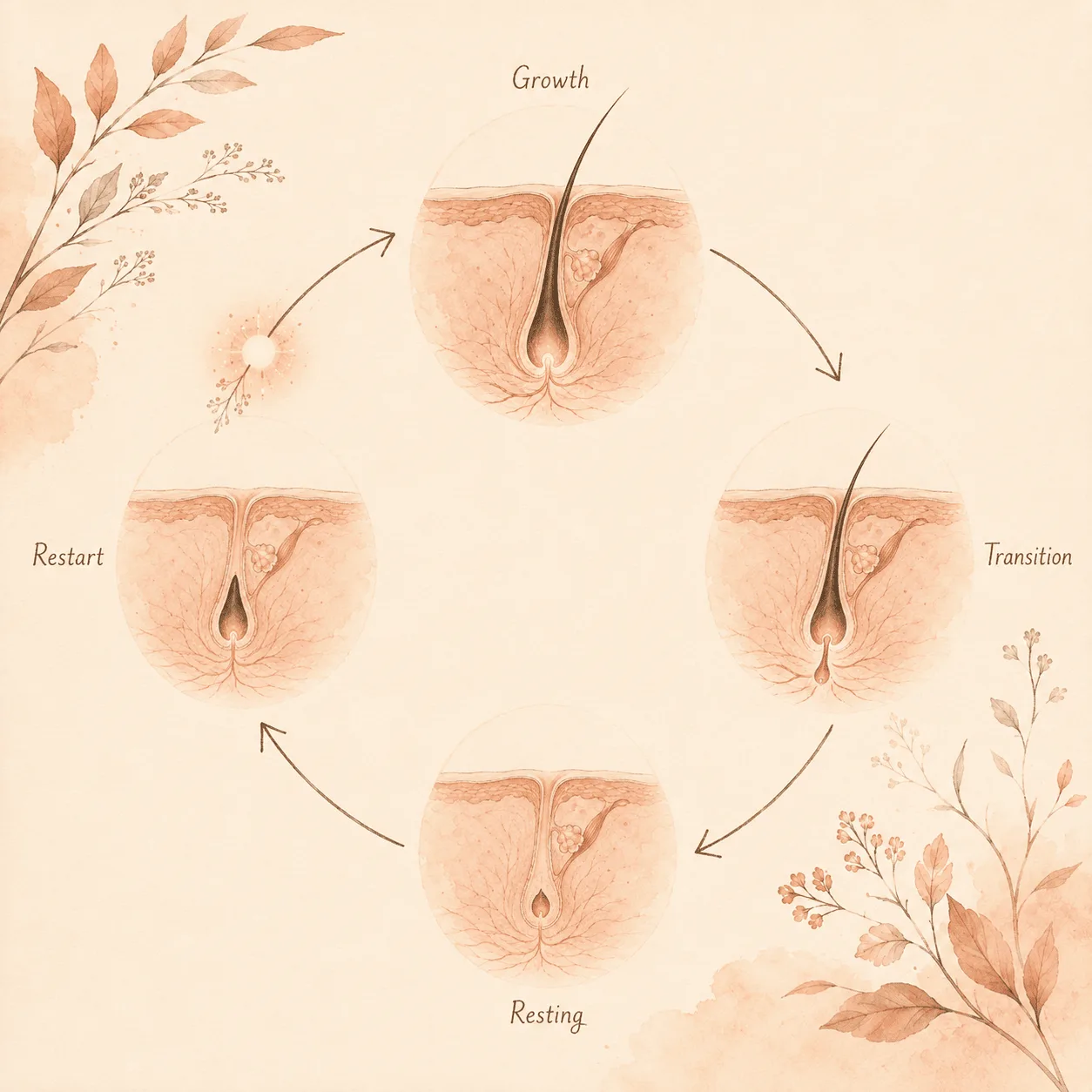
When you pull a hair out mid-anagen, you don't just remove the strand. You end that cycle early. The follicle has to reset before it can start a new hair, and if it resets into a long telogen you can be standing in front of a mirror doing everything right while that particular follicle is, biologically, asleep.
SkinAware, the app behind this site, lets you log urges and episodes for free and start a habit reversal course.
Get the appHow long it takes
Scalp hair grows at about 0.35 mm a day. That works out to roughly a centimetre a month, or 15 cm a year, and it's remarkably consistent between people. You can't speed it up, but you can use it to check your progress against something other than your mood.
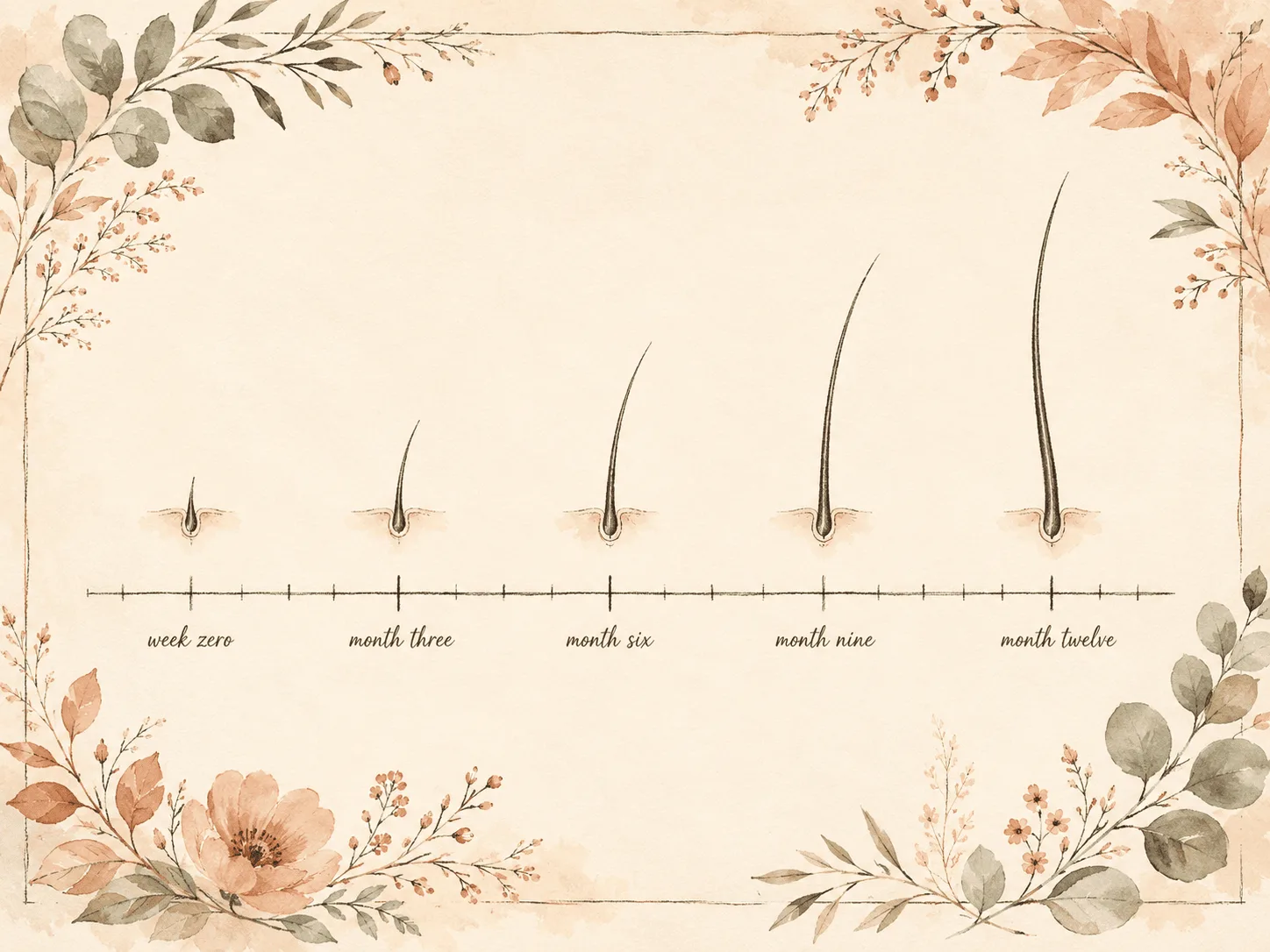
Weeks 0 to 6. Mostly nothing visible. Some follicles that were pulled near the end of a cycle restart quickly, so you may see a few short hairs. Most won't have started.
Weeks 6 to 12. Fine, short, often pale hairs appear across the patch. They're easy to miss in normal light and easy to find under a bright bathroom bulb, which is a mixed blessing.
Months 3 to 6. Those hairs reach two to six centimetres. The patch stops reading as bare and starts reading as short. It's also the stage most people find hardest.
Months 6 to 12. Length accumulates at a centimetre a month, and density keeps improving as slower follicles come online. A patch that's been pull-free for a year generally looks like hair rather than like recovery.
Other body areas run on different clocks, and the difference is large. Eyelash and eyebrow follicles rest for weeks where scalp follicles rest for close to a year, so the eye region shows new growth much sooner while taking a long time to look complete. Lash and brow pulling has its own mechanics and its own risks, covered separately.
Beard, body, and pubic hair sit in between, with shorter growth phases than the scalp. That's why they never reach scalp length, and why regrowth there is often noticeable within a couple of months.
What makes damage permanent
Two things have to be true for hair loss from pulling to become permanent: the follicle structure itself has to be destroyed, and it has to be replaced by scar tissue. Ordinary pulling doesn't do that.
When dermatologists biopsy skin from someone with trichotillomania, what they find is damaged and emptied follicles, twisted and malformed hair shafts, and clumps of pigment left in the follicular canal from hairs that were torn out. What they don't typically find is significant inflammation. The follicle count is normal.
That last detail matters more than it sounds. Normal follicle count means the machinery is still there. It's been through something, but it's there.
Scarring happens when the same follicles take that trauma repeatedly over a very long period, which makes "how long have you pulled from this exact spot" a more useful question than "how much have you pulled". Someone who has moved sites over ten years has spread the damage. Someone who has pulled from one small area at the crown since they were twelve has concentrated it.
Repeated infection is the other route. Broken skin that gets infected, heals, and gets opened again can scar the follicles around it without needing decades of pulling.
The stage nobody warns you about
The part that catches people who have done everything right is the regrowth itself.
A hair that's grown to full length has a tapered tip that's been worn soft. A hair that's a few weeks old has never been worn down at all. It's short, stiff, blunt at the end, and it stands away from the scalp instead of lying flat. Under a fingertip it's coarser than anything else on your head.
If your pulling has ever been driven by finding a hair that felt wrong, recovery hands you a patch of hairs that all feel wrong, concentrated in exactly the place you're most likely to check.
And you will check. Checking is what usually restarts pulling, not a decision to pull. It begins as running a hand over the area to see whether anything's happening, which is a completely reasonable thing to want to know, and it ends with fingers on a short coarse hair that's asking to be removed.
The second thing that helps is treating months three through six as a planned high-risk period rather than a finish line. Most people relax their stimulus control the moment things start looking better, which is precisely when the sensory triggers peak. The wider plan for keeping hands off during that window is here.
Track the streak, not the patch
SkinAware logs pull-free days, urges you resisted, and the areas you're protecting, so your sense of progress comes from data instead of from checking with your hands.
Available on iOS, Android and in your browser.
When to see a dermatologist, and what happens there
Worth booking if any of these are true: a patch has shown nothing at all after four to six months completely pull-free, the skin in a pulled area looks or feels different from the skin around it, you've had repeated infected sores in one spot, or the uncertainty itself is keeping you stuck. That last one counts. Not knowing is its own problem, and it drives a lot of relapse.
What happens in the room is far less confronting than most people picture. The main tool is a dermatoscope, a handheld magnifier held against the scalp. It doesn't hurt and nothing gets removed.
The practical value for you is that it separates pulling from the conditions that look like it and are treated completely differently, particularly alopecia areata and fungal scalp infection. Plenty of people find out at this appointment that some of what they'd blamed on themselves was something else.
If the picture is still unclear, a small punch biopsy under local anaesthetic can settle it. That's uncommon and not the default.
You don't have to disclose the pulling to be seen. Most dermatologists will recognize it regardless, and most have seen it before. Saying it directly gets you a faster and more useful appointment, and "I pull my hair out and I want to know whether the follicles are still viable" is a complete and sufficient sentence.
What helps regrowth, and what's sold to people who are scared
The gap between these two lists is wide, and the second one is marketed hard at people searching this exact question.
The one that moves the needle
Stopping the pulling. Not as a platitude, as a mechanism: every follicle you don't pull gets to complete a full cycle, and completing cycles is the only way a patch fills in. Nothing you apply to your scalp competes with this, and nothing compensates for its absence.
Which makes the behavioral work the real regrowth treatment. StatPearls describes habit reversal training as a low-risk treatment for hair pulling that has been shown to be effective, built on awareness of when it happens, a competing physical response, and other people knowing. How habit reversal training works, step by step.
Reasonable, with real limits
Minoxidil. It works by pushing follicles into the growth phase and shortening the resting phase, which is genuinely relevant to a patch full of follicles stuck in telogen. In a 2025 open-label trial of 5% minoxidil for telogen effluvium, terminal hair count rose by around 12.5 hairs per square centimetre by week four. The caveats are real: it hasn't been trialled in trichotillomania specifically, it does nothing about pulling, it causes a temporary increase in shedding in the first weeks before it helps, and it does nothing for a scarred follicle. Raise it with the dermatologist you're already seeing rather than ordering it on the strength of a search result.
Treating what else is going on. Iron deficiency and thyroid problems slow hair growth independently, and someone recovering from pulling has every reason to want the rest of the system working. Standard bloodwork, not a supplement guess.
Rosemary oil. The trial people cite is real: 100 patients, rosemary oil against 2% minoxidil over six months, comparable hair count at the end, less scalp itch with rosemary. It's also a small study in pattern hair loss, not in pulled hair. Low risk, modest and uncertain benefit, not a substitute for anything.
Sold hard, delivers little
Biotin. A 2024 review in the Journal of Clinical and Aesthetic Dermatology found no studies demonstrating a benefit for hair growth in people who aren't biotin-deficient, and deficiency is rare on a normal diet. The highest-quality trial it identified, 10 mg daily against placebo, found no significant difference.
Castor oil, scalp massage, hair vitamins, growth serums. These change how hair and scalp feel and condition, which isn't worthless when you're managing a sensory trigger. None of them make a follicle restart a cycle it isn't ready for.
Anything sold on a before-and-after photo of a patch. Those photos are consistent with the product working. They're equally consistent with a person having stopped pulling for six months.
Transplants are a real option for genuinely scarred areas, but every reputable surgeon requires the pulling to be in sustained remission first, because grafted hair can be pulled out too.
FAQs
Give it four to six months genuinely pull-free before drawing any conclusion. Follicles resting in telogen can take close to a year to restart. If a patch has produced nothing at all after that, it's worth a dermatologist looking at it rather than you deciding.
Probably not, and finding out costs one appointment. Duration raises the risk of scarring without making it certain, and dermatologists routinely see long-standing patches that still have viable follicles. Whatever's true, it's more true today than it will be after another year of pulling.
Common, and usually temporary. A hair damaged during the pull can come through malformed, and new growth often arrives finer, lighter, or curlier before settling. Grey or white regrowth in a pulled patch also happens and frequently normalizes over later cycles.
No. Growth rate and thickness are set at the follicle. A cut hair feels thicker because a blunt end is wider than a tapered tip, which is the same reason fresh regrowth feels coarse.
Generally yes. Those follicles rest for weeks where scalp follicles rest for close to a year, so new growth shows up sooner, though filling in completely takes longer than most people expect.
Nothing available reliably outpaces the follicle's own clock. The one intervention that changes the outcome is reducing the pulling. The second-best is having a dermatologist check whether anything else is slowing your growth.