
Written using peer-reviewed research including Ricketts et al. (2017) in the Journal of Obsessive-Compulsive and Related Disorders, Cavic et al. (2021) in Comprehensive Psychiatry, and a 2024 meta-analysis of sleep deprivation and inhibitory control.
Most people who pick at night assume the problem is the bathroom. The mirror, the overhead light, the twenty minutes that turn into fifty.
The research points somewhere else. When researchers surveyed 182 adults with skin picking disorder about their sleep-related behavior, 82.9% said they picked after getting into bed, before falling asleep. Eight in ten of those people gave the same reason: they zone out and pick without thinking.
The bathroom is where the damage gets noticed. The bed is where most of it happens.
That distinction matters because the bathroom and the bed need completely different interventions, and most night-picking advice only addresses one of them. This guide covers the whole window, from the point in the evening when structure disappears to the 2am wake-up, and what to change at each stage.
The evening isn't one problem, it's three
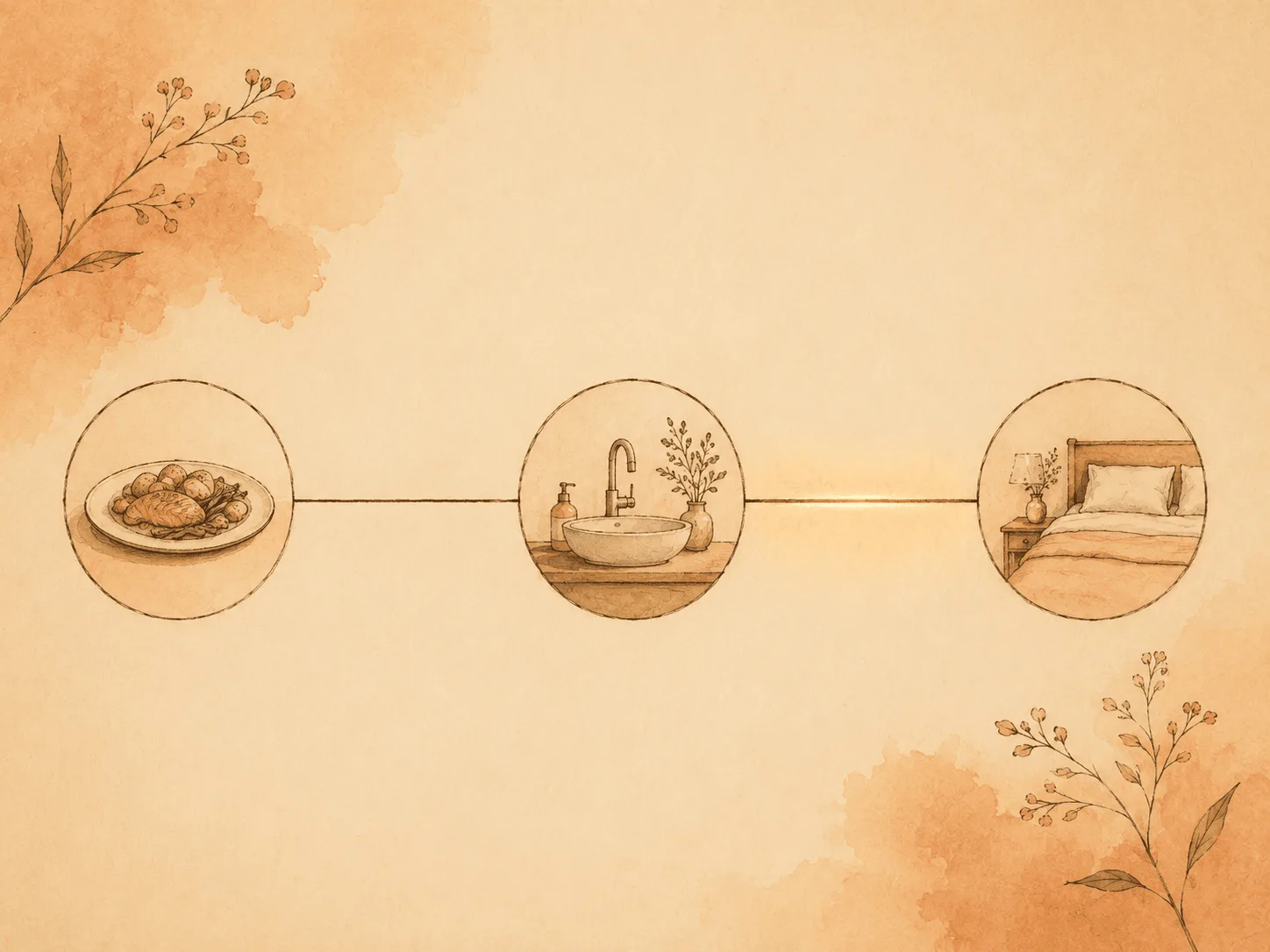
Picking between 8pm and sleep tends to come from three separate situations that happen to share a time slot.
The unstructured hour. The stretch after obligations end and before sleep starts. Nothing has a shape. Your hands are free and your attention is elsewhere.
The lit mirror. Face washing, contacts out, teeth, skincare. Ten minutes of standing close to a mirror under the brightest light in your home, with a legitimate reason to touch your face.
The bed. Lying still, warm, phone in one hand, the other hand idle on your own skin, waiting for sleep that hasn't arrived.
Each one fails for a different reason. The unstructured hour fails because there's nothing else for your hands to do. The mirror fails because it supplies targets. The bed fails because you're conscious for a long time with nothing to occupy you and no one watching.
What actually makes evening harder
There's a popular explanation for this: willpower is a battery, you drain it across the day, and by 10pm there's nothing left. It's a satisfying story and the evidence behind it is shakier than its popularity suggests. A preregistered replication across 23 laboratories and more than 2,000 participants found no reliable ego-depletion effect, and later meta-analyses that corrected for publication bias put the estimate somewhere between very small and zero. Being tired at night is real. "Your self-control ran out" is not a well-supported reason for it.
What is well supported is narrower and more useful.
The gap between noticing your hand move and stopping it is smaller when you're short on sleep, and it's smallest late at night after a short night before.
The rest of it isn't neurological at all. It's logistics. In the evening you have more skin exposed than at any other point in the day, no clothes over your arms and shoulders, no one in the room, no meeting to end the episode, and no consequence until morning. Every structural thing that shortens a daytime episode is missing.
The evening doesn't weaken you. It removes every external brake you'd normally have.
That reframe is worth sitting with, because it changes what you'd try. If evening picking were a willpower failure, the fix would be resolve. If it's the absence of external brakes, the fix is to put some back.
The mirror problem, and the lighting fix
A pick usually starts as a search rather than a feeling. Your eyes or your fingers scan, find something raised or rough, and the hand follows. Bathroom lighting is built to make that search succeed: bright, overhead, often cool-toned, positioned to eliminate exactly the shadows that would otherwise hide a pore. Visual and tactile triggers are worth understanding on their own terms.
Clinicians and the BFRB community have converged on the same set of changes here. None of these come from randomized trials, but they're the standard practical guidance and they're cheap to test.
Turn off the overhead light in the evening. A single lamp, a nightlight, or a candle gives you enough to wash your face and brush your teeth and not enough to run a skin audit. The TLC Foundation's community guidance specifically suggests a candle in the evening bathroom, partly for the low light and partly because lighting it is a deliberate act that reminds you what you decided earlier.
Get rid of the magnifying mirror. Not covered, not turned around. Out of the house. It exists to make small things look like problems, which is the entire mechanism you're trying to interrupt.
Reduce the reflective surfaces on your route to bed. Closet doors can be turned around. Bathroom mirrors can hold a taped-up photo or a sticky note across the section at face height.
Move the tools. Tweezers, needles, extractors, comedone loops. They don't need to be thrown away to be effective barriers. They need to be somewhere that requires a decision to reach, ideally in a different room from the mirror.
Designing the evening, in the order it happens
The goal isn't to fill every minute. It's to make the risky parts short and put something between them and the bed.
Give the bathroom a closing time. Everything that has to happen in there gets done before it: teeth, contacts, face, skincare. After that hour the door stays shut. The point of setting an arbitrary time is that you're replacing a decision you make badly at 11:40pm with one you made calmly at noon.
Front-load the routine. Most people do their skincare last, which puts the highest-risk activity directly against the least-supervised hour. Move it an hour earlier. Wash your face when you get home from work, not when you're already tired.
Put a low-stimulation activity between the bathroom and the bed. Twenty minutes of something with your hands in it. Reading a physical book, tidying one surface, folding laundry, stretching, a puzzle. This isn't a wellness suggestion, it's a buffer. The transition straight from lit mirror to dark bed is the most common path into a long episode.
Cover the targets before you're tired, not after. Hydrocolloid patches, thin cotton gloves, long sleeves, a light layer of ointment on the areas you go for. Apply them at the start of the evening while you still care about the plan. Nobody gets up at midnight to put on gloves.
Pick one competing response and keep it at the bedside. Something that occupies the same hand and doesn't touch skin: a textured stone, cuticle oil, putty, a fidget ring. Practice it when there's no urge in sight, because a motor pattern you've never rehearsed will not appear at 11pm. Habit reversal training covers how to build one properly.
The bed itself needs a different rule
Since most picking happens in bed before sleep, the bed deserves its own protocol, and behavioral sleep medicine already has a good one.
Stimulus control therapy, developed by Richard Bootzin in 1972, is one of the best-evidenced components of CBT for insomnia. Its core rule: if you've been lying awake for roughly twenty minutes, get up, leave the bedroom, do something calm and dimly lit, and return only when you're actually sleepy. The purpose is to stop your brain learning that bed is a place where you lie awake doing things.
For picking, the same rule does double duty. The twenty-minute mark is roughly where "trying to fall asleep" becomes "lying in the dark with idle hands," which is the setup that produces the zoning-out episodes the research describes. Getting up interrupts it before it starts.
The practical version:
- Go to bed when you're sleepy, not when the clock says to. Lying down early buys you extra unoccupied minutes, and unoccupied minutes are the raw material of night picking.
- If you're still awake after about twenty minutes, get up. Don't check the clock repeatedly, just estimate.
- Sit somewhere else in low light. Read something undemanding. No phone.
- Go back when you feel sleepy. Repeat as needed.
- If you notice you're already picking, that counts as being awake. Get up.
Worth checking what your phone is doing in there. Extraction videos, pimple-popping content, and dermatology reels are not neutral background. If your feed has learned you slow down for that content, it will keep bringing it, and it lands during the exact window where your hands are free.
Waking up picking at 2am
This is the part that frightens people, and it's worth separating two different things that both get called picking in your sleep.
Waking up and then picking. You surface at 2 or 3am, you're groggy, and you pick for a while before going back to sleep. You may remember it vaguely or not at all. This is the more common of the two, and it responds to the same interventions as pre-sleep picking, with a few additions.
Picking during sleep. Genuine sleep-related scratching exists as a parasomnia, occurring mostly in lighter NREM stages and REM, sometimes without any daytime itch at all. In the Ricketts sample, 27% of people with skin picking disorder reported picking during sleep at least once in the past month, though frequent episodes were rarer and nobody picked only during sleep. It always sat alongside waking picking.
The practical response overlaps for both:
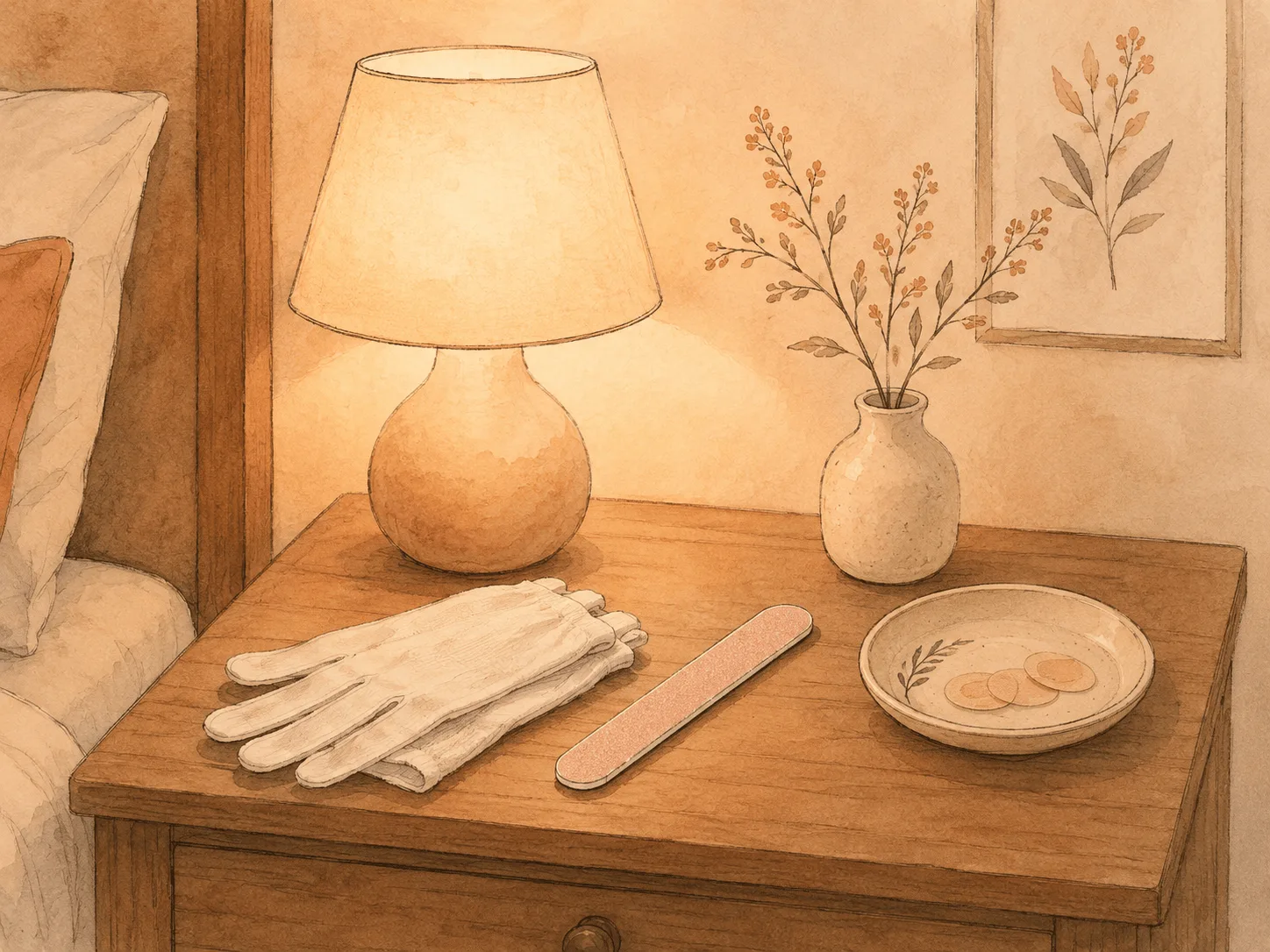
- Physical barriers are the highest-yield intervention here, because awareness training can't reach you while you're asleep. Thin cotton gloves, mittens, or sleeves taped at the wrist. Hydrocolloid patches over the areas you wake up damaging.
- Keep your nails short and filed smooth. A filed nail does dramatically less damage in the same number of movements, and this is the change with the best effort-to-effect ratio for night damage.
- Keep the room dark and don't turn on a light if you wake. Light makes the skin visible, and visible skin restarts the search.
- Log it in the morning. Which area, roughly what time if you know, what the previous evening looked like. Two weeks of that usually reveals whether it's every night or clustered after particular days.
What the sleep research actually says, and what it doesn't
A lot of night-picking advice online amounts to "fix your sleep and the picking will improve." The evidence doesn't support that promise, and it's worth being precise about why.
The findings that exist are real but correlational. People with skin picking disorder and trichotillomania report significantly more sleep disturbance than unaffected comparison groups, and that held even after controlling for anxiety and depression symptoms (Ricketts et al., 2017). Within that sample, people who picked during sleep took longer to fall asleep than those who didn't. An earlier and much smaller study of 30 dermatology patients found that those who picked had poorer subjective sleep and higher anxiety (Singareddy et al., 2003).
Then it gets complicated.
Every one of these studies is cross-sectional. The Ricketts authors state plainly that they cannot determine whether there's a causal relationship in either direction. So what we can say is that sleep problems and picking travel together, we don't know which drives which, and improving your sleep is worth doing on its own merits without being sold as a picking treatment.
What is directly actionable is the inhibitory-control finding. Short sleep measurably narrows the gap between an urge and a movement. You don't have to fix your sleep to use that. You just have to treat a five-hour night as advance notice that tomorrow evening is a higher-risk window, and put an extra layer of friction into it: patches on before dinner, gloves during TV, bathroom closed early.
Finding your own slot
Night picking is rarely spread evenly across the evening. Most people have a specific twenty to forty minute window where the majority of it happens, and almost nobody can name theirs accurately from memory.
Two weeks of logging usually finds it. For each episode: rough time, where you were, what was in your hands, what you'd been doing for the ten minutes before. Paper works. So does a notes app. The thing that matters is that you'll actually open it at eleven at night.
What you're looking for is boring and specific. Picking that always starts within ten minutes of getting into bed. A cluster on nights you got home late. Everything happening on the sofa and nothing in the bathroom. Boring patterns are the ones you can build a barrier around.
Once you know your window, the general recovery toolkit becomes much easier to aim. The full protocol covers awareness, stimulus control, and competing responses in depth. This article's argument is just that you should point all of it at the right ninety minutes.
Find your night window
SkinAware logs episodes with time and location, tracks the urges you resisted, and surfaces the patterns across a couple of weeks. It also includes a habit reversal course for the competing-response part.
Available on iOS, Android and in your browser.
Frequently Asked Questions
Usually because the evening removes the things that end daytime episodes. More exposed skin, free hands, no one in the room, no meeting to interrupt you, no consequence until morning. Add short sleep, which measurably impairs the ability to stop a movement in progress, and the same urge that passed unnoticed at 2pm gets acted on at 11pm. It's less that you change at night and more that your circumstances do.
It's the majority experience. In a sample of 182 adults with excoriation disorder, 82.9% reported picking after getting into bed but before falling asleep, and 80% of them described zoning out and picking without thinking (Ricketts et al., 2017). If your picking clusters there, you're in the typical pattern, not an unusual one.
Some people do. In the same study, 27% reported picking during sleep at least once in the past month, though daily occurrence was uncommon and nobody picked exclusively while asleep. Separately, sleep-related scratching is recognized as a parasomnia in its own right. Because awareness techniques can't operate while you're unconscious, physical barriers and short filed nails do most of the work here.
It might help and it isn't a treatment. The studies linking sleep problems and picking are cross-sectional, and the researchers say directly that they can't establish cause in either direction. One 2021 study even found skin-picking severity wasn't associated with sleep quality. Better sleep is worth pursuing for its own sake, and a short night is useful advance warning that the next evening needs extra friction.
For most people it's moving skincare and face-washing an hour earlier and closing the bathroom after it, so the highest-risk activity isn't sitting directly against the least-supervised hour. If picking happens mainly in bed rather than the bathroom, the higher-yield change is the twenty-minute rule: get out of bed if you're still awake, rather than lying there with idle hands.
They work well for in-bed and during-sleep picking, and they fail when people try to live in them. Thin cotton gloves for the specific window where picking happens beat all-night gloves you abandon by Thursday. Short, smoothly filed nails do a surprising amount of the same job with none of the compliance problem.
Start with barriers and nail filing, and log what you find each morning for two weeks. If it happens with no daytime urge to pick, or alongside sleepwalking, sleep-talking, or acting out dreams, mention it to a doctor. Sleep-related scratching can occur as a primary parasomnia and is managed differently from a BFRB.