
Written using peer-reviewed research on the triggers and phenomenology of excoriation disorder, including experimental work on visual provocation of the urge to pick.
Most lists of skin picking triggers start with stress, anxiety and boredom. Those belong on the list. They're just rarely the thing that started the episode you had yesterday, because a pick almost never begins with a feeling. It begins with a search.
A hand goes to the jaw and moves slowly, not touching so much as reading. Or a reflection catches at an angle you don't usually see yourself from, and you lean in. Nothing has been picked yet. The urge hasn't arrived yet. But the moment your fingers start hunting for something, the episode has effectively already started, and everything after that is a formality.
So there are two different questions hiding inside "what are my triggers," and confusing them is why the usual answers go nowhere. There's what your fingers found, which is the target. And there's what put your fingers on your skin in the first place, which is the scan-starter. You can't do much about the first one. The second one is where the whole thing is actually solvable.
A pick starts as a search
Watch yourself closely for a few days and the sequence tends to look the same.
Something puts a hand or an eye onto skin. The scan runs, and it's usually slow, exploratory, and completely unremarkable to anyone watching. It finds something: a raised bit, a rough patch, a scab that's lifted at one edge. Only now does the urge show up, sharp and specific and attached to that exact spot. Then the pick, then the part everyone else writes about.
The reason this matters is that people try to intervene at the urge, which is the point of maximum difficulty and minimum warning. The scan is slow and easy to catch once you know it's a thing.
Emotions are real in all of this. They're just doing a different job than the one they get credit for. In practice, a state like stress or exhaustion tends to govern how long an episode runs and how much damage it does, rather than whether it started. Plenty of people have a perfectly calm evening with a fifteen-minute pick in it, and a genuinely terrible day with none, which makes no sense until you separate the starting from the sustaining.
What your fingers are looking for
Touch does more of the work than most people expect.
That's worth sitting with if you've ever concluded that you don't really have triggers because you pick in the dark, in bed, in a car, at your desk with your eyes on a screen. You do. They're arriving through your fingertips, and the search is happening at a resolution your eyes can't match anyway. A fingertip can find an irregularity well under a millimeter that is genuinely invisible in a mirror.
What the scan is hunting for, roughly in order of how often it comes up:
- Height. Anything that stands proud of the surface. A closed comedone, a small raised bump, a healing scab that's begun to lift at one edge.
- Roughness. A flaking patch, a dry area at the hairline, the sandpapery feel of keratosis pilaris on the backs of the arms.
- Edges. Hangnails, the border of a healing spot, a bit of cuticle that catches. Edges are the most reliable targets on the body because they give the fingers somewhere to start.
- Something underneath. Reported by around 32% of one clinical sample: the sense that something is in there and needs to come out, whether or not anything actually is.
- Asymmetry. One side of a jaw or chest rougher than the other, and the mismatch itself becomes the thing that needs fixing.
Then there's the one that's hardest to describe and probably the most important. Around 40% of the same sample described a "right feeling" sensation, and if you've had it you'll recognize the description instantly: a specific spot that feels somehow wrong, and the certainty that picking it would make it right.
That's not a thought and it isn't quite an emotion. It's closer to an itch with an opinion. It's also why arguing with yourself rationally at that moment tends to fail, and why substitutes that give the fingers something with genuine texture (a rough stone, a seam, a textured fidget) sometimes work better than anything cognitive.
What your eyes are looking for
The visual channel is more powerful than it seems, and it doesn't need your own skin to fire.
An earlier brain-imaging study found that when people with skin picking disorder looked at images of skin irregularities, they reported more disgust, more tension and more urge to pick than matched controls, with greater activity in the insula and the amygdala.
Two things follow from that, and neither gets much airtime.
The first is that extraction videos, before-and-after acne content, and dermatology reels are not neutral. If your feed has learned that you slow down for that content, it will keep bringing it. A lot of people describe a picking evening that started while they were lying still watching someone else's skin get squeezed on a phone screen.
The second is that visual triggers travel. Someone else's scabbed knuckle in a meeting, a bug bite on a friend's arm, a close-up in a film. If you've ever felt your own hand start moving after noticing a mark on somebody else, that's the same mechanism, and it isn't strange.
The mirror-and-lighting side of the visual channel is covered thoroughly elsewhere, and the object-level fixes (which bulb, which mirror, where the lotion lives) are all in our A-to-Z of practical tips. What's usually missed is the screen half of it, which most people have never counted as a trigger at all.
When your skin supplies the targets
This is the section most trigger lists skip, and for a lot of people it's the one that explains everything.
If you have a dermatological condition, you have a standing supply of targets. It regenerates. Every day there is something legitimately there to find, and the scan is rewarded almost every time it runs. That's a fundamentally different situation from someone picking at clear skin, and it deserves naming rather than filing under "sensory triggers" alongside a preference for textured fidgets.
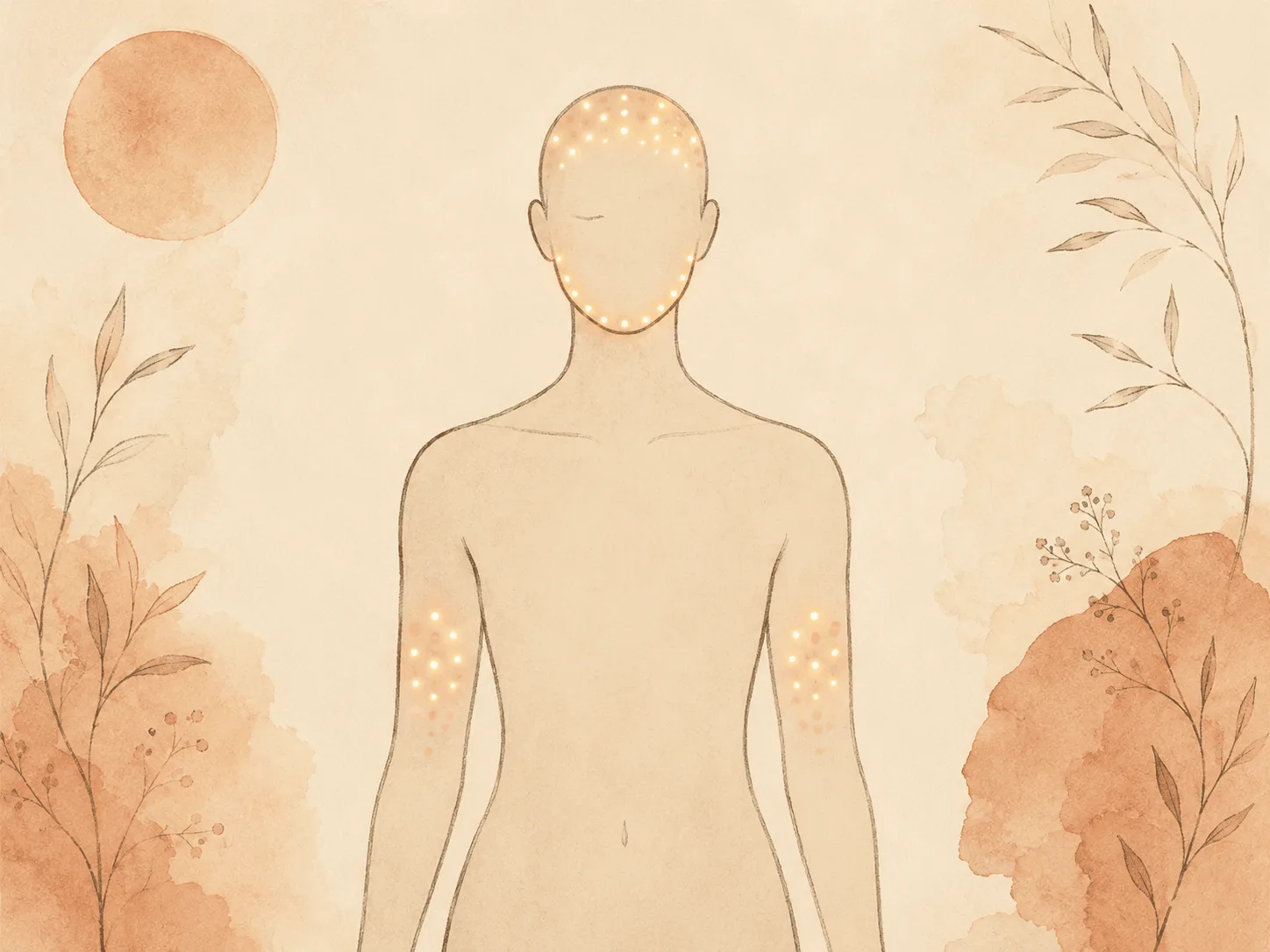
The conditions that most reliably do this:
- Acne, including the closed bumps that never come to anything but can be felt for weeks. Picking often begins here, in adolescence, alongside a real breakout, and then outlives the breakout by a decade or more.
- Keratosis pilaris, the rough small bumps on the backs of the upper arms and thighs. Extremely common, medically harmless, and close to perfectly designed to be a target: hundreds of them, all raised, all reachable, all day.
- Eczema and dry or flaking skin, where genuine itch and the urge to pick sit on top of each other and become almost impossible to tell apart in the moment.
- Ingrown hairs and shaving bumps, which combine height, an edge, and the "something underneath" sensation in a single target. Shaving and waxing schedules quietly become picking schedules for a lot of people.
- Folliculitis, psoriasis, insect bites, healing wounds. In one student sample, insect bites were named by 64% and scabs by 57%.
Then there's the loop that makes this circular. Picking creates scabs, and scabs are by some distance one of the most reliable targets there is. A picked spot is not a resolved spot, it's a target with a delivery date a few days out. This is why a single bad evening reliably produces a bad week, and why the "let it heal" advice that sounds so passive is doing more work than it appears to.
What starts the scan
This is the part with a handle on it. If the target is what your fingers found, the scan-starter is what put them there, and it's almost always something small and repeatable.
Idle hands with skin in reach. The single most common one. Reading, on a call, in the passenger seat, waiting for something to load. Not boredom exactly, but hands with nothing assigned to them and skin within a few centimeters.
A routine that involves touching your face or body. Washing, moisturizing, shaving, applying makeup or removing it, hair washing. These are all legitimate and all end with your fingers already in position, which is why so many episodes start in the last thirty seconds of an otherwise normal skincare routine.
Heat, sweat and friction. After exercise, in summer, under a mask or a collar or a bra strap. Heat makes skin feel different, and different invites a check.
Clothing and equipment. A waistband, a helmet strap, headphones on a jaw or an ear, a rough seam. Anything that makes one area of skin newly noticeable.
A recent change to the skin. A new product, a sunburn, a haircut that exposes a hairline, a healing spot, a fresh shave. Novelty is what a scan is for.
Hormonal cycle. If you have one, breakouts arrive on a schedule, which means target supply is not constant across the month. Worth logging alongside everything else.
Being unobserved. Not the same as being alone with your thoughts. Just the absence of anyone who might see, which is why bathrooms and parked cars appear on so many people's lists, and why picking so often stops the instant someone walks in.
And yes, states. Tiredness, understimulation, anxiety, the flat stretch after something socially demanding. These are genuine scan-starters, and they're also the ones that lengthen an episode once it's running. They belong here. They just don't belong first.
Finding yours in a week
Three things, none of them heavy. A tracking system you abandon by Thursday tells you nothing.
Log the first touch, not the pick. This is the whole trick, and it's the opposite of what most tracking asks for. When you catch yourself, don't record that you picked. Record what your hand was doing thirty seconds before it, and where you were. Left hand on jaw, on the sofa, phone in the other hand. Six words. If you only ever log completed episodes you'll build a beautiful record of the part of the sequence you can't change.
Take a target census. Once, at the end of the week, write down every place on your body you went to and what you were going for. Not how often. Just what and where. People are routinely wrong about this. Someone certain they're a face picker finds the census full of upper arms and cuticles, which points at keratosis pilaris and dry hands rather than anything they'd been working on.
Run one supply audit. Take the body area that came up most and ask a plain question about it: is there actually something there most days? If yes, that area needs a skin plan alongside the behavioral one. If no, and you're scanning skin that's essentially clear, the scan-starter is carrying all the weight and that's where the week's effort should go.
Log the near-misses too. A scan that ran and found nothing, or found something and stopped, has the same beginning as a completed episode and tells you which scan-starters you're already able to interrupt.
Paper is fine. The reason people move to an app is the first-touch log specifically: it has to happen in the moment, and if it takes longer than ten seconds it stops happening by day three. SkinAware logs an episode or a resisted urge in a few taps, with fields for trigger, feeling, body part, environment, duration and urge intensity, so the body-part data builds your target census without you reconstructing anything at the end of the week.
Log the search, not just the pick
SkinAware captures episodes and resisted urges in seconds, with body-part and trigger fields that build your own map as you go.
Available on iOS, Android and in your browser.
Where this goes wrong
Stopping at "stress." It's a category, not a trigger, and there's no version of your week where you schedule less of it. "The twenty minutes after I take my makeup off" is a trigger, and you can put something in that gap.
Only logging completed episodes. The most common failure by a distance. It produces a log full of endings, and endings are the part you already know about.
Treating the permission thought as the cause. Let me just check how that's healing arrives after the scan has already started, not before. It's the loudest part of the sequence and one of the last, which is why arguing with it so rarely works.
Assuming clear skin ends it. Eighteen percent of one sample named healthy skin as a trigger. If the scan is well established it will run on whatever is available, which is why treating the skin is necessary for some people and sufficient for almost nobody.
Turning the mapping into the project. Finding triggers is genuinely interesting and costs nothing emotionally, which makes it an excellent hiding place. If it's been six weeks and nothing about your evenings has changed, the map is finished.
What to do once you know
The map isn't the treatment. It's what makes the treatment specific rather than generic.
Roughly: if your scan-starters are postural and situational, the answers are environmental, and those are the fastest wins available to anyone. If the targets are being supplied by a real skin condition, some of the answer is dermatological and no amount of willpower substitutes for it. If the scan is tactile, substitutes need to deliver comparable texture rather than just occupying the hands. If it's visual, the screen half of your life is worth auditing before the mirror half. And if a state is doing most of the work, the state needs handling directly.
The full set of what to do with each is in our guide on how to stop skin picking. If you're still working out why this happens at all, why can't I stop picking covers the mechanism underneath it.
Frequently Asked Questions
It can certainly feel that way, and what that usually means is that the scan ran without you registering it. Stress was never the starting mechanism for most episodes anyway. Something put your hand or your eyes on your skin, the search ran, and it found something. Calm evenings with free hands and skin in reach are high-risk in exactly the way stressful ones are, which is why picking so often shows up during reading, scrolling and TV rather than during a crisis.
For most people it's both, but they do different jobs. Sensation and situation tend to start an episode; emotional state tends to decide how long it runs and how much damage it does. If you've been treating it as purely emotional and getting nowhere, the sensory half is usually the unexplored part.
No, but it does mean you're working with a renewing supply of targets, which is a harder starting position than clear skin. Treating the condition genuinely reduces trigger load. It rarely stops picking on its own, because the scan is a learned behavior that outlives the thing that taught it, so the behavioral work still has to happen alongside it.
Scabs are close to an ideal target: raised, edged, and arriving on a predictable schedule. A picked spot is a target with a delivery date a few days out, which is the mechanism behind a single bad evening turning into a bad week. It's also the strongest argument for the unglamorous advice about covering spots and leaving them alone.
The research points that way. In an experimental study of 601 adults, people rated a stronger urge to pick while viewing picking-related images than neutral ones, and the effect was strongest in those reporting skin picking disorder. If your feed serves you that content and your picking has an evening pattern, it's worth a week of watching what happens without it.
A week gives you a usable first map and it will be incomplete. Two to four weeks gives you something you can trust, mainly because it catches the rarer, worse episodes a single week misses, and covers a full hormonal cycle if you have one. Start acting on your top scan-starter as soon as it's visible.
Yes. Clinicians describe triggers as varying considerably both between people and within the same person over time. Seasons, skin condition, a new job, a house move, a change in medication. If a plan that worked for months stops working, re-running a week of tracking is usually more useful than deciding the plan was wrong.
Continue Reading
References
- Mehrmann, L. M., Urban, A., & Gerlach, A. L. (2020). Visual triggers of skin picking episodes: An experimental study in self-reported skin picking disorder and atopic dermatitis. Clinical Psychology in Europe, 2(4).
- Neziroglu, F., et al. (2008), as reported in Mehrmann et al. (2020): trigger endorsement rates for skin imperfections, itchiness, the sensation of something beneath the skin, the "right feeling," and mirror checking.
- Bohne, A., et al. (2002). Nonclinical German student sample (N = 133), cutaneous trigger rates, as reported in Mehrmann et al. (2020).
- Odlaug, B. L., & Grant, J. E. (2008). Clinical characteristics and medical complications of pathologic skin picking. General Hospital Psychiatry, 30(1), 61–66.
- Schienle, A., Übel, S., & Wabnegger, A. (2018). Visual symptom provocation in skin picking disorder: An fMRI study. Brain Imaging and Behavior, 12(5), 1504–1512.
- Massachusetts General Hospital, Center for OCD and Related Disorders. Excoriation (skin picking) disorder.