
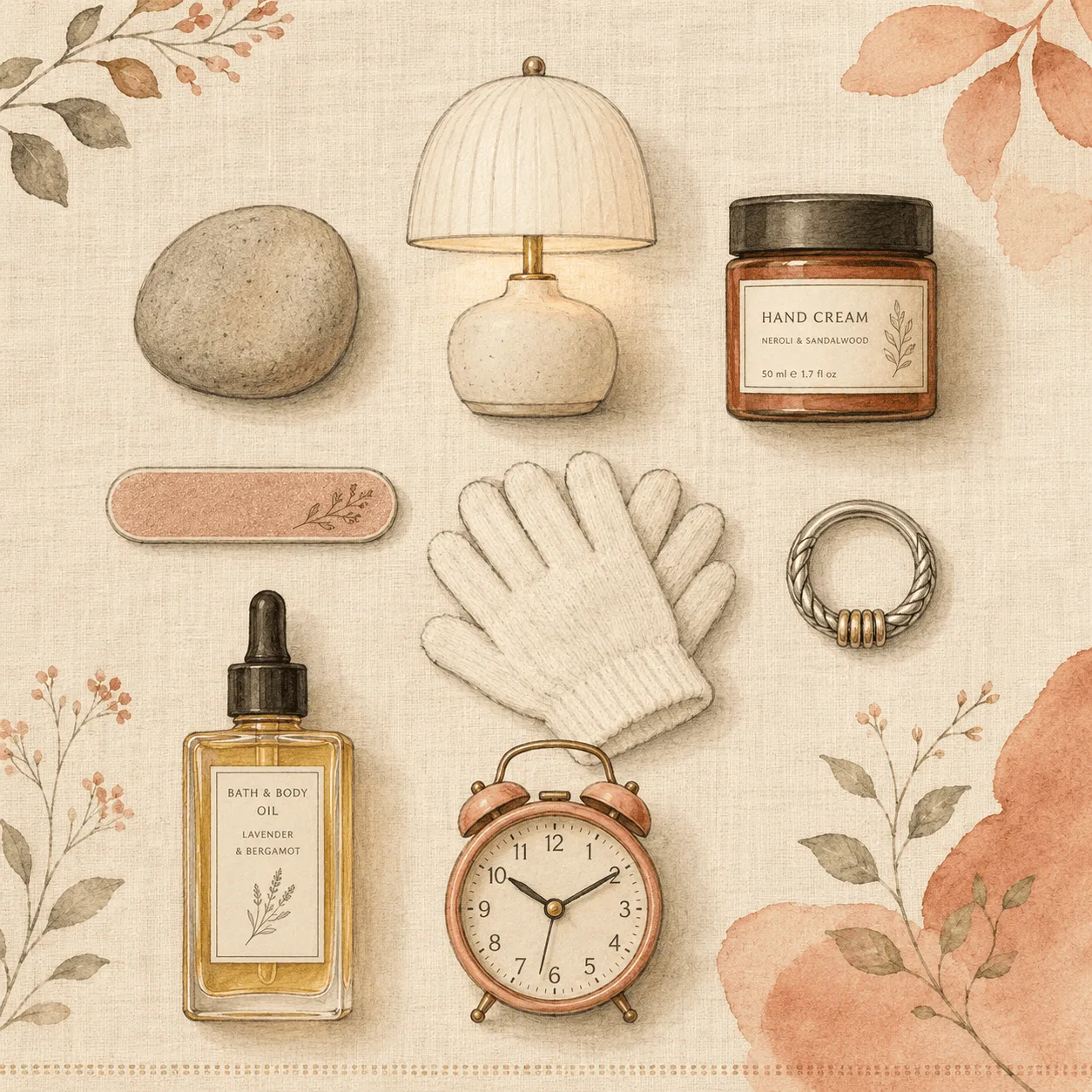
Every tip below is tagged by picking style, because that's what decides whether it helps you or wastes your week. Automatic picking is the kind you notice afterwards: your hand drifted to your jaw during a call or your cuticles while reading, and you were three minutes in before you knew. Focused picking is deliberate, usually at a mirror, usually with a ritual. Most people do both and one tends to dominate, so skim for your tag, take two, and ignore the rest.

A–I: alarms, bulbs, gloves, if-thens
A. Set the alarm before your window, not during it
Focused picking
Most focused picking happens in a predictable slot: after work, after the shower, the half hour before bed. Find yours and set a recurring phone alarm for twenty minutes before it starts. The alarm isn't there to stop you mid-episode. It's there to catch you while a different plan is still cheap: brush your teeth now, get into bed early, leave the bathroom light off tonight. An alarm at 10:40pm for an 11pm pattern is a nudge. An alarm at 11:15 is an accusation, and you'll turn it off.
B. Change the bulb before you try to change the behavior
Focused picking
Bright overhead bathroom light turns every pore into something that needs handling. A lower-wattage warm bulb, or a small lamp set across the room from the mirror instead of above it, does more work here than most willpower. You can still see well enough to wash your face and brush your teeth. You just can't run an inspection. If you rent and can't touch the fixture, a battery-powered motion light on the far counter does the same job for about the price of lunch.
C. Keep the same object in five places
Both
Whatever your competing object is (cuticle oil, hand cream, a fidget ring, putty), one of them at home is close to useless. The urge doesn't wait until you're near your nightstand. Buy four more and put them where you actually are: work bag, desk drawer, car door, coat pocket, bedside. It's an unglamorous tip and it's the one that most reliably converts "I have a strategy" into "I used my strategy."
D. Do your skincare somewhere without a mirror
Focused picking
Cleanser and moisturizer don't need a mirror. Take them to the kitchen sink or your bedroom for two weeks and see what changes. For a lot of people, most of an episode isn't the picking. It's the twelve minutes of looking that came first. Take away the looking and the picking often has nowhere to start from.
E. Give the bathroom a closing time
Focused picking
Give the room a closing time the way a shop has one. Everything you need in there gets done before it: teeth, face, contacts out. After that hour the door stays shut. It sounds arbitrary, and that's the point. You're replacing a decision you make badly at midnight with one you made calmly at noon.
F. Firm fidgets, not soft ones
Automatic picking
Squishy toys don't hold attention long enough for an urge to pass. Therapy putty at a firm resistance, a stress ball you have to work at, a textured stone with enough detail to find with your thumb: these ask for real force and real attention, so the picking loop can't quietly run underneath them. If you've tried fidgets and decided they don't work for you, there's a good chance you tried a soft one.
G. Wear gloves for two hours, not all day
Automatic picking
Gloves fail when people try to live in them. Pick the two hours where automatic picking is worst (evening TV, reading, the commute, late-night scrolling) and wear thin cotton gloves only then. Two hours you'll actually do beats twelve hours you abandon by Thursday. Texting gloves work if the window includes your phone.
H. Put a hydrocolloid patch on while the skin is calm
Both
Patches do two jobs. They keep a healing spot covered so it doesn't become tomorrow's target, and they block the re-check: your finger arrives, finds a smooth plastic disc where the texture was, and the loop breaks. The trick is putting them on before you're tempted rather than as damage control at 1am. Plain pharmacy ones work as well as the branded ones.
I. Write your if-then before you need it
Both
An if-then is one sentence, decided in advance, matching a specific cue to a specific response. The specificity is the active ingredient. A general intention to do better has nothing to fire on, while "if my hand reaches my jaw, then both palms go flat on my thighs for sixty seconds" fires by itself. Write two. Ten is a project, and projects get abandoned.
J–R: nails, mirrors, NAC, rehearsal
J. Treat "let me just check" as the first move, not a neutral one
Focused picking
Almost nobody starts an episode by deciding to pick. It starts with a small, reasonable-sounding sentence: let me just check how it's healing, or let me just wash my face properly first. That sentence isn't the moment before the episode, it's step one of it. Once you can hear yourself saying it, you have a place to intervene that's ten minutes earlier than the one you were aiming for.
K. File your nails flat instead of clipping them
Both
Short nails help, but clippers leave a ridge and a corner, and a corner is a tool. Filing straight across leaves nothing to get under a scab with. It costs an extra ninety seconds and it changes what your hands are physically able to do. Weekly, not monthly.
L. Keep lotion within arm's reach of every mirror
Both
Two mechanisms in one bottle. Slippery fingers genuinely can't grip well enough to pick effectively, and applying it occupies both hands for a minute or two, which is roughly how long you need. Storing it where the mirror is means the decision is already made by the time you get there.
M. The magnifying mirror goes in a drawer
Focused picking
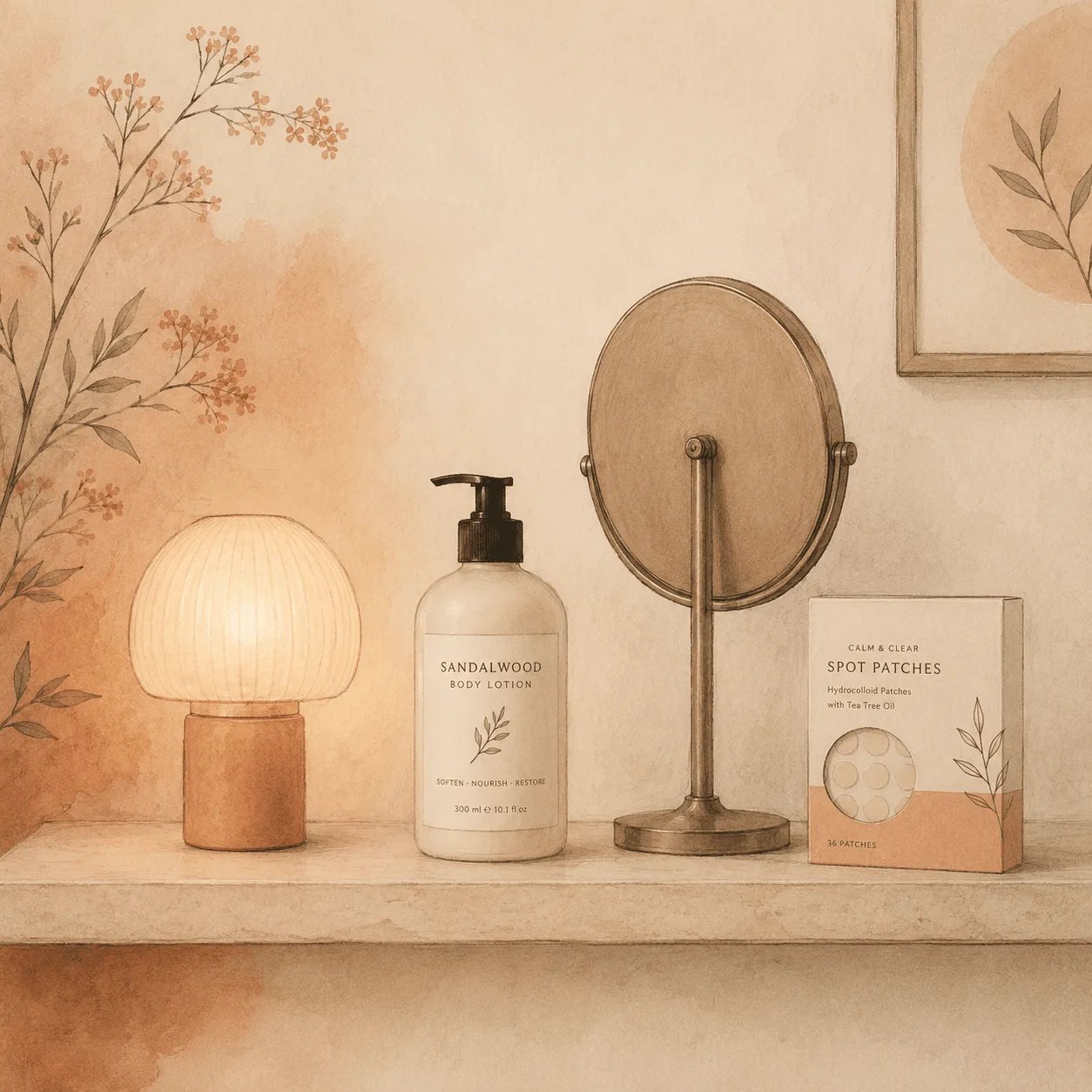
Nothing on a human face benefits from being viewed at ten times magnification by someone already anxious about it. If it belongs to someone else in the house, turn it to the wall. If it's fixed to the wall, hang a cloth over it. For most face pickers this is the highest-yield object change available, and it costs nothing.
N. Ask a doctor about NAC
Both
N-acetylcysteine is an over-the-counter amino acid derivative with randomized trial evidence behind it for skin picking, which is more than can be said for most things marketed at this. The doses used in trials sit well above a general supplement-aisle serving, and it interacts with some medications, so this is a conversation rather than a self-experiment. What the trial actually found, and where medication sits relative to therapy, is covered in the full guide to stopping skin picking.
O. One person knows, and knows what to say
Both
Telling someone helps, but only if you tell them what you want from them. "Point it out when you see me" works well for some people and feels like surveillance to others. Decide which you are, then give a real instruction: "if you notice, just touch my arm, don't say anything out loud" is something a person can actually follow. Vague disclosure tends to end in a well-meant comment at the worst possible moment.
P. The phone stays out of the bathroom
Focused picking
A three-minute mirror visit becomes a thirty-minute one when there's something to scroll. The phone isn't causing the picking. It's extending the window in which picking is possible, and window length is most of what determines the damage. Leave it on the kitchen counter. You'll be back in four minutes.
Q. Run the quiet-hands drill when nothing is happening
Both
Whatever you plan to do instead of picking (fists clenched, palms flat, stone in hand), practice it three times a day when you feel no urge at all. Sixty seconds each. It feels pointless, which is why almost nobody does it, and it's the whole difference between a response you have to remember under pressure and one your hands already know. A spiking urge is a bad moment to learn a new skill.

R. Rate the urge and note the time before you act on it
Both
Give it a number out of ten and write it down with the time. Two things happen. You get a few seconds of delay in a moment where seconds are the whole game, and after a couple of weeks you have evidence for something that's very hard to believe while it's happening: urges rise, peak, and come down on their own. Your own log will show you roughly how long yours take. If you're mid-urge as you read this, the emergency version of this is here.
S–Z: sleep, tracking, maps, self-view
S. Protect your sleep like it's part of the treatment
Automatic picking
Tired hands resist less. It's one of the most consistent patterns people notice once they start logging: the bad evenings follow the short nights. You don't have to fix your sleep to use this. You just have to know that a five-hour night makes tomorrow evening a high-risk window, and plan a little extra friction into it. If evening crashes and understimulation sound familiar, the ADHD overlap is worth reading about.
T. Track one number, not ten
Both
Detailed logs get abandoned in about a week. Pick one thing to record (episodes per day, or urges resisted, or minutes spent) and record only that for a month. A rough number you keep beats a rich data set you quit on day nine. Add detail later, once logging itself is automatic.
U. Set a timer and surf the urge instead of fighting it
Both
Fighting an urge usually makes it louder. Surfing means letting it be there without acting on it: set a timer for ten minutes, describe what you feel in your body (tight across the shoulders, itchy along the jaw), and let it rise without doing anything about it. You're not gritting your teeth until it leaves. You're collecting first-hand evidence that it leaves on its own, and that evidence is what eventually makes urges less frightening.
V. Look at your skin on a schedule, not on impulse
Focused picking
If you're tracking progress, photograph it once a week at a fixed time and don't inspect in between. Daily checking isn't monitoring, it's the inspection loop wearing a productivity costume. A weekly photo also shows you healing you'd never spot otherwise, because day to day your skin mostly looks like it did yesterday.
W. After a slip, restart the clock, not the day
Both
"I've already ruined today" is the sentence that turns a two-minute slip into a two-hour session, and it causes more damage than the original urge did. There's no day to ruin. There's the next hour, and it's still available. Clean the area, cover anything open, and count from now.
X. Map exactly where you pick
Both
Draw a rough body outline, or use a tracker that records location, and mark every spot for two weeks. Most people are surprised by the result. They think of themselves as a face picker and the map shows scalp and left forearm doing half the work. It matters because the fix follows the location: scalp picking is more often solved with a different shampoo and a hat than with anything mirror-related, cuticles want oil and something to hold, jawline wants the lighting changed.
Y. Give your dominant hand the job first
Automatic picking
Almost everyone picks mainly with one hand, and most people have never noticed which one. Watch yourself for a day. Then, when you're occupying your hands, make sure that hand is the one holding the stone or the putty or the ring. Handing the fidget to your spare hand is a quiet, common reason people conclude fidgets don't work for them.
Z. Turn off self-view on video calls
Focused picking
Hours spent watching your own face in a small bright rectangle is an inspection session with a work meeting happening around it. Every major video app has a hide-self-view option, usually two clicks deep. Turning it off removes one of the more reliable modern triggers, and nobody else on the call can tell you did it.
If you only do one thing
Take two tips with your tag on them and run them for two weeks. Not six. Two, long enough to know whether they did anything, because the most common reason people conclude none of this works is that they tried nine tactics in four days and couldn't tell which was which.
If the ones that keep appealing to you are the tracking tips (R, T, V, X), that's the part SkinAware was built for: logging an episode or an urge in a few taps with location and trigger, a private photo timeline you control the schedule of, and the habit reversal course in short modules for when a list of tips stops being enough. It's $5.99 a month or $34.99 a year, with a two-week trial on iOS.