
Reviewed for accuracy using peer-reviewed research including meta-analyses by Farhat et al. (2023), Selles et al. (2016), and clinical studies published in JAMA Psychiatry and the American Journal of Psychiatry.
Key Takeaways
- Dermatillomania (skin picking disorder) affects about 1 in 29 people, making it far more common than most realize
- It's a recognized psychiatric condition in the DSM-5, not a "bad habit" or character flaw
- Most people struggle for nearly 20 years before getting help, often because they don't know it has a name
- Behavioral therapy is the most effective treatment, with significant improvement possible
- Simple tools like tracking and self-monitoring are core components of evidence-based treatment
What Dermatillomania Actually Is
That compulsive urge to pick at your skin has a name. It's called dermatillomania, and it's a real, recognized mental health condition.
You might also hear it called excoriation disorder, skin picking disorder (SPD), neurotic excoriation, or psychogenic excoriation. Doctors use these terms interchangeably. Whatever the name, it describes the same thing: repeated picking at your own skin that causes visible damage, despite wanting to stop.
If you've ever lost track of time in front of the mirror, only to realize you've been picking for an hour, you're not alone. If you've canceled plans because you couldn't stop, or spent way too long covering up the evidence with makeup or long sleeves, a lot of us have been there too.
"Skin picking isn't something you can 'just stop' through willpower. It's not a weakness."
The American Psychiatric Association added dermatillomania to the DSM-5 (the manual doctors use to diagnose mental health conditions) in 2013. It sits in the category of Obsessive-Compulsive and Related Disorders, alongside conditions like trichotillomania (hair pulling) and body dysmorphic disorder.
This classification matters. It means the medical community recognizes that skin picking isn't something you can "just stop" through willpower. It's not a weakness. It's not attention-seeking. It's a condition with biological, psychological, and environmental components that responds to proper treatment.
The Official Criteria: How Doctors Diagnose It
The DSM-5-TR lays out specific criteria for diagnosing excoriation disorder. Here's what clinicians look for:
A. Recurrent skin picking resulting in skin lesions
You pick repeatedly, and it causes visible damage. This could mean scabs, scars, sores, or infections. The picking might happen with fingernails, tweezers, pins, or other picking tools.
B. Repeated attempts to decrease or stop skin picking
You've tried to quit. Maybe many times. This isn't something you're doing because you enjoy it (even if there's momentary relief). You genuinely want it to stop.
C. The skin picking causes clinically significant distress or impairment
The behavior affects your life. Maybe you avoid social situations, spend hours camouflaging damage, feel intense shame, or have trouble functioning at work or school because of it.
D. The skin picking isn't attributable to substances or another medical condition
Picking caused by drugs (like stimulants) or skin conditions (like scabies) doesn't count as dermatillomania. Though many people with skin conditions like acne do develop picking behaviors on top of their dermatological issues.
E. The skin picking isn't better explained by another mental disorder
If someone only picks because they believe there's something under their skin (a delusion) or only picks to "fix" a perceived appearance flaw (body dysmorphic disorder), that would be diagnosed differently.
Common Signs and Symptoms
Skin picking looks different for everyone, but there are patterns that show up again and again. If you're wondering whether your experience counts, this section can help you see yourself in the data.
Where People Pick
Research shows the face is by far the most common target (about 84% of people with dermatillomania pick there). But really, anywhere on the body can become a focus:
- Face — especially around acne or perceived imperfections (84%)
- Arms and hands
- Scalp — often hidden under hair
- Legs
- Back and shoulders
- Cuticles and nail beds
- Chest
- Feet
Many people pick from multiple body sites. And the specific areas can shift over time based on what triggers episodes.
How the Picking Happens
There are two main patterns, and most people experience both:
Automatic (unconscious) picking happens when you're not really aware you're doing it. You might be watching TV, reading, driving, or lying in bed, and your hand just... finds its way to your skin. Research suggests about 45% of picking episodes fall into this category.
Focused (conscious) picking is deliberate. You might go to the mirror specifically to pick, or you feel a bump and decide to "investigate." There's often a ritual quality to it. About 55% of episodes are focused.
Time Spent
The average person with dermatillomania spends 57 to 107 minutes per day picking. Not all at once, usually. It might be 20 minutes in the morning bathroom routine, quick episodes throughout the day, and another extended session at night before bed.
Emotional States Before, During, and After
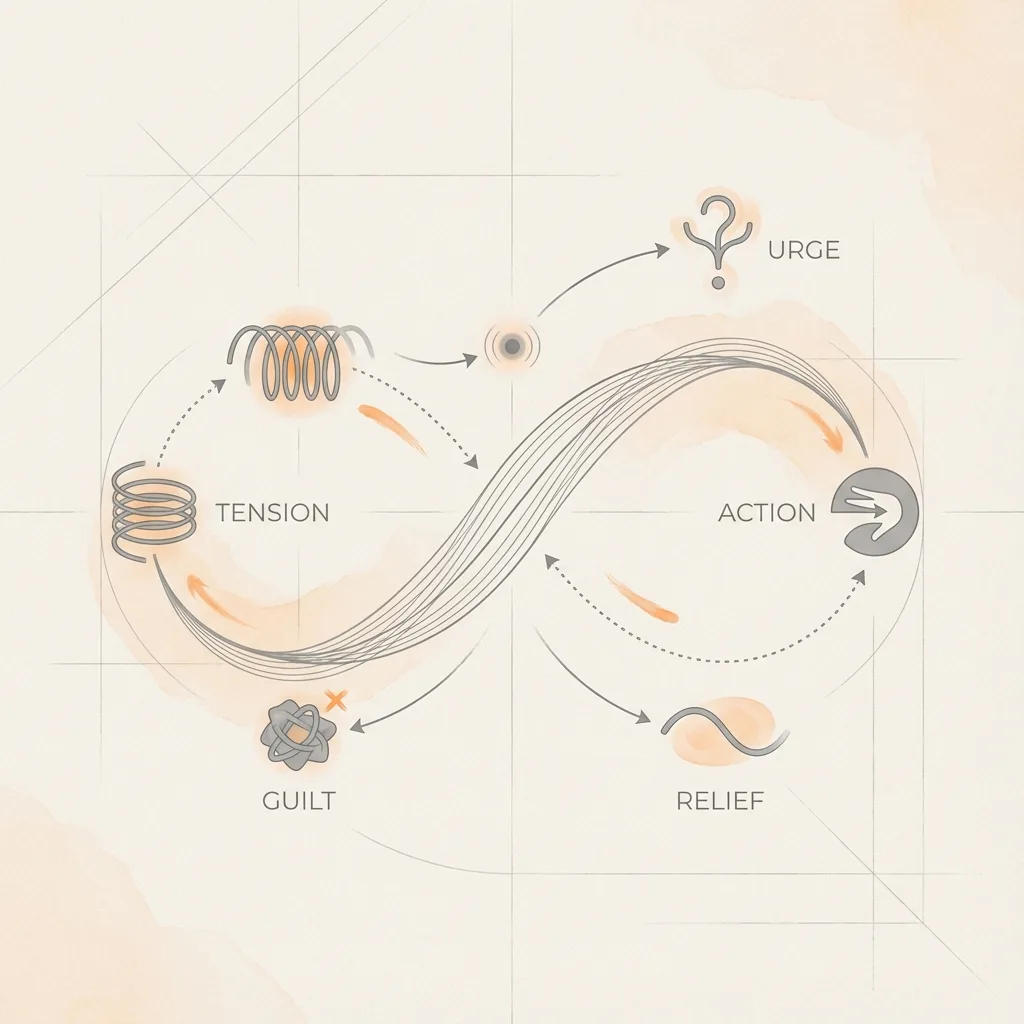
Before: Many people report feeling tension, anxiety, boredom, or an urge they can't ignore. Some describe feeling drawn to imperfections they need to "fix."
During: There might be a trance-like quality, a sense of hyperfocus, or momentary satisfaction when a scab or bump is removed. Research shows about 79% of people with dermatillomania report a pleasurable or satisfying feeling during picking. Pain isn't usually prominent during the episode, even when causing significant damage.
After: This is where it gets hard. Most people feel shame, guilt, frustration, or despair. The cycle of picking to relieve tension, then feeling worse, is exhausting. This cycle can repeat multiple times per day.
What Causes Skin Picking?
There's no single cause. Like most mental health conditions, dermatillomania develops from a combination of factors.
If you want to understand why you can't "just stop," this section explains the science behind what's happening in your brain and body.
Biological Factors
Genetics: Twin studies show about 40% heritability for skin picking. If you have a close family member with dermatillomania, you're more likely to develop it yourself. About 28% of people with the condition have a first-degree relative who also picks.
Brain differences: fMRI studies show people with dermatillomania have different activity patterns in areas related to impulse control, reward processing, and habit formation. Specifically, researchers see reduced activity in the dorsal striatum and anterior cingulate cortex (areas that help us stop unwanted behaviors) and increased volume in the nucleus accumbens (involved in reward).
Neurotransmitters: Glutamate, dopamine, and serotonin systems are all implicated. This explains why certain medications (like NAC, which affects glutamate) can help reduce symptoms.
Psychological Factors
Emotion regulation: Many people pick as a way to manage emotions. It might temporarily relieve anxiety, provide stimulation when bored, or offer a sense of control when things feel chaotic.
Perfectionism: The urge to "fix" perceived flaws, remove bumps, or achieve "smooth" skin drives a lot of focused picking. Perfectionist tendencies are significantly more common in people with dermatillomania than in the general population.
Sensory seeking: Some people are drawn to the tactile sensations of picking, the feeling of finding something to remove, or the visual feedback of extraction. This is especially common in people who are also neurodivergent.
Environmental Triggers
Research has identified the most common triggers:
| Trigger | % of People |
|---|---|
| Boredom / inactivity | 86.7% |
| Bodily tension | 82.3% |
| Negative feelings | 76.0% |
| Thinking about appearance | 74.4% |
| Examining skin | 73.1% |
How Common Is It? (More Than You Think)
Here's something that might surprise you: dermatillomania is common. Really common.
A 2023 meta-analysis found a lifetime prevalence of 3.45%. That's about 1 in 29 people. In the US alone, that's roughly 11 million people dealing with this.
Who Gets It?
- Women are affected more often (about 75%+ of those diagnosed), though men may be underdiagnosed
- Age of onset follows a trimodal pattern: peaks in childhood, adolescence/young adulthood, and middle adulthood. The average is 13.6 years, often coinciding with puberty
- It commonly begins with a dermatological condition like acne, then persists after the skin clears
- It occurs across all ethnic backgrounds and socioeconomic levels
- People with ADHD have significantly higher rates (30-40% overlap)
Average time people struggle before seeking help
Most people don't know it has a name until they stumble across it online
The Hidden Epidemic
Despite how common it is, dermatillomania often goes undiagnosed. Here's why:
- Less than 20% of people with skin picking ever seek professional help
- Average delay from onset to treatment is 18-20 years
- Many healthcare providers aren't trained to recognize BFRBs
- Shame keeps people silent—many never tell anyone
- Finding specialized therapists can be challenging
Dermatillomania vs. Normal Picking
Everyone picks at their skin sometimes. A hangnail, a scab, a pimple. So where's the line?
| Normal Picking | Dermatillomania |
|---|---|
| Occasional, brief | Frequent, extended sessions |
| Easy to stop when you decide to | Difficult or impossible to stop despite wanting to |
| Minimal skin damage | Visible damage: wounds, scars, infections |
| Doesn't affect daily life | Impacts social life, work, emotional wellbeing |
| Little to no emotional distress | Significant shame, guilt, or distress |
| Grooming-oriented (removing a splinter, etc.) | Often ritualistic or compulsive |
| Can resist without difficulty | Urges feel overwhelming |
The key differences are control, damage, and distress.
If you're reading this article, you probably already know something feels different about your picking. Trust that instinct.
Self-Assessment: Could This Be You?
Self-assessment
Question 1 of 5
Answer these questions honestly. There's no judgment here—this is just to help you understand your experience better.
Do you pick at your skin repeatedly, even when you want to stop?
Related Conditions and Comorbidities
Dermatillomania rarely shows up alone. Most people with skin picking also have at least one other mental health condition—often several.
Most Common Co-occurring Conditions
| Condition | % with Dermatillomania |
|---|---|
| Generalized Anxiety | 63.4% |
| Major Depression | 53.1% |
| OCD | 52.0% |
| Trichotillomania | 38.3% |
| Body Dysmorphic Disorder | 32.0% |
| PTSD | 27.2% |
| ADHD | 23.5% |
Why This Matters
Understanding co-occurring conditions helps with treatment. If you're struggling with anxiety AND picking, treating just one probably won't fully resolve either. Effective treatment addresses the whole picture.
The Real Impact on Daily Life
Let's talk honestly about what dermatillomania actually does to people's lives. This isn't to scare anyone. It's to validate that this is real and serious, and that getting help matters.
Physical Consequences
- Visible scarring (14.6% report severe scarring)
- Risk of infection, including serious infections like staph or MRSA
- Tissue damage and disfigurement in severe cases
- Pain and discomfort
- Hyperpigmentation and uneven skin tone
When to Seek Emergency Care
Most picking doesn't require emergency treatment, but watch for these warning signs:
- Severe bleeding that won't stop with pressure
- Signs of infection: increasing redness, swelling, warmth, pus, or red streaks spreading from a wound
- Fever or chills after picking
- Signs of sepsis (rare but serious): rapid heart rate, confusion, dizziness, extreme pain, or low blood pressure
If wounds become infected, they may need antibiotics. In severe cases, tissue damage can require surgical repair or skin grafting. Don't wait to seek help if something doesn't look right.
Psychological Impact
- Intense shame and secrecy
- Depression and anxiety (both as causes and consequences)
- Low self-esteem and negative body image
- Social isolation and avoidance
- In severe cases: 12% report suicidal ideation and 11.5% have attempted suicide
Functional Impairment
- Missing work or school
- Avoiding social situations (pools, beaches, intimacy)
- Hours spent picking, covering up, or thinking about picking
- Financial costs (skincare, makeup, medical treatment, therapy)
- Relationship strain
- Dating avoidance
Treatment Options That Actually Work
Here's the good news: dermatillomania responds to treatment. Not everyone achieves complete cessation of picking, but meaningful improvement is absolutely possible for most people.
Behavioral Therapy (The Gold Standard)
Habit Reversal Training (HRT) and Cognitive Behavioral Therapy (CBT) are the most effective treatments. Meta-analyses show large effect sizes (g = 1.19), meaning these therapies work substantially better than doing nothing.
HRT has four main components:
- Awareness training: Learning to notice urges and automatic behaviors before they escalate
- Competing response training: Replacing picking with incompatible actions
- Stimulus control: Modifying your environment to reduce triggers
- Social support: Building accountability and encouragement
Another approach gaining traction is the Comprehensive Behavioral Model (ComB), which addresses multiple factors: sensory triggers, cognitive patterns, emotional states, motor habits, and environmental cues. It's particularly useful because picking rarely has just one cause.
Why Tracking Works
Self-monitoring is one of the most accessible interventions you can start today. Here's why it helps:
- Builds awareness: You can't change what you don't notice
- Reveals patterns: See connections between triggers, times, and episodes
- Shows progress: Even small improvements become visible over time
- Creates behavioral consequences: The act of logging interrupts automatic behavior
Join 1,000+ people tracking their recovery
Medication Options
No medication is FDA-approved specifically for skin picking, but research supports several options:
N-Acetylcysteine (NAC): This over-the-counter supplement showed 47-62% response rates in studies. Doses of 1,200-3,000 mg/day reduced symptoms significantly compared to placebo. NAC works on the glutamate system and is generally well-tolerated. Common side effects are mild gastrointestinal symptoms.
Memantine: A 2023 trial showed 60.5% of participants much or very much improved versus 8.3% on placebo. This is the strongest pharmacological result to date. Memantine requires a prescription and also works on the glutamate system.
Naltrexone: This opioid antagonist has shown promise in some studies. It may work by reducing the reward/pleasure response associated with picking. Requires a prescription.
Lamotrigine: An anticonvulsant that some clinicians prescribe off-label. Research is limited but shows potential for some people.
Antipsychotics: Medications like aripiprazole or olanzapine are sometimes used in treatment-resistant cases, particularly when picking is severe.
What about SSRIs? Despite being commonly prescribed, SSRIs (like Prozac or Zoloft) haven't shown efficacy for skin picking in controlled trials. If they help, it may be by treating co-occurring anxiety or depression rather than the picking itself.
Self-Help Approaches
Not everyone can access specialized therapy right away. That's okay. Research shows self-help approaches can work too:
- Self-help HRT programs show meaningful effect sizes
- About 27% achieve significant improvement (35%+ reduction) through self-help alone
- Online and app-based tools can provide structure and tracking
- Workbooks and guided programs offer structure
Immediate Strategies
Need something you can try right now? These fall into two categories: what to do and what to avoid.
Do:
- The 1-minute delay rule: When you feel an urge, wait 60 seconds before acting on it. The urge often passes.
- Fidget tools: Textured stones, putty, stress balls, or spiky rings give your hands something else to do
- Keep hands busy: Squeeze a soft ball, wear gloves while watching TV or reading
- Hydrocolloid patches: Create a physical barrier on spots you're tempted to pick
- Apply moisturizer: When you feel the urge, massage lotion into your skin instead. It's a competing response that also helps healing.
- Tell someone: Having accountability helps. Let a trusted person know what you're working on.
- Keep skin clean: Reduces the "reasons" your brain finds to pick
Don't:
- Let nails grow long: Short nails make it physically harder to pick effectively
- Keep tweezers, pins, or tools accessible: Remove them from your bathroom or put them somewhere inconvenient
- Use magnifying mirrors: These make every pore look like a problem. Cover them or get rid of them.
- Pick in bright bathroom lighting: Dim lighting makes imperfections less visible and reduces the urge to "fix" them
What Works Best
Most experts recommend combining approaches:
- Behavioral therapy (HRT/CBT) as the foundation
- Self-monitoring and tracking as a daily practice
- Medication as an adjunct for some people
- Treatment of comorbid conditions like anxiety or depression
Frequently Asked Questions
No, though there's sometimes overlap. People who pick aren't typically doing it to hurt themselves or punish themselves. The behavior is driven by urges, habit, and (paradoxically) an attempt to feel better in the moment. That said, the line can get blurry, and some people experience both.
"Cure" is a tricky word for behavioral conditions. Many people achieve long periods of minimal or no picking with treatment. Others manage it to the point where it no longer significantly impacts their lives. Complete elimination of all urges forever isn't always realistic, but meaningful recovery is.
Some scarring can fade significantly over time, especially with good skincare and sun protection. Deeper scars may be permanent, though treatments like laser therapy, microneedling, or dermatological interventions can help. The most important thing is stopping the ongoing damage so healing can happen.
Many healthcare providers haven't been trained on BFRBs. You might need to advocate for yourself. Using the clinical terms (excoriation disorder, dermatillomania, skin picking disorder) can help. Consider bringing printouts from reputable sources like the International OCD Foundation, which now hosts the TLC Foundation's BFRB material.
There's about 40% heritability, so genetics play a role but don't guarantee anything. Environmental factors matter too. If you have children who show early signs of skin picking or other BFRBs, early intervention can help prevent entrenchment of the behavior.
Mental health parity laws require most insurance plans to cover mental health treatment similarly to physical health. Dermatillomania (excoriation disorder) is a recognized DSM-5 diagnosis, which helps with coverage. However, finding in-network providers who specialize in BFRBs can be challenging.
The most common triggers are boredom (87%), bodily tension (82%), negative emotions (76%), and examining skin in mirrors (73%). But triggers are highly individual. Understanding your personal triggers is key to management.
There's no known way to prevent dermatillomania from developing, since the exact causes aren't fully understood. However, if you notice early signs of skin picking in yourself or a child, early intervention can prevent the behavior from becoming deeply ingrained. The sooner you address it, the easier it is to change the pattern.
For most people, it's a chronic condition that tends to wax and wane over time. Stress, life changes, and other factors can trigger flare-ups even after long periods of improvement. The good news: many people achieve remission, meaning extended periods with minimal or no urges. Treatment significantly improves outcomes and quality of life.
Where to Get Help
Professional Resources
International OCD Foundation (iocdf.org) Now the home of the BFRB work the TLC Foundation built: educational resources, a therapist directory, a BFRB special interest group, and BFRB programming at the annual conference. TLC's own site, bfrb.org, stays online only through Summer 2026.
Psychology Today Therapist Finder Search for therapists in your area and filter by specialty. Look for providers who list BFRBs, skin picking, trichotillomania, or habit disorders.
Self-Help Tools
SkinAware App Track your episodes, identify triggers, log resistance victories, and see your progress over time. Evidence-based tracking that fits in your pocket.
Fidget Tools Many people find alternative sensory input helpful. Textured stones, putty, fidget toys, or spiky rings give your hands something else to do.
Community Support
Reddit Communities r/CompulsiveSkinPicking and r/Dermatillomania are active communities where you can connect with others who understand.
You're Not Alone
If you've read this far, you might be recognizing yourself in these words. That's actually a good thing. Knowing what you're dealing with is the first step toward doing something about it.
Dermatillomania is common, treatable, and nothing to be ashamed of. The fact that you've struggled doesn't mean you're weak or broken. It means you've been coping with a real condition without the support and tools you deserve.
Recovery is possible. Not easy, and not overnight. But possible.
Start by tracking. Pay attention to when urges hit, what triggers them, and what helps. That awareness is the foundation everything else builds on.
You've been fighting this alone long enough.
Ready to Start Tracking Your Progress?
SkinAware helps you log episodes, identify patterns, celebrate victories, and see real progress over time. Join thousands of others working toward recovery.
This article was reviewed for accuracy using peer-reviewed research including meta-analyses by Farhat et al. (2023), Selles et al. (2016), and clinical studies published in JAMA Psychiatry and the American Journal of Psychiatry.
Last updated: December 2025