

Written using peer-reviewed research including Selles et al. (2016) in General Hospital Psychiatry, Schuck, Keijsers & Rinck (2011) in Behaviour Research and Therapy, and a 2024 randomized trial in Behavior Therapy, alongside clinical guidance from the International OCD Foundation and Cleveland Clinic.
Habit reversal training teaches you to catch a picking episode early and put your hands somewhere that makes picking physically impossible until the urge passes. It was built in the 1970s for tics and nervous habits, and it sits underneath almost every structured skin-picking programme a therapist will run with you.
Most pages about it stop at that description. Two things they leave out are worth your time. The first is how good the evidence actually is, which is messier than the marketing suggests. The second is that picking is the only body-focused behavior that manufactures its own next target, and that single fact changes the drills.
What the evidence actually says
There's one meta-analysis of treatments for skin picking disorder. Selles and colleagues pooled twelve trials in 2016, nine of which had usable data. Behavioral treatments came out with a large effect, ahead of lamotrigine and roughly level with SSRIs.
Then comes the part nobody quotes. When the authors restricted the analysis to controlled trials only, the effect dropped to moderate, and their own conclusion was that the pooled data did not provide strong evidence for any specific treatment over control conditions.
That's not a reason to skip HRT. It's a reason to hold it correctly. The trichotillomania literature is deep, with dozens of randomized trials behind it. The skin-picking literature is thin, and most trials in it are small. What can be said is that behavioral work reliably beats doing nothing, that the individual trials point the same direction, and that nothing has outperformed it.
Two trials are worth knowing about specifically.
That last detail matters more than the headline number. Gains erode when practice stops. Plan for maintenance from week one instead of treating month three as a finish line.
Why picking needs a different protocol
Pull a hair and it's gone. Nothing is left at the site to draw your fingers back tonight.
Pick a spot and you've made something. A scab with a raised edge. A patch rougher than the skin around it. Something that will itch on day three as it knits, which is exactly when it feels like it wants attention. Five days later it's still there, and it's the single most interesting thing on your body to a fingertip on autopilot.
So the loop closes on itself. Inspect, find, pick, damage, heal, new texture, inspect.
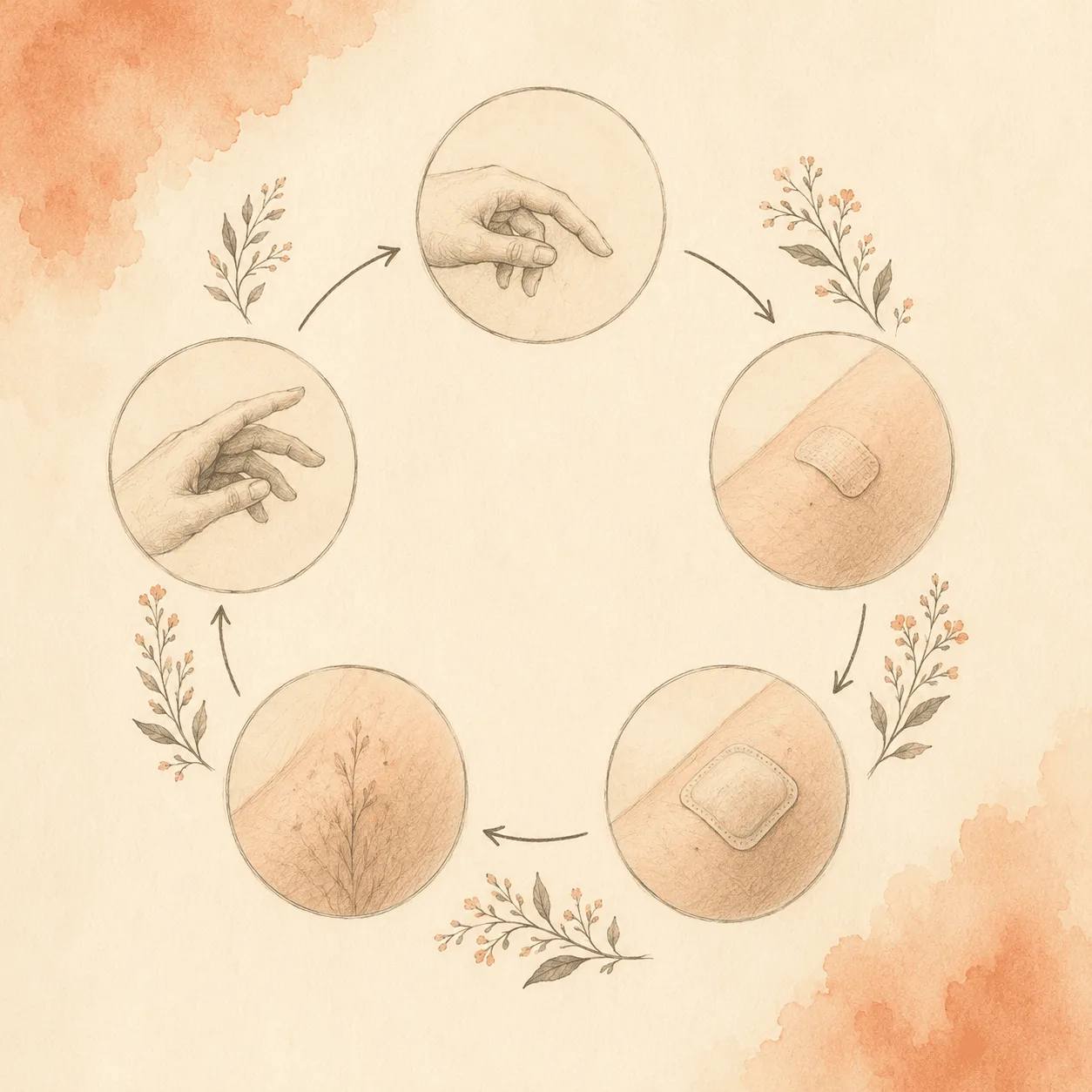
Two consequences follow, and they shape everything below.
Your competing response has to intercept the inspection, not the pick. Once your nail is under an edge you're three links into the chain. The link that starts it is a fingertip sweeping an area to see what's there, or your eyes catching the mirror on the way past.
And healing stops being the outcome of treatment and becomes part of it. Every spot that closes cleanly is one fewer trigger next week. That's why skin picking protocols include wound care and hair pulling protocols don't. If you're working on both behaviors, the hair pulling version of this protocol diverges from here.
Before you start: two weeks of mapping
Two weeks, not one. Skin varies more across a fortnight than most people expect, and if you happen to start on a calm week you'll build the entire protocol around the wrong pattern.
For every episode, record:
- Time and place
- What you were doing in the ten minutes before
- Which site on your body
- Whether you inspected first, or your hand arrived on its own
- What you were looking for, in your own words
- What you did with what came off
- Whether you noticed at the time or afterwards
Clinicians trained in body-focused repetitive behaviors sort all of this using the ComB model, which files triggers into five domains under the acronym SCAMP: sensory, cognitive, affective, motor and place. Your log is a rough version of that assessment.
1. Awareness training: catch the scan
A scan is any time your fingertips travel across skin looking for irregularity, or your eyes settle on a patch of skin with intent. Running a hand down your jaw. Checking your shoulders in a changing-room mirror. Feeling along a fingertip for loose cuticle. Most scans end in nothing, which is the point: every one was a branch you didn't see.
People who count for a week typically find scans run five to ten times higher than episodes. That gap is the working space of the whole treatment.
Three tells come before the scan and are catchable:
The pause. You stop moving. Walking past the bathroom, you slow. On a call, you go still. Stillness with free hands is the posture almost every episode grows out of.
The lighting change. Overhead bulbs, daylight through a window, phone torch, front camera. If you're suddenly somewhere better lit than you were a minute ago and your hands are free, an episode has already started.
The justification. "Let me just see." "That one's ready." "It'll heal faster if it's out." Some people catch the sentence before they catch the hand.
Then describe your own picking in more detail than feels comfortable. Which fingers pinch. Nails, tweezers, pins or teeth. Squeezing, scratching, peeling, or lifting an edge. What happens to it afterwards. A competing response has to block your movement, and a generic fist doesn't stop someone who picks with a thumbnail braced against an index finger.
2. Competing response training
A competing response has four conditions to meet. Physically incompatible with the movement you actually make. Holdable for a full minute. Discreet enough for a meeting or a bus. And requiring nothing you'd have to go and find, because the urge arrives on the evening your putty is in the other bag.
For picking, the shortlist tends to be:
- Fists closed with thumbs tucked inside, arms straight down
- Arms crossed, hands tucked under the opposite upper arms
- Both palms flat and pressed onto your thighs, fingers spread
- Both hands wrapped around a mug, a glass, or a bottle
- Fingers interlocked, gripped firmly enough that unlocking takes a decision
- Both hands on the wheel at ten and two, if you pick while driving

Every one of them occupies both hands, and that's the detail people miss. Most picking uses two hands cooperatively, one to hold or stretch the skin and one to work. A response that fills one hand and leaves the other loose isn't a competing response. It's half of one, and half doesn't hold.
Hold for sixty seconds, or until the urge drops, whichever runs longer. Sixty isn't magic. It's long enough for an urge to crest and start falling, and short enough that you'll do it instead of negotiating.
The four ways it fails
A response that's really a gentler pick. Rubbing the area smooth. Pressing instead of squeezing. Exfoliating. Applying pressure through a tissue. Patting in skincare with a fingertip and having a feel while you're there. All of these keep your hand inside the target zone, and the hand finishes the job most nights. If it involves touching the skin you pick, it isn't a competing response.
Deploying it too late. With a nail already under an edge, this is a tug of war you lose. Deploy at the scan. Better, at the pause.
One hand occupied, one hand free. A fidget ring is a decent supplement and a poor competing response.
Only ever rehearsing it in one room. Which is what generalization exists to fix, further down.
The urge is going somewhere, not away
The competing response holds the door. It doesn't remove the reason someone's knocking. Where picking is doing an emotional job, and for a lot of people it's discharging restlessness or damping anxiety, a held fist is a sixty-second answer to something that needs a different one.
Pair the response with something that shifts the same state. Standing up. A cold glass of water. Slow breathing with a long exhale. Two minutes of walking. This is the point where acceptance-based work gets added to plain HRT, and it's why recent trials test acceptance-enhanced behavior therapy rather than the 1970s original.
3. Stimulus control, ordered by impact
Barriers buy time while the skill is still forming. They aren't the treatment, and mistaking them for it is the most common way people plateau around month two. The beginner's version of the barrier toolkit lives here. What follows is the ordering, which matters more than the list.
Lighting and magnification, first. For face picking this outranks everything else by a distance. Magnifying mirrors turn every pore into a task. Remove it, or turn it to the wall. Swap harsh overhead bulbs for something warm and dim. Most face-picking sessions begin as looking, and looking needs light.
Tools, second. Tweezers, needles, pins, comedone extractors, cuticle nippers. Not in the bathroom. In a box, in a drawer, in another room. The thirty seconds it takes to retrieve them is often the entire intervention.
Nails, third. Short and filed smooth. Most picking needs an edge to get under. A gel or acrylic overlay blunts the fingertips, and some people find it's the single most effective physical change they make.
Coverage, fourth, and only on a schedule. Hydrocolloid patches over your most-picked spots, thin cotton gloves during known high-risk hours, long sleeves for arm picking. Worn constantly they stop registering within a week. Worn during your two worst hours, they keep working.
The situation, fifth. Brush your teeth in the kitchen for a month. Charge the phone across the room. Get out of the car instead of sitting in it on the drive. Bathrooms, cars and beds are where most episodes live.
4. Healing as a treatment component
This step has no counterpart in a hair pulling protocol, and it's where a picking-specific plan earns its keep.
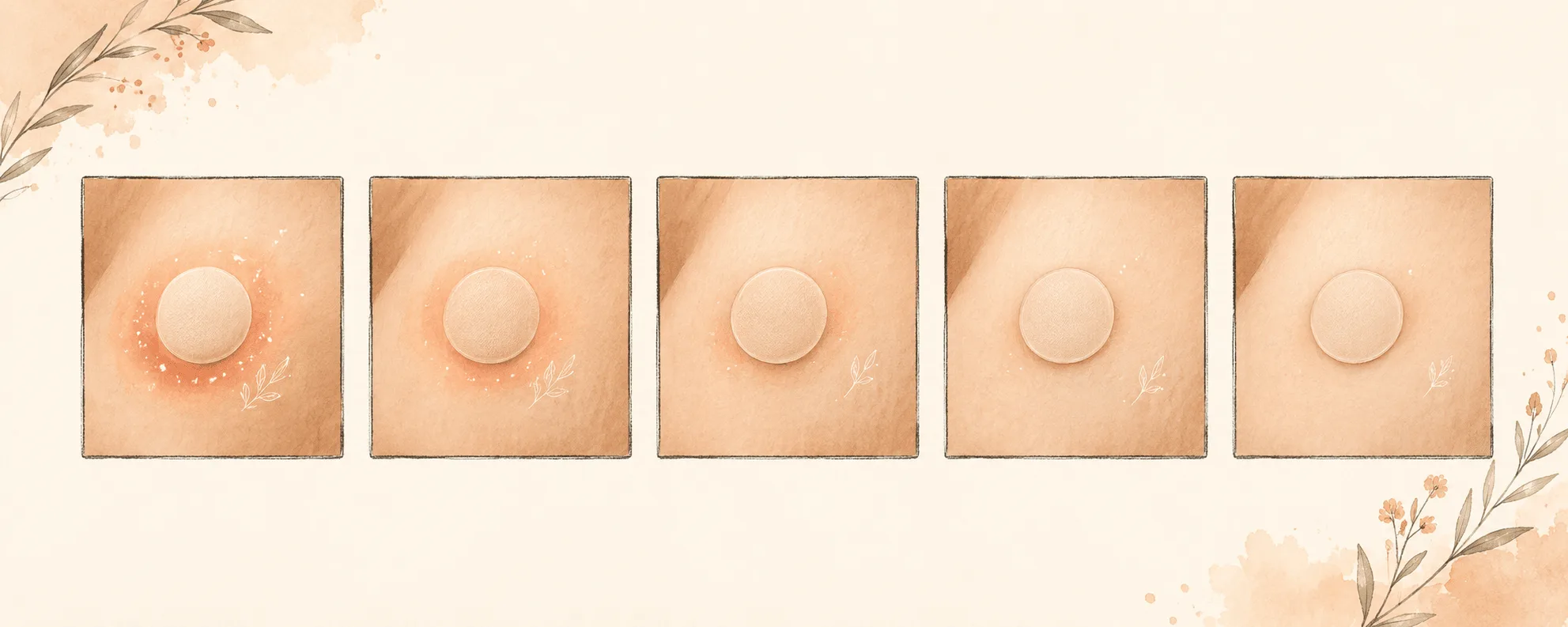
Every spot you leave alone until it closes is a trigger removed from next week. Every spot you reopen resets its clock and usually leaves a rougher finished texture, which makes it more interesting to a fingertip. Healing isn't the reward at the end of the protocol. It's a lever inside it.
In practice that means covering a spot rather than treating it. A hydrocolloid patch does two jobs at once: it keeps the wound moist so it closes faster, and it puts a physical layer between skin and fingernail. Then leave it. Changing it to check on progress is an inspection, and inspections are what you're training out.
Keep skin moisturised, particularly anywhere that goes dry and flaky. Dryness is a sensory trigger in its own right and the cheapest one to remove.
5. Social support
This component is in the clinical protocol and gets cut from nearly every self-help version of it. The job is narrow, and it isn't policing. Ask one person to do exactly three things:
- Say something when they notice you using the competing response. Out loud. That's the reinforcement mechanism, and the whole reason the component exists.
- If they see your hand on your skin, use one agreed neutral cue. A word, a look, a tap on the table. Chosen together, while you were calm.
- Never comment on how your skin looks. Not when it's worse, and not when it's better.
That third line surprises people. "Your face looks so much clearer" lands as surveillance, and it makes the next bad week much harder to admit to.
Write the three lines down and hand them over. Unbriefed people default to "stop it," or to sympathetic remarks about your complexion, and both raise shame. Shame raises picking. If the only available person would police rather than reinforce, a peer group is the better call.
6. Generalization
A competing response you've only run at your desk is a competing response that lives at your desk.
List the five places you pick most. For most people that's some combination of the bathroom mirror, bed, the car, a desk, and the sofa. Go to each one deliberately, at a calm time of day with no urge anywhere, and run the response there. Sit in the driver's seat and do it. Stand at the mirror under the light you normally use and do it. It feels ridiculous, and it's the step that separates a good month from a good year.
Then keep going past the point where it feels necessary. The protocol isn't finished when picking stops. It's finished when your hands go to the position without you deciding, and that takes months.
When HRT isn't enough
The method has limits, and knowing them in advance is what stops people abandoning it at the first plateau.
Other conditions are usually in the room. Anxiety, depression, OCD, ADHD and autism all travel with skin picking. If untreated anxiety is generating the urges, a competing response is bailing a boat with a hole in it. The foundational guide to dermatillomania covers how often those overlap and what the diagnosis actually involves.
Emotion-driven picking needs more than a motor block. Where picking is regulating a feeling, clinicians add acceptance and commitment work, or run the full ComB model, which matches a different strategy to each of the five SCAMP domains instead of loading everything onto the competing response.
Medication is a reasonable conversation. In the Selles meta-analysis, SSRIs and lamotrigine both showed effects in a similar range to behavioral treatment. N-acetylcysteine is commonly tried. None are cures, all belong with a prescriber, and none replace the behavioral work.
Relapse is in the data, not a character flaw. The 2024 online trial showed symptoms drifting back up between the end of treatment and six months, while still sitting well below baseline. That's the shape of it: reduction, plateau, slip, reduction.
Running the protocol without a therapist
Therapists trained in body-focused repetitive behaviors are scarce nearly everywhere, so for most people self-directed work is the realistic option rather than the second-best one. The 2024 trial is encouraging here. Its therapist contact was asynchronous and remote, and it still produced a large effect.
Two things decide whether a self-directed attempt works.
The first is a logging habit that outlives week one. Paper is fine. Anything you'll actually open at eleven at night is fine.
The second is structure, because the failure mode of self-directed HRT is doing the awareness component, feeling better, and never building the rest. Awareness alone buys a fortnight and then stalls. If you want a wider bank of tactics to draw on while you build the components, this collection of specific picking tactics pairs well with the protocol.
SkinAware has the protocol built in as a course of four modules: the habit loop and the two types of episode, the SCAMP trigger framework and your high-risk situations, competing responses and urge management, then slips and long-term maintenance. Alongside it you can log episodes and log urges you resisted, which is the awareness drill above, and add an accountability friend, which is the social support component. There's a moderated community in the app too, which for a lot of people is a more realistic version of a support person than anyone in their house.
Frequently Asked Questions
Trials have produced meaningful change in four to ten weeks. Four sessions was enough in one randomized study, and the guided online trial ran ten weeks. Expect noticeable reduction within two to four weeks of daily practice, and expect the competing response to take several months to become automatic.
Something that occupies both hands away from your face and can be held for a minute. Fists at your sides, arms crossed with hands tucked under the opposite arms, or both palms flat on your thighs. Avoid anything that keeps a fingertip in contact with facial skin, including patting in skincare or smoothing an area, because those turn into picking more often than not.
That's exactly what awareness training is for. Automatic picking needs the scan-counting drill more, not less. Expect awareness training to take longer if most of your picking happens outside your notice.
HRT is a behavioral technique, usually delivered inside a broader CBT frame. A therapist will typically combine it with cognitive work on the thoughts that precede picking, and increasingly with acceptance-based strategies for the emotional side.
Yes, and most people who do it, do it this way. It works better with a trained therapist and better still with some form of guided structure. The most common reason a self-directed attempt fails is that only the first component ever gets built.
No trial settles it yet. ComB includes the HRT components and adds structured work on sensory, cognitive and emotional triggers, which suits people whose picking is doing an emotional job. A head-to-head comparison is part of the ComB research programme but has not reported.
Treat it as a healing problem before treating it as a willpower problem. Cover it, set a five-day rule, and moisturise the area. A spot that closes fully stops being a trigger. A spot reopened every three days is a trigger you are renewing yourself.