
Written using the DSM-5 criteria for excoriation disorder, Odlaug and Grant's study of medical complications in pathologic skin picking (General Hospital Psychiatry, 2008), Lee and Lipner's 2022 review of onychophagia and onychotillomania (International Journal of Environmental Research and Public Health), DermNet, and case series on trichobezoar and Rapunzel syndrome.
Most people who pick their skin, pull their hair, or bite their nails will never have a medical complication worth the name. Marks, yes. Slow-healing spots, sore fingers, the occasional infected patch that needs a week of antibiotics. But the outcomes that show up in case reports and frighten people at two in the morning are genuinely uncommon, and they almost never arrive without warning.
Which is the actual reason to know what they look like. Not so you can inspect yourself for disaster every night, because for a lot of people reading this, that habit is the more likely harm. The reason is narrower and more useful: the rare complications are straightforward to treat when someone catches them in week one, and difficult when they're caught in month four. Knowing three or four signs buys you that.
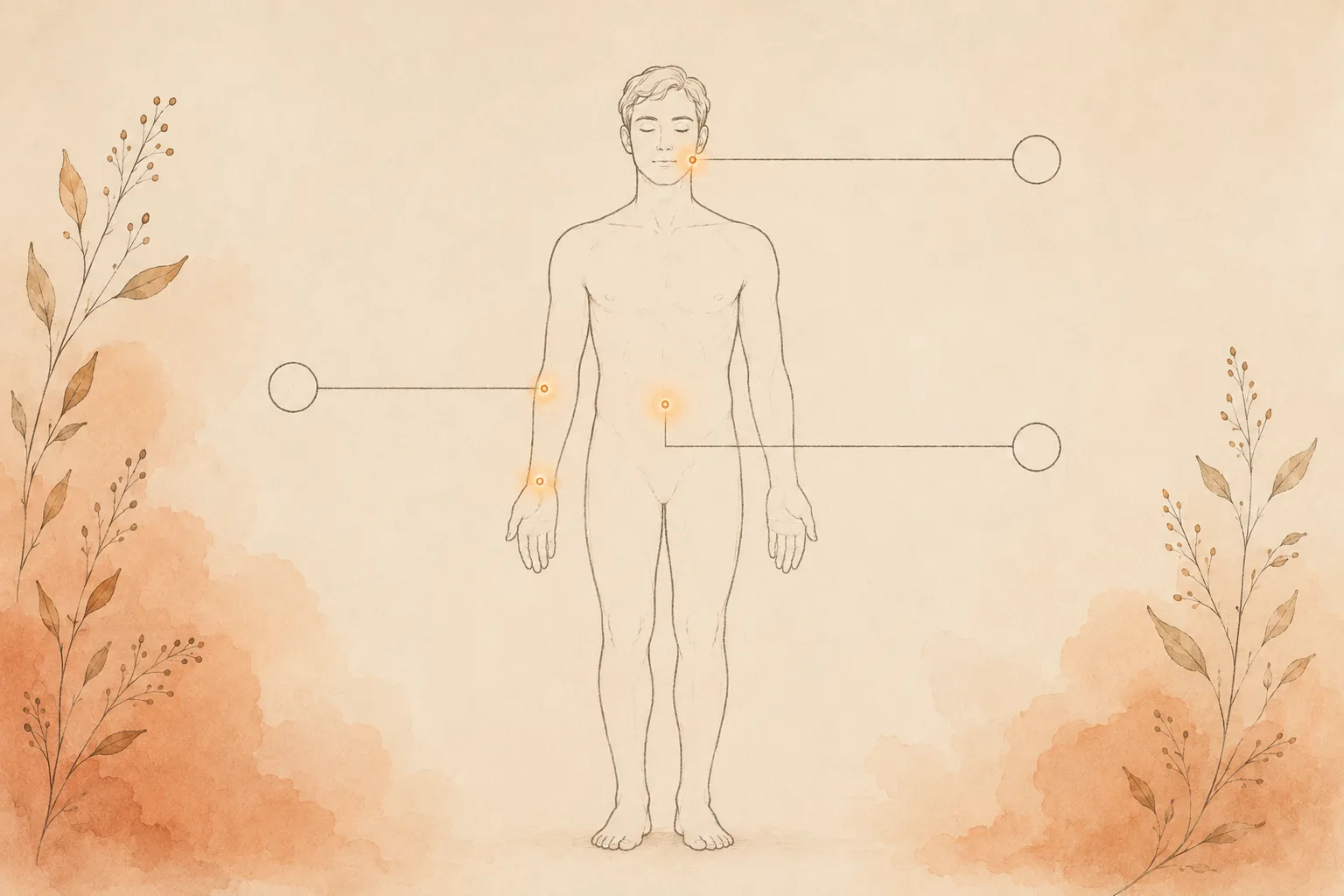
The physical side of body-focused repetitive behaviors splits into four categories that have almost nothing to do with one another: skin, hands and joints, teeth, and gut. Only the first two belong to picking. The teeth belong to nail biting and the gut belongs to hair pulling, which is why nobody has put them on one page before.
What happens to almost everyone
The common complications are the boring ones, and they account for nearly the whole picture.
Marks first. Most of what picking leaves behind is a flat color change in skin that is structurally intact, and most of it fades on its own over months. A smaller share is true scarring, meaning the texture of the skin has changed, and that doesn't fade. Sorting your own skin into one category or the other takes about two minutes with a lamp, and it's worth doing before you spend anything on treatment.
Then minor infection. A picked spot is an opening in a barrier that exists specifically to keep bacteria out, and the bacteria that get in are usually ones you were already carrying. Most of these stay small. Some need antibiotics. A very small number head somewhere worse, and the signs that separate those are specific enough to memorize.
Both of those have their own pages here, because both deserve more room than a paragraph.
The number worth sitting with is that self-inflicted skin conditions make up around 2% of all dermatology appointments. That figure cuts two ways. It says these behaviors put real numbers of people in front of a doctor, which is not nothing. It also says that a behavior affecting somewhere around one in twenty people produces a fairly modest share of dermatology visits, which tells you most of it is being managed at home, correctly, without incident.
The rare things that are actually real
Some complications are serious and they do happen. Being straight about them is more calming than vague warnings, because the specifics almost always turn out to be narrower than the fear.
Cellulitis. Infection that spreads out of the wound into the deeper tissue underneath. It's the most likely of the serious ones, it's treatable with tablets when caught early, and it's the one people wait too long on because it doesn't look like an infection is supposed to look.
Abscess. A pocket of infection walled off under the skin, usually firm, deep, and painful out of proportion to what the surface shows. It needs draining properly rather than squeezing.
Wounds severe enough for surgery. The International OCD Foundation puts it plainly: in extreme cases, picking can cause sores severe enough to require surgery. This is the far end of chronic, deep, years-long picking at a single site.
Bone infection. Documented for nail biting in a handful of case reports going back to 1990, where infection around the nail fold reached the bone of the fingertip. Two published cases across three decades of dermatology literature is the right sense of scale.
Systemic infection. Rare, and it doesn't creep. Infection reaching the bloodstream produces fever, chills, feeling genuinely unwell in yourself, racing heart, confusion. Those are the symptoms that mean today rather than tomorrow.
Hands, wrists and joints
This is the category nobody mentions, and it's the one more people actually have.
The mechanism is unglamorous. A picking or pulling session isn't one movement. It's a fine, repetitive, forceful pinch performed hundreds of times, usually with the wrist held at an angle and the shoulder hunched, often for stretches that run well past an hour without the person noticing any time pass. That's the same loading pattern that produces overuse injuries in people who do precision work for a living, minus the ergonomic assessment.
What it feels like: aching at the thumb base or in the wrist, stiffness in the morning, a dull ache through the forearm, sometimes tingling in the fingers. Easy to attribute to your phone or your keyboard, which is usually where people leave it.
This one goes to a GP or a physiotherapist, not a dermatologist, and it responds to what any overuse injury responds to. It's also the complication most likely to improve simply because the sessions got shorter.
Teeth and jaw
Almost everything here belongs to nail biting rather than picking, and it's the most under-treated category on the page, because the relevant professional is one nobody thinks to book.
The documented oral consequences of chronic nail biting are specific: gum injury that can swell or abscess, increased wear on the incisors, malocclusion, rotation of the front teeth, and apical root resorption, which is shortening of the tooth root. Pain and dysfunction of the temporomandibular joint have also been reported in long-term biters. The fuller picture of what chronic biting does covers the nail side alongside it.
Two things make this category different from the rest. Some of it is structural and permanent, so early is genuinely better. And unlike a skin infection, none of it announces itself. Root resorption doesn't hurt. Nobody notices their incisors rotating. It gets found on an X-ray at a routine check-up, or it doesn't get found.
The gut one
Swallowed hair is the only complication in this family that can become a surgical emergency, and it's also the one most likely to be catastrophized, so the numbers matter.
A common behavior with an uncommon consequence, whose severe version is rarer still. All of that is true at once, and most articles on the subject pick whichever part suits their tone.
What matters if it does happen is that trichobezoars are quiet for a long time. They cause nothing while they're small, and by the time symptoms appear the mass is usually substantial. The things to report are abdominal pain, nausea and vomiting, feeling full after very little food, unexplained weight loss, and anemia. Untreated, the complications are obstruction and bleeding, and both are surgical problems.
The practical instruction is short. If you eat the hair you pull, tell a doctor, even with no symptoms and even if it feels absurd to raise. It's a two-sentence conversation that occasionally saves someone an operation, and a doctor who knows to look for it will find it years earlier than one who doesn't. The wider picture of hair pulling has more on where this sits.
Which door to knock on, and what to say
The gap in every article on this subject is that "see a doctor" covers four different professionals and three different levels of urgency, and nobody sorts them out.

| What you have | Who | How soon |
|---|---|---|
| Fever, chills, red streaks, feeling unwell in yourself | Emergency care | Now |
| Spreading redness, thickening drainage, pain climbing after day three | Family doctor or urgent care | Within 24 hours |
| A wound that hasn't started closing after about a week | Family doctor | This week |
| You bite your nails and haven't been checked | Dentist | This month |
| You swallow pulled hair | Family doctor, who may refer to gastroenterology | Next available |
| Aching wrist, thumb base or forearm | Family doctor or physiotherapist | Routine |
| Scarring or marks you want treated | Dermatologist | Routine |
On the saying-it part, which is the real barrier for most people. You don't owe anyone an explanation of the behavior to get a physical problem looked at. What a clinician needs is the timeline and the direction: how long it's been there, and whether it's better or worse than three days ago. "There's an open sore on my arm, it's about ten days old, and the redness spread yesterday" is a complete history.
Saying the word picking is optional for a same-day infection and genuinely useful for anything long-term, because it changes what a good clinician offers. Nobody in a treatment room is going to be shocked.
And the variable that beats every row in that table is how many times a single spot gets reopened. One wound given one attempt at healing rarely becomes any of this. The same wound reopened five times is where infections, scars and the rare complications all come from. Habit reversal training is the best-supported behavioral approach for these behaviors, and reducing reopening does more for physical risk than any product or protocol.
Know how old the spot is
SkinAware lets you log a specific spot, mark it active or healed, and see how many days it's been open and how many times you've gone back to it. That history is exactly what a clinician asks for, and exactly what nobody can reconstruct from memory.
Available on iOS, Android and in your browser.
Frequently asked questions
It can, and it usually doesn't. The realistic complications are localized infection and scarring. Serious outcomes like cellulitis needing treatment, abscesses, and rarely infections reaching bone or bloodstream do occur, but they typically follow wounds left open and reopened over long periods rather than a single episode. Most people who pick never experience any of them.
Direction over three days is the answer, not any single symptom. Redness, warmth and tenderness in the first two days are normal healing. Redness spreading outward past where it started, pain climbing after day two or three, and drainage turning thick or foul-smelling are the infection signs.
Some of it. Flat marks fade. True scarring, meaning any change in the texture of the skin, is permanent, though it can be improved with treatment. The strongest predictor of how much permanent change you end up with is how often the same site gets reopened before it finishes healing.
Yes, and more specifically than most people expect. Documented consequences include increased incisor wear, malocclusion, rotation of the front teeth, gum injury, and apical root resorption, which is shortening of the tooth root. Temporomandibular joint pain has also been reported. Most of it is painless and only visible on a dental X-ray.
Usually nothing. Around 1% of people who swallow pulled hair develop a trichobezoar, a hair mass in the stomach, which can cause obstruction and needs removing surgically. Symptoms to report are abdominal pain, nausea, vomiting, feeling full quickly, weight loss, and anemia. Anyone who swallows hair should tell a doctor even without symptoms.
Rarely, and it is a documented complication. The DSM-5 notes that synovitis of the wrists has been reported with chronic picking, and reviews of hair pulling name repetitive-use hand injuries. Aching in the wrist, thumb base or forearm after long sessions is worth mentioning to a family doctor or physiotherapist.
Emergency care is for fever or chills alongside a wound, red streaks tracking away from it, skin turning dusky or blistering, pain far out of proportion to how the skin looks, or feeling genuinely unwell in yourself. Spreading redness, thickening drainage, or pain climbing after day three need seeing within a day, but not in an emergency department.