
Written using dermatological research including Bulengo-Ransby et al. (New England Journal of Medicine, 1993), a 2024 systematic review of post-inflammatory hyperpigmentation treatment in skin of color, a 2023 randomized trial of azelaic acid in the Journal of Research in Medical Sciences, and Cochrane reviews of silicone gel sheeting.
There's a good chance that most of what you're counting as scars isn't scarring.
That sounds like reassurance. It isn't. It's the single most practical thing to get right on this topic, because the two categories behave in opposite ways. Flat marks, the pink ones and the brown ones, are temporary color changes in skin that is otherwise intact. They fade. Left alone with sun protection, most of them go on their own. True scarring is a change in the structure of the skin, and structural change does not fade with time. No cream reaches it. Waiting does nothing.
So the reader who spends eighteen months and several hundred dollars on brightening serums for a set of indented scars has bought the wrong thing. And the reader who books a fractional laser package for what was going to clear by itself in five months has bought something they didn't need. Sorting your own skin into the right category takes about two minutes and changes what you should do next.
Key Takeaways
- Most of the marks left by picking are post-inflammatory color changes, not scars, and they resolve without treatment.
- Red and brown marks run on different clocks. Red typically settles in three to six months, brown often takes a year or more.
- True scarring is a texture change: indented, raised, or pale and shiny. It doesn't fade, and topicals won't reach it.
- Daily sunscreen is the highest-return thing you can do for fading marks, and the one most consistently skipped.
- Every procedure works on settled skin. While picking is still active, results are limited and new damage keeps arriving.
The five things people call "skin picking scars"
Almost every article on this subject treats "scar" as one object with one list of treatments. It's five things, and they respond to completely different interventions.
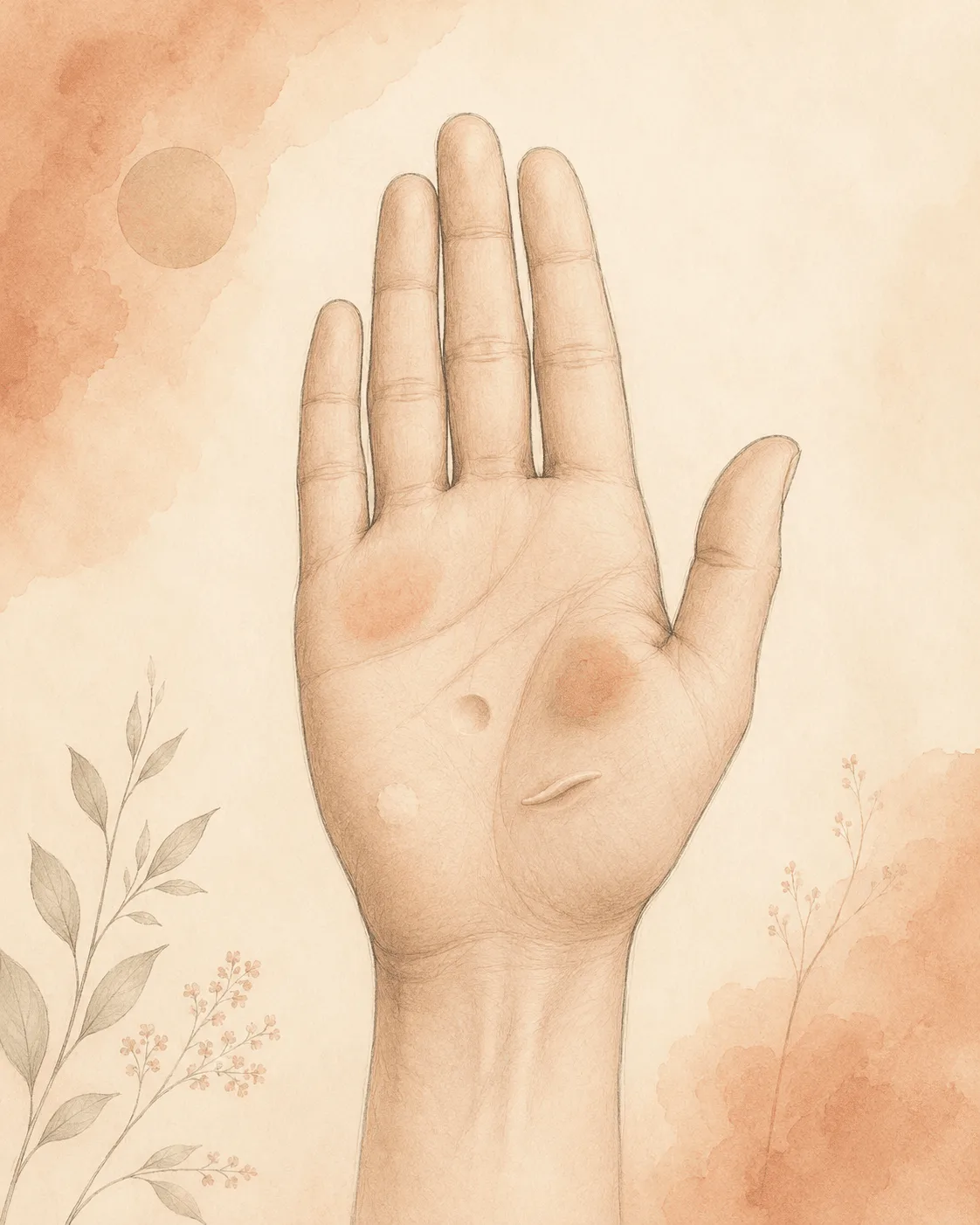
Post-inflammatory erythema (PIE). The pink or red flat mark. It's vascular, meaning dilated or damaged capillaries sitting close to the surface after inflammation. Not pigment, not a scar. More visible on lighter skin.
Post-inflammatory hyperpigmentation (PIH). The brown, gray, or tan flat mark. Melanin overproduced in response to injury. Also not a scar. Far more common, and far more persistent, on medium and deeper skin tones.
Atrophic scars. Indentations. The skin sits below the level of the surrounding surface because collagen was lost during repeated wounding. Sub-types get named by shape: boxcar (wide with defined edges), rolling (soft undulating dips), ice pick (narrow and deep). These are the most common true scars in people who pick, because picking reopens the same site before it finishes closing.
Hypertrophic and keloid scars. Raised, firm, sometimes itchy or tight. Too much collagen rather than too little. A hypertrophic scar stays within the boundary of the original wound. A keloid grows past it. More common on the chest, shoulders, jawline, and upper back, and more common in people with deeper skin tones.
Hypopigmented scars. Pale or white patches, often slightly shiny. These happen when picking goes deep enough to remove the pigment-producing cells from the upper layer of skin. They're the least discussed and the hardest to treat, and they're what deep, chronic picking at one site tends to produce eventually.
The first two fade. The last three don't.
The two-minute test
You don't need a dermatologist to sort this, and you don't need good lighting. You need a lamp and something made of glass.
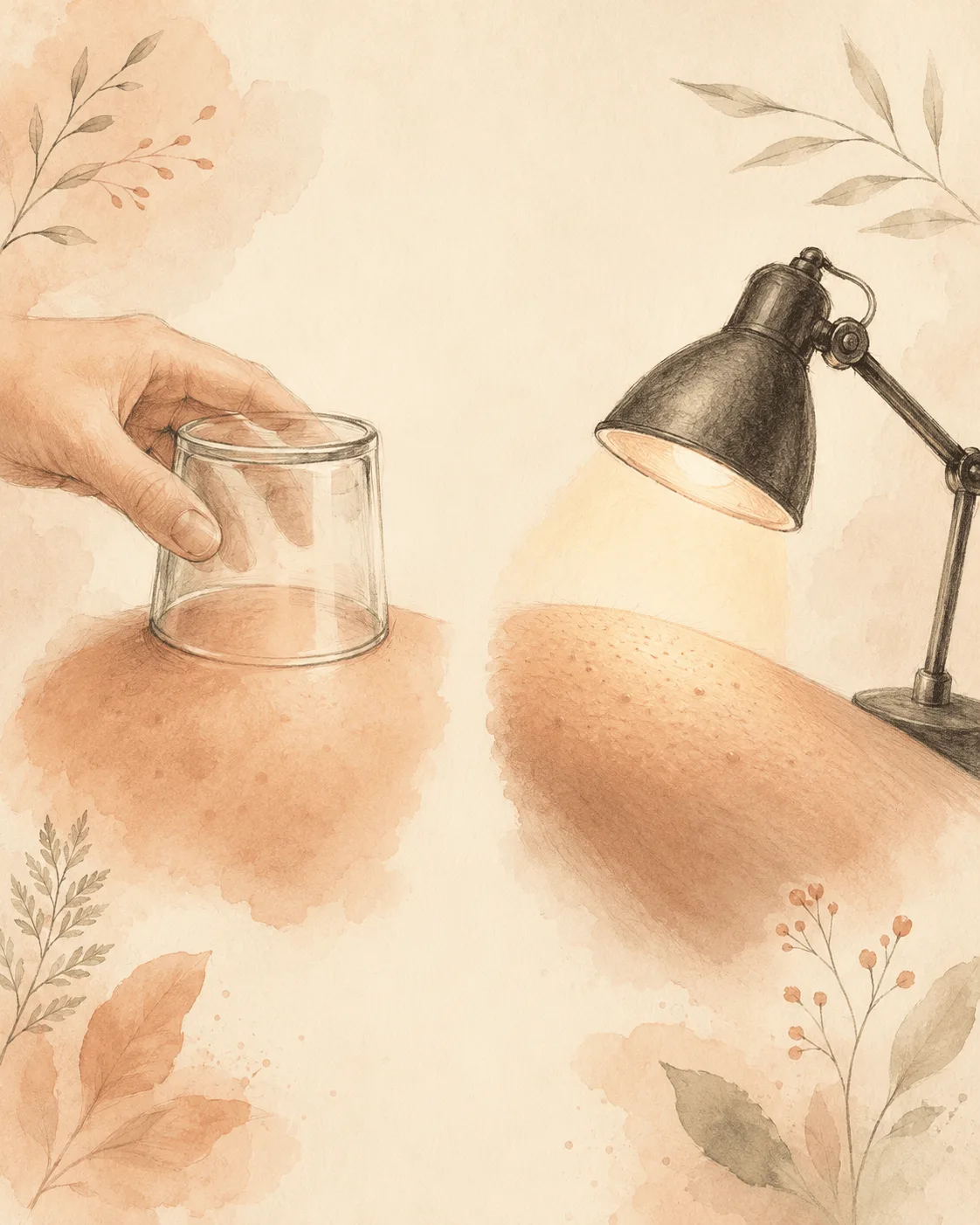
Test one: is it color or is it texture?
Turn off the overhead light and put a lamp low and off to one side, so the light rakes across your skin at a shallow angle rather than hitting it flat. Flat lighting hides texture, which is why bathroom mirrors are so misleading in both directions. Raking light exposes it. If a mark casts a small shadow, or catches the light differently from the skin beside it, there's a structural change there. If it vanishes and only the color remains, it's a flat mark.
Then close your eyes and run a fingertip slowly across it. Skin is better at detecting a change of a fraction of a millimeter than eyes are. If you can feel a dip, a ridge, or a change in firmness, that's texture.
Test two: if it's flat, is it red or brown?
Press a clear drinking glass gently against the mark and watch what happens to the color as you release. If it blanches to pale and then refills with pink, it's vascular: PIE. If the color sits there unchanged under pressure, it's pigment: PIH. Plenty of people have both in the same place, which reads as a muddy purple-brown.
How long each one actually takes
Red marks generally settle over three to six months. They can drag on longer if the area keeps getting re-inflamed, which for a picker it often does.
Brown marks are slower. Dermatologists working with picking wounds put the usual window at six to eighteen months, and deeper skin tones sit at the longer end of that. A brown mark that's been there four months and looks unchanged is behaving normally, not failing to heal.

True scars don't have a fade window. An atrophic scar at month three looks much like it will at year three. Some soften slightly as the surrounding skin remodels in the first year, and hypertrophic scars often flatten and pale somewhat over twelve to eighteen months. But the collagen loss underneath an indentation doesn't refill on its own.
What has real evidence at home
The home list is short, which is good news, because it means the useful version is cheap.
Broad-spectrum SPF 30 or higher, every day. This is the highest-return item in the whole category and the one people skip because it feels passive. UV drives melanin production, so sun exposure on an area that is already producing excess melanin makes brown marks darker and much slower to clear. It also keeps red marks lingering. If you do exactly one thing from this article, this is it, and it costs almost nothing.
A topical retinoid. The evidence here is genuinely good. Retinoids speed up cell turnover and interfere with pigment transfer, and they're the best-supported topical for post-inflammatory hyperpigmentation.
Start slow. Two or three nights a week, on skin with no open wounds, and expect an adjustment period of flaking. That flaking phase matters more for you than for other people, because dry flaking skin is a supply of new things to pick at. If it's making the picking worse, it's not the right tool for this month.
Azelaic acid. A good option if retinoids are too irritating, if you're pregnant, or if you have both marks and active spots. It inhibits the enzyme that produces melanin and it's anti-inflammatory, and it's available over the counter at 10% or on prescription at 15% to 20%.
Silicone, but only for raised scars. Silicone gel or sheeting is the standard first-line home option for hypertrophic and keloid scars. Worth knowing that the evidence for it is weaker than the marketing suggests. The Cochrane review found some benefit in preventing hypertrophic scarring in people prone to it, but flagged the underlying studies as highly susceptible to bias, and rated the evidence for treating existing scars as low to very low certainty. It's cheap and harmless, but it asks for twelve or more hours a day over several weeks before anything changes. And it does nothing at all for flat marks or indentations.
Hydrocolloid patches, during the wound phase. Not a scar treatment, and worth naming for what it is: the intervention that stops scars from forming in the first place. A wound kept moist and covered heals faster and with less scarring than one that hardens into a scab, and a scab is exactly what your fingers will go looking for in four days. Buy plain hydrocolloid dressings from a pharmacy. The branded acne-patch versions are largely packaging, and dermatologists writing on this are blunt about it: a box should not cost more than a few dollars.
What doesn't work, and what makes it worse
Vitamin E oil. The most persistent piece of scar folklore, and it does not hold up. A 1999 controlled study by Baumann and Spencer, still the most-cited work on this, found topical vitamin E gave no cosmetic improvement over plain moisturizer, and in most participants it either did nothing or made the scar's appearance worse. Around a third developed contact dermatitis from it. The American Academy of Dermatology advises against using it for scars. If you like the routine of massaging something in each night, use an ordinary moisturizer and you'll get the same result without the rash risk.
Scrubs, and exfoliating "until it's gone." Physical scrubs and aggressive acid use on a pigmented mark cause inflammation, and inflammation is the mechanism that made the pigment in the first place. This is the most common self-inflicted setback in the whole category. It feels like progress and runs backwards.
Lemon juice and other kitchen brighteners. Highly acidic, unpredictable in strength, and phototoxic. Lemon juice on skin followed by sunlight can produce a burn that leaves worse pigmentation than what you started with.
Waiting, if what you have is texture. Patience is the correct treatment for a flat mark and the wrong treatment for an indented one. Years of waiting for an atrophic scar to fill in is time that could have gone into the treatments that actually address it.
Any cream sold as reaching an indented scar. Nothing applied to the surface rebuilds lost collagen at depth. If a product's before-and-after shows a pit filling in, the change you're seeing is lighting.
Dermatologist options, and what they cost
| What you have | What's usually offered | Rough cost |
|---|---|---|
| Red marks (PIE) that won't settle | Pulsed dye or vascular laser | Often a few hundred per session, 1–3 sessions |
| Brown marks (PIH) that won't shift | Prescription topicals (hydroquinone 2–4%, or combination creams), chemical peels, pigment-targeting lasers | Topicals are cheap; peels and laser run into the hundreds per session |
| Indented (atrophic) scars | Microneedling, subcision, fractional laser resurfacing, dermal filler | Microneedling roughly $200–700 a session and usually 3–6 sessions; fractional laser roughly $800–3,000 a session depending on device |
| Raised (hypertrophic/keloid) scars | Intralesional steroid injections every 2–6 weeks, silicone, pressure dressings, cryotherapy | Injections are among the cheaper options and are sometimes covered when symptomatic |
| Pale (hypopigmented) scars | Microneedling with pigment stimulators, phototherapy, and in specialist centers melanocyte transfer | Variable, and generally the hardest and least predictable to treat |
A few things worth knowing before you spend anything:
Prescription hydroquinone works, and it isn't a forever product. Long-term uninterrupted use carries a risk of ochronosis, a paradoxical darkening that's difficult to reverse. It's prescribed in cycles for that reason, which is one of several arguments for getting it from a dermatologist rather than an unregulated online seller.
Microneedling and laser both need a course, not one appointment. Three to six sessions spaced four to six weeks apart is the usual shape for atrophic scarring, so budget for the course, not the taster price.
And no procedure returns skin to its original state. Realistic expectation for atrophic scarring is meaningful improvement in how much it catches the light, not erasure.
The part the skincare articles leave out
Everything above assumes the damage has stopped arriving. That assumption is doing a lot of work.
While picking is still active, scar treatment runs into two problems. The first is straightforward: new wounds keep appearing, so the total picture doesn't improve no matter how well any individual mark responds. Money spent on resurfacing a cheek that will be picked again next month buys very little.

The second problem is specific to picking, and no dermatology page says it out loud. Procedures make picking targets. Microneedling leaves pinpoint crusting. Fractional laser leaves several days of visible flaking and small dark specks as the treated tissue sheds. Chemical peels leave sheets of peeling skin. For most patients that's an inconvenience. For someone with dermatillomania it is an engineered relapse: a fresh field of texture, on the face, that you have a medical reason to be inspecting closely in the mirror twice a day. People lose long stretches of progress in the week after a procedure.
Which puts the sequence in an order most people don't want to hear. The picking settles first, then the skin. It isn't a moral point about earning your treatment. It's that the treatments only work on settled tissue, and the recovery period from each of them is a high-risk window.
If the picking is the part that hasn't shifted, that is where the real gain is. Habit reversal training is the best-supported behavioral approach for body-focused repetitive behaviors, and it works on the mechanics: noticing the urge earlier, and having something specific to do with your hands when it arrives. The practical version of that is more concrete than most people expect, and for facial picking specifically, the trigger stack around mirrors and concealer is worth handling separately.
What to tell your dermatologist
A lot of people book a scar consultation and describe the marks without mentioning the picking. Understandable, and it costs you a better plan.
Say it plainly: "These are from skin picking, and I'm still picking sometimes." It changes what a good clinician recommends. They'll sequence procedures differently, they'll think harder about anything that makes skin more fragile or more flaky, they may suggest occlusive dressings that serve double duty as a barrier, and they can refer you on the behavioral side rather than treating the same skin every eight months. If a dermatologist responds to that sentence badly, that's information about the dermatologist.
Frequently asked questions
Flat marks usually do. Red marks tend to clear in three to six months, brown marks in roughly six to eighteen. True scarring, meaning any change in texture, doesn't disappear on its own and won't fully disappear with treatment either, though it can be improved substantially. The single biggest factor in the final result is when the picking stops.
Because flat lighting hides texture and angled lighting reveals it. Bathroom mirrors with overhead lighting exaggerate every dip and shadow, which is one reason a picking session so often starts there. What you see in raking light is real, but it isn't what other people see in ordinary light.
No. Existing scarring is what it is, but flat marks laid down last month will still fade on the same schedule as anyone else's, and treatment for texture works the same whether the scar is one year old or ten. Long-standing scars don't respond worse than recent ones.
Both, in that order of importance. Procedures on skin that's still being picked deliver limited and temporary results, and the recovery period from each one is a relapse risk. If you can only do one thing this year, do the behavioral one.
Existing treated scars don't reappear, but the same skin can be re-damaged, and repeated wounding at one site is exactly how the deepest scarring forms. This is also why dermatologists want the behavior addressed before investing in resurfacing.
Some things, but it's the hardest category. Pigment cells in the upper layer have been removed rather than over-stimulated, so brightening and fading products are irrelevant, and pigment-stimulating approaches are needed instead. Microneedling combined with prescription topicals, phototherapy, and in specialist centers surgical melanocyte transfer are the options. Expect a longer road and set expectations with a dermatologist early.
For wound healing, no. The active ingredient is the hydrocolloid itself, which keeps the wound moist, keeps it clean, and puts a physical barrier between the spot and your fingernail. Plain dressings from a pharmacy do the same job for a fraction of the price of the branded versions.
Where to go from here
If you take one thing from this: find out which of the five things you actually have before you buy anything. Two minutes with a lamp and a glass will tell you whether you're looking at something that resolves on its own, or something that needs a dermatologist and a real budget. Most people are looking at more of the first than they think.
Then the boring part, which is also the part that works. Sunscreen daily. A retinoid or azelaic acid at night on closed skin. A monthly photo so you can see change you can't perceive day to day. And, if the picking is still going, attention on that first, because it's the variable that determines what any of the rest of it is worth.