

Written using clinical wound-care guidance and dermatology sources, including trials published in the Journal of Cosmetic Science (Chao et al., 2006) and the Journal of the American Academy of Dermatology (2024). Product prices checked July 2026.
A hydrocolloid patch is doing two separate jobs at the same time, and almost every article about them only explains one.
Job one is medical. The patch is a wound dressing. It holds moisture against the spot so the skin closes without hardening into a scab, and it keeps bacteria out while that happens. Job two is behavioral. It puts a physical layer between your fingernail and the thing your fingernail wants, and it does that during the exact hours you're least able to argue yourself out of picking.
For most people with acne, job one is the point and job two is a bonus. If you pick, that's backwards. Job two is the point. Which changes what you should buy, how long you leave it on, and how you handle the part nobody writes about, which is what to do when you start picking at the patch.
What to buy: plain, non-medicated hydrocolloid. Thin if you want it invisible under makeup, thick if the spot is open and weeping. Skip the medicated versions for picked spots. Put it on clean dry skin, leave it until it goes cloudy white and starts lifting on its own, and don't take it off early to check.
Does this even suit the way you pick?
This is the question that decides everything else, and it's the one no patch article asks.
A patch needs a target. A discrete spot with edges, somewhere you can cover with a circle of adhesive. If your picking is organized around specific lesions, a pimple you popped, a scab on your jaw, one spot on your chest you keep going back to, patches are close to the highest-yield thing you can buy for under ten dollars.
If your picking isn't organized that way, they mostly won't help, and it's worth knowing that before you spend the money.
Patches work well for:
- One or a few identifiable spots you return to
- Popped or picked lesions that are open
- Face, chest, shoulders, upper back, anywhere flat and dry enough for adhesive
- Night picking and evening mirror sessions, where a physical barrier outperforms awareness
Patches do very little for:
- Texture-scanning, where your fingers roam looking for anything raised. There's no single target to cover, and covering one spot just redirects the scan.
- Cuticles, nail beds and fingertips. Adhesive fails on skin that bends and gets wet, and you use those fingers all day.
- Scalp picking, for the obvious reason.
- Blackheads and whiteheads, which hydrocolloid can't treat.
- Deep cystic acne. There's no fluid at the surface for the patch to draw on.
- Preventing new spots. A patch does nothing for the skin around it.
If you read that list and recognized yourself in the second half, the money is better spent elsewhere. Texture-scanning responds to different tools, and matching a substitute to the sensation you're actually chasing is its own piece of work.
Thin, thick, medicated, microdart
Four things get sold as pimple patches and they are not interchangeable. Dermatologist Kord Honda, writing for University Hospitals, splits the market into non-medicated hydrocolloid, medicated, and microneedling patches, and the distinction matters more for pickers than for people treating acne.

| Type | What's on it | Best for | Skip it when |
|---|---|---|---|
| Thin hydrocolloid | Hydrocolloid only, translucent, roughly 12mm | Daytime wear, closed or lightly open spots, makeup over the top | The spot is producing real fluid, it'll saturate in hours |
| Thick hydrocolloid | Same material, more of it | Open picked wounds, overnight, anything weeping | You need it invisible |
| Medicated | Salicylic acid, benzoyl peroxide, tea tree oil, niacinamide | Early inflamed spots that haven't come to a head, if you're also treating acne | The skin is broken. Actives on an open wound sting, dry the wound bed, and irritate |
| Microdart | Dissolving needles carrying actives | Intact skin after a wound has closed, pigment and residual bumps | The spot is open |
For a picked spot, plain hydrocolloid wins on every axis that matters. Honda's assessment of medicated patches is that salicylic acid "is best for preventing acne, rather than treating individual pimples," and prevention is not what you're doing when there's an open wound on your chin. Actives also add the main thing you don't want on damaged skin, which is a reason for it to sting, redden, or flake, all of which give your fingers something new to investigate.
What the evidence actually shows
The research on hydrocolloid for acne is thin but real, and it points in a consistent direction.
A more recent trial presented in the Journal of the American Academy of Dermatology in 2024 is more relevant to picking, because it looked specifically at popped pimples. Forty-one participants completed a 14-day randomized study; patched popped lesions scored significantly better on general wound appearance at day 1 and day 4, with improvements in crusting and scabbing, redness, size and elevation. The study was sponsored by a patch manufacturer, which is worth knowing when you read the result, though "an open lesion heals better covered than uncovered" is also the least surprising finding in wound care.
What no trial has tested is the thing you actually want to know, which is whether covering a spot reduces how often you pick it over months. That evidence doesn't exist. What exists is decades of clinical practice using barriers as stimulus control, and the consistent observation from clinicians who treat pickers that patches give what Lim calls "haptic feedback if you re-pick these spots." Your hand arrives, hits smooth plastic instead of a scab, and there's a half-second gap where you notice what you're doing. That gap is the whole mechanism.
How to wear them
Most instructions are written for acne, and one of them is actively wrong for pickers.
1. Clean and dry the skin first. Adhesive fails on anything oily. If you've just used a serum or moisturiser, wait until it's absorbed. This is the step most people skip and then blame the patch for sliding off.
2. Put it on before the risk window, not after the damage. For most people that's evening. Patching at 11pm after an hour at the mirror is wound care. Patching at 8pm is prevention. Both are worth doing, but only one of them changes the night.
3. Cover the whole spot with room to spare. The adhesive needs to seal onto intact skin all the way round. A patch that only just covers the wound will lift at the edge, and a lifted edge is a catchable edge.
4. Leave it. This is where the acne advice and the picking advice split. Honda's guidance for acne is that "the patch should be replaced daily." For a picker, a scheduled daily change is a scheduled daily inspection, and inspecting is the behavior you're trying to unlearn. The clinical wound-care standard is more forgiving: hydrocolloid dressings are routinely left in place for three to five days, and removal is usually pain free. Let the patch tell you when it's done. It goes cloudy white as it absorbs, and when that white area spreads near the edge, it's saturated and needs changing.
5. Peel slowly from the edge, don't flick it off. Fast removal takes the new surface with it, and stripping a healing wound is functionally a picking episode with better branding.
6. Change it, then re-cover immediately. Don't leave a gap where the spot is exposed and you're standing at a mirror holding a used patch. Have the fresh one out of its backing before you remove the old one.
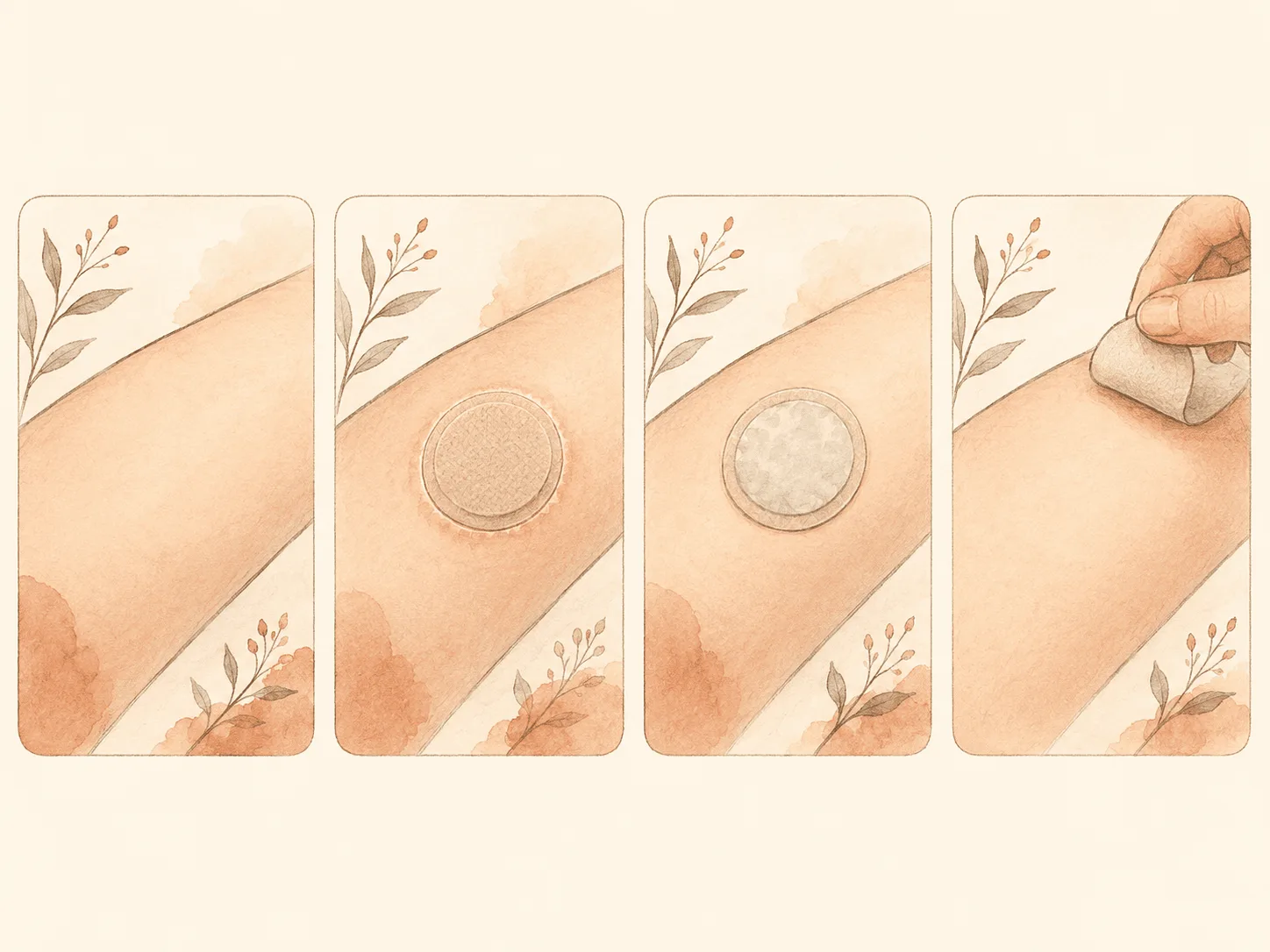
What they cost
Branded acne patches are priced as cosmetics. Plain hydrocolloid is priced as a medical supply. The material doing the work is the same.
Hero's Mighty Patch Original is $12.99 for 36 patches on the brand's own site, which is about 36 cents per patch. At Target, a 24-count box runs $8.99, or roughly 37 cents. That's not outrageous for occasional acne. If you're covering three spots a night through a flare, it's about a dollar a day for adhesive.
Lim's advice to his own patients is blunt about the markup: "You do not need to buy Hero Patches or Zit Sticka, as these are more about marketing, & packaging over medical therapy," and his ceiling for a box of pharmacy hydrocolloid acne patches is five to seven dollars.
A large hydrocolloid wound dressing cut down at home is the cheapest route by a wide margin. One 4x4 inch dressing yields a lot of 12mm rounds, and the price per covered spot stops being a consideration in how often you patch.
That last part matters more than the money. If patches feel expensive, you ration them, and rationing means choosing which spot deserves covering, which means standing at the mirror evaluating your face. The cheap option is the one you'll actually use freely.
When you start picking the patch
This is the most common way patches fail, and it isn't a personal failing. It's predictable from the design of the thing.
A patch has a raised edge on smooth skin. If what your fingers hunt for is an edge to get a nail under, you've just installed one. And peeling something off skin in one piece delivers almost exactly the sensory payoff of removing a scab: resistance, then release, then something in your hand. For a subset of pickers the patch doesn't reduce the behavior, it relocates it.
Relocation isn't nothing. Peeling a patch damages no skin, and if the trade is "picked the sticker instead of the spot," that's a real improvement worth keeping. Plenty of people run it that way on purpose and keep a spare patch on the back of a hand as a decoy.
If you'd rather stop it, the fixes are mechanical:
- Press the edges down hard when you apply it, for a full ten seconds. Most peeling starts at an edge that never sealed.
- Use a bigger patch than the spot needs. More adhesive contact means a harder edge to lift, and the extra margin sits on skin that isn't sore.
- Cover the patch. Thin surgical tape or a fabric plaster over the top removes the edge entirely.
- Put it where your hands don't idle. If your fingers rest on your jaw while you read, a jaw patch will get worried at. The same spot patched at bedtime in a dark room lasts fine.
- Give the hand a real alternative during the hours the peeling happens. If the reward is the peel specifically, a stress ball won't cover it; things designed to be peeled and reset will.
- Log it as an episode. Not to feel bad about, as data. If the patch comes off in the same 40-minute window every evening, that window is the thing to plan around, not the patch.
When not to use one
- Infected wounds. Redness spreading outward, warmth, pus, red streaks, or a fever means see someone, not seal it under an occlusive dressing. Hydrocolloids are specifically cautioned against on infected wounds.
- Deep or gouged wounds. A 12mm sticker is not a dressing for a wound with depth. Pharmacy staff can point you at the right thing.
- If the adhesive irritates you. Honda names the adhesive as the most likely irritant, ahead of any active ingredient, and some patches contain latex or other polymers that can trigger reactions. Redness that follows the exact shape of the patch is the tell. Stop, and try a different brand or a silicone-adhesive dressing.
- On broken skin, if it's a medicated patch. Covered above, and worth repeating because most of what's stocked at eye level in a pharmacy is medicated.
Where patches sit in the bigger picture
Patches are stimulus control. They change the environment so the behavior is harder to perform. That's a genuine, evidence-backed component of habit reversal training, and it's also the component that stops working when it's the only thing you're doing.
Barriers fade. Worn constantly, a patch stops registering within a week or two and your hand routes around it. Worn during your two worst hours, it keeps its effect for much longer. Same object, different result, and the difference is whether it's still a signal or has become wallpaper.
The other reason not to treat patches as the whole plan: they only cover the spots that already exist. Awareness training, competing responses and knowing your own triggers are what reduce the number of new ones. A patch is the thing you use while that work is happening.
One thing patches do give you that's easy to miss: a clean measurement. A spot that gets covered and left alone closes on a timeline. A spot that gets re-picked doesn't. Naming a specific spot, noting the day you first covered it, and marking the day it healed turns a vague sense of "my skin is bad" into a number that moves. That's the same logic behind self-monitoring in habit reversal, and it's the most transferable habit in this article. It also changes what you're left with afterwards, since how a spot scars depends mostly on how many times it gets reopened.
Track a spot from first patch to healed
SkinAware lets you name a specific spot, log every time you pick it or resist it, and mark the day it finally heals. Watching one spot close is more convincing than any before-and-after photo.
Available on iOS, Android and in your browser.
Frequently asked questions
Until it's saturated, which shows as a cloudy white area spreading toward the edge, or until it starts lifting on its own. That's usually 8 to 12 hours for an actively weeping spot and considerably longer for a quiet one. Clinical hydrocolloid dressings are commonly left in place for three to five days. Resist changing it on a schedule just to look at the spot.
Yes. Thin patches are close to invisible and hold foundation reasonably well. Apply the patch first, then makeup over the top, not the other way round.
No. The hydrocolloid is the active component and it's the same material across price points. Branded boxes work out around 36 cents a patch. Pharmacy hydrocolloid acne patches cost a fraction of that, and cutting down a large wound dressing is cheaper still.
Less well. Hydrocolloid draws fluid, so it does most of its work on a lesion that's come to a head or been opened. On closed skin it still functions as a barrier, which for a picker may be the whole reason you put it on. It won't do anything for blackheads, whiteheads, or deep cystic spots.
No, and this is common. A patch edge is a catchable edge and peeling is an extraction, so for some people the behavior relocates rather than stops. Press the edges down firmly, size up, cover it with tape if you need to, and consider that picking a sticker instead of your skin is a trade worth taking in the meantime.
Not on the same spot at the same time. Actives under an occlusive patch penetrate harder than intended and irritate broken skin. Treat the rest of your face as usual and leave the patched spot alone.
It reduces the main driver of it, which is repeat damage to the same spot plus a hard scab that invites removal. A wound that closes cleanly the first time scars less than one that's reopened four times. It isn't a scar treatment, and once a mark has formed the tools are different.