
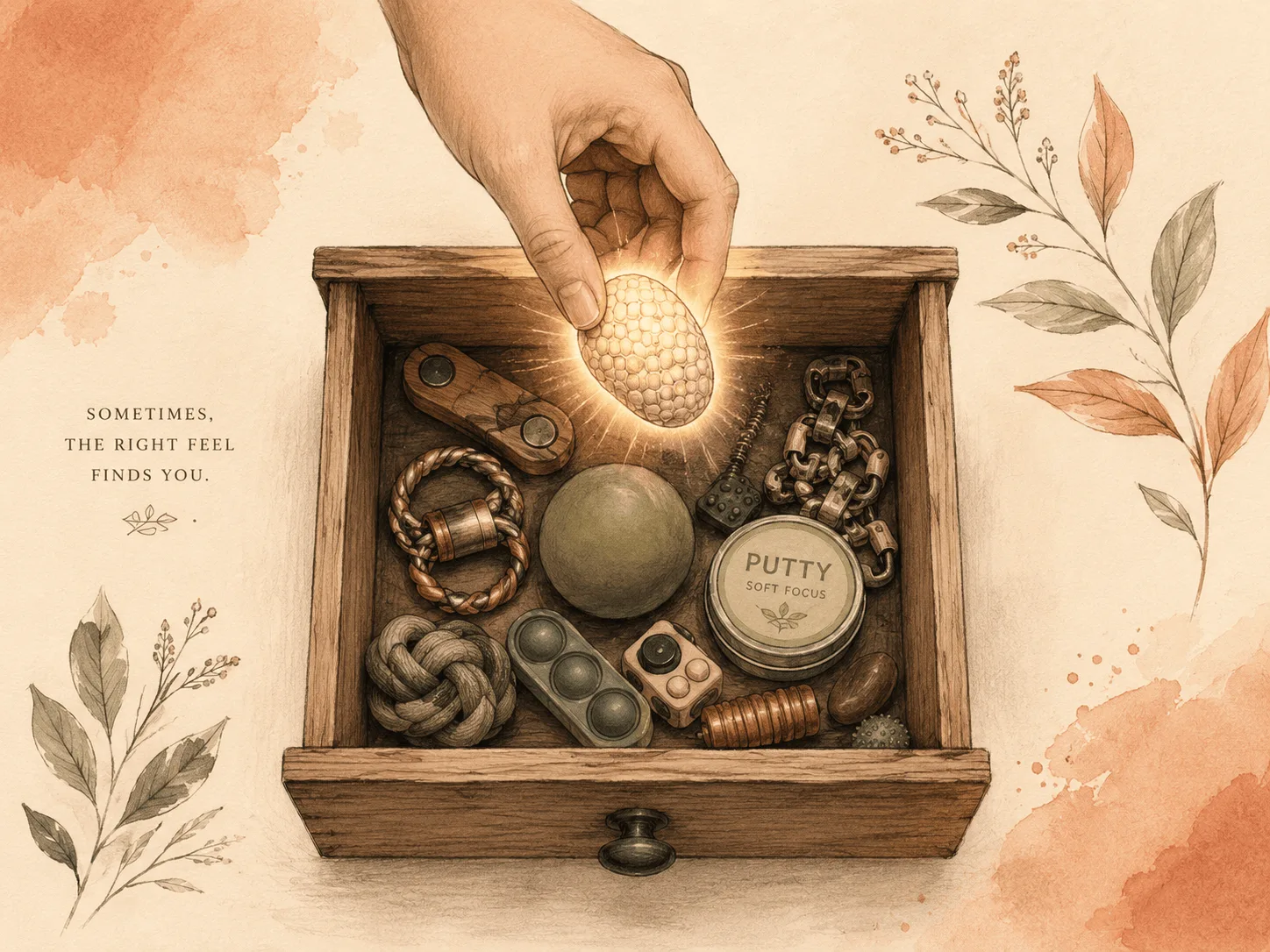
Most people reading this already own fidgets. A spinner ring, a stress ball, one of those cubes with the clicky buttons. They lasted about four days each and they're in a drawer now.
The reason is nearly always the same, and it isn't willpower. Picking, pulling and biting each deliver one very specific physical sensation, and a fidget substitutes for the behavior only if it reproduces that sensation. A smooth stress ball gives your fingers pressure. If what your fingers are hunting for is a raised edge to catch a nail under, pressure isn't a substitute. It's a different sensation entirely, and your hand goes back to your face inside a minute.
So the useful question isn't which fidget is best, it's which sensation yours has to copy. The short version, before the reasoning:
Picking at edges, scabs, cuticles, rough patches: findable texture, not squish. A Tangle Jr. Textured ($9 at tanglecreations.com) or a spiky sensory ring.
The extraction, the pop, the thing that comes away: something that yields and detaches. Picking pads and pick-and-peel stones are the only category built for this.
Hair pulling: bristles or fibers anchored in a base, so there's resistance and then release. A silicone bristle brush or a tickle ball with rubbery strands. Squeezing things does nothing for pulling.
Nail, cheek or lip biting: firm jaw resistance, which means a chew pendant rated for strong chewers, not a soft one.
Hands that mostly roam: firm putty. Crazy Aaron's Thinking Putty is $15 for a 4" tin and $4 for a mini, and the mini is the better buy because you'll want four of them in four places.
The 60-second sensory audit
Think about the last episode you remember clearly, and answer one question: at the exact moment it felt good, what was happening? Not what triggered it, not how you felt afterwards. The moment itself.
Answers people give, roughly in order of how common they are:
- My nail found an edge and got under it.
- Something came away. A scab, a hair with a root on it, a strip of skin.
- I was scanning. My fingers were moving over a surface looking for the next spot.
- There was resistance and then it gave, with a small snap.
- I was pressing down hard with my teeth and it felt good to press.
- The sound. A click, a small tear, a pop.
- I was looking at it as much as feeling it.
Most people land on two of these, one dominant. That pair is your signature, and it's the only thing that should decide what you buy. A list organized by product type asks you to guess. A list organized by sensation lets you match.
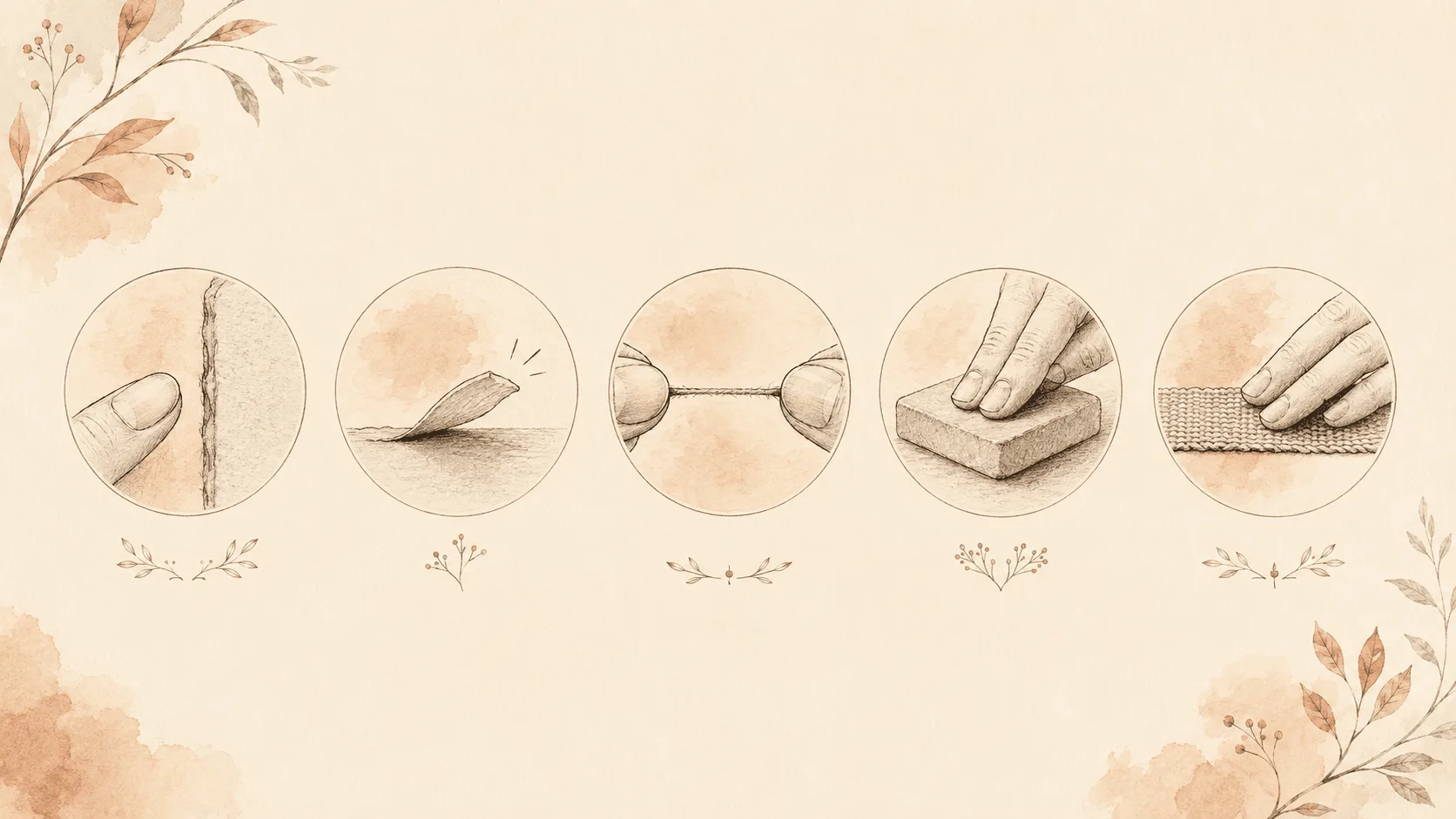
The clinical literature is more specific about this than most fidget roundups are. In the Comprehensive Behavioral model of BFRB treatment, the sensory domain gets assessed on its own terms, and the rewards it lists are physical.
A competing response that ignores which of those applies to you is being asked to do a job it wasn't shaped for. There's more on how competing responses get built properly in our guide to habit reversal training.
Match the signature to the fidget
| Your signature | What the fidget has to do | Options that actually do it | Rough cost |
|---|---|---|---|
| Catchable edge (scabs, cuticles, rough patches) | Present a raised lip a fingernail can get under, repeatedly | Tangle Jr. Textured ($9), spiky sensory rings, textured adhesive strips, a rough stone rather than a polished one | Under $10 |
| Extraction (the pop, the removal, something coming away) | Yield and detach, then reset | Picking pads and picking palettes, pick-and-peel stones, edamame-pod keychains | $10–$30 |
| Traction and release (hair pulling) | Resist a tug, then give, with fibers you can grip | Silicone bristle brushes, tickle balls with rubbery strands, Tangle Jr. Fuzzies ($7), elastic loop fidgets | $7–$20 |
| Jaw pressure (nail, cheek and lip biting) | Take a hard bite without deforming | Chew pendants rated for strong chewers (Chewigem's sensory chews are £17.95) | £15–£25 |
| Roaming and scanning | Occupy the whole hand with something that keeps changing shape | Firm putty (Crazy Aaron's, $15 full tin / $4 mini), Tangle Therapy ($18), therapy putty at a firm resistance grade | $4–$18 |
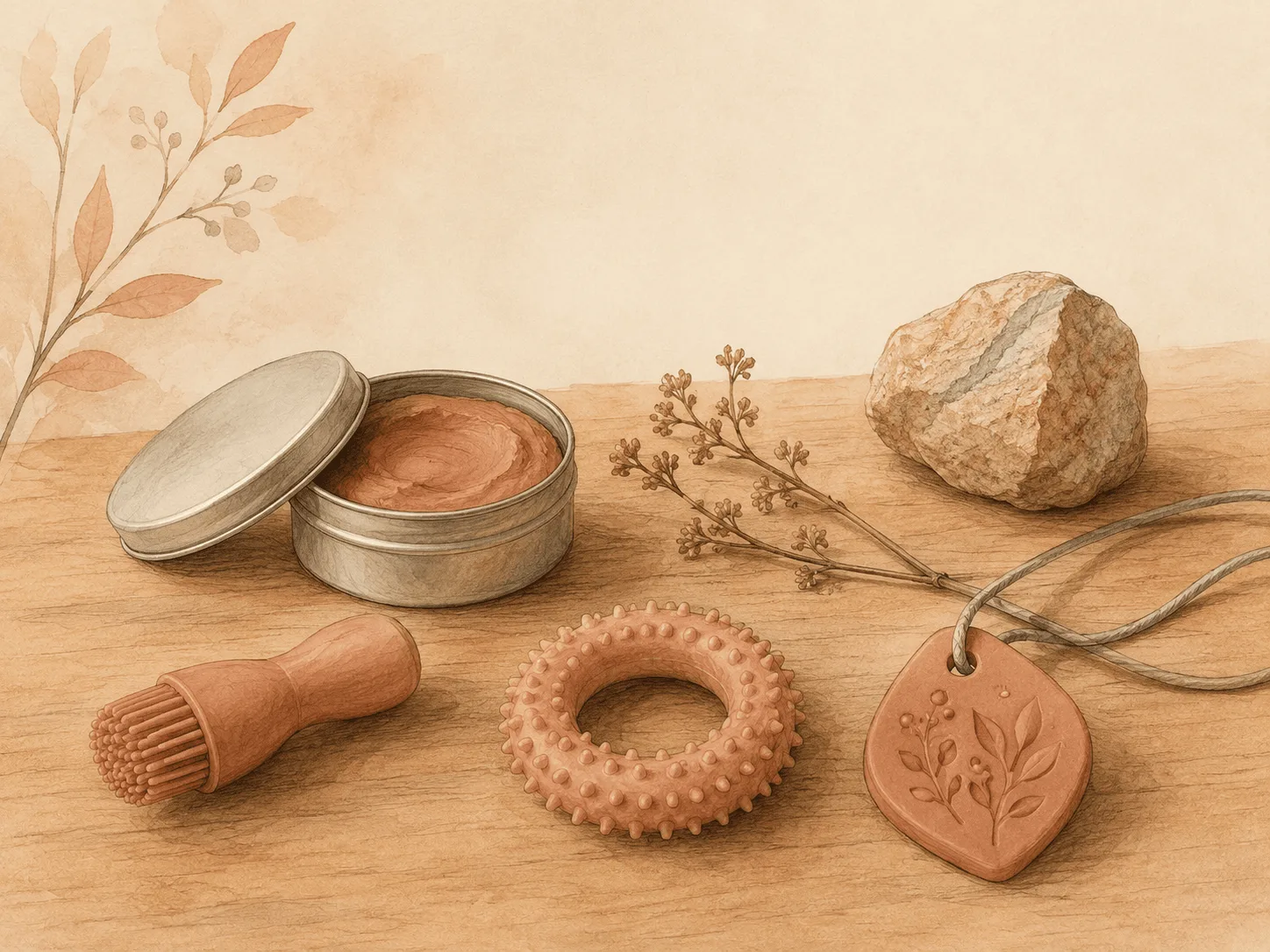
If you're chasing an edge
This is the most common picking signature and the worst served by generic fidgets, because almost everything sold as a stress reliever is smooth or squishy. Both are the wrong shape for a fingernail.
What works is texture with structure: bumps that stay put when you press them, ridges with a defined lip, a surface with enough variation that your thumb can find the same interesting spot again. The Tangle Jr. Textured ($9) is the cheapest thing that reliably does this, and it's silent and pocket-sized, so it works on a call or in a lecture. Spiky sensory rings do the same job on a finger and cost a few dollars for a set of five, which is the right way to buy them, because a single one lives permanently in whichever room you're not in.
Textured adhesive strips (Calm Strips are the best known) solve a different half of the problem. They stick to a laptop lid, a phone case, a desk edge, a bedside table. You can't lose them and you don't have to remember them, which for automatic picking matters more than how satisfying the texture is.
What this category does badly: none of it helps with focused picking in front of a mirror. When the picking is deliberate and visual, a pocket object isn't competing with anything.
If you're chasing the extraction
If the good part is the moment something comes away, texture alone will never do it, and this is where most people conclude fidgets don't work for them.
Picking pads (also sold as pick pads, picking palettes or pick plates) are the only mainstream product designed for this. They're a board covered in a peelable layer, often arranged as a pattern you rebuild afterwards. You pick it apart, it comes away, you reset it. Pick-and-peel stones do a smaller, more portable version of the same thing.
The Mighty's writer described an edamame keychain as producing "a cathartic feeling similar to releasing pus or hair from under your skin," which is an uncomfortable sentence and also the most accurate product description in this category. If that line landed, that's your signature, and a stress ball was never going to touch it.
The catch is time. Rebuilding a picking pad takes real minutes, so they live on a desk rather than in a pocket, and they suit evening picking windows better than a sudden urge in a meeting. They're also the category where cheap marketplace versions are noticeably worse: the peel layer either won't come away or won't stick back down.
If you pull hair
Hair pulling has a sensory profile that squeeze toys miss completely. There's the search for a particular hair, the tension as it resists, the release, and for many people something at the end: a root to feel between the fingers, a hair to run across the lip.
The fidgets that map onto that have fibers or bristles anchored in a base. Silicone bristle brushes let you twist and tug the bristles, and they're soft enough that scalp pullers often use them on the scalp itself as a substitute for the hand. Tickle balls covered in rubbery strands give you something to grip that pulls back. Tangle Jr. Fuzzies ($7) is a cheap way to test whether texture-plus-fiber does anything for you before spending more.
Two things worth doing alongside, both free: keep a hair tie on your wrist to pick at, and use a scalp massager during the high-risk window rather than after it starts. Setting the substitute up before the trigger matters more than which object you chose. Our guide on how to stop pulling hair covers the awareness half of this.
What none of them replicate is the root. If the root is the reward for you, no fidget on the market copies it, and this is a case where the behavioral work has to carry more of the weight.
If you bite
Nail biting, cheek biting and lip biting sit in the same family, and the sensation is pressure. Teeth against something that pushes back.
The category is chew jewellery, sold as chewelry or sensory chews: silicone pendants, bracelets and zipper pulls in different firmness grades. Chewigem's sensory chews run £17.95 on their own site and comparable brands sit in the same band. The grade matters more than the design. Most people who bite their nails need a strong or extra-strong chew, and a soft one gets destroyed in a fortnight and teaches you that chews don't work. Cheek and lip biters often do better with something small held between the teeth than a pendant on a cord.
The other half of biting is the finger, not the mouth. Textured fingertip covers and adhesive bandages on the two fingers you bite most are stimulus control rather than substitution, and they pair well with a chew. Our nail biting guide goes into the competing responses in more detail.
Why the last three didn't work
Assuming the sensation was matched, four things account for nearly every abandoned fidget.
You bought one. A single fidget at home is close to useless, because urges don't wait until you're near your nightstand. Cheap items bought in fives and scattered across bag, desk, car and bedside beat one expensive item every time. We've written about the placement problem in our skin picking tips.
It was too soft. Soft objects don't hold attention long enough for an urge to pass. Firm resistance asks for real force, which is what stops the picking loop running quietly underneath.
It was in the wrong hand. Almost everyone picks or pulls mainly with one hand and has never noticed which. Handing the fidget to your spare hand leaves the working hand free to carry on.
It was a focused episode, not an automatic one. This is the big one.
What a fidget can't do
A fidget is a prop for a competing response. It isn't a treatment, and anyone selling it as one is overselling it.
The competing response is the actual mechanism, and it comes from habit reversal training: when the urge arrives, you do something physically incompatible with the behavior, and you keep doing it for a minute or so until the urge drops. The object in your hand makes that minute easier to get through. It does not, on its own, change what your nervous system is asking for.
Therapist Stacy Nakell describes fidgets as "transitional objects, providing another way to soothe the central nervous system as clients begin to find the words for their feelings." That's a fair ceiling to set. HabitAware use the phrase "training wheels," which is the same idea in fewer syllables.
In practice that means three things. A fidget bought without awareness training tends to fade within a fortnight, because you're not catching the urge early enough to use it. A fidget can't address hunger, exhaustion or a bad afternoon, and a lot of urges are one of those wearing a costume. And if picking or pulling is causing real damage or real distress, a matched fidget is a good week-one move and a poor year-one plan.
None of that makes fidgets a waste of money. Matched properly, they buy you the minute you need, and a minute is often the whole difference.
Where tracking fits
The audit at the top of this article is a one-off guess. Repeating it is how you find out whether you guessed right. Log the moment rather than the day (what your hands were chasing, what you reached for, whether it held) and within two weeks you'll know which fidget is earning its place and which is decoration. A notes app does this.
So does ours, and full disclosure: SkinAware publishes this site. It's a BFRB app for picking, pulling and nail biting, with fast episode logging, the option to log an urge you resisted, a four-module habit reversal course and a community. The logging is free; the course sits behind Premium at $5.99/month or $34.99/year, with a two-week trial on iOS.
Get support for picking, pulling and biting
SkinAware helps you log episodes, identify patterns, and see real progress over time.
Available on iOS, Android and in your browser.
FAQ
Frequently Asked Questions
For automatic picking, often yes, if the texture matches what your fingers are looking for. For focused picking, where you're at a mirror and fully absorbed, they're much weaker, and stimulus control (covering the mirror, moving your skincare out of the bathroom, hydrocolloid patches) does more. Fidgets work as part of habit reversal, not instead of it.
Something with fibers or bristles you can grip and tug: a silicone bristle brush, a tickle ball with rubbery strands, a fuzzy Tangle. Squeeze toys and spinner rings are popular recommendations and they miss the pulling sensation almost entirely. If the root is your reward, no product replicates it, and the behavioral work matters more.
Not usually, with two exceptions. Chew jewellery is worth buying from a brand that publishes firmness grades, because a cheap soft chew fails fast. Picking pads are worth buying from a maker rather than a generic marketplace listing, because the peel layer is the whole product. Everything else works fine cheap, and buying five cheap ones beats one expensive one.
About a minute is the working figure used in competing response training. Long enough for the urge to peak and start dropping. If you put it down after ten seconds you'll conclude it didn't work, when what happened is you stopped before the urge did.
Yes, and this is underrated. A hair tie on the wrist, a rubber band, a bottle cap with a ridged edge, velcro, a rough stone from a walk, terry cloth, a twist tie. The audit matters more than the purchase. Test the sensation with something free, then buy the good version of whatever passed.
Same rule, one addition: the object has to be sitting where the behavior happens before the high-risk window starts, not fetched once a hand is already in the hair. A basket by the sofa beats a drawer upstairs.