
Reviewed for accuracy using peer-reviewed research including randomized controlled trials by Ghanizadeh et al. (2013), the head-to-head self-help trial by Moritz et al. (2022), and clinical reviews of onychophagia management.
Start With Why the Usual Advice Keeps Failing You
If you've bitten your nails since childhood, you have almost certainly tried the standard list. Cut them short. Paint on the bitter stuff. Get a manicure you won't want to ruin. Keep a stress ball on the desk.
Those tips are on every page that ranks for this question, and they share one assumption: that biting is a conscious choice you can out-stubborn or out-taste. For a lot of people who bite, that assumption is wrong, and the research quietly says so.
That is close to the opposite of what the top search results tell you to do first.
None of this means bitter polish is useless. It has a real job, and it shows up later in this guide. But it belongs at the end of your plan, as a backstop, not at the front as the plan itself.
What actually moves the needle is a behavioral method called habit reversal training, plus a lesser-known technique called decoupling that has trial data specifically favoring people whose repetitive behavior is something other than skin picking. Both are learnable at home. This guide walks you through them, attached to the exact points in a bite where each one can interrupt you.
What Nail Biting Actually Is
Chronic nail biting has a clinical name, onychophagia, and it sits in the same family as hair pulling and skin picking: body-focused repetitive behaviors, or BFRBs. The DSM-5-TR files it under "other specified obsessive-compulsive and related disorders."
It is not rare.
The TLC Foundation for BFRBs estimates 20% to 30% of the general population bites chronically, with published estimates ranging anywhere from 12% to 44% depending on how strictly the studies define it. One review found 21.5% among adults aged 18 to 35, so this is not something most people simply age out of.
The detail that matters most for your plan is this one: most biting is automatic. You are not deciding to bite. Your hand is already at your mouth by the time you notice, often while you're reading, driving, scrolling, or sitting through a meeting. A psychologist at NewYork-Presbyterian described the behavior as acting like a natural pacifier, which is a fair description of why willpower is such a poor tool against it. You cannot resist a decision you never consciously made.
The Bite Chain
A bite is not a single event. It's a short sequence, and each stage of that sequence is a different opportunity to interrupt yourself. Once you can see the sequence in your own hands, the techniques below stop feeling like random tips and start slotting into place.
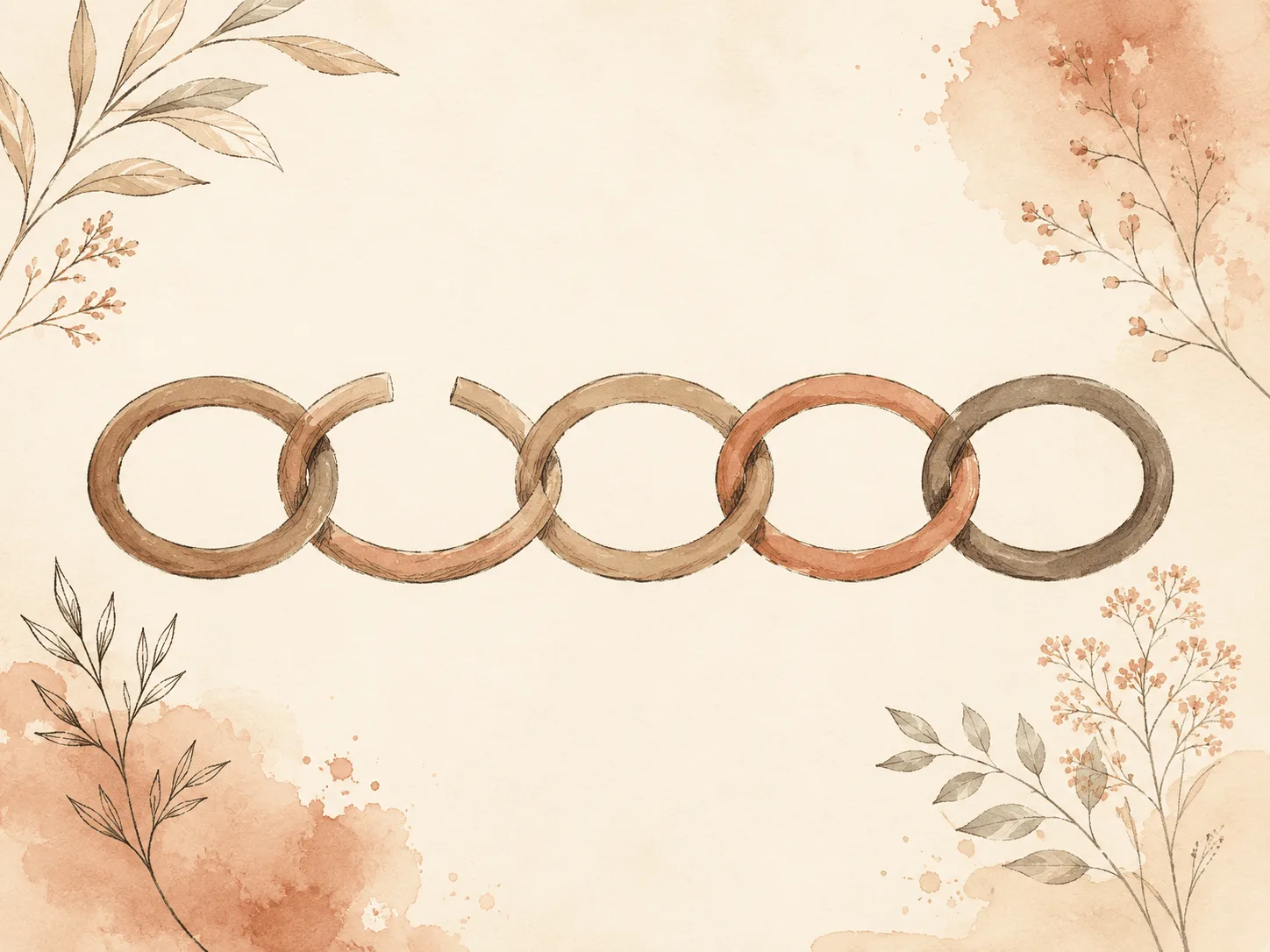
The chain runs roughly like this:
- The trigger. A state (bored, frustrated, concentrating) or a physical cue (a rough edge, a hangnail, a torn cuticle).
- The hand rises. Your hand leaves whatever it was doing and moves toward your face. Still almost always outside awareness.
- The teeth scan. Your teeth or fingertips search for the imperfection. This is the last moment before contact.
- The bite. Contact, biting, sometimes tearing or eating the nail.
- The aftermath. Relief, then usually shame, and a fresh rough edge that becomes tomorrow's trigger.
Notice that step five manufactures step one. That loop is why the behavior is so durable, and it's also good news: break the chain anywhere and the loop loses power everywhere.
The rest of this guide is organized by link.
Link One: The Trigger
Habit reversal training starts with awareness training, and that is not a warm-up. It is the intervention that makes every later technique possible, because a competing response you deploy after the bite is worth nothing.
For one week, do nothing but record. Every time you catch yourself biting, or catch your hand on the way up, note four things:
- Where you were (desk, car, bed, sofa)
- What you were doing (working, watching something, on your phone, doing nothing)
- What you felt just before (bored, stuck on a task, irritated, anxious, calm)
- What your hands found (a rough edge, a hangnail, nothing in particular)
Most people find their biting is far more concentrated than they assumed. It is not "all day." It is the forty minutes of a specific task, or the drive home, or the hour before sleep. Two or three contexts usually account for the majority of episodes, and once you know which ones, you're no longer defending a whole day. You're defending three windows.
That is also the point where tracking on paper starts to lose to tracking on your phone. The logging has to be quick enough that you actually do it in the moment, because reconstructing a day's biting from memory in the evening flattens exactly the detail you need.
Log the Moment, Not the Memory
SkinAware supports nail and cuticle biting alongside skin picking and hair pulling. Log a bite or a resisted urge in seconds, see which contexts your episodes cluster in, and work through a guided habit reversal course at your own pace.
Available on iOS, Android and in your browser.
If you cannot catch yourself at all
Some people genuinely cannot notice the behavior in real time at first. Two things help.
Put a physical marker on the hand you bite most, a bandage on one finger or a hair tie on the wrist. You are not using it as a barrier. You are using it so that when your hand reaches your mouth, something feels wrong and pulls the episode into awareness.
Ask one person who is around you often to tell you when they see it, neutrally and without commentary. Habit reversal has included a social support component since Azrin and Nunn's original protocol, and it isn't decoration. An outside observer catches the episodes you structurally cannot.
Link Two: The Hand Rises
This is where the competing response goes, and it's the piece that most consumer advice gets subtly but importantly wrong.
A competing response is not a distraction. A stress ball is a distraction. A competing response is a specific movement that is physically incompatible with biting, held deliberately until the urge drops. The distinction matters, and there's trial evidence behind it.
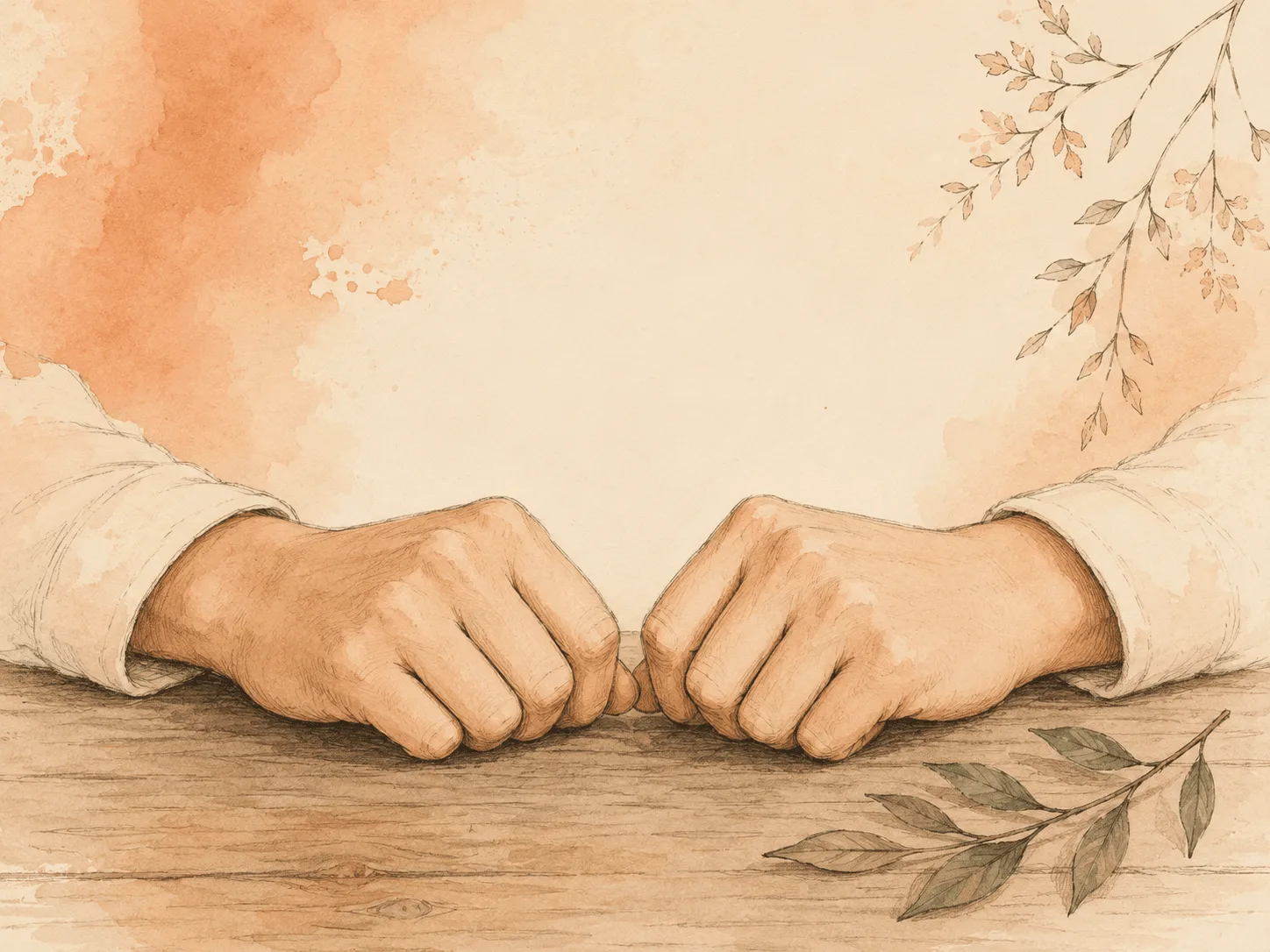
What it looks like: the moment you notice the urge or catch your hand rising, close both hands into a fist, or grip the arms of your chair, or press your palms flat against your thighs. Hold it for a full minute. Keep going if the urge hasn't faded. That's it.
Three details make it work:
- It must involve the hands, and it must be static. Fiddling with an object keeps your hands mobile and near your face. A held, closed position does not.
- It must be held long enough. A three-second squeeze doesn't outlast an urge. Sixty seconds is the working figure, and urges genuinely do fall away in that window.
- It must be usable in public. A fist under a table or hands pressed flat on your knees draws no attention. If your competing response is embarrassing, you won't use it in the meeting where you bite most.
Two caveats. That trial was in children and adolescents, not adults, and much of the nail-biting treatment literature has the same limitation. And note that object manipulation still beat doing nothing by a wide margin. If a fidget object is what you'll realistically use, use it. The point is that a held competing response is the stronger option when you can manage it.
Link Three: The Teeth Scan
This is the newest and least-known part of the toolkit, and it's the one worth reading twice if you've already tried habit reversal and bounced off it.
Decoupling was developed as a self-help technique for BFRBs, and it works differently from a competing response. Instead of blocking the movement, you let it run and then redirect it. You bring your hand up toward your mouth exactly as you normally would, and then, just before contact, you accelerate the hand past your mouth and away, ending with the movement completed somewhere else. Earlobe, chin, a point in the air.
The idea is that an automatic behavior is a motor sequence, and a motor sequence that keeps getting hijacked at the final moment stops running smoothly. The interruption creates a small jolt of wrongness that drags the behavior into awareness early enough for you to act.
Read those numbers carefully, though. Completion rates were poor across the board and lowest for decoupling itself, at 53.5%. Habit reversal scored better on how people felt about it than on what it did. This was four weeks, self-guided, in a modest sample. What it fairly supports is that decoupling is worth trying, particularly for nail biters, and particularly if habit reversal alone hasn't worked. It does not support decoupling as a replacement for everything else.
Rebuilding the Environment
Stimulus control is the unglamorous third component, and it's where most of the standard advice finally earns its place, once the behavioral work is underway.
The single highest-value item is removing physical triggers, because a rough edge or a torn cuticle is a legitimate reason your hands find their way to your mouth. Keep nails filed smooth rather than just short, since a jagged short nail is more provoking than a smooth longer one. Carry a file. Treat hangnails with clippers immediately instead of leaving them for your teeth to find. Keep hands and cuticles moisturized, because dry, frayed skin around the nail is one of the most common physical triggers people report.
Then make biting harder in the specific windows your tracking identified. Not all day, just those windows. Gloves while reading. A plaster on the finger you bite most. Sitting somewhere your hands are visible.
And this is where bitter polish belongs. As a late-stage alarm on top of an active plan, on the fingers you bite most, in the contexts where you bite most, it can convert a bite you'd otherwise complete into a caught episode. As a standalone strategy it is asking a bad taste to do the work of awareness training, which is the job it keeps failing at.
The Damage, and What Can Be Done About It
Nail biting is not cosmetically trivial, and this section is here because the physical consequences are often what finally pushes people to act.
Breaks in the skin around the nail are entry points for infection. Paronychia, an infection of the soft tissue around the nail, is common and sometimes needs antibiotics or drainage. Warts are also common in people who bite, and warts around or under the nail are notoriously hard to treat and can spread to the lip area. Chronic biting also transmits organisms in both directions between hands and mouth.
The dental and jaw side is real too: chipped or notched incisors, gum inflammation, and an association with temporomandibular joint problems.
The consequence people most want to know about is the nail itself. A nail dermatologist at NewYork-Presbyterian describes long-term biters developing progressive shortening, where damage to the nail bed means the nail only ever grows back to a certain point, and after many years that can be permanent. The more hopeful part of the same picture: a fingernail replaces itself in roughly six months, and pressure-related ridging from rubbing the nail growth center does grow out once the habit stops.
Supplements and Medication
There is no medication approved specifically for nail biting anywhere in the world. What exists is a small evidence base worth discussing with a clinician rather than acting on alone.
N-acetylcysteine (NAC) has the most support. It's an over-the-counter amino acid derivative that acts on the brain's glutamate system, and it has shown positive results across several body-focused repetitive behaviors. For nail biting specifically, a randomized trial found 800 mg per day over one month reduced biting in children compared with placebo. Clinical reviews describe the evidence for nail biting as limited rather than settled.
SSRIs, particularly fluoxetine, appear in case reports for onychophagia on the basis that it belongs to the obsessive-compulsive family. The evidence is thin, and reviewers note that this drug class can worsen impulse-related behaviors in some people. That is a prescriber's decision, not a self-help one.
When Nail Biting Is Travelling With Something Else
Nail biting frequently arrives in company, and if you've tried to stop several times without success, this is worth checking.
About a quarter of people who bite their nails also have an anxiety disorder, according to the psychologist quoted in the NewYork-Presbyterian piece, though large clinical reviews find inconsistent overlap between nail biting and diagnosed anxiety or OCD. So anxiety is common but not universal, and if you don't feel anxious when you bite, you are not misreading yourself.
ADHD shows up repeatedly in the literature. One clinical sample of children referred for nail biting found ADHD in 74.6% of them, which is a striking figure, though it comes from a referred clinical group rather than the general population, so treat it as a signal rather than a rate. The same pattern appears in the overlap between ADHD and skin picking.
Other BFRBs cluster too. Bruxism, cheek biting, lip biting, skin picking, and hair pulling all commonly co-occur with nail biting. If you bite your nails and also pick at your cuticles or the skin around them, you are dealing with one behavioral family rather than two problems, and the same protocol covers both.
The practical takeaway: if biting is one of several repetitive behaviors, or if it sits on top of untreated ADHD or an anxiety disorder, self-help alone may plateau. That is a reason to bring in a therapist who works with BFRBs, not a sign that the techniques don't work for you.
Your First Two Weeks
A plan you'll actually run beats a better plan you won't.
Days 1 to 7, observe only. Log every episode you catch, with location, activity, feeling, and what your hands found. Change nothing else. At the end of the week, find your two or three highest-frequency contexts.
Day 8, choose one context. Not all of them. The single one where you bite most.
Days 8 to 14, run one technique in that one context. If you usually feel the urge coming, use the competing response: hands closed, held sixty seconds. If you're always catching yourself too late, use decoupling: let the hand rise, then redirect past your mouth at speed. Meanwhile, file your nails smooth, deal with hangnails with clippers rather than teeth, and moisturize your hands daily.
Then add the second context. Then the third.
Expect an uneven line. Stress, illness, deadlines, and boredom all bring it back temporarily. A bad week after three good ones is the normal shape of this, not a failure of the method.
Frequently Asked Questions
Chronic nail biting is recognized in the DSM-5-TR under "other specified obsessive-compulsive and related disorders" as a body-focused repetitive behavior. That classification is less about labeling you and more about pointing to treatment: it means the behavioral methods developed for hair pulling and skin picking apply to nail biting too. Occasional biting with no damage or distress isn't a disorder.
There's no reliable published figure, and anyone quoting a specific number of days is guessing. What the trials show is measurable change within four weeks to three months of consistent technique use, with results improving over time rather than arriving at once. A useful early marker is catching more urges before contact, which typically improves before overall frequency does.
It works better than nothing and worse than a competing response. One comparison found competing response training produced significantly greater nail-length improvement than a bitter substance. Clinical guidance also cautions against aversive coatings when biting is compulsive, since punishment can intensify a self-soothing behavior. Use it as a backstop alongside behavioral work, not as your main strategy.
Usually, yes. A fingernail replaces itself in roughly six months, and ridging from pressure on the nail growth center grows out once you stop. The exception is long-term damage to the nail bed, which can permanently limit how far the nail grows. That's a reason to start now rather than a reason to give up.
Because stress isn't the only trigger, and for adults it's often not the main one. Research points to boredom and frustration as the two states that most reliably precede biting in adults. Under-stimulation while concentrating, driving, or watching something is an extremely common context, and it explains why "relax more" advice tends to miss.
Plenty of people improve with self-guided habit reversal and decoupling, and both were designed to be usable without a therapist. Trials of self-help delivery show real but modest effects, with dropout as the main obstacle. If you've run a technique consistently for a couple of months without change, or if nail biting sits alongside other BFRBs, ADHD, or an anxiety disorder, a therapist who works with BFRBs is the right next step.
Partly. More than 30% of people with onychophagia have a family member who also bites, and twin studies suggest a substantial heritable component. That doesn't make it fixed. It makes it a behavior you may have been more predisposed to learn.
Where to Go From Here
Pick one context, one technique, and one week of logging. That's the whole starting move, and it's deliberately small because the failure mode here is not insufficient motivation. It's trying to defend every hour of the day and running out of attention by Wednesday.
The behavior has probably been running for years without your permission. It will take more than two weeks to unwind. But awareness is the part that unlocks everything else, and it's available to you today.