

Written using peer-reviewed research including Lee & Lipner (2022, Int J Environ Res Public Health) and Cohen et al. (2022, Cureus), alongside clinical guidance from DermNet and nail specialists at Weill Cornell Medical Center.
That strip of skin you tear off beside your thumbnail is almost never your cuticle.
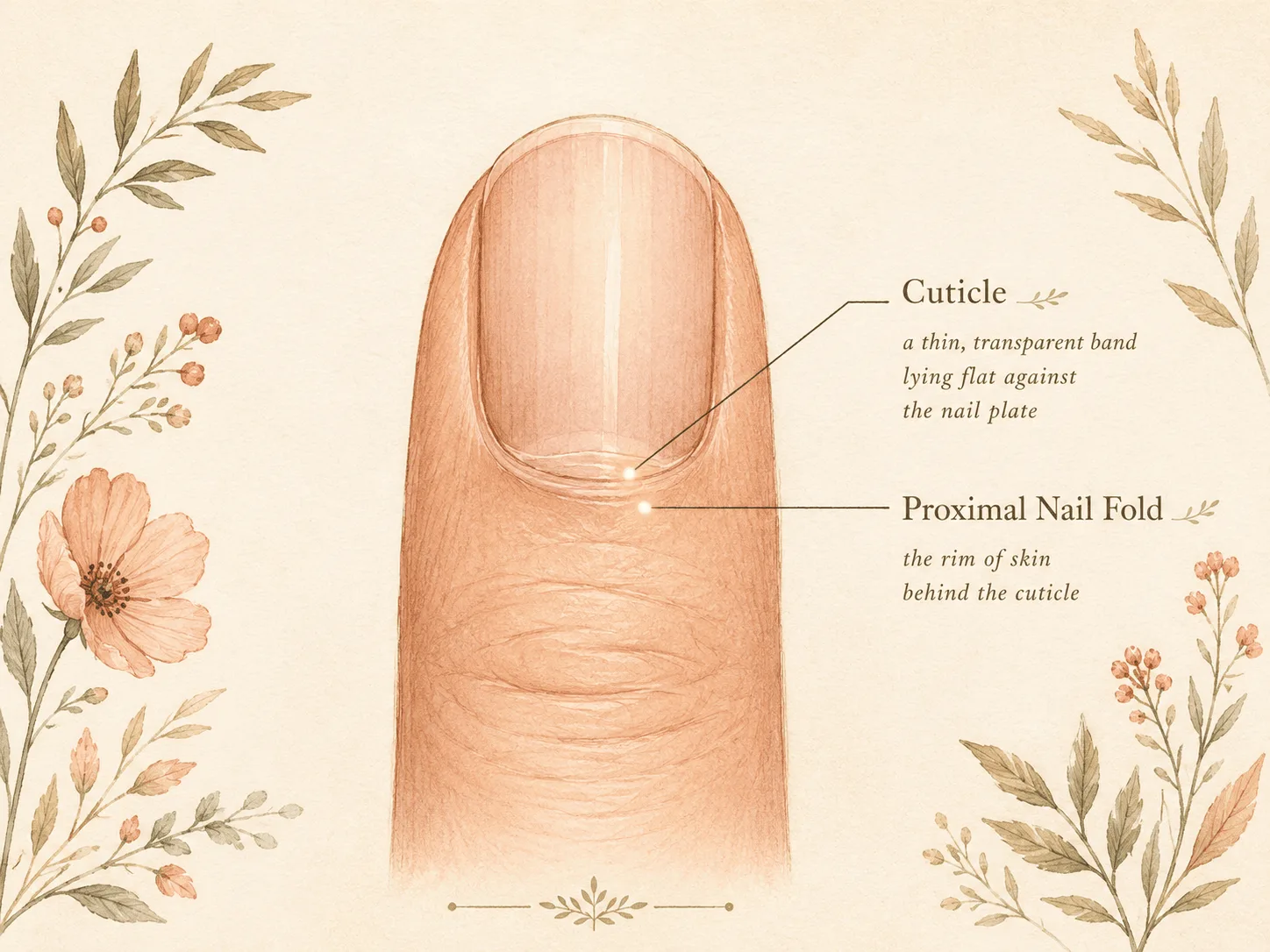
Your actual cuticle is a thin, transparent layer of already-dead cells lying flat on the nail plate, sealing the gap where the nail comes out from under the fold. It's a few cells thick. It has no nerve supply and it doesn't bleed. The thing you can get a fingernail under, the piece that gives when you pull, the piece that stings for two days afterwards: that's the proximal nail fold, the living rim of skin at the base of the nail.
The distinction changes what the behavior is. Tidying a dead layer would be grooming. Removing living skin from the seal that keeps bacteria out of the space where your nail is being manufactured is something else, and it comes with a different set of consequences.
It also changes what stopping requires. On your hands, the picking creates its own next target on a two-to-four day cycle, and that loop is the thing you're actually up against. The general treatment ladder for picking is covered in the complete guide to stopping. What follows is what changes when the site is your fingers.
Where the next edge comes from
Those first two numbers come from the same 339 people, and the gap between them is not a real gap. Nail biting gets asked about. Nail picking mostly doesn't, and it isn't in most screening questionnaires, so it turns up in the data at a rate nobody in a dermatology clinic believes. In one clinical series the average age at diagnosis was 47.5. In the student study, picking had started at around age nine and had been running for fourteen years.
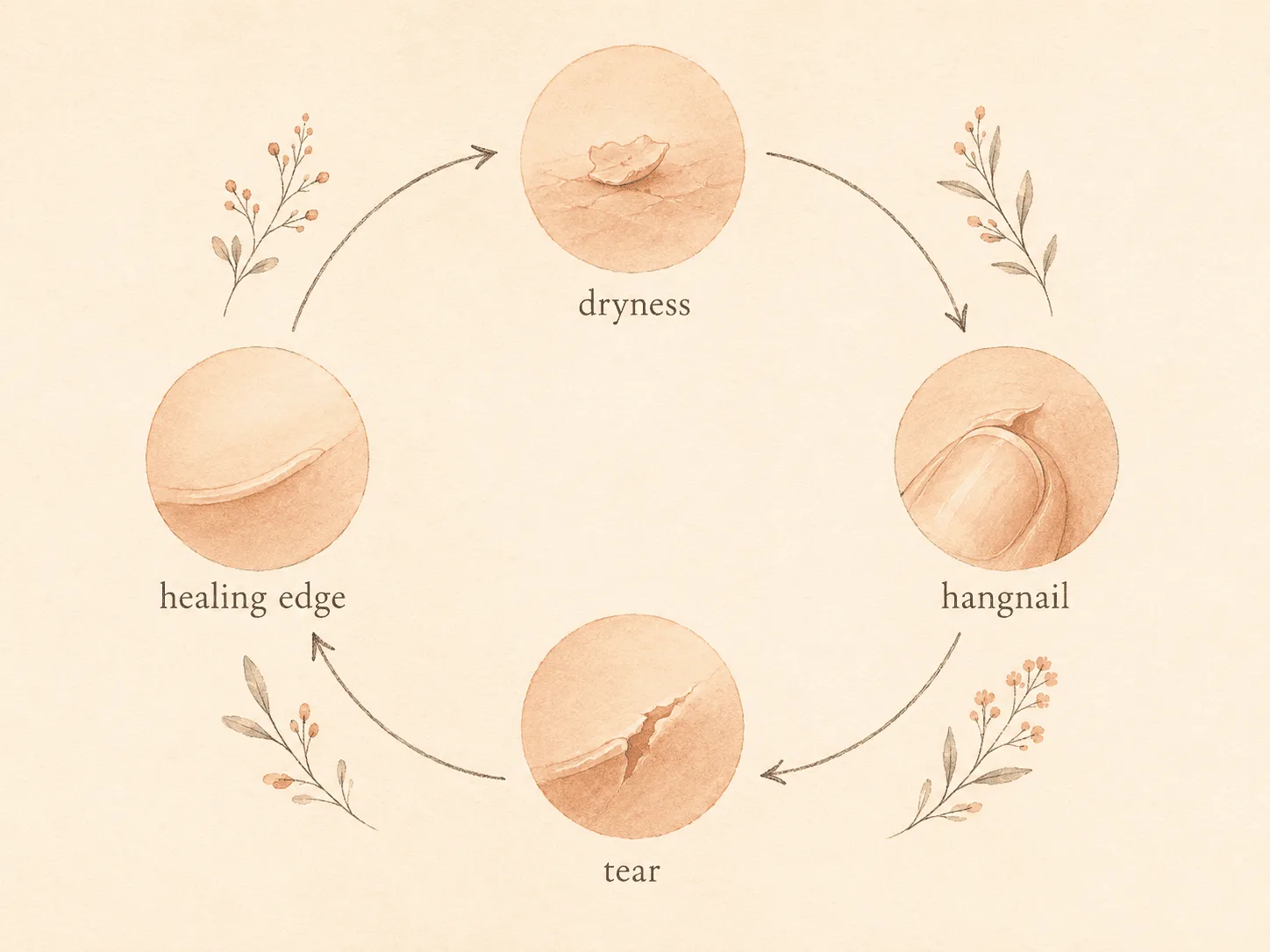
The sequence that keeps it running goes like this. Skin at the nail folds dries out and lifts. A lifted edge snags on fabric or a zip and becomes a hangnail, which is a torn strip of that living fold rather than any part of the nail. You pull it, and skin tears along its own grain rather than where you'd like it to stop, so the tear runs down into tissue that's still attached. That spot heals over the next few days, and healing skin is raised, dry, and slightly itchy. Which makes it the single most catchable thing on your hand.
Three other things make the hands their own problem, and they compound.
There's no setup. Face picking needs a mirror and reasonable light. Scalp picking needs a free hand raised to your head. Cuticle picking needs nothing. It runs under a desk, in a lecture, on a phone call, in the passenger seat, in bed. Nobody has to leave the room.
It's socially invisible until it isn't. Two hands resting together look like two hands resting together. Which means the behavior never collects the ordinary interruptions that slow down more visible picking, right up until the point where someone notices a bandaged thumb.
Why dryness is the lever here
On most sites, moisturising is comfort. On the hands it's upstream of the behavior, because dryness is what generates the edges in the first place.
Hands get dried out more thoroughly and more often than any other skin you have. Washing, sanitiser, washing up, cold air, and the fact that nail tissue behaves unlike skin under water.
Hangnails are the direct output of that. Dermatologists describe them as skin around the cuticle getting too dry and snagging on something. Which means every hangnail is a small, preventable manufacturing event, and the intervention is boring and it works.
Two products, and they do different jobs. A cuticle oil penetrates the nail fold itself, which is the tissue you're picking. Any skin-safe oil does this; jojoba and grapeseed are common, and dermatologists will tell you plain olive oil works in a pinch. A hand cream (thicker and higher in oil content than a lotion) holds the moisture in over hours. Oil for the folds, cream for the hands, and the two aren't interchangeable.
None of this stops the behavior. It lowers the number of things your fingers can find, and on this site that's a much larger share of the problem than it is anywhere else.
What the damage actually costs
The seal you're removing has a job, and two separate things go wrong when it's gone.
Infection gets a route in. Acute paronychia is a bacterial infection of the tissue around the nail, and the classic entry point is a break in the skin between the proximal nail fold and the nail plate. Usually Staphylococcus aureus or Streptococcus pyogenes. It develops over a few hours in a single nail fold, with pain, redness and swelling, and pus can collect under the cuticle and progress to an abscess. Left alone it can spread into the hand as cellulitis or reach the tendons. Chronic paronychia is the slower version, presenting with loss of the cuticle and nail folds that stay swollen and lifted off the plate, which keeps letting organisms and irritants in. Its main long-term cost is nail dystrophy, and after it clears, nails can take up to a year to grow back normally.
The nail matrix sits directly under the skin you're picking. The matrix is where the nail plate is made, and it lives beneath the proximal nail fold. Damage there doesn't show up as a mark on your finger, it shows up months later as a defect running out along the nail.
The split is worth stating plainly. Skin heals well on the hands, and most people's fingers recover completely once they're left alone. Matrix damage is the part with a permanent tail, and it's the part nobody warns you about, because the delay between cause and effect is long enough that most people never connect the ridge in their thumbnail to what their index finger has been doing.
In severe, long-running cases the literature describes pterygium (scar tissue growing forward across the nail bed) and anonychia, complete loss of the nail. Those are rare, and they take years.
Gels, acrylics and press-ons
This comes up constantly, usually as a plan rather than a question: get a set of nails you'd rather not ruin, and the picking stops.
There's something real in it. Preventive filing and a manicure worth preserving both appear in the clinical literature as genuine stimulus-control measures, not as vanity. A gel overlay caps the nail plate so there's no free edge to peel or split. Some people find the cost and the appointment work as a deterrent by themselves.
And there's a documented failure mode nobody mentions.
That's the mechanism to watch for. Anything glued to a growing nail eventually lifts, and a lifting edge is a new target with a satisfying give that wasn't on your hand before. Removal is the other risk window: acetone soaking dries out the nail folds exactly where the hangnails come from, and picking gel off instead of soaking it takes layers of nail plate with it. Press-ons are gentler in principle but shed and pit the nail plate when they're pulled off rather than dissolved.
If you do wear them, the two things that matter are keeping to the maintenance schedule so nothing gets a chance to lift, and having them removed properly rather than picked off.
Shrinking the supply of edges
Everything here is aimed at the same thing: fewer catchable edges on your hands at any given moment. The behavioral core is the same wherever you pick, and habit reversal training is covered in full separately. This is the hands layer on top of it.
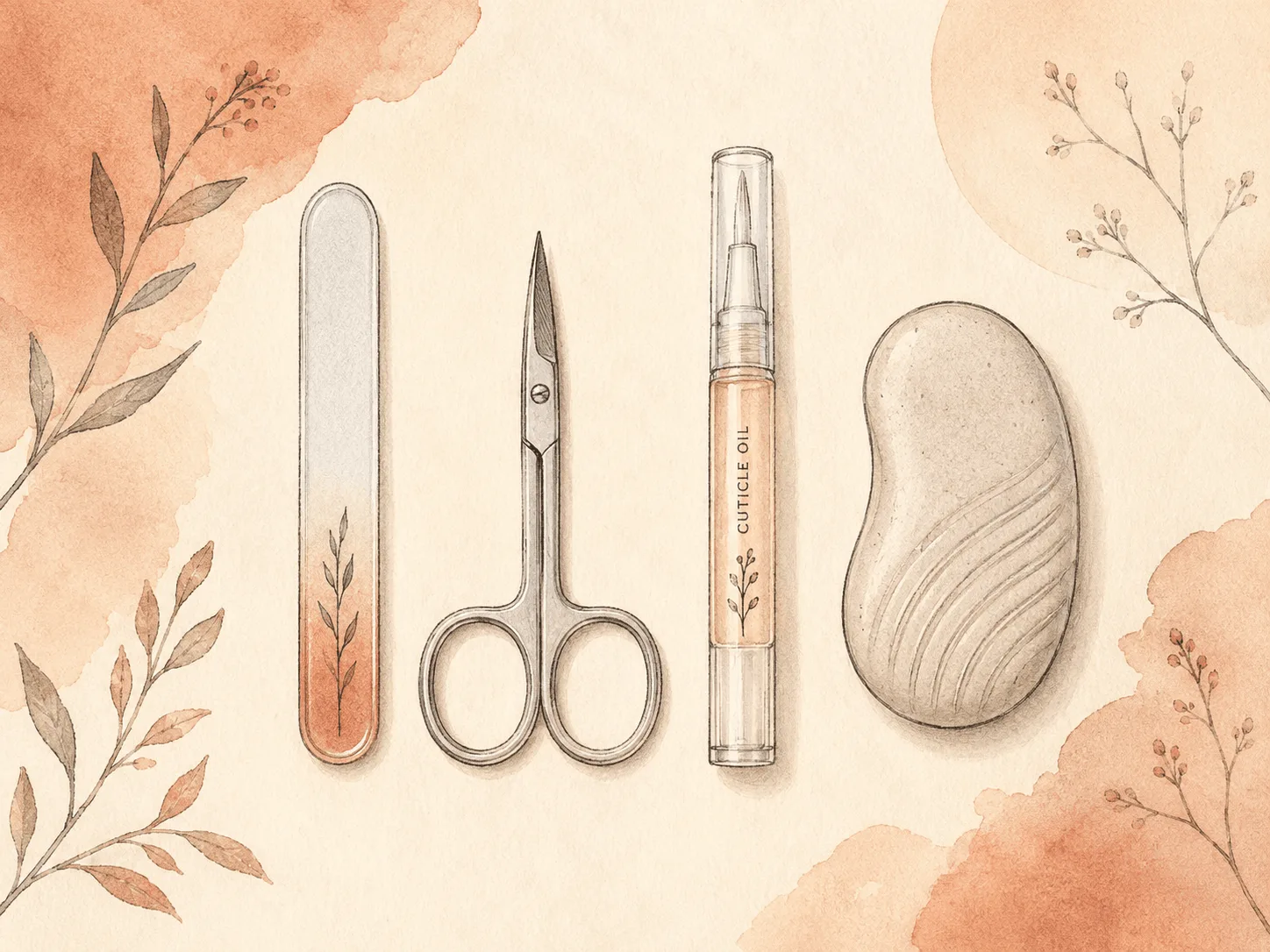
File, don't tear. A fine file or buffer smooths a rough edge in about ten seconds and takes the target off the board. Glass and crystal files leave a sealed, smooth edge, where cardboard emery boards tend to cause splits and peeling that give you more to find. Keep one wherever you keep the oil.
Clip hangnails at the base the moment they appear. Nail clippers or small scissors, right at the base, straight away. This is standard dermatological advice and it exists precisely because pulling doesn't work: skin tears along its own grain and takes living tissue with it.
Consider a barrier over the folds. Adhesive dressings and occlusive bandages are documented as effective in some cases, and also as the intervention people abandon fastest because wearing them is conspicuous. A quieter option in the literature is cyanoacrylate adhesive, applied over the cuticles once or twice a week as both a physical barrier and a tactile reminder. In a two-patient case report both stopped picking within three to six months and their nails returned to normal. That's a small evidence base, so it's worth raising with a dermatologist rather than improvising on broken skin, but it's a real clinical measure rather than an internet trick.
Pick a competing response you can run one-handed. For nail-directed picking the usual instruction is to spread your fingers wide apart and hold until the urge drops, which is workable at a desk or in a meeting without looking like anything. Rehearse it a few times when you don't have an urge, so it's available when you do.
Match the sensation, not the shape. What's being chased is a hard edge catching under a nail, and a smooth stress ball is nowhere near that. Something with a lip, a seam, a ridge or a textured groove is closer. The fidget rundown sorts them by sensation rather than by what they look like.
Count the hand, not the pick. By the time you're picking you're several links into the chain. The event you can actually catch is one hand arriving at the other, including every time nothing happens.
One thing to hold onto if the treated skin heals and the hands keep going: that's the expected pattern rather than a failure. Picking that started with a real physical trigger routinely outlives it, which is what makes the behavior persisting after the trigger is gone such a demoralising experience for people who did everything right.
When it's also biting
A lot of people reading this do both, and the clinical definitions overlap on purpose: chronic nail biting is defined as biting of the nail plate, the nail folds, the nail bed, or the cuticle. Same tissue, different tool.
Migration between the two is common in one particular direction. People who bite and then decide they want better-looking nails often stop biting and start picking, and count that as having quit. The nails do look better. The nail folds don't.
The distinction worth making is what ends an episode, because it changes the response. Biting needs something that occupies the mouth or makes the hand-to-mouth path impossible. Picking needs something that occupies the fingers. If both are running, they're worth logging separately or the pattern averages into noise. The full picture on chronic nail biting covers the treatment evidence, which is considerably stronger than most people expect, along with the dental and oral consequences that don't apply to picking.
There's also an infection detail specific to biters. The bacteria that cause acute paronychia in nail biters typically arrive from the mouth, which is a route picking doesn't have. If you do both, you have both.
A two-week starting point
Run three things at once for a fortnight. None of them requires you to try harder.
- Oil after every hand wash and again at bedtime. Buy three bottles, not one, and put them where your hands already are.
- A file in each of those same places. Rough edge gets smoothed, hangnail gets clipped at the base, neither gets pulled.
- Log every time one hand goes to the other, including the times nothing happens. Note which finger and what you were doing.
At the end of two weeks you'll have two pieces of information that almost nobody has about their own hands. Which fingers account for most of it, and which settings. Findings in nail picking are typically asymmetric, so most people discover it's concentrated on one or two digits rather than spread evenly, and that the setting repeats far more reliably than the mood does.
That second job is what SkinAware is built for. Logging a pick or a resisted urge takes a few taps with the body area attached, and cuticles is one of the listed areas rather than something you have to write into a notes field. Nail biting runs as its own full mode, so if you do both they stay separate in the data instead of merging. The habit reversal course runs in short modules. It's $5.99 a month or $34.99 a year, with a two-week trial on iOS.
FAQ
It's in the same family. Repetitive picking of the nail unit and the skin around it has its own clinical name, onychotillomania, and both it and skin picking disorder sit under body-focused repetitive behaviors in the DSM-5's "other specified obsessive-compulsive and related disorders" category. In practice the label matters less than the two markers clinicians actually use: whether it's causing you distress or getting in the way of your life, and whether you've genuinely tried to stop more than once and couldn't.
The skin, almost always. Hands heal quickly and completely once they're left alone. Nails are slower and depend on what was damaged. If the nail folds were inflamed for a long time, dystrophy can take up to a year to grow out. Ridging from habit tic deformity usually improves once the pushing and picking stops. The one change that generally doesn't reverse is longitudinal melanonychia, the grey-brown band running the length of a nail, which comes from pigment cells in the matrix being activated by repeated trauma. A dermatologist can tell you which category yours falls into, and it's worth asking rather than assuming the worst.
It depends what you pick. If you target the nail plate and free edge, a capped nail removes the target and can genuinely help, and a manicure worth preserving appears in the clinical literature as a real stimulus-control measure. If you target the skin around the nail, gels cover none of it, acetone removal dries out exactly the tissue that generates hangnails, and every set eventually lifts, which adds a new edge that wasn't there before. There's a published case of a woman whose picking began only after she started having acrylics applied and who then picked off every set for fifteen years.
Clip it at the base straight away with nail clippers or small nail scissors, then put oil on the area. Pulling never works the way you want it to, because skin tears along its own grain rather than stopping where the dead part ends, which is how a two-millimetre snag becomes a bleeding nail fold. If it's already torn, keep it moist and covered rather than letting it form a hard scab, since a scab is the next thing your fingers will look for.
That's the usual pattern rather than an odd one. Clinical findings in nail picking are typically asymmetric, and habit tic deformity shows up most often on the thumbnails specifically. Usually one finger got damaged first, healed with a raised edge, and became the reliable target, after which the others get largely left alone. It's useful information: a behavior concentrated on two digits is a smaller thing to interrupt than one spread across ten.
Redness, warmth, swelling and tenderness around a nail, pus collecting under the cuticle or nail fold, red streaks running up the finger or hand, a swollen fingertip pad, or any fever. Acute paronychia can spread into the hand and reach the tendons, and it is far easier to treat in the first few days. Also worth an appointment: any nail fold that's been swollen for more than six weeks, and any new dark band running the length of a nail.