
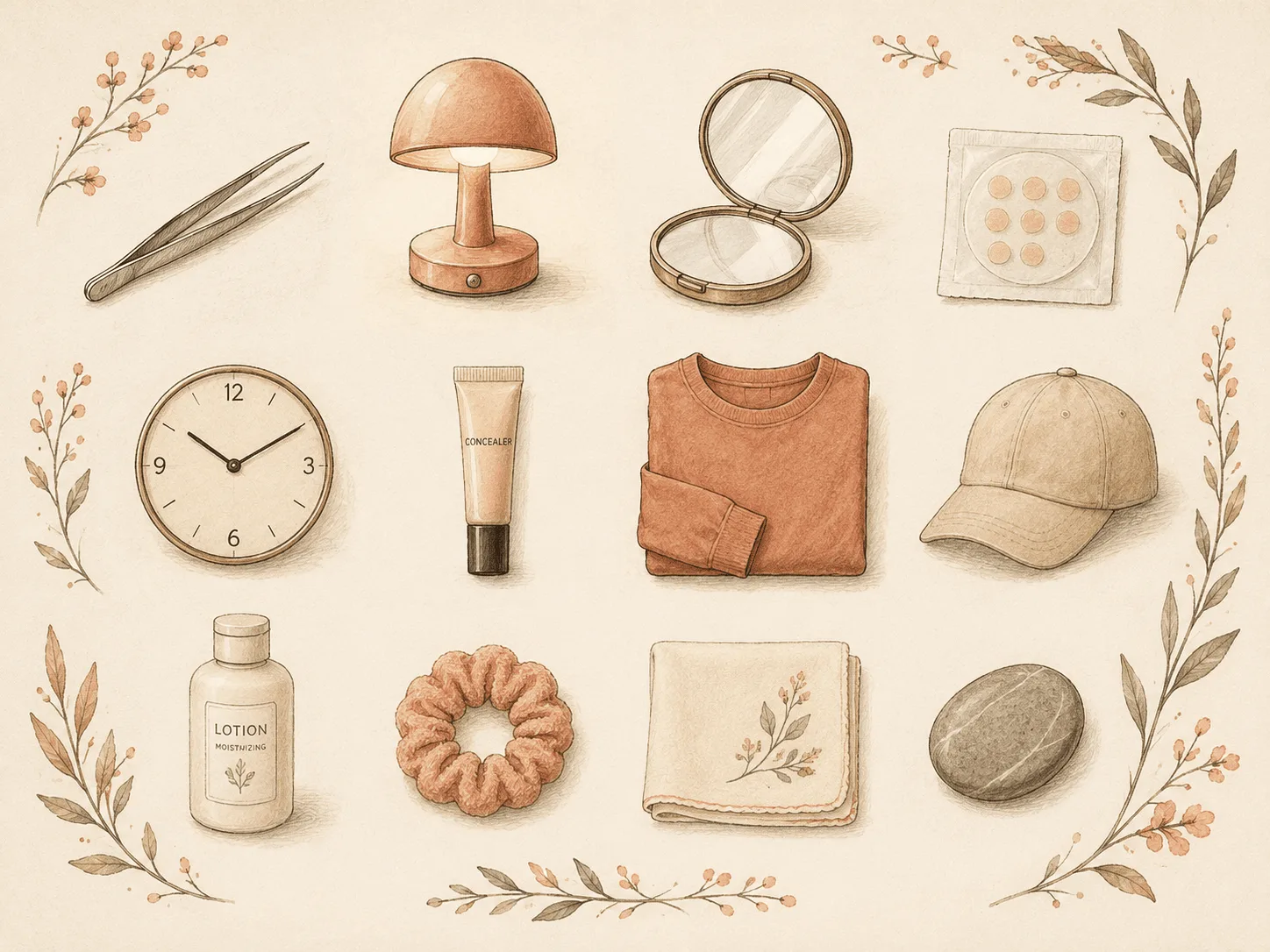
Most pages that answer this question hand you the clinical criteria: picking that causes damage, repeated failed attempts to stop, distress. All true, all accurate, and all still abstract enough that you can read them twice and not know whether you qualify. The twelve below are the specific, ordinary things that show up in the life of someone who picks. Read them against your own week rather than against a definition.
1–4: how it starts
1. You can't point to the moment you started
Ask someone who picks occasionally when they began and they'll tell you: there was a scab, they went for it. Ask someone with dermatillomania and the answer is usually that there wasn't a beginning they can find. The episode was already twenty minutes old the first time they noticed it existed.
That gap matters more than the picking itself. It's the difference between a decision you made and a behavior that ran without asking you, and it's the reason "just stop" lands so badly on people who pick. There was no moment to stop at.
2. Your fingers check your skin without your eyes
Sitting in a meeting, your hand goes to your jaw and runs across it, looking for texture. Waiting for a kettle, your fingertips walk the back of your scalp. You're not looking at anything. You're reading your skin by touch, and you've probably been doing it so long you'd have said you don't do it at all.

Clinicians call this an antecedent: the thing that reliably comes before an episode. For a lot of people the scan is the whole condition in miniature, because the hand knows what it's looking for and finds it every time.
3. Time goes missing
You sat down at nine. When you next look at the clock it's twenty to ten, and you have no memory of the intervening forty minutes beyond a general sense of having been busy.
Time distortion is one of the more reliable separators between ordinary picking and the disorder. Ordinary picking takes as long as it takes and you can feel it passing. Picking that has become compulsive absorbs attention the way a good book does, which is why people describe it as trance-like rather than as something they were doing. If you've ever been genuinely startled by a clock after picking, that's the sign.
4. You keep a mental inventory of which spots are "ready"
Somewhere in your head there's a list. A scab on the shin that's still too tight. A bump on the shoulder that'll be worth something in two days. Something on the hairline that you've been aware of continuously since Tuesday.
Nobody teaches you to do this and most people who do it have never described it out loud.
5–8: what's built up around it
5. There's a tool, and you know exactly where it is
Tweezers, a safety pin, a comedone extractor, cuticle nippers, a needle. If you have one, you know precisely which drawer, which pocket of which bag, and you'd feel something specific if you found it missing.
Tool use shows up in every clinical description of this condition. WebMD lists "tweezers, needles, pins, or scissors"; Psychology Today notes that people may use their fingers or an instrument. What those descriptions don't capture is the relationship. Plenty of people own tweezers. Knowing where yours is at all times, without ever having decided to know, is a different thing.
6. One mirror in your home is the real one
There's a mirror, or a lamp, or a particular time of day, where you can actually see. The others are for brushing your teeth. You didn't choose this deliberately. You worked it out over years the way you work out which stair creaks.
Preference this specific means picking has quietly shaped how you use rooms. Some people have gone further and covered the good mirror, or moved their skincare somewhere else entirely, which is a strategy rather than a symptom. But knowing which mirror is the good one, and knowing you'd be annoyed if someone moved it, belongs on this list.
7. Nobody has ever watched you do it
Psychology Today puts it plainly: skin picking "does not generally occur in the presence of other individuals." Not because you decided to keep it private, exactly, but because episodes only really get going when you're alone, and because the idea of a partner or a flatmate walking in produces a particular kind of jolt.
Secrecy at this level is also why so many people go years without knowing the condition has a name. If you've never seen anyone else do it and nobody has seen you, there's nothing to compare yourself against. The longer write-up on what dermatillomania actually is covers how the condition sits alongside hair pulling and nail biting in the same family.
8. It doesn't need anything to be wrong with your skin
An acne flare or a bad patch of eczema will keep you occupied for a week. But when your skin is clear, the picking doesn't stop. It relocates. You find something, or you make something.
This is the detail that surprises people most about their own behavior, and it's well documented: the TLC Foundation notes that people pick at both healthy and previously damaged skin. Picking that only ever follows a genuine blemish is a different pattern. Picking that carries on regardless of the state of your skin is one of the clearer signals that the behavior has stopped being about your skin at all.
9–12: what it costs afterwards
9. There's relief, and then a drop that comes fast
The relief is real. It's why people are reluctant to talk about this, because describing something that feels good while it's damaging you sounds indefensible said out loud.
What follows tends to arrive within minutes: a flat, specific dread, plus the practical realization that tomorrow is now harder. That two-part shape, brief relief then a fast drop, is far more characteristic of the disorder than the picking itself.
10. You have a camouflage routine and you know how long it takes
Long sleeves in July. A hat when the scalp's bad. A concealer whose exact shade you know by name, applied in an order you've refined. You know roughly how many minutes the whole thing takes, because you've had to build it into your morning.
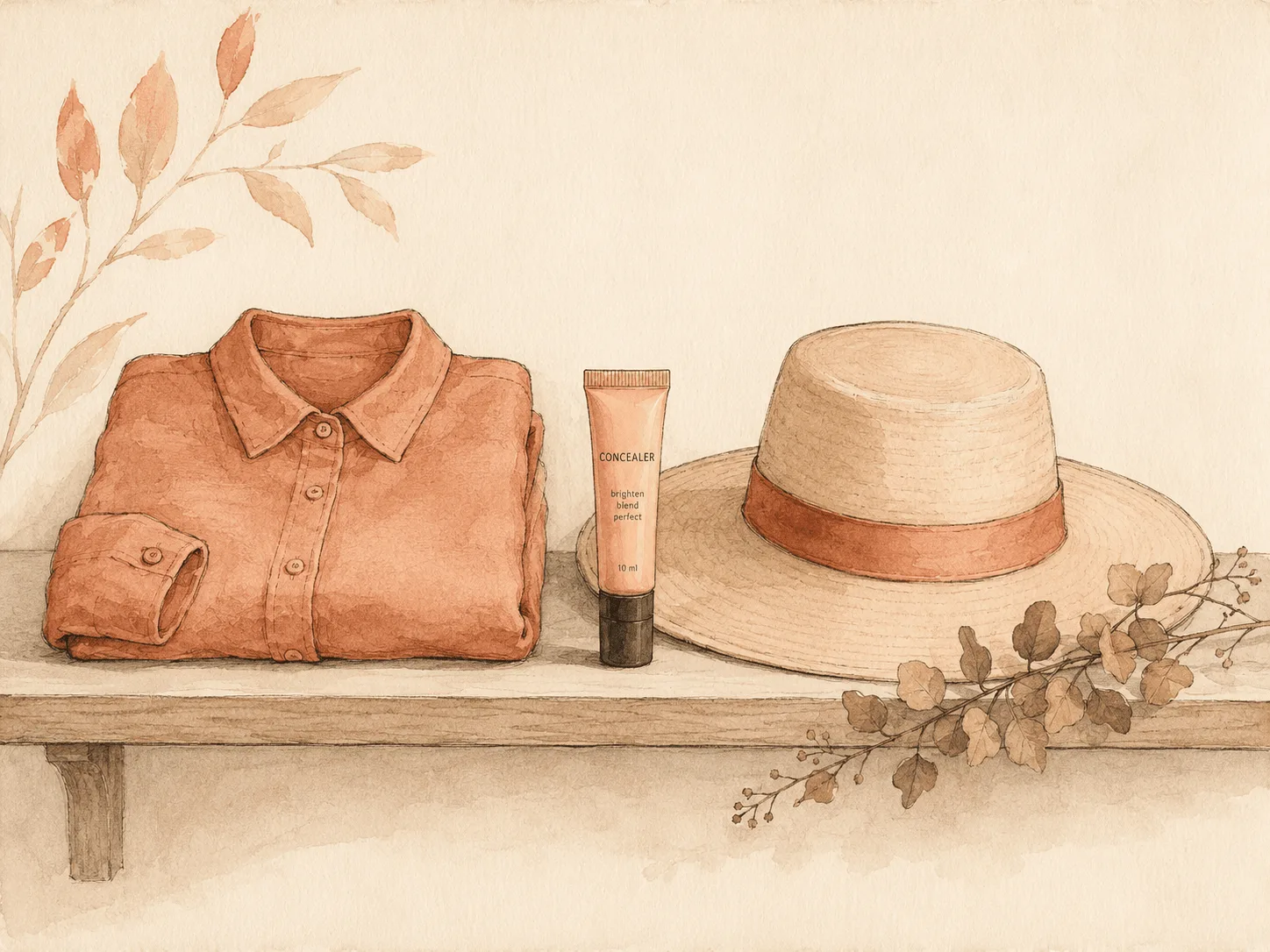
The TLC Foundation describes people going to great lengths to cover, hide, or camouflage damaged skin, and having difficulty with time management because of the time involved in both the picking and the concealing. That second half is the part that rarely gets counted.
11. You've said no to specific things, and you know which ones
Not vague social avoidance. Actual instances. The pool day. The massage. Staying over. Being seen without makeup by someone who's seen you a hundred times. The photo you asked them to delete.
The TLC Foundation names these directly, including wearing shorts, being seen by others without makeup, and intimacy. If you can list three occasions from the last year where your skin made the decision for you, that's the impairment criterion showing up in real life rather than on a form.
12. You've quit before, and the attempts have dates
New year. The week before a wedding. The Monday after a bad Sunday. Some of them lasted, four days, eleven days, once nearly two months, and the fact that you can recall the numbers tells you how much they mattered.
Why the attempts keep collapsing at roughly the same point is its own subject, and the mechanics of it are worth reading if you've been treating your own relapses as a character problem.
What these twelve are measuring
None of the twelve is a diagnostic criterion. They're the everyday forms the criteria take, and it's worth seeing how they line up.
The DSM-5 criteria for excoriation disorder are recurrent skin picking that results in skin lesions; repeated attempts to decrease or stop it; clinically significant distress or impairment in social, occupational, or other important areas of functioning; picking not attributable to a substance or another medical condition; and picking not better explained by another mental disorder.
Signs 1 through 4 and sign 8 sit under the first criterion, the recurrent part. Sign 12 is the second criterion almost word for word. Signs 9, 10 and 11 are what distress and impairment look like when they're happening to a person rather than being described in a manual. Signs 5, 6 and 7 aren't criteria at all, but they're strong pattern indicators, and they're the ones people tend to recognize fastest.
The fourth and fifth criteria are the ones you can't check yourself, which is where self-assessment hits its ceiling. Picking driven by opiate withdrawal, by a dermatological condition, or by body dysmorphic disorder can look identical from the inside and needs different treatment.
Roughly 2% to 5% of people pick to a degree that causes noticeable tissue damage and real distress, and it usually begins around ages 13 to 15. Whether you sit inside that group isn't something a list of twelve items can tell you.
What to do with this
If most of these were familiar, the useful next step isn't a verdict. It's information about your own pattern, which is what every treatment for this condition starts with, and which almost nobody has when they first go looking.
If you want something more structured than a note on your phone, that's the part SkinAware was built for: logging an episode or an urge in a few taps with location and trigger, a private photo timeline, and the habit reversal course in short modules. It's $5.99 a month or $34.99 a year, with a two-week trial on iOS.