
The questions below are based on the diagnostic criteria for excoriation (skin-picking) disorder and on the Skin Picking Scale-Revised. They can't give you a diagnosis. They can give you an honest read on whether the pattern you're already noticing has a name and a body of evidence behind it.
The quiz
Self-assessment
Question 1 of 10
Answer yes or no for each question based on the last twelve months. There's no right answer, no wrong answer, and nothing here is recorded outside this page.
Do you pick at your skin regularly, at least once on most days?
What your result means
The number itself is less important than what the pattern around it tells you. Below is what each tier actually signals, written for the person reading it, not for a chart in a paper.
If you scored 8 to 10: the pattern fits
Eight or more yes answers means your picking matches almost every feature clinicians look for. It's frequent, it's caused real damage, you've tried to stop and couldn't, it carries shame, and it's reaching into the rest of your life. There's a name for that pattern. The DSM-5 calls it excoriation (skin-picking) disorder. Most people call it dermatillomania. You can read the longer write-up on what dermatillomania actually is if you want the full picture.
You might be feeling two things at once right now. Relief, because what you've been doing alone for years has a name and other people have it. Dread, because naming it makes it real. Both responses are normal. Neither of them changes what's true, which is that this is a recognized condition, not a character failure, and the evidence base for treating it is solid.
The next reasonable step is not panic and it's not a vow to stop tonight. People who've been picking for years rarely white-knuckle their way out of it, and the question of why willpower alone struggles here is its own topic, covered in why can't I stop picking. The thing that helps is structured, gentle work over weeks, ideally with some external support, whether that's a therapist, an app, a partner who knows what's going on, or all three.
If you scored 4 to 7: the pattern is real but partial
A score in this range is the hardest to sit with, because it doesn't give you a clean yes or no. Four to seven yes answers usually means one of three things. You might be earlier in the pattern, where the behavior exists but hasn't yet pulled in your sleep or your relationships. You might be a focused picker who picks heavily but only during certain stretches, so questions about "every day" don't fully apply. Or you might be someone whose picking is genuinely milder, sitting on the edge of clinical and sub-clinical without crossing over.
None of those three readings means your picking doesn't matter. The clinical threshold is a tool for researchers and insurers. It is not a measure of whether your experience is worth attention. If picking is on your mind enough that you searched for this quiz, it's on your mind enough to address.
If you scored 0 to 3: the clinical pattern isn't there
A low score means at least one of two pieces is missing. Either your picking doesn't reach the frequency or duration that the criteria require, or the picking isn't causing damage, distress, or impairment in the way the disorder typically does. That's a useful piece of information. It doesn't mean you imagined it.
There's a real category of person who scores low here and is still bothered by their picking. The most common version is breakout-response picking: you pick when you have a spot, you don't pick when you don't, and the picking stops on its own when the skin clears. That's closer to compulsive grooming than to excoriation disorder, and while it can still leave scars and frustration, it doesn't usually need the same treatment approach.
The thing to watch for is drift. Picking patterns can grow. If the frequency creeps up, if you start picking at intact skin instead of just bumps, or if shame starts following each session, the quiz is worth retaking. A low score now is information, not a closed file.
What the quiz is actually measuring
The ten questions cover the five criteria the DSM-5 uses to define excoriation disorder. The clinical language is dense; in plain English the criteria are:
Recurrent picking that damages skin. Picking that's regular enough and forceful enough to leave sores, scabs, bleeding, or scarring. One isolated pick at a pimple doesn't count. A pattern over months does.
Repeated attempts to cut back. You've tried to stop, more than once. The trying itself is part of the diagnostic picture, because it separates picking-as-disorder from picking-as-choice. People who don't have the disorder don't usually feel the need to try to stop.
Significant distress or impairment. Picking affects your life beyond the skin itself. That can look like avoidance of beaches or gyms, lost time, sleep loss, relationship strain, missed work, or a steady undertow of shame. If picking were purely cosmetic, this criterion wouldn't exist.
Not caused by a substance or medical condition. Picking from stimulant use, scabies, or another physical itch source is treated separately. The disorder is the picking that happens without an external explanation.
Not better explained by another mental disorder. OCD, psychosis, body dysmorphic disorder, and a few others can all produce picking, and clinicians rule those out before settling on excoriation disorder. Many people with dermatillomania also have anxiety, ADHD, or OCD running alongside, but the picking has its own diagnostic identity.
What dermatillomania looks like from the inside
The diagnostic criteria are an outsider's view. They describe what a clinician would observe. Inside the experience, it looks different, and two distinctions matter more than the criteria themselves.
Focused versus automatic picking
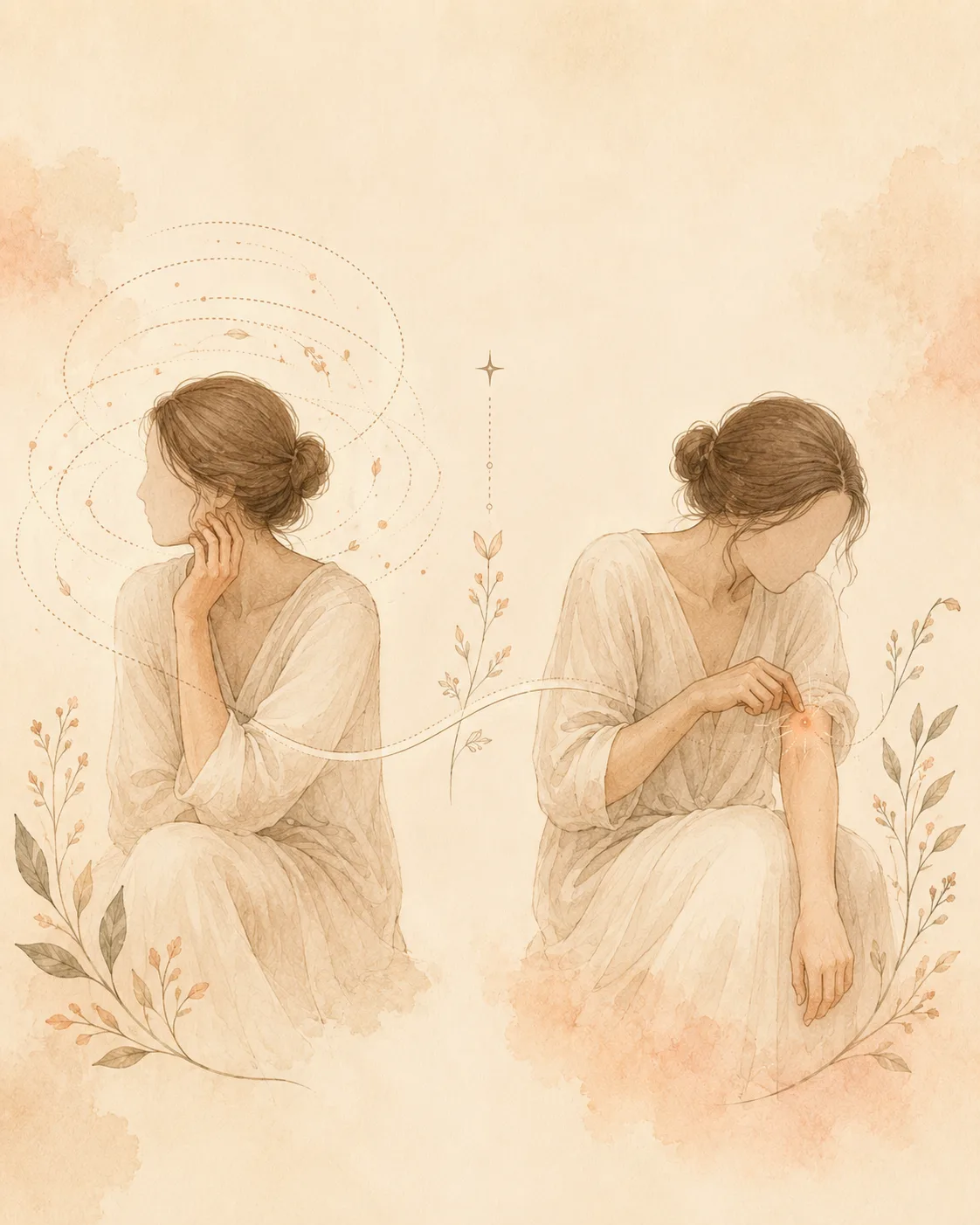
Most people who pick do both, but in different ratios. Automatic picking happens with your attention somewhere else. You're watching a show, scrolling, on a phone call, and your hand has been at your scalp or jaw or forearm for ten minutes before you notice. There's often no clear emotional trigger, just availability. The hand finds something, the something gets worked, you come back to the room.
Focused picking is the opposite. You go to the mirror on purpose. You're looking for something specific. The session might last an hour. There's often a target spot, a planning phase, and a strong urge that builds before you start. Focused picking is more likely to involve tools, more likely to cause visible damage in a single session, and more likely to be followed by deep shame.
People often assume their picking is one or the other and feel like a fraud if it's actually both. It's almost always both. The ratio shifts with stress, with menstrual cycle, with sleep, and with whether mirrors are nearby.
The ABC framework
The OCD Center of Los Angeles, via the Stop Skin Picking Coach blog, describes a useful three-part distinction for what gets picked:
A is for Anyone. Something almost anyone would touch or squeeze. A whitehead with visible content. A loose bit of cuticle. A scab that's about to fall off anyway. Picking at A-type targets isn't, on its own, a sign of disorder. Plenty of people without dermatillomania pick at A-type targets occasionally.
B is for Bump. A small tactile irregularity that only a person with a picking pattern would target. A barely-raised pore. A texture change. A spot that hasn't surfaced yet but can be felt under the skin. B-type picking starts to separate the pattern from typical grooming.
C is for Create. Picking at intact skin to make something to pick. Pulling, gouging, or breaking the surface to access a deeper layer. C-type picking is the most distinctive feature of excoriation disorder and is almost never present without it.
If you scored medium or high and your picking includes B-type or C-type targets, that's part of why it fits. If you scored low and your picking is almost entirely A-type, that's part of why it doesn't.
What is not dermatillomania
A few things often get confused with it:
- Acne touching. Squeezing the occasional pimple, even badly, isn't excoriation disorder by itself. The pattern, the frequency, and the C in ABC are what tip it over.
- Normal grooming responses. Picking a loose hangnail or peeling sunburn. These are universal and short-lived.
- OCD picking. OCD can drive picking that looks similar from the outside, but the internal experience is different. The picking is performed to neutralise an obsessive thought, and the relief is from the thought, not from the picking itself. If your picking is wrapped in specific rituals or in fears about contamination or symmetry, OCD is worth ruling in or out separately.
- Dermatological self-care. Squeezing a comedone with clean hands, once, after a steam, is not the disorder. The disorder is the loss of choice about whether the picking happens at all.
What to do next
The right next move depends on where you landed.
If you scored low
You don't need a treatment plan. What's useful is noticing. If your picking stays where it is, you're fine. If it grows, you'll catch it earlier than most people do, because you'll have a baseline. Save this page. Retake the quiz in three months if anything has shifted.
If you scored medium
This is the tier where structure helps the most, because the pattern is real but not yet entrenched. The first move is usually awareness rather than restraint. Logging when you pick, where on the body, and what was happening just before tells you more about your pattern in two weeks than years of trying to stop have. That's the basic premise of habit reversal training, the gold-standard treatment for body-focused repetitive behaviors.
SkinAware is built around exactly this kind of low-friction logging, with the habit reversal modules folded in so you're not only tracking, you're working through the same protocol a therapist would walk you through. It's not the only way to start. A notes app and a quiet hour with a written walkthrough of how to stop skin picking can also do it. The point is to begin somewhere structured, not somewhere willpower-based.
If you scored high
The strongest first move is talking to someone, ideally a clinician who has heard of BFRBs. The International OCD Foundation (iocdf.org), which now hosts the TLC Foundation's BFRB resources, maintains a therapist directory and is the most reliable starting point. If a therapist isn't accessible right now, for cost, geography, or readiness reasons, the same evidence-based protocol (habit reversal training, stimulus control, and competing response training) is also delivered through self-directed tools. Many people start with self-directed work and add a therapist later. Either order works.
What matters more than the order is not waiting alone. Dermatillomania responds to treatment, and the longer the pattern runs unattended, the more it shapes habits and scarring you'll later have to unwind. There's no medal for handling it solo.
Frequently asked questions
Frequently Asked Questions
No. A quiz like this one, or any self-test, can tell you that your pattern matches the criteria. A formal diagnosis requires a licensed mental-health clinician, usually a psychologist or psychiatrist, who can rule out other causes and assess severity. The quiz is a strong indicator, not a substitute.
Low scores happen for two main reasons. The picking is mild enough that it doesn't reach the criteria, or it's focused on acne and breakouts rather than on intact skin. Both are common. If picking still bothers you, it's still worth addressing, just not with the same intensity of intervention the full disorder calls for. Retake the quiz if anything changes.
No, although they sit close to each other in the diagnostic manual. OCD picking is driven by a specific intrusive thought that the picking is meant to neutralise, and the relief is from the thought going away. Dermatillomania picking is driven by an urge, often without a specific thought, and the relief is from the picking itself. The two can co-occur, and many people with dermatillomania have OCD-spectrum traits, but they're treated as separate conditions.
If picking is affecting your sleep, work, relationships, or how you move through public spaces, that's the threshold most clinicians use. If you've tried to stop and couldn't, that's another. If your skin has scars or persistent wounds you're hiding, that's a third. Any one of those is reason enough.
Yes. Excoriation disorder can begin at any age and frequently starts in adolescence around puberty, often coinciding with the onset of acne. In children and teenagers, the picture can be harder to read because some skin-touching is developmentally normal. A paediatric psychologist or child psychiatrist is the right person to assess it.
Dermatillomania is chronic in the sense that the underlying tendency tends to stick around, but the active behavior responds well to treatment. Many people reach long stretches with no picking at all, or with picking reduced to the point that it no longer affects their life. "Always" is the wrong word. "Manageable" is the right one.