
Written using peer-reviewed research including Houghton et al. (2018, Comprehensive Psychiatry), Houghton et al. (2019, Behaviour Research and Therapy), Schienle et al. (2022, Journal of Nonverbal Behavior), Falkenstein et al. (2018, Psychiatry Research), and trigger-prevalence data from Odlaug & Grant (2008), Neziroglu et al. (2008) and Bohne et al. (2002, Behavior Modification).
For a lot of people who pick, the thing that starts an episode isn't a feeling. It's a texture. A ridge on a cuticle, a scab that's gone crisp at one edge, a patch on the upper arm that's slightly wrong under a fingertip. Nothing has to be stressful for it to happen, and often nothing is. The finger finds it, the finding registers as intolerable, and the hand goes to fix it.
That's a sensory problem wearing an emotional problem's clothes, and it matters because almost all the advice you'll be handed assumes the emotional version. Track your mood before an episode. Notice what you were avoiding. Sit with the feeling. If your trigger was a bump, there's no feeling to sit with, and after a few weeks of looking for one you can end up fairly convinced you're either lying to yourself or failing at something simple.
If you want the groundwork on skin picking disorder itself, the foundational guide covers what it is and how it's diagnosed. This page is about the tactile route in.
What the trigger actually is
The research on picking triggers has been asking people this for over twenty years, and touch keeps coming out on top.
In a clinical sample, people with skin picking disorder named the feel of their skin as the most common trigger, at 55%, ahead of the sight of it at 26.7%. Earlier interview work put skin imperfections at 80% of reported visual triggers, with checking or examining the skin at 52%, itchiness at 40%, a "right feeling" sensation at 40%, and the sense of something sitting under the skin surface at 32%. In a non-clinical sample of German students, the specific textures were pimples (93.2%), insect bites (63.9%), scabs (57.1%) and itching (45.9%).
The numbers vary because the samples do. The ordering doesn't. Whatever else is going on, a physical irregularity on the skin is doing most of the work of starting episodes, and quite a lot of the work of continuing them.
There's more on the wider trigger picture, emotional ones included, in our guide to what sets picking off.
The pattern in the data isn't the one everyone repeats
Search this topic and you'll be told, more or less everywhere, that picking is sensory seeking: an under-stimulated nervous system generating input for itself. It's a tidy story. The measurement work is less tidy than that.
A 2018 study put adults with clinical body-focused repetitive behaviors, adults with subclinical ones, and people with neither through the Adolescent/Adult Sensory Profile, the standard adult self-report measure of sensory processing. It sorts responses into four patterns: low registration, sensation seeking, sensory sensitivity and sensation avoiding.
A follow-up the next year moved from questionnaires to instruments and found the same direction: people with pathological hair pulling and skin picking detected vibratory stimuli at lower thresholds than controls, meaning they registered touch that others didn't. Separate work on hair pulling found elevated tactile and auditory responsivity, the kind that shows up as being bothered by a shirt collar or a towel that isn't soft enough.
Read together, that's a fairly consistent picture, and it isn't hunger for input. It's turning up loud.
Your fingers aren't sharper. Your response is louder.
This distinction sounds academic until you test it, which somebody did.
A 2022 study took 160 people, blindfolded them, and measured actual tactile ability: two-point discrimination on the fingertip, and telling seven grades of sandpaper apart by feel. If people who pick had unusually fine texture perception, that's where it would show. It didn't. Discrimination performance predicted nothing about how severely someone picked.
What did predict it was the third task. Participants had their forearm stroked slowly with a soft brush, the standard paradigm for pleasant touch, the sort of thing that reliably reads as soothing. The people who picked most were the ones who reported an urge to pick while being gently stroked.
That's worth sitting with, because it inverts the usual advice. Gentle touch is what everyone recommends as the replacement: moisturize instead, stroke the area instead, be kind to your skin. For a subset of people, soft touch on skin appears to be an on-switch rather than an off-switch. If you've ever started an episode in the middle of applying moisturizer and quietly concluded you were beyond help, this is a documented effect and not a personal failing.
The same group had earlier found that people with skin picking disorder responded less than controls to gentle self-touch at the brain level. One reading of that, which the authors offer cautiously, is that if soft touch doesn't do its usual regulating job for you, something more intense may get recruited to do it instead.
Two routes, and how to tell which one you're on
Both patterns end with a hand on your face. They need different things.
The sensitivity route. The texture is aversive. It registers as wrong, it won't fade into background the way it does for other people, and picking is removal. What ends the episode is the wrongness being gone. People on this route often describe relief rather than pleasure, and they'll pick something that isn't remotely satisfying if it's the thing that was bothering them.
The seeking and low-registration route. The texture is interesting. Fingers roam, scanning for something worth working on, and the good part is the working. Episodes drift longer, often during under-stimulating stretches, and they end when you're interrupted rather than when you're finished.
Most people run both, with one dominant, and the dominant one should decide where the effort goes. Sensitivity route: reduce the number of textures available, and treat the ones you have. Seeking route: supply comparable input somewhere that isn't your body, on a schedule rather than in response to an urge.
If you're autistic, there's an additional layer here worth its own treatment, and the autism and picking connection is mapped separately. This article is written for the sensory trigger regardless of whether it arrives attached to a diagnosis, because it very often doesn't.
Delete the texture before you resist it
If a rough patch is what starts episodes, then the cheapest intervention available is having fewer rough patches. This gets treated as a footnote in most write-ups and it shouldn't be, because it's the only approach that removes the trigger rather than asking you to out-argue it.
Do it as an inventory rather than a resolution. Name the five specific places your fingers go most, and work out what's actually there:
- Bumpy upper arms or thighs are usually keratosis pilaris, which is extremely common, harmless, and responds to a urea or lactic acid cream far better than to willpower.
- Ragged cuticles and hangnails are a dryness problem with a mechanical fix. Cuticle oil at the desk rather than in the bathroom cabinet, and clippers rather than fingers.
- Persistent small bumps on the jaw or back may be folliculitis or ingrown hairs, both of which have dermatological answers and neither of which improves with excavation.
- Scabs from previous episodes heal into rough edges when left exposed. A hydrocolloid patch keeps the surface flat and, more usefully, physically out of reach.
- Dry flaking around the nose or hairline is often seborrheic dermatitis rather than ordinary dryness, and is treated differently.
The visual half of this deserves the same treatment. Magnifying mirrors turn ordinary pores into projects, and bright overhead bathroom light does the same job more slowly. Lower the light, lose the magnification. Neither is glamorous and both work.
What a sensory diet actually is
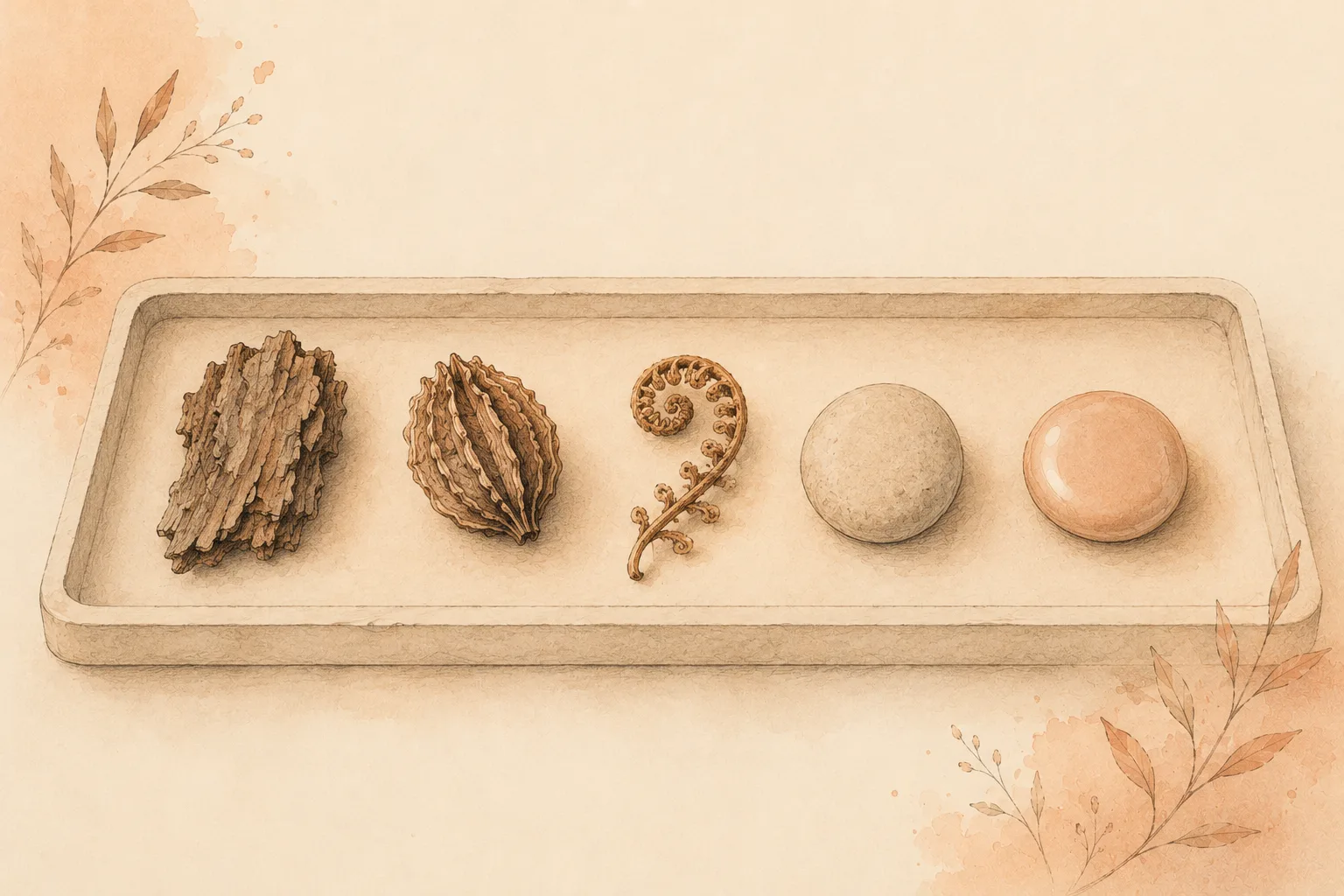
The term comes from occupational therapy, coined by Patricia Wilbarger and built on Jean Ayres' sensory integration theory. Ayres defined sensory integration in 1972 as the neurological process that organizes sensation from your own body and the environment so you can use your body effectively in it. A sensory diet is the applied version: planned sensory input spread across a day to hold you at a workable level of arousal, the way meals are spread across a day rather than eaten once you're already faint.
The distinction that matters here is between a sensory diet and a competing response. A competing response is reactive. The urge arrives, you deploy something against it. A sensory diet is scheduled, and it runs whether or not you feel anything, which is precisely why it reaches automatic picking that a competing response never catches. The competing-response protocol and its limits are covered here.
In practice that means input at fixed points rather than in emergencies. Texture in your hand during the 4 p.m. slump because 4 p.m. is when it goes wrong, not because you noticed an urge at 4:20. Deep pressure or heavy work in the morning if mornings are flat. Something for the mouth during long calls if that's where the biting lives.
What goes in your hand should match what you're chasing, and getting that match right is most of whether any of this works. Our guide to choosing fidgets by sensory signature works through that properly, including why smooth and squishy things fail people who are hunting for an edge.
Occupational therapy, the route nobody sends you down
When picking gets referred anywhere, it's to psychology. That makes sense, given that habit reversal training and the Comprehensive Behavioral model have the evidence behind them. But the sensory domain is exactly what occupational therapists are trained in, and almost nobody thinks to ask one.
What an OT brings that a CBT therapist typically doesn't is a structured assessment of how you process sensation across every channel, not just touch. The Adolescent/Adult Sensory Profile, developed by Catana Brown and Winnie Dunn, is a self-report measure for ages 11 and up covering visual, auditory, tactile, taste, smell and movement input, and it produces a profile across those four patterns rather than a yes-or-no answer. Knowing that you score high on sensitivity and low on registration tells you more about which strategies will fit than another month of episode logs will.
They also work at the level of the day rather than the episode: routines, environments, workstations, clothing, the actual conditions under which the picking happens.
If you want to try it, the practical route is your national professional association, the American Occupational Therapy Association in the US or the equivalent listed by the World Federation of Occupational Therapists elsewhere, and to ask specifically for someone who works with adults on sensory modulation. A therapist already treating your picking can often make the referral faster than you'll find one cold.
FAQ
No, and the two aren't alternatives. Skin picking disorder is defined by the picking, the damage, the repeated attempts to stop and the distress, not by what triggers it. Sensory processing describes one common route into it. You can meet every criterion for excoriation disorder and have a trigger that's purely tactile. Sensory processing difficulties also aren't a psychiatric diagnosis in their own right in the DSM, so this isn't a question of which label you get. It's a question of which mechanism you're working on.
Usually because the competing response was built to oppose a movement rather than to answer a sensation. Clenching your fists for a minute blocks the hand and offers nothing where the trigger was. The version that fits better is the Comprehensive Behavioral model, which assesses the sensory domain separately and builds substitutions that deliver the same feeling without removing skin. It's worth asking a therapist directly whether they assess sensory triggers or fold them into emotional ones.
Yes. Sensory sensitivity varies continuously across the population and isn't the property of any one diagnosis. The 2018 sensory profile study recruited on the basis of body-focused repetitive behaviors rather than neurodevelopmental diagnosis, and still found elevated sensitivity in the clinical group. The reason nearly everything written about sensory picking is framed around autism and ADHD is that those are the communities that talk about sensory experience openly, not that they hold a monopoly on it.
They're one tool and they fail often, almost always because they reproduce the wrong sensation. A smooth stress ball is no help to a fingernail looking for an edge. Match the object to the specific feeling you're chasing, own several so one is always within reach, and treat it as scheduled input rather than an emergency measure.
No, but change how and when. The affective touch finding suggests slow, light contact on skin can raise the urge in some people, so apply firmly and briskly, treat it as a task rather than a soothing ritual, and do it away from mirrors and immediately before something occupies your hands. Keeping skin in good condition removes triggers, and that's worth more than the risk of an occasional prompt.
Whichever route you're on, the thing that decides what helps is knowing what the texture is doing for you, and that's a question about pattern rather than willpower. SkinAware's episode logging captures the trigger and the time of day, which is what turns "afternoons are bad" into something specific enough to schedule against, and its HRT course is built on the ComB framework, so the sensory domain gets assessed properly rather than folded into mood. A notebook does the same job if you'd rather. The record is the part that matters.
Get support for picking, pulling and biting
SkinAware helps you log episodes, identify patterns, and see real progress over time.
Available on iOS, Android and in your browser.