
Written using the only two studies that have examined pregnancy in trichotillomania and skin picking disorder, ACOG guidance on skin conditions in pregnancy, a meta-analysis of antidepressant discontinuation in pregnancy, and obstetric research on third-trimester insomnia. Where evidence for skin picking specifically does not exist, this article says so.
You are pregnant, something has shifted in your picking, and most of what you would normally reach for has quietly stopped applying. The retinoid is out. The medication you may have been taking is now a conversation rather than a given. Your skin is producing things to find that weren't there three months ago, and the one instruction every pregnancy resource offers on the subject is a version of "avoid picking or squeezing," which is roughly as useful as being told to avoid feeling anxious.
The most useful thing to know first is that getting worse is not the default. Until this year there was essentially no research on this question, and the one study that finally asked it found that most people didn't experience an escalation. Some improved. Your symptoms aren't forecastable, but the terrain is, and pregnancy changes that on a fairly specific schedule.
What the research actually says
Almost nothing, and that's worth stating plainly rather than dressing up.
Until recently there was one study, from 1997, and it was about hair pulling. Keuthen and colleagues surveyed 59 people who pull, asking about menstruation and about pregnancy. The menstrual findings were reasonably clear. The pregnancy findings weren't: "the impact of pregnancy was less unidirectional, with both symptom exacerbation and lessening reported." Their conclusion ran to one sentence. "The impact of pregnancy on TTM is less clear."
Twenty-eight years later, a research group finally asked the question of skin picking directly. Grant, Chamberlain and colleagues recruited people with trichotillomania and/or skin picking disorder who had been through at least one pregnancy, and asked how their symptoms had related to it.
Two things follow, and they point in different directions.
The reassuring one: escalation is not the default. If you've been bracing for nine months of it because pregnancy hormones are supposed to make everything harder, the only data that exists says most people didn't experience that.
The unsatisfying one: this was a retrospective survey. People were asked to remember a pregnancy, sometimes years later, which is the design most vulnerable to memory shaped by what came afterwards. The authors say so themselves and call for the work to be done prospectively. The full text sits behind a paywall, so the precise proportions aren't something this article can quote you.
So your picking may worsen, stay flat, or ease. Nobody can tell you which, and anyone writing confidently about "the effect of pregnancy on dermatillomania" is describing a study that does not exist. What can be described specifically is the terrain.
What changes about your skin, and roughly when
This is the part with real evidence behind it, because obstetric dermatology has been studied properly even when BFRBs have not. Pregnancy doesn't vaguely affect your skin. It does a fairly specific sequence of things on a fairly specific schedule, and if you pick, that sequence is a map of what your fingers are going to find.
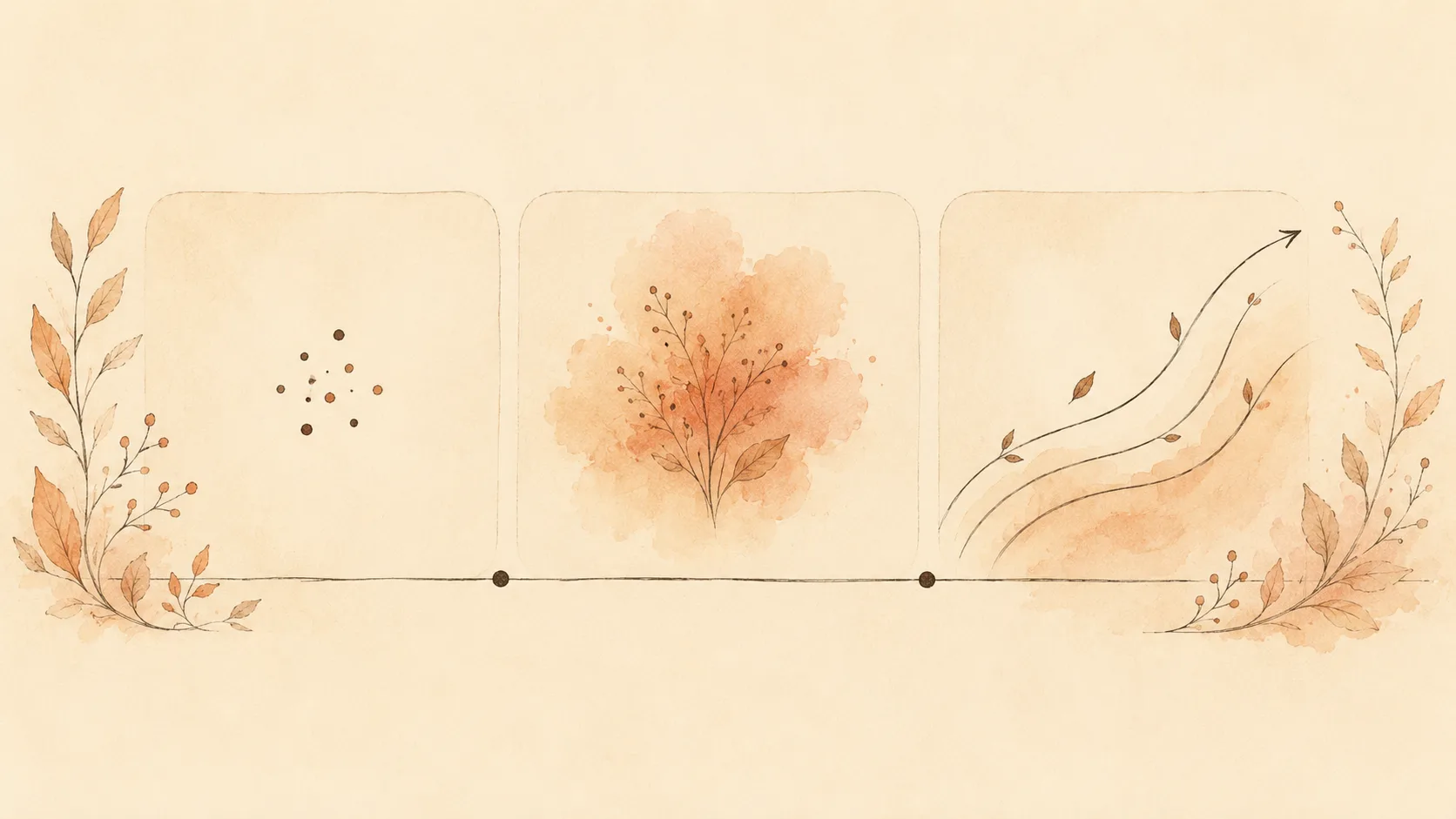
First trimester, often into the second: oil and breakouts. Rising progesterone increases sebum production. For some people that reads as the famous glow. For others it is acne, sometimes for the first time since adolescence, sometimes worse than adolescence, and typically along the jaw and chin. This is the biggest change in supply for most people who pick faces. If your picking has always been anchored to breakouts, there is simply more there now, and it isn't a lapse in discipline.
Second trimester: pigment. Melasma, the mottled brown patching across cheeks, forehead and upper lip, affects roughly three quarters of pregnant people. Linea nigra, the dark line down the abdomen, close to ninety percent. Neither is pickable the way a spot is. Both change what you see in the mirror, and for anyone whose picking starts with an inspection rather than a sensation, a face that suddenly looks uneven is an invitation to go looking.
Third trimester: stretching, itching, texture. As the abdomen and breasts expand, skin gets tighter, drier and itchier. Skin tags often appear under the arms and breasts. PUPPP, the most common pregnancy rash, shows up as itchy red patches around stretch marks late on and can spread to arms, legs and buttocks. Real, treatable, and miserable at exactly the point when reaching the affected area to care for it properly gets hardest.
None of this is unique to people with dermatillomania. What's different is that everyone else gets these changes as an annoyance and you get them as raw material. The wider hormonal picture across the menstrual cycle and perimenopause sits in its own article and deliberately left pregnancy out, because pregnancy behaves differently: it isn't a repeating wave you can average across cycles, it's a one-way sequence.
The itch that is not an urge
One thing on that list is not like the others, and it's worth knowing about before it happens rather than after.
Intrahepatic cholestasis of pregnancy is a liver condition in which bile flow is disrupted, and its main symptom is intense itching. It typically starts after about 28 weeks. It is usually worst on the palms and the soles of the feet, it is worse at night, and unlike the other itchy conditions of pregnancy it comes with no rash at all. It is diagnosed with a blood test, and it needs to be, because untreated it carries real risk to the pregnancy.
Say the itch out loud to a clinician even if you're half convinced it's psychological. That call takes four minutes and rules out the one thing on this page that is urgent.
The medication question
A lot of people find out they are pregnant and stop their psychiatric medication that same day, before telling anyone. If that's what happened, you're in extremely ordinary company. The useful thing now is to tell your prescriber this week rather than at the next scheduled appointment.
This article will not tell you whether to take medication during pregnancy, and you should be wary of anything online that does. What it can do is show why the question is harder than "is this drug safe," and why the answer is specific to you rather than general.
Start with the smaller half. No medication is approved by the FDA for skin picking or hair pulling, and the controlled evidence for SSRIs in skin picking is thinner than most people assume. So if you take an SSRI, there is a reasonable chance it was prescribed for depression, anxiety or OCD rather than for the picking, which means the pregnancy conversation is mostly about that condition and only secondarily about your skin.
Then the part people get backwards. The intuitive assumption is that stopping is the cautious choice and continuing is the risky one. The evidence doesn't divide that neatly.
That is one study producing two different answers, and which one applies to you depends entirely on your own history. The authors' recommendation is not that anyone should stop or continue. It's that women with severe or recurrent depression be told about the relapse risk, and monitored if they do discontinue. Your prescriber is the only person holding the information that decides which row of that table you are in.
The same logic covers supplements. NAC has the strongest trial evidence of anything in the BFRB space and is sold over the counter, which makes it feel lower-stakes than it is. Over the counter isn't the same as studied in pregnancy. It belongs in the same conversation, not in a shopping basket.
Why behavioral treatment gets more attractive right now
When the medication side of the ledger becomes complicated, the behavioral side becomes the part of the plan that is fully available to you. That isn't a consolation prize. Habit reversal training is the best-supported treatment for BFRBs generally, and it involves no fetal exposure to anything.

The mechanics of habit reversal are covered properly elsewhere. Three things about running it while pregnant are worth adding.
Your competing response probably needs rebuilding. The standard version, clenching fists or gripping something until the urge passes, assumes a body that hasn't changed shape. Late pregnancy changes your reach, what is comfortable to hold and for how long, and where your hands naturally rest. Rebuild it rather than concluding it stopped working.
Stimulus control gets new, specific targets. The generic version of that advice is vague. The pregnancy version isn't: the magnifying mirror matters more once melasma arrives, the bathroom lighting matters more once breakouts do, and the new sites (abdomen, breasts, thighs) are ones you are now being told to moisturize daily, which hands you a scheduled, sanctioned reason to have your fingertips on them.
Track where, not just how much. Because the site migrates, and because it migrates gradually, minutes-picked alone will hide it. Knowing your picking moved from face to abdomen around week 26 tells you which set of tactics to change.
That framing is worth borrowing. A pregnancy with severe sickness, a difficult scan, a hospital stay: those are extreme circumstances. Picking more during one is information about the circumstance, not a verdict on your recovery.
The pattern moves during pregnancy, and it moves quietly
SkinAware logs picked and resisted episodes in seconds with the body site attached, and its habit reversal course is available whatever else is on hold right now.
Available on iOS, Android and in your browser.
What is actually safe to put on your skin
The restrictions here are narrower than the internet suggests, but they land squarely on the products people who pick tend to rely on.
Retinoids are the clear one. Retinol, tretinoin, adapalene, tazarotene: all avoided during pregnancy, because oral retinoids are established teratogens and topical versions are treated on the same principle. If a retinoid was doing the work of keeping your skin clear, expect that work to stop, and expect more to find as a result.
ACOG's own list of over-the-counter acne ingredients that can be used during pregnancy is short and specific: topical benzoyl peroxide, azelaic acid, topical salicylic acid and glycolic acid. Anything outside that list is a question for your obstetrician rather than a search engine, and high-dose or peel-strength versions of even the listed ingredients are a different conversation from the low-percentage over-the-counter ones.
For the itching specifically, PUPPP responds to prescription steroid creams considered safe in pregnancy, so it is worth being treated rather than endured. Plain, fragrance-free emollients on tight, dry skin reduce the itch that generates the urge in the first place. Unglamorous, and it works.
Acne excoriee is worth reading if your picking is anchored to breakouts, because pregnancy makes its central point sharper: the acne is treatable to a point, the picking is a separate track, and clearing one does not automatically clear the other.
The third trimester: sleep, reach, and three in the morning
The last stretch has its own shape, and it is mostly about time and consciousness rather than skin.

Insomnia in the third trimester isn't a minor complaint.
That matters for picking in two ways that compound. Short sleep makes urges harder to sit with, which is true outside pregnancy too. And being awake at 3 a.m. with nothing to do, in the dark, in bed, hands free, is the highest-risk configuration there is. Most night picking happens in bed rather than at the mirror, and almost all of that transfers here. The parts needing adjustment: side-sleeping with a pillow between the knees leaves one hand permanently free and resting on skin, and getting up to break the cycle is a bigger undertaking at thirty-six weeks than at sixteen.
If you are already logging, this is where the log earns its keep. It'll show whether your picking is tracking sleep, the new sites, or the days around appointments, and those three findings lead to three different responses.
Frequently Asked Questions
Picking your skin does not directly harm a fetus. The realistic risks are to you: infection at broken skin sites, scarring, and the stress and shame that come with a flare-up. Infections during pregnancy are worth treating promptly, so an area that is spreading, hot, swollen, or producing pus should be seen rather than watched. If picking is severe enough to cause significant distress, that is worth telling your midwife or doctor, because untreated distress during pregnancy is itself worth addressing.
There is no way to predict it for an individual, and only one study has examined the question directly. In it, some people reported worsening while the majority reported no change or a reduction. That study was retrospective, so treat it as a rough signal rather than a forecast. What is more predictable is the supply side: pregnancy acne, melasma and late-pregnancy itching are common, and they change what your fingers find.
That is a decision for you and your prescriber, and it should not be made alone or abruptly. Stopping is not automatically the safer option. In a 2020 meta-analysis, women with severe or recurrent depression who discontinued antidepressants had more than twice the relapse risk of those who continued, while for mild to moderate depression the difference was not statistically significant. Your own history determines which of those findings is relevant to you. If you have already stopped, tell your prescriber promptly rather than waiting for a scheduled appointment.
Retinoids are avoided during pregnancy. ACOG lists topical benzoyl peroxide, azelaic acid, topical salicylic acid and glycolic acid among over-the-counter ingredients that can be used, and advises checking anything not on that list with your obstetrician. Hydrocolloid patches contain no active drug and are a physical dressing rather than a medication.
Mild itching from stretching skin is very common. Intense itching without a rash in the second half of pregnancy, especially on the palms and soles and especially worse at night, is a specific symptom of intrahepatic cholestasis of pregnancy and needs a same-day call to your midwife or doctor. It is diagnosed with a blood test. Do not assume an itch with nothing visible behind it is your BFRB.
The post-partum period was included in the same 2025 study, and the finding was the same: variable, with most reporting no change or reduction. The pressures shift rather than disappear, since sleep deprivation and long solitary stretches while feeding both suit picking. Worth separating out is mood: post-partum depression and anxiety are common, treatable, and different from a picking flare-up, and both can be raised at the same appointment.
Yes. It is a behavioral treatment with no fetal exposure, which is one reason it becomes a larger part of the plan when medication options narrow. The main adjustment is physical: competing responses designed for your pre-pregnancy body may need rebuilding as your reach and comfortable positions change.
Continue Reading
References
- Grant, J. E., Neelapu, M., Avila, L., Boutouis, S., & Chamberlain, S. R. (2025). Trichotillomania, skin picking disorder, and pregnancy. Comprehensive Psychiatry, 152647.
- Keuthen, N. J., O'Sullivan, R. L., Hayday, C. F., Peets, K. E., Jenike, M. A., & Baer, L. (1997). The relationship of menstrual cycle and pregnancy to compulsive hairpulling. Psychotherapy and Psychosomatics, 66(1), 33–37.
- Bayrampour, H., Kapoor, A., Bunka, M., & Ryan, D. (2020). The risk of relapse of depression during pregnancy after discontinuation of antidepressants: A systematic review and meta-analysis. Journal of Clinical Psychiatry, 81(4), 19r13134.
- Salari, N., Darvishi, N., Khaledi-Paveh, B., Vaisi-Raygani, A., Jalali, R., Daneshkhah, A., Bartina, Y., & Mohammadi, M. (2021). A systematic review and meta-analysis of prevalence of insomnia in the third trimester of pregnancy. BMC Pregnancy and Childbirth, 21, 284.
- American College of Obstetricians and Gynecologists. Skin Conditions During Pregnancy (patient FAQ).
- Society for Maternal-Fetal Medicine (2021). Consult Series #53: Intrahepatic cholestasis of pregnancy. American Journal of Obstetrics & Gynecology.
- TLC Foundation for BFRBs. Medications for Body-Focused Repetitive Behaviors.