
Written using per-episode data from an ecological momentary assessment study of diagnosed skin picking disorder, plus the validation and community-sample research behind the automatic and focused subscales.
Automatic picking is the kind you find out about. Focused picking is the kind you decide on. The whole distinction rests on one thing: whether you were aware of the moment it started. Duration, damage, body part and how you felt about it afterwards are all beside the point.
That sounds like a small technical difference. It is the reason two people can read the same list of anti-picking tactics and one of them gets somewhere while the other concludes that none of it works. Barriers, alarms and awareness drills are aimed at behavior that starts without you. Lighting changes, mirror rules and urge work are aimed at behavior you walked into. Aim one at the other and it does almost nothing, which is a very easy result to misread as "I've tried everything."
What the two words actually mean
The cleanest version of the question is the one researchers use to sort episodes. In a 2024 study that had 57 people with diagnosed skin picking disorder answer prompts on their phones seven times a day for ten days, all 1467 reported episodes were classified with a single yes or no: did you notice when you started picking your skin?
No is automatic. Yes is focused. That's the entire test.
The precision matters. The question isn't asking whether you knew you were picking at some point during the episode, because you almost always do eventually. It isn't asking whether you wanted to stop. It's asking about the first few seconds, and specifically whether they involved you.
Automatic episodes tend to arrive attached to something else you were doing. Hands on a keyboard, a phone, a book, a steering wheel, and a hand that goes wandering while your attention stays where you left it. You learn about the episode from evidence: a sting, blood on a fingertip, a changed texture under your thumb, occasionally somebody else looking at you.
Focused episodes have a beginning you were present for. Something drew your attention to your skin, you went toward it, and the picking followed from a decision, even a fast and half-hearted one. Most people can name the sentence involved.
"Which one am I" is the wrong shape of question
Most articles on this topic present two boxes and invite you to stand in one of them. That's where they lose you.
Roughly a third of that sample leaned clearly focused, with three quarters or more of their episodes starting consciously. Only eight people, 14%, leaned that heavily automatic.
The individual numbers spread enormously. One person's automatic share was zero. Another's was 98.2%. The middle of the sample sat at 39%, with half of everyone falling somewhere between 14% and 63%.

There's a second piece of evidence pointing the same way. In a study of 596 community adults, scores on the automatic and focused subscales of that MIDAS questionnaire correlated strongly with each other, at r = 0.67. If the two were opposite ends of one axis, high on one would mean low on the other. They don't behave that way. Doing a lot of one style tends to come with doing a lot of the other.
So the honest output of this exercise isn't a label. It's a ratio, it's yours, and it moves. The same research notes a drift from focused toward automatic as people get older, and most people can feel their own mix shifting between a busy week and a quiet one.
What genuinely differs, and what doesn't
Two claims about this distinction circulate constantly and neither survives contact with the per-episode data.
"Focused picking is more severe." It wasn't. Episode intensity came out at 2.56 for focused and 2.45 for automatic on a five-point scale, a gap that didn't reach significance. Urge intensity was 2.86 and 2.90, effectively identical. Focused episodes are more memorable, which is not the same as being worse, and the belief that they're worse leads a lot of people to spend all their effort on the half of the problem they can already see.
"Boredom drives focused picking, stress drives automatic picking." A high-traffic page from a major OCD treatment provider says exactly this. The data runs the other way on the first half and shows nothing at all on the second. Boredom scored higher in automatic episodes, not focused. Tension showed no significant difference between the two styles whatsoever, and neither did itch.
What did differ, in the direction you'd hope:
| Trigger | Focused | Automatic | Difference |
|---|---|---|---|
| Something seen or felt on the skin | 4.01 | 3.47 | higher in focused |
| Wanted to pick | 2.61 | 1.94 | higher in focused |
| Problems concentrating | 2.06 | 2.31 | higher in automatic |
| Boredom | 1.69 | 1.84 | higher in automatic |
| Tension | 2.67 | 2.84 | no significant difference |
| Itch | 1.75 | 1.81 | no significant difference |
| Habit or routine | 2.82 | 2.56 | no significant difference |
Read that table carefully and something useful falls out. The biggest gap of the lot, "wanted to pick," is close to a restatement of the definition. The differences that actually tell you something new, boredom and concentration, are small.
Which means the two styles are less different on average, across a whole population, than the framing suggests. The reason the distinction still matters so much is that averages aren't what you live in. Within your own week, an automatic episode and a focused episode are not slightly different versions of one problem. They start in different rooms, at different times, out of different states, and they need different things done about them.
Finding your own mix in a week
You need a count, not a quiz. A quiz asks how you generally are, and how you generally are is exactly the thing you're wrong about.
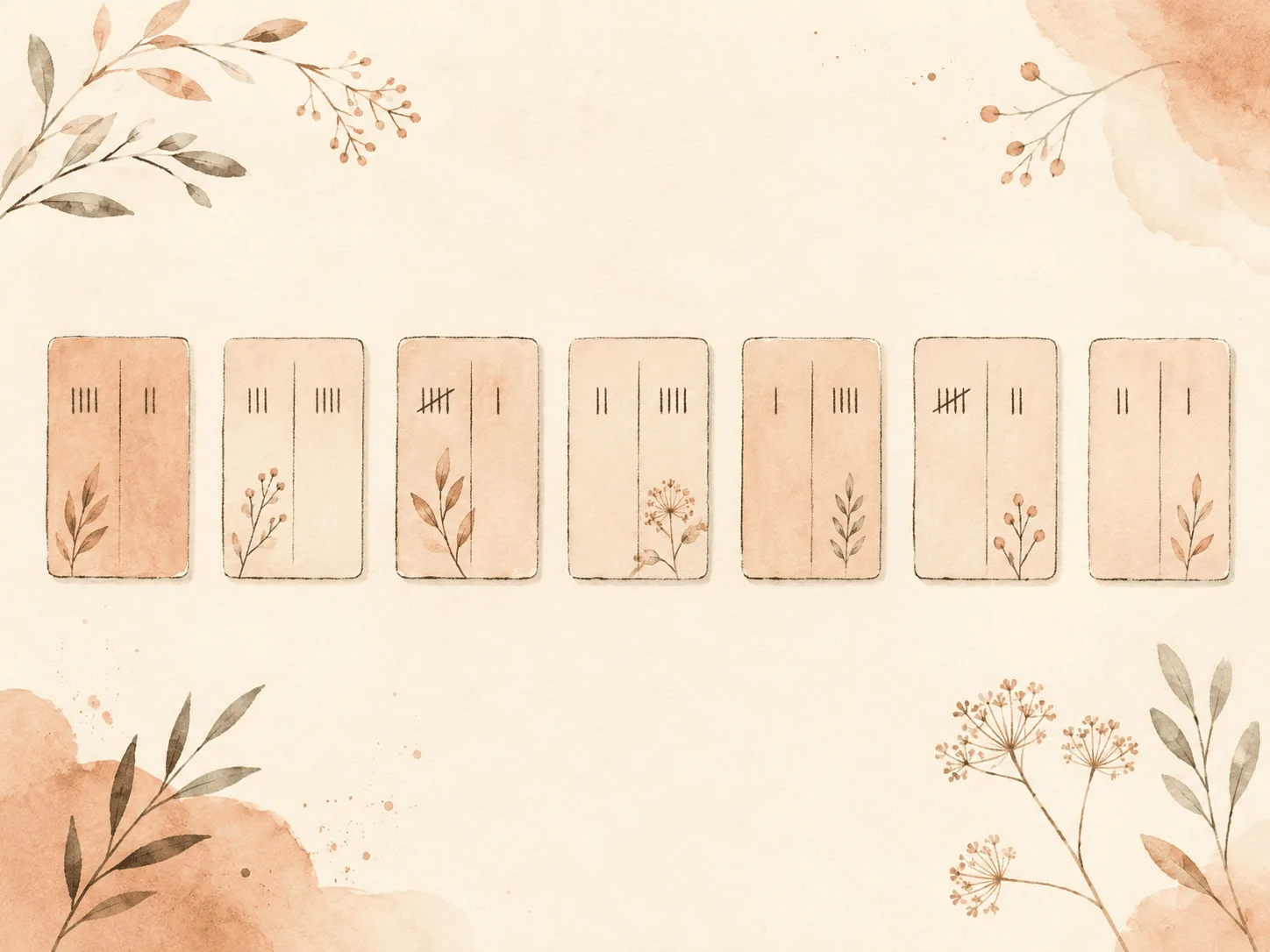
Ask one question, at the episode. Every time you catch yourself, ask: did I notice when this started? Two columns, one tally mark. That's it. Seven seconds of effort, because a method that takes longer than that gets abandoned by Wednesday and tells you nothing.
Count where it started, not where it ended up. A lot of episodes begin automatically and turn focused the moment you notice, which is genuinely confusing to record. The research question resolves it: the classification is about onset. If your hand was already there before you knew, that's an automatic episode with a focused second half, and it goes in the automatic column.
Don't reconstruct it later from memory. Retrospective counting is biased heavily toward focused, because focused episodes are the ones with a memory attached. Automatic episodes leave evidence rather than memories, and evidence fades by evening.
Note the setting in three words. Sofa, laptop, alone. Bathroom, after shower. After a week, the two columns usually sort themselves geographically without you doing anything clever. Automatic marks cluster around occupied attention: calls, reading, screens, driving, meetings. Focused marks cluster around windows, meaning the bathroom, the twenty minutes after makeup comes off, the stretch before bed.
Two weeks is better than one, mostly because it catches the rarer bad episodes and gives your awareness time to stop distorting the count. But one week is enough to see which column is heavier, and that's the only decision this is feeding.
If it's the specific triggers rather than the ratio you're after, our guide to what actually starts a picking episode covers a different week-long method aimed at that question.
What each answer actually changes
The point of the ratio is sequencing. It tells you which half of the advice to spend the next fortnight on, and which half to leave alone until that one is running.
If the automatic column is heavier, awareness is the bottleneck and everything else is downstream of it. You can't interrupt something you haven't noticed, so the first job is shortening the gap between the behavior starting and you knowing about it. That's the whole purpose of awareness training, the first component of habit reversal training, and it's unglamorous work that pays for everything after it. Alongside it, the tactics that keep working while you're not paying attention: a competing response rehearsed until your hands know it, something with real texture within reach of wherever you sit, patches on the spots that have become habitual destinations.
If the focused column is heavier, the room to act sits upstream of the pick, in the minutes before you arrive. Focused episodes have an approach: a room, a light, a mirror, a routine that ends with your fingers already in position. Changing those objects does more than resisting does, because the resisting happens at the worst possible moment and the objects don't get tired. The other half is the function question, which is what the episode is doing for you.
Every tip in our A to Z of tactics is tagged automatic, focused or both, so once you have a ratio that page becomes a shortlist rather than a menu.
If they're close, which is the most common result, take the slightly heavier one and work only on that for two weeks. Running both programs at once is the standard way people end up unable to tell what helped, conclude nothing did, and stop.
If you'd rather not run the count on paper, this is the part of SkinAware built for it. Logging an episode takes a few taps and includes an "Unconsciously" trigger tag, so your automatic and focused episodes separate as you go rather than at the end of the week, and resisted urges get logged the same way. The habit reversal course does the classification directly: one lesson walks you through the automatic and focused situations that apply to you, then shows your own two-bar pattern and routes the rest of the course accordingly. It's $5.99 a month or $34.99 a year, with a two-week trial on iOS.
Find your mix without keeping a tally
SkinAware logs episodes and resisted urges in seconds, and its habit reversal course maps your automatic and focused pattern before it starts giving you techniques.
Available on iOS, Android and in your browser.
Frequently Asked Questions
Very commonly, and it's usually the same shape: it starts without you, you notice partway through, and the second half is deliberate. For counting purposes it goes down as automatic, because the classification is about onset and because onset is the part you can do something about. The focused half of a mixed episode is still worth noting, though. It tells you how long your current catch time is.
No. Episode intensity and urge intensity came out statistically indistinguishable between the two styles in daily-life data. Focused episodes feel more serious because you remember them, and that memory bias is one reason automatic picking goes untreated for years.
They overlap but they aren't the same. Automatic simply means the onset happened outside your awareness, which describes a lot of ordinary divided attention: a phone call, a film, a spreadsheet. Some people do describe a trance-like quality to longer episodes, and that's worth mentioning to a clinician, but a wandering hand during a meeting is not evidence of anything unusual.
Yes. Research points to a general drift from focused toward automatic with age, and shorter-term shifts happen with stress, sleep, skin condition and how much of your day involves sitting still with free hands. If a plan that worked for months stops working, re-running a week of counting is usually more informative than deciding the plan was wrong.
No, and waiting for certainty is a good way to spend two months not starting. Habit reversal training covers both sides regardless. The ratio changes the order and the emphasis, not whether you begin.
Possibly, though one-sided patterns are rarer than people expect: only about one in seven participants in the daily-life study reported exclusively focused episodes. Before concluding it, spend a week checking the settings automatic picking prefers, which are the ones where your attention is elsewhere. Cuticles during a call and scalp while reading are the two most commonly missed entirely.
Either column. Scabs are one of the most reliable targets there is, and they get found both ways: deliberately checked in a mirror, and stumbled into by a hand that was already wandering. Which one it is for you is worth knowing, because it decides whether covering the spot or changing the bathroom does more.
Continue Reading
References
- Gallinat, C., Moessner, M., Wilhelm, M., Keuthen, N., & Bauer, S. (2024). Patterns of skin picking in skin picking disorder: Ecological momentary assessment study. Interactive Journal of Medical Research, 13, e53831.
- Walther, M. R., Flessner, C. A., Conelea, C. A., & Woods, D. W. (2009). The Milwaukee Inventory for the Dimensions of Adult Skin Picking (MIDAS): Initial development and psychometric properties. Journal of Behavior Therapy and Experimental Psychiatry, 40(1), 127–135.
- Pozza, A., et al. (2020). Early maladaptive schemas as common and specific predictors of skin picking subtypes. BMC Psychology, 8, 27.
- American Psychiatric Association. (2013/2022). Diagnostic and Statistical Manual of Mental Disorders, excoriation (skin-picking) disorder criteria.