
Written using occupational dermatology data on skin picking in healthcare workers, plus peer-reviewed research on video-meeting self-view and facial appearance dissatisfaction.
A desk job is close to a perfect picking environment, and almost nobody describes it that way.
Consider what an ordinary working day supplies. Six to eight hours of moderate, unbroken concentration, which is the exact mental state where a hand goes wandering without checking in first. Two hands resting on a keyboard, inches from ten fingertips and ten cuticles. A bathroom you can walk to at any point without explaining yourself to anybody. And, since roughly 2020, a screen that shows your own face back to you for hours at a stretch.
That's four different problems wearing one label. The desk, the video call, the bathroom, and the moment a colleague looks at your hands and says something. Each runs on a different mechanism, and each needs a different thing done about it. Aiming a desk fix at a bathroom problem is one of the more common reasons people conclude that nothing works at work.
The workday is an environment, not just a stressor
The usual framing is that work is stressful and stress causes picking. That's true as far as it goes, and it's also the less useful half of the picture, because you can't remove your job.
What's more actionable is that work supplies conditions. Sustained partial attention, idle hands, dry office air, overhead lighting, privacy on demand, and a face on a screen.
The authors were careful, and so should we be. They couldn't separate ordinary picking from the disordered kind, and they suspected that wet work and dry, cracked skin were doing a lot of the driving.
But the geography is the interesting part. When people pick at work, they pick at whatever is already in front of them. Which means the fix is mostly about what's in front of you.
The desk: the automatic half
Desk picking is overwhelmingly the automatic kind, which means it starts before you know it has. If that distinction is new, our guide to automatic versus focused picking explains why the two need opposite tactics.
The practical version: you can't decide your way out of something you didn't decide to start. So desk changes work best when they're structural, sitting there doing their job whether you're paying attention or not.
Occupy the resting hand. Watch yourself for a day and you'll notice the picking hand is almost never the busy one. It's the hand not on the mouse, parked somewhere while you read. That's the hand that needs a job, and it needs it within reach of where it actually parks, not in a drawer. Texture matters more than novelty. Our guide to choosing a fidget covers matching the object to the sensation you're chasing, which is the reason most desk fidgets get abandoned by week two.
Cut your nails shorter than feels necessary. Desk picking is fingertip picking, and fingertip picking is mechanically weak without a nail edge. This is the biggest single win available at a desk, and it takes four minutes.
Keep hand cream at the desk and use it hourly. Air-conditioned offices dry hands out, dry skin lifts and flakes, and lifted skin is a target that wasn't there yesterday. Applying cream is also a competing response that occupies both hands for thirty seconds.
Move the tools. Nail scissors live in the desk drawer, tweezers live in the make-up bag you carry. Both are twenty seconds from your hand at any moment, which is the whole problem. A nail file is the useful substitute, because filing an edge down removes the snag without removing skin.
Video calls: the mirror you can't walk away from
This is the newest of the four and the least discussed.
A bathroom mirror at least requires you to go to it. A self-view tile sits on your screen for the length of every meeting, at a distance and a lighting angle nobody chose, and it stays open while you're supposed to be doing something else.
None of that research is about skin picking. But if you pick at your face and you're spending three hours a day looking at it, the connection doesn't need much of a bridge.
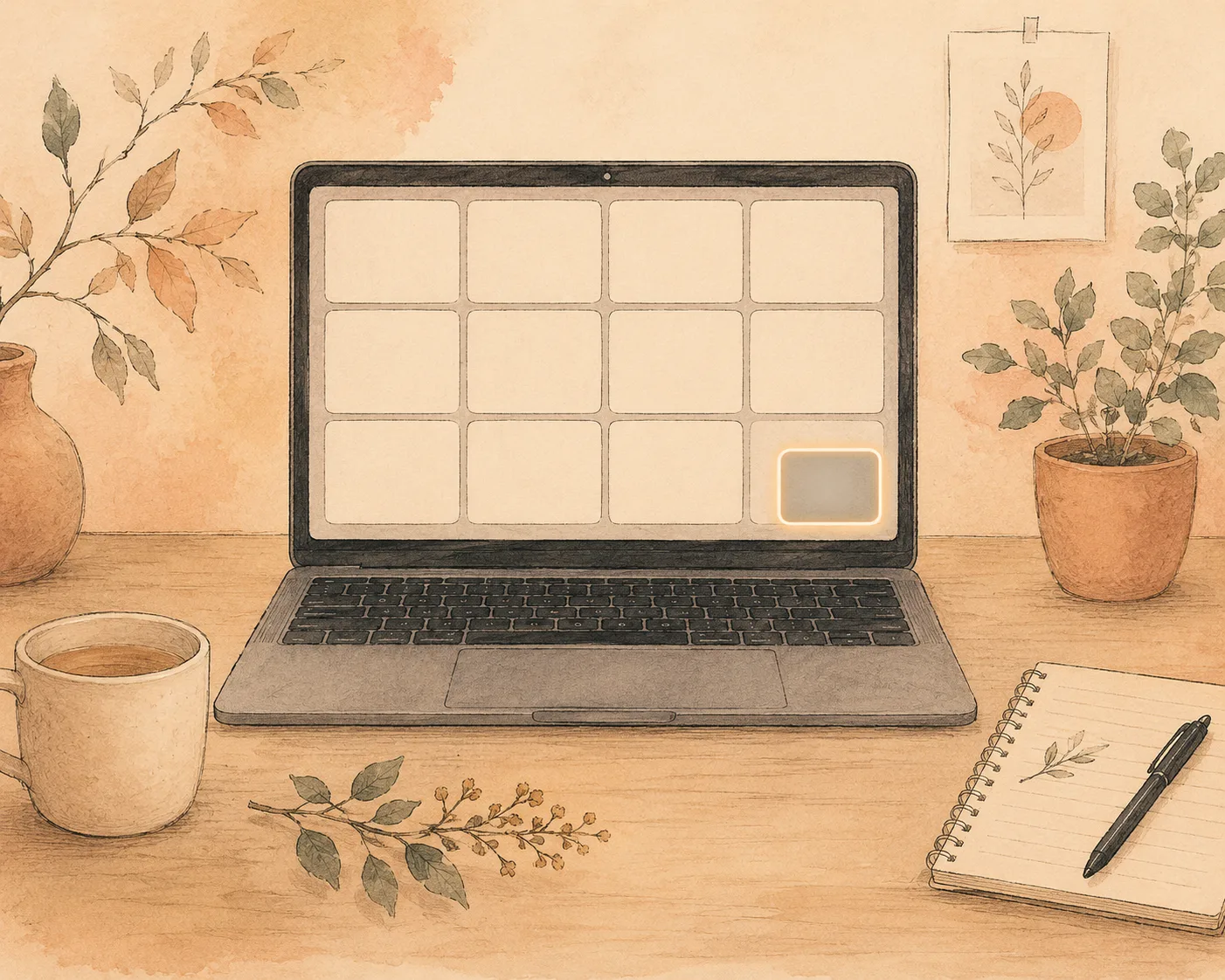
The fix is close to free.
- Zoom: right-click your own video tile and choose Hide Self View.
- Teams: open the menu on your own video and choose the option to hide it for you.
- Google Meet: the three-dot menu on your own tile has Minimize.
In every case your camera stays on and everyone else sees you exactly as before. Menu wording shifts between versions, so if the exact label isn't there, the thing you're looking for lives on your own tile rather than in the main settings.
Two more that help:
Put your hands in shot. It sounds like the wrong direction, and it works. A hand that's visible to eleven colleagues is a hand that stays where it is. This matters most during the long listening stretches, which are exactly when the automatic pattern shows up.
Take notes on paper. Both hands occupied, no willpower required, and it makes you look like the most engaged person in the meeting.
Your work laptop isn't the only screen doing this. The phone on the desk beside it carries a front-facing camera that most people use as a mirror without noticing, plus whatever your feed has decided you want to watch. The same logic and the relevant settings are in our guide to blocking triggers on your phone.
If the call itself is fine but the twenty minutes afterwards aren't, the call isn't the problem. The bathroom is.
The office bathroom
The office bathroom is the only place at work you can go, alone, at any time, without a reason. That single fact explains most of what happens in it.
Trying to ban the trip doesn't work, because you'll take it anyway and then feel worse about it. Change what happens inside it instead.
Use a different bathroom. A floor up, a different wing, ideally one where the mirror isn't directly over the sink. The nearest one is the one your habit has memorized. A less familiar room breaks the sequence more effectively than resolve does.
Stay back from the mirror. Distance is the variable that decides whether you see a face or a map of individual pores. Nothing needs deciding if you never get close enough to find a target.
Give the trip a fixed ending. Wash, dry, cream, leave. Rehearsed as one motion, the visit gets a shape that finishes, which the open-ended version never does.
Take something with you. Hand cream in a pocket, applied at the sink, occupies the thirty seconds where you'd otherwise be looking.
If an episode has already happened, the ten minutes after it are worth more attention than the episode itself. Going straight back to your desk with a plan to never do it again is how the next one gets set up. Two minutes outside, or a task that needs your hands, resets more than a promise does.
When someone asks about your hands
At some point a colleague notices. Usually it's kind, usually it's small talk, and small talk wants a small answer.
The instinct is to explain, and explaining is what makes the moment memorable to both of you. Something short and true works better than something detailed and defensive:
- "Dry skin. This office air is brutal."
- "I've been at my cuticles again. Hazard of a keyboard job."
- "It's a skin thing, it flares up sometimes."
None of these are lies. They're true and incomplete, which is the ordinary register of every other conversation you have at work. Then ask them something. A returned question moves attention off you faster than any amount of elaboration.
If you want practical cover, plasters on two fingers read as completely unremarkable, and hydrocolloid patches sit under office lighting better than makeup does.
There's one thing worth knowing about that moment. If the person asking is someone you'd trust with the real answer, their question is the cheapest opening you'll ever get. You don't have to take it. It's easier than raising it cold, though, and it's worth recognizing when it happens.
Whether to tell anyone
This isn't a step in a program. It's a trade, and one half of it can't be undone.
What disclosure can buy: not having to perform normality, a fidget on your desk that needs no explanation, sometimes flexibility about cameras or hours. What it costs: you can't un-tell someone, information moves through workplaces on its own, and you know your employer better than any article does.
Before you weigh it, notice how much of this list needs nobody's permission. Shorter nails, cream on the desk, a textured object beside your keyboard, self-view hidden, a bathroom on a different floor. Not one of those requires disclosing anything to anyone.
If you do want a change that involves your manager, you can often ask for the condition without the diagnosis. "I concentrate better with something in my hands" is a complete sentence. So is "I'd rather keep my camera off for internal calls." Neither requires a medical history.
A week of work data beats a month of trying harder
Work is the most repeatable environment most of us have. The same desk, the same recurring meetings, the same 3pm. That regularity is tedious in every other context and genuinely useful in this one, because a pattern that repeats weekly shows up inside a week of notes.
You're looking for three things: what time of day, which of the four surfaces, and whether you noticed it starting. Nothing else. A week of that tells you which section of this article is actually yours, and the answer surprises most people. The meeting they dreaded turns out to be fine. The unremarkable Tuesday afternoon block turns out to be where it all happens.
If you want the same information at a finer grain, our guide to finding your triggers runs a longer version of this count, and habit reversal training is the structured program the awareness work belongs to.
This part is what SkinAware is built for. Logging an episode takes a few taps and includes an "Unconsciously" tag, so your automatic and focused episodes separate as you go instead of at the end of the week, and urges you resisted get logged the same way. Its in-app tools are short enough to run at a desk between meetings, and the habit reversal course teaches the competing-response work that makes a desk fidget do something rather than just sit there. It's $5.99 a month or $34.99 a year, with a two-week trial on iOS.
Find your workday pattern in a week
SkinAware logs episodes and resisted urges in seconds, tags whether you noticed it starting, and its habit reversal course turns that pattern into a plan.
Available on iOS, Android and in your browser.
Frequently Asked Questions
Not necessarily, and assuming so sends you after the wrong fix. Work also supplies long stretches of divided attention, idle hands and dry air, none of which are stress. If your picking clusters in unstressful stretches like reading or listening on a call, understimulation is a more likely driver than pressure. The distinction matters because the tactics barely overlap.
They fail differently. Home gives you privacy, a bathroom whenever you want one and nobody to see your hands, which suits focused picking. An office removes the privacy but adds hours of video calls, unflattering overhead light, and the specific tension of being watched. Plenty of people find their picking dropped in one column and rose in the other after switching.
Some people do, and thin cotton or texting gloves attract less attention than you'd expect if you're mostly on a keyboard. It's worth being clear about what they do, though. Barriers buy you time and awareness, not a cure, and they stop working the moment they come off. Treat them as one layer alongside the structural changes rather than a replacement for them.
Occupy your hands with something the meeting itself explains. Handwritten notes are the best cover story there is. Second best is a small textured object under the table, ideally one that makes no noise. If it's a video meeting, hide your self-view before it starts rather than during it.
Short term, plasters on the worst two or three spots are unremarkable and buy healing time, and healing time is what actually changes how your hands look. Longer term, the fingertip and cuticle damage most desk workers carry responds well to keeping nails short and hands moisturized, because both remove the snags that give picking somewhere to start.
Only if you want something specific that requires it, and only after you've checked what protections apply where you work. HR represents the organization rather than you, which isn't sinister but is worth knowing. Most of the changes in this article need nobody's approval at all.
It's a plausible one. There's solid research linking self-view to negative self-focused attention and appearance dissatisfaction, though none of it studies skin picking specifically. Hiding your self-view is close to a free experiment: it takes seconds, nobody else can tell, and two weeks of it will tell you whether that pattern is yours.
Continue Reading
References
- Symanzik, C., Brans, R., Skudlik, C., John, S. M., & Dicke, K. (2023). Skin picking: a problem among healthcare workers? Health Science Reports, 6, e1348.
- Ratan, R., Miller, D. B., & Bailenson, J. N. (2022). Facial appearance dissatisfaction explains differences in Zoom fatigue. Cyberpsychology, Behavior, and Social Networking, 25(2), 124–129.
- Job Accommodation Network. Obsessive Compulsive Disorder (OCD) accommodation guidance, askjan.org (United States).