

Written using the Comprehensive Behavioral (ComB) model of body-focused repetitive behaviors (Mansueto & Golomb, International OCD Foundation), a multicentre subtyping study of picking and pulling (Journal of Psychiatric Research, 2021), research on incompleteness in excoriation disorder (Cognitive Therapy and Research, 2021), a qualitative study of perfectionism in trichotillomania (Psychology and Psychotherapy, 2025), and experimental work on the frustrated action model (Journal of Behavior Therapy and Experimental Psychiatry, 2015).
A lot of skin picking isn't an attack on your skin. It's an attempt to repair it. The bump is wrong, so it should come off. The patch is uneven, so it should be smoothed. Something is under the surface that shouldn't be under the surface, so out it comes. From the inside, none of that registers as harm. It registers as maintenance.
Notice the words people actually use. Fixing. Cleaning it up. Getting it out. Sorting it. Finishing it. Those are repair words, and they explain two things at once: why episodes cluster around specific perceived flaws instead of spreading evenly across skin, and why picking can feel productive while it's happening.
That feeling is why this kind of picking resists the usual advice. You can't talk someone out of a task they believe they're halfway through.
Picking as repair, not damage
Correction picking has an object. There's a specific thing wrong, in a specific place, and a specific action that would resolve it. Picking that soothes you, occupies restless hands, or happens while your attention is somewhere else entirely doesn't work like that. It has a function but no target.
A target changes everything. It gives the behavior an internal logic, and logic is far harder to interrupt than a habit is.
Most of what's written about perfectionism and picking treats perfectionism as an emotional driver. Perfectionists get frustrated, the theory goes, and frustration triggers picking. That's real, and it's the smaller half. The bigger half is that the picking is the perfectionism, applied directly to skin.
What the research actually says
The clinical framework that takes this seriously is the Comprehensive Behavioral model, developed by Charles Mansueto and colleagues and usually shortened to ComB. It sorts what drives a picking or pulling episode into five domains, remembered as SCAMP: sensory, cognitive, affective, motor, and place.
The cognitive domain is the one that matters here, and Mansueto and Ruth Golomb give examples of the triggering beliefs in plain language: "Kinky hairs are ugly and have to go," "My pimples have to be popped to heal," "My eyebrows or lashes must be symmetrical." They're just as direct about what reinforces the behavior afterwards. The consequence, in their words, is "satisfaction gained from completing the goal."
Completing the goal. Not relief. Completion.
The quantitative research points the same direction. In a multi-site study of 279 adults with hair pulling, skin picking, or both, statistical modelling found three subtypes of hair pulling and two of skin picking, and perfectionism was one of the traits that separated them. A separate study of people who pull their hair without distress found that perfectionism was one of the things distinguishing them from people with diagnosed trichotillomania, and that the difference held even after symptom severity was accounted for. Same behavior, different burden, and perfectionism tracked the burden rather than the frequency.
The most useful finding is also the most surprising, because it suggests the trait involved isn't really high standards at all.
The shape of it is worth sitting with. Whatever is driving correction picking, it isn't primarily the drive to be excellent. It's a low-level intolerance of something being not quite right yet, which is a different feeling with a different remedy.
The same thing shows up in hair pulling, described more vividly than any questionnaire manages. In a 2025 interview study, twenty women with trichotillomania described searching for particular hairs: coarser, differently textured, out of place. The researchers called that theme "the perfectly imperfect hair". Perfectionistic traits were present in all twenty of them, including the ones who didn't think of themselves that way.
Why the standard toolkit slides off this
Three separate things go wrong, and only the first one gets discussed.
Substitution has nothing to substitute for. Competing responses, fidget toys and textured objects work by offering a replacement for what the behavior was providing. When picking is doing sensory or emotional work, that's a fair trade. When the job is removing one specific bump, nothing else performs it. The wider version of this problem, and why appearance-focused advice tends to misfire, sits inside the loop that correction picking is one stage of.
Waiting it out only reschedules it. "Ride the urge, it'll pass in a few minutes" is sound advice, and it's built on the fact that urges decay. Targets don't. The bump is still there in ten minutes, still there tomorrow morning, and the delay you performed successfully has bought you nothing except a later episode. This is why people who do everything right with delay tactics still report picking the same spot four days running.
The thought is usually partly true. Most cognitive advice assumes a distorted perception you can test against reality. Here the perception is often accurate. There is a bump. It is raised. What's distorted isn't the observation, it's the demand attached to it, and if you go looking for evidence that the spot doesn't exist you'll find the opposite and lose the argument in about four seconds.
The sentence that starts it
Correction beliefs almost never arrive as full sentences. They arrive compressed, in a fragment or a feeling, which is what makes them so hard to catch.
Written out, they usually look like one of these:
- "It'll heal faster once it's out."
- "It's already there, so it doesn't count."
- "Just this one, and then I'll stop."
- "I can't leave it like that."
- "It's ready."
- "If I don't do it now it'll be worse tomorrow."
- "I'm just going to have a look."
Read cold, in daylight, most of them are obviously not true. Read at eleven at night, six inches from a mirror, every one of them is persuasive.
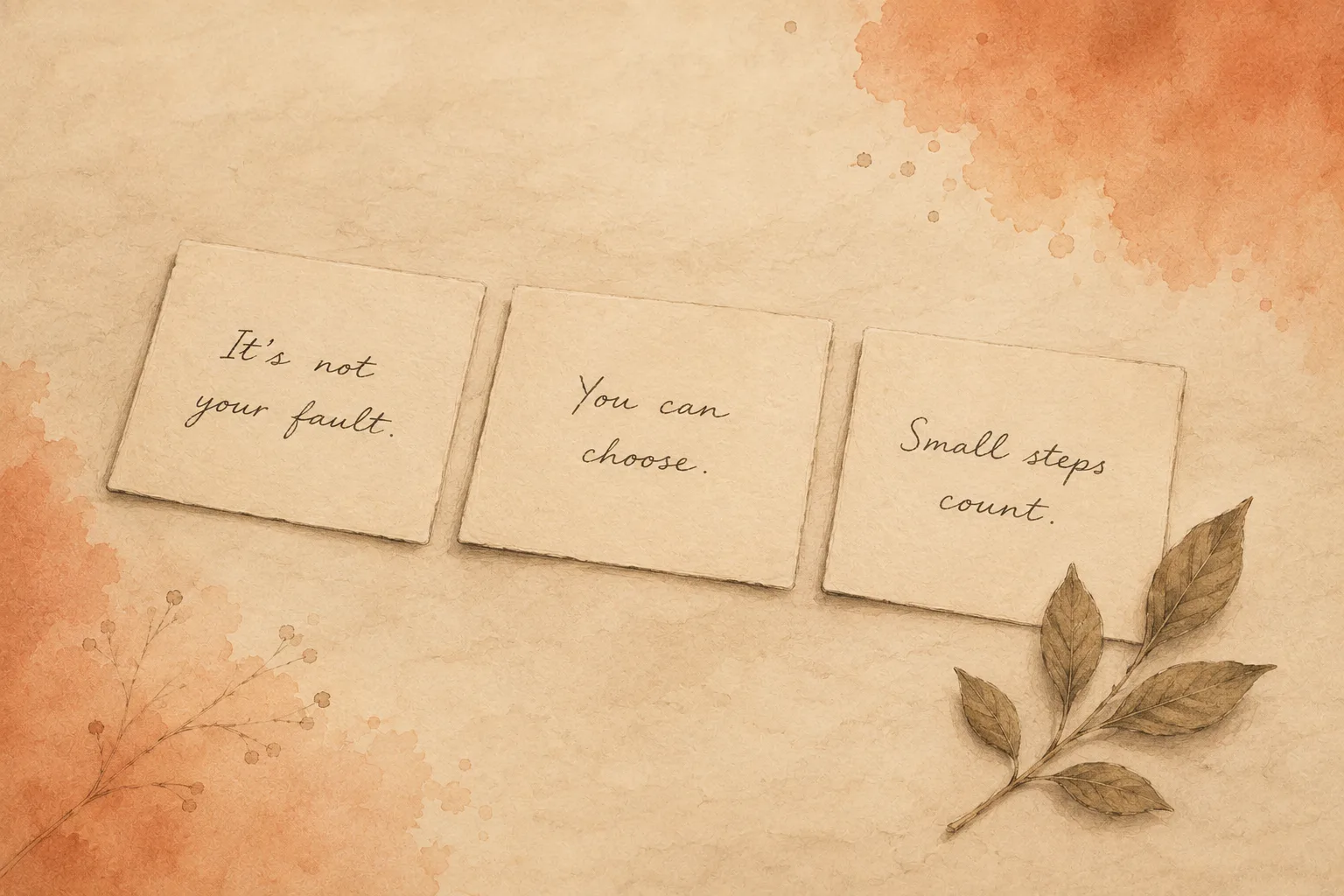
Arguing with them at that distance is a losing position. Testing them later isn't. Several of these are factual claims about your own skin, which means your own skin can answer them.
Take the most common one. "It'll heal faster once it's out" is checkable: note the spot, note the date, look again in three days, and compare it against a spot you left alone. Do that a handful of times and you'll have something no amount of self-talk generates, which is your own evidence, gathered on your own face, about the belief that keeps launching episodes.
Practising imperfection instead of arguing with it
The target isn't believing your skin is fine. It's raising how much unfinished you can stand.
That's a smaller ask than it sounds, and it's the one that moves. What follows is deliberately unglamorous.
Leave one standing. Every day, choose one thing you'd normally handle in passing and don't. Not the worst one. A small one. The point isn't the restraint, it's the discomfort afterwards, because that discomfort is the thing you're actually training.
Time the feeling, not the urge. When the not-right-yet sensation arrives, set ten minutes and pay attention to what it does when nobody answers it. Most people have never once let that feeling run to the end, which means most people don't know it ends.
Answer the sensory half. This is the one substitution that genuinely works on correction picking. A hydrocolloid patch puts a physically smooth surface over the bump. So does a clay mask on a rough patch. Part of what you were chasing was smooth, and smooth is available without removal.
Define "done" before you start. Correction picking has no natural stopping point, because the criterion is a feeling and the feeling never arrives. So set the criterion in advance and make it countable. Two minutes. One spot. Then it's finished whether or not it feels finished.
Let healing be the argument. Photograph a left-alone spot on day one and day four. The comparison does the persuading, and it can't be talked out of.
None of this asks you to stop thinking the bump should come off.
Awareness and competing responses still belong in the plan, they just belong second here rather than first. Habit reversal training is the structure the rest of this hangs on once the tolerance work is underway.
If you want the belief captured at the moment it fires rather than reconstructed later, that's the case for logging it on your phone. SkinAware logs an episode or a resisted urge in a few taps, with the trigger, how you felt, and what the aftermath was, so the pattern that connects a specific thought to a specific episode assembles itself instead of relying on your memory of a week you'd rather not revisit. It's $5.99 a month or $34.99 a year, with a two-week trial on iOS.
Catch the thought before the episode
SkinAware logs picking episodes and resisted urges in seconds, with the trigger and how you felt, so correction beliefs become visible instead of automatic.
Available on iOS, Android and in your browser.
The perfectionism that isn't about your skin
There's a second route, and it doesn't run through appearance at all.
The frustrated action model proposes that people who overprepare and try to accomplish too much generate their own frustration, impatience and boredom, and that those states drive body-focused behaviors. In a small experimental test, 24 people with BFRBs and 23 controls were put through conditions designed to induce boredom and frustration, stress, or relaxation. Urges rose in the boredom and frustration condition compared to relaxation, and the BFRB group scored higher on a maladaptive planning style that correlated with difficulty regulating emotion.
The interview study found both ends of the same spectrum. Some participants pulled while concentrating hard on work they cared about doing well. Others pulled while avoiding work entirely, and one described that with unusual precision.
If that's the version you recognise, the intervention isn't about your skin. It's about how you approach tasks: what you overprepare for, what you put off, and the standard neither strategy ever quite meets.
Frequently asked questions
Not on its own. Incompleteness is a transdiagnostic experience, meaning it turns up across OCD, tics, hoarding and body-focused behaviors rather than belonging to any one of them. What it does suggest is that approaches built for compulsions may be more relevant to you than approaches built for anxiety. If you're also experiencing intrusive thoughts and rituals in other areas of life, that's worth raising with a clinician.
Yes, and it's common. The research pointing to incompleteness rather than high standards is the reason. Being untroubled by mess, deadlines or mistakes has no bearing on whether an uneven patch of skin feels unbearable to leave alone.
A dermatologist performing an extraction is doing something different from what fingers do at midnight: sterile conditions, tools designed not to rupture the follicle wall underneath, and a judgement about which lesions are suitable. Self-extraction often pushes some of the contents deeper, which is what turns a small blemish into a longer-lasting mark. If persistent or painful spots are part of why you pick, treating the acne properly with a GP or dermatologist removes the reason rather than the opportunity.
The distinction is what your attention is fixed on. Correction picking aims at specific, temporary things with an endpoint, so the spot goes and the episode is over. In body dysmorphic disorder the concern is a feature or a face experienced as defective, other people usually can't see it, and fixing one thing reveals the next. They overlap often enough that it's worth sorting out with a clinician rather than alone.
They usually are. That's what makes this hard to treat with standard cognitive techniques, and it's why the work is about tolerating something real rather than disputing something imagined.
Start with the picking, because the behavioral work has the strongest evidence and it's available now. But if you keep bouncing off techniques that assume your picking is about stress, tell a therapist explicitly that yours is about correction. It changes what belongs in the plan: less substitution, more tolerance practice, and direct work on the beliefs that launch an episode.
References
- Mansueto, C. S., & Golomb, R. G. Comprehensive Behavioral (ComB) Treatment for Skin Picking and Hair Pulling Disorders. International OCD Foundation.
- Grant, J. E., Peris, T. S., Ricketts, E. J., et al. (2021). Identifying subtypes of trichotillomania (hair pulling disorder) and excoriation (skin picking) disorder using mixture modeling in a multicenter sample. Journal of Psychiatric Research, 137, 603–612.
- Ricketts, E. J., Snorrason, I., Mathew, A. S., et al. (2021). Heightened sense of incompleteness in excoriation (skin-picking) disorder. Cognitive Therapy and Research, 45.
- Zarandi, A. L., Millar, J. F. A., Waites, E., & Stevenson, J. L. (2025). A qualitative study exploring the role of perfectionism in trichotillomania. Psychology and Psychotherapy: Theory, Research and Practice, 98(4), 901–917.
- Flannery, M. K., Falkenstein, M. J., Boyd, M., & Haaga, D. A. F. (2023). Untroubled pullers: an examination of nonclinical hair-pulling. Journal of Obsessive-Compulsive and Related Disorders, 38, 100821.
- Roberts, S., O'Connor, K., Aardema, F., & Bélanger, C. (2015). The impact of emotions on body-focused repetitive behaviors: evidence from a non-treatment-seeking sample. Journal of Behavior Therapy and Experimental Psychiatry, 46, 189–197.