
Written using peer-reviewed research on appearance-related concerns in pathological skin picking (Frontiers in Medicine, 2023), phenomenology and body image in skin picking (Frontiers in Psychiatry, 2021), co-occurring skin picking and body dysmorphic disorder (Body Image, 2015), and a clinical review of excoriation disorder versus skin-centered BDD (Dermatologic Therapy, 2020).
If you pick mostly at skin you can see, then how you feel about your appearance and how much you pick aren't two separate problems. They're one system, running in a circle, and each half keeps the other going.
The circle works like this. Dissatisfaction with your skin sends you to inspect it. Inspection is very good at finding things, because skin under close attention always has something on it. Picking is what you do about what you found. The damage that follows is worse than what you started with, so there's more to be dissatisfied about, and the loop is round again.
Almost everything written about this treats the appearance distress as wreckage: picking damages your skin, and feeling bad about your skin is the cost you pay afterwards. That's true, and it's the smaller half of the story. The research points in the other direction as well, and once you can see the loop running forwards instead of backwards, the reason ordinary body-image advice keeps sliding off you starts to make sense.
The four stages, named
Naming the parts matters more than it sounds, because the loop is much easier to interrupt at some points than others.
Dissatisfaction. A background sense that your skin isn't right. Not usually a dramatic thought. More often a low, constant, barely-verbal preference for a version of your face that doesn't currently exist.
Inspection. You go and look. Or you run your fingers over your jaw at a red light. The important thing about this stage is that it always succeeds. Nobody inspects their skin closely and concludes there's nothing there.
Correction. You pick, squeeze, extract, or scratch, with a rationale attached. Getting it out. Cleaning it up. Making it flat. This stage feels productive, which is why it's so hard to argue with in the moment.
Confirmation. An hour later, the area is red, raised, and more visible than the thing you were correcting. The evidence that your skin isn't right is now real, and it's evidence you made. Back to stage one, with the belief better supported than before.
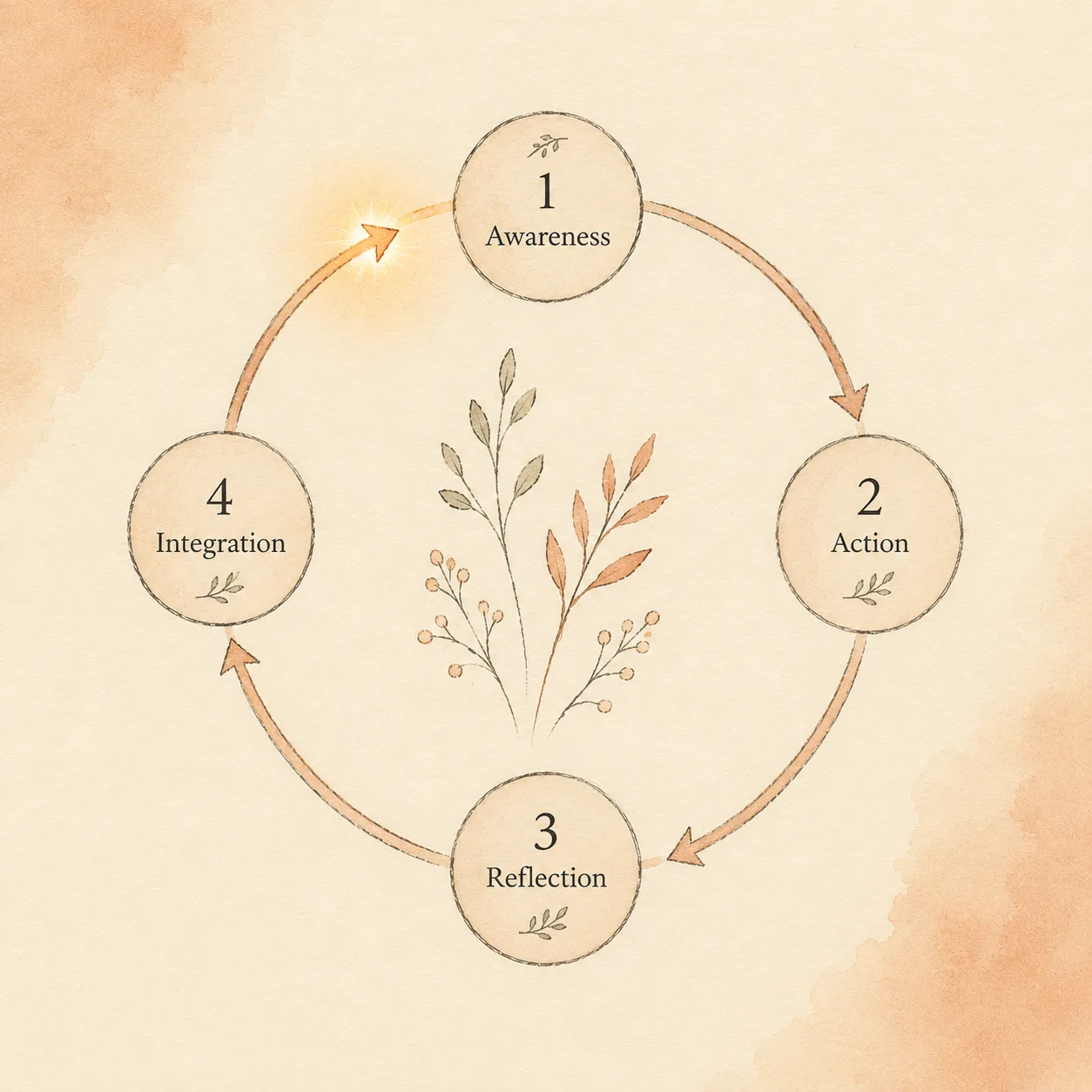
Most advice aims at stage three, the picking itself, because that's the visible stage. Stages one and two are where the loop is actually easier to break, and they're the ones almost nobody works on.
What the research actually found
One study was built to answer the question you'd actually want answered: is the appearance distress just proportional to the damage?
Sit with the middle of that ranking for a second. People who pick, with no diagnosed dermatological condition at all, reported more appearance distress than people living with diagnosed acne, eczema, or psoriasis. And only the picking groups crossed the clinical threshold. Whatever is driving the distress, it isn't tracking how much is objectively visible on someone's face.
The same study screened for body dysmorphic symptoms. Among skin-healthy participants, 7.2% screened positive. Among people with a diagnosed skin condition, 21.6%. Among people who pick with no skin condition, 44.6%. Among people who both pick and have a skin condition, 63.9%.
A separate German study of 363 people found picking severity strongly correlated with body image disturbance at r = 0.62. The obvious objection is that depression could be producing both. So they controlled for it. The association dropped but held, at r = 0.44. The same held for self-esteem: a correlation of −0.55 that stayed significant at −0.27 with depression accounted for.
None of this proves which direction causation runs, and the researchers are careful not to claim it does. What it does establish is that appearance dissatisfaction isn't just residue. It's load-bearing. Treating it as an afterthought is why so many recovery attempts stall.
Why "just love your skin" doesn't land
There's a specific reason appearance-motivated picking shrugs off advice that works elsewhere.
Most strategies for skin picking assume the behavior is doing a job that something else could do instead. Fidget toys, textured objects, keeping your hands busy: all of these are substitutions, and substitution works beautifully when the job is sensory or emotional regulation. The habit and reward mechanism underneath that is worth understanding on its own terms.
But if the job is removing a specific bump from your face, a stress ball doesn't do that job. Nothing does that job except picking. You've handed your brain a replacement for a task it wasn't performing. The substitution fails, you conclude you have no willpower, and the loop takes the credit.
Then there's the advice that goes the other way and tells you to love your skin, celebrate it, find it beautiful. The problem isn't that it's too soft. It's that it leaves the machinery intact. "My skin is ugly" and "my skin is beautiful" are answers to the same question, and the question is the thing generating the loop. If your worth still routes through your face, then a good skin day is a good day and a bad skin day is a referendum on you, and you will keep going to look, because the stakes are enormous.
Where this stops being skin picking and starts being BDD
This is the distinction most people who pick have wondered about privately and never had drawn properly.
Body dysmorphic disorder is a preoccupation with a perceived flaw in appearance that other people either can't see or think is trivial. Skin picking disorder is a repeated behavior that damages skin, which the person keeps trying to stop. They sit in the same DSM-5 chapter. They look similar from the outside. They're driven by different things.
| Skin picking disorder | Body dysmorphic disorder | |
|---|---|---|
| What holds your attention | A specific, usually temporary thing: a bump, a scab, a rough patch | A feature, or your face as a whole, felt as defective |
| What would count as done | The spot is gone. There's an endpoint. | No endpoint. Fixing one thing reveals the next. |
| How the behavior feels | Often relieving or satisfying in the moment, regretted after | Distressing throughout, driven by intrusive thoughts |
| Other behaviors in the picture | Covering real damage, avoiding people until it heals | Reassurance seeking, camouflage of flaws others can't see, pursuit of cosmetic procedures |
| What the treatment targets | The behavior: habit reversal, competing responses, awareness | The belief: cognitive restructuring, exposure and response prevention |

The cleanest single test is what you're covering up. If the makeup and the long sleeves are hiding damage you can point to, that fits picking. If they're hiding something other people have told you they genuinely can't see, that's closer to BDD territory.
But the two overlap often, and the overlap is not a technicality. In one study of 55 people with skin picking disorder, 16 of them, 29.1%, also met criteria for BDD. Those with both had significantly worse picking, significantly worse psychosocial functioning, and measurably more difficulty with cognitive flexibility than those with picking alone.
Neutral, not positive
Body neutrality gets described as a gentler cousin of body positivity. It's actually a different mechanism, and the mechanism is what makes it useful here.
People who are highly appearance-schematic, meaning they organize their sense of self heavily around how they look, do worse psychologically whether their appearance evaluations are positive or negative. The goal that falls out of that research isn't a better opinion of your skin. It's a smaller role for skin in deciding who you are.
Anne Poirier, who popularised the term, defined body neutrality as prioritising the body's function and what it can do rather than its appearance. Cleveland Clinic psychologist Susan Albers is direct about why the alternative struggles: "Body positivity is a subset of toxic positivity. Some feel that it blames people for how they feel based on their mindset. It can also push people into trying to feel something that they don't."
In practice, for someone who picks, neutrality sounds less inspiring and works better:
- "My skin is healing at the rate skin heals" instead of "my skin is beautiful."
- "That's a spot. Spots resolve." instead of either "that's disgusting" or "that's fine, I love it."
- "My face is not the thing about me that needs managing today."
Each of those declines the question rather than answering it. That's the point. You're not trying to win the argument about your skin. You're trying to stop having it several times a day.
Cutting the checking, not the room
Appearance checking is the stage-two behavior, and it's the highest-value target in the entire loop, because it's the step that converts a vague feeling into a specific location on your body.
In the research on body dysmorphic disorder, appearance-related behaviors like mirror checking and reassurance seeking are treated as safety behaviors: things that promise relief and deliver maintenance. Checking feels like gathering information. What it actually does is generate targets.
The physical environment side of this is its own subject, and redesigning the room where checking happens covers it properly. What follows is the behavior itself, which travels with you regardless of the room.
Count before you cut. One ordinary day, tally every appearance check. Every mirror, every darkened phone screen, every front-facing camera, every time your fingers go to read the texture of your jaw or your shoulders. Most people are wrong about this number by a factor of three or four. You can't reduce something you haven't measured, and the count itself tends to reduce it.
Learn the difference between a check and a scan. A check has a question and an answer, and then it's over. Did I get everything off my chin, yes, done. A scan has no question, so it has no ending, and it keeps going until it finds something. Scans are where episodes start. If you notice you're looking without knowing what you're looking for, that's the moment worth naming.
Count touch as checking. This is the one people miss. Fingers reading skin is an inspection, it's usually invisible even to the person doing it, and for a lot of people it's the actual entry point into an episode rather than the mirror.

Delay instead of forbid. Banning checking tends to produce a rebound. A ten-minute delay doesn't, and it collects information: how many urges to check simply expire, and which ones don't.
Give checking a schedule. Fixed times, briefly, at a normal distance. The reason this helps isn't discipline. It's that a scheduled check has a defined end, and an impulse check doesn't.
Stop asking other people. "Does this look really bad?" is a check performed with someone else's eyes. The answer never settles anything for long, and the asking teaches your brain that the question was worth asking.
Make the loop visible
SkinAware logs resisted urges alongside episodes, with mood before and after each one, so you can see for yourself whether your picking is tracking your feelings about your appearance or something else entirely.
Available on iOS, Android and in your browser.
When skin stops being a project
A project has a completion state. Skin doesn't. It renews, it reacts to weather and sleep and hormones, and it will produce something new to notice for the rest of your life. Any relationship with your skin built around getting it finished is a relationship with a moving target, and the picking is just the most efficient tool you've found for chasing it.
What changes when the project ends is quieter than people expect, and it usually shows up in this order.
Getting ready gets shorter first. Not because your skin improved, but because the inspection that used to precede leaving the house has stopped being part of the routine.
Unfinished skin becomes survivable next. A spot exists, you register it, you go to work anyway. The distance between noticing and acting starts to have room in it.
Then a bad skin day stops being a bad day. This is the one that actually indicates the loop has loosened, and it's also the last to arrive.
Marks and discoloration follow their own timeline regardless of any of this, and most of what people call scarring isn't permanent. What the marks actually are and how long each kind takes is worth reading if the state of your skin right now is part of what's keeping the loop fed.
The goal was never to think your skin is beautiful. It's for your skin to become one ordinary fact about you among many, boring enough that your hands stop going there to check.
Frequently asked questions
The question to ask is what you're focused on rather than how much you pick. If your attention goes to specific, temporary things (a bump, a scab, a rough patch) and the picking is about removing them or about how the removing feels, that fits skin picking disorder. If your attention is on a feature or your face overall as defective, in a way other people don't see, that's closer to BDD. Around 29% of people in one skin picking sample had both, so it isn't either-or, and a clinician who works with OCD-related conditions is the right person to sort it out.
Both directions run at once, which is what makes it a loop rather than a sequence. The research can't establish a single direction from cross-sectional data. What it does show is that the body image piece doesn't disappear when you account for depression, so it isn't simply a symptom of feeling low. Practically, this means you don't have to work out which came first. You can intervene at either point.
Because it keeps appearance as the axis, and it adds a performance requirement on top. You're now failing at loving your skin as well as disliking it. Body neutrality asks something smaller and more achievable: not a better verdict on your appearance, but appearance carrying less weight in deciding your worth.
No, and it usually backfires. Total avoidance tends to increase the charge around looking, and it makes the eventual look worse. Scheduled, brief, at normal distance is the target. Genuine medical monitoring, like a mole your doctor asked you to watch, stays on its own schedule and shouldn't be caught up in this.
Sometimes, and less reliably than people expect. In the group comparison, people who pick reported more appearance distress than people with diagnosed skin conditions, which means the distress isn't simply proportional to what's visible. If it were, clearing the skin would fix it. Often the relationship to appearance needs its own attention alongside the behavior work.
Some of it. Counting checks, delaying them, scheduling them, and shifting how much your appearance decides your day are all things people do on their own or with an app. The part worth getting professional help for is anything that looks like BDD, because the treatment differs and it's not the sort of thing that responds well to being handled alone.
References
- Schmidt, J., Gallinat, C., & Martin, A. (2023). Appearance-related concerns in individuals with pathological skin picking: a comparison with individuals with dermatological conditions and skin-healthy controls. Frontiers in Medicine, 10, 1075743.
- Gallinat, C., Stürmlinger, L. L., Schaber, S., & Bauer, S. (2021). Pathological skin picking: phenomenology and associations with emotions, self-esteem, body image, and subjective physical well-being. Frontiers in Psychiatry, 12, 732717.
- Grant, J. E., Redden, S. A., Leppink, E. W., & Odlaug, B. L. (2015). Skin picking disorder with co-occurring body dysmorphic disorder. Body Image, 15, 44–48.
- McDonald, K. A., Jafferany, M., & Rohani, K. (2020). Excoriation disorder vs skin-centered body dysmorphic disorder: a clinical and therapeutic update. Dermatologic Therapy, 33(6), e13994.
- Cleveland Clinic Health Essentials. Body positivity vs. body neutrality (interview with Susan Albers, PsyD).
- Simply Psychology. Body neutrality vs. body positivity: what the science says (appearance schematicity).