
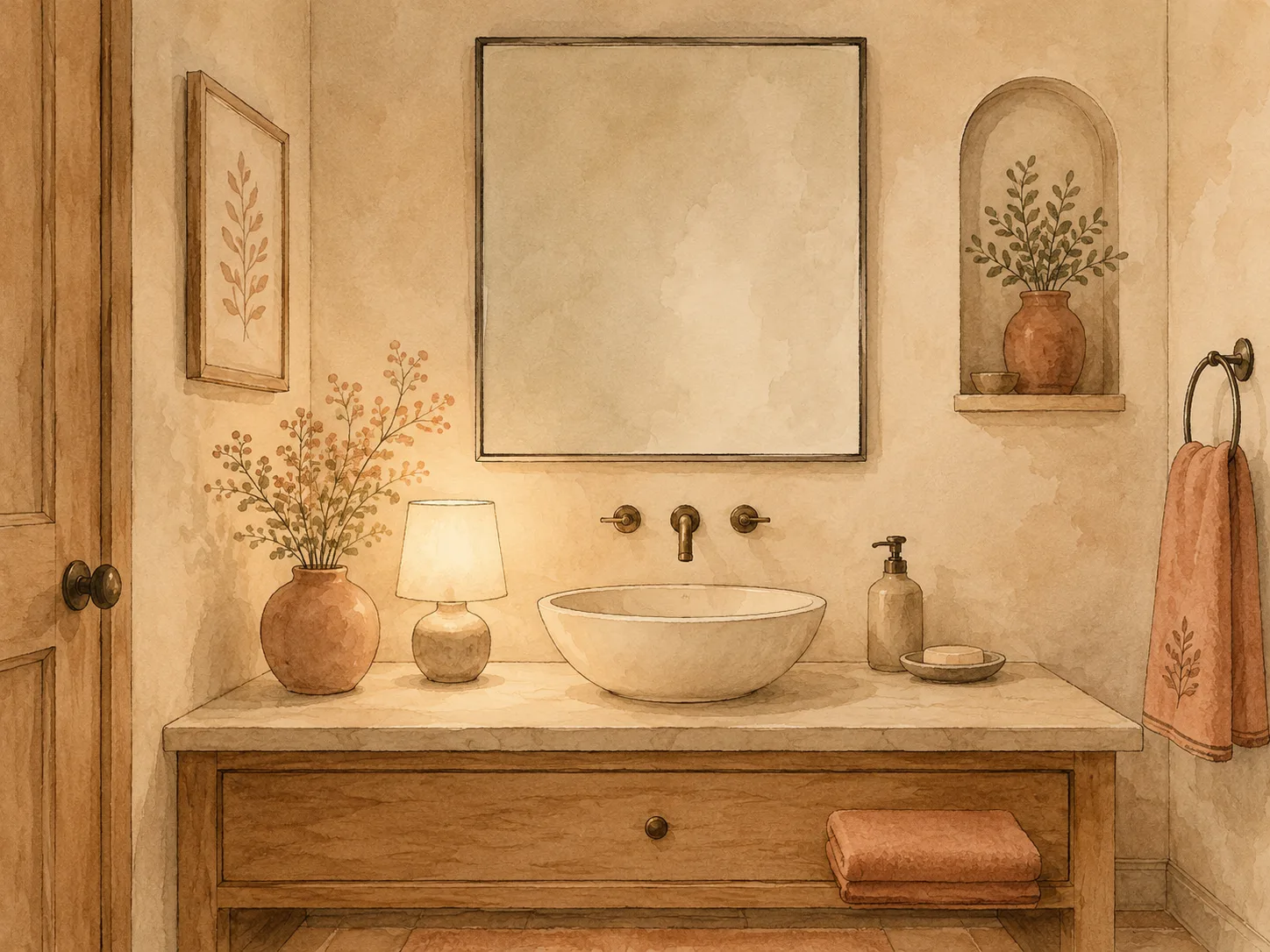
Written using dermatology literature on tangential lighting for skin examination (Mukhtar, Journal of Cutaneous and Aesthetic Surgery), clinical guidance on stimulus control within habit reversal training, and practical guidance from the Picking Me Foundation and BFRB clinicians.
Changing the room you pick in is a real clinical technique. It's called stimulus control, and it's one of the components of habit reversal training, sitting alongside awareness training and competing response training. The idea is narrow and unglamorous: make the behavior harder to start, so the skills you're building have time to work.
It isn't the treatment. Barriers buy time. If you change nothing else, picking usually finds a new room within a month or two. But of everything you could do about skin picking, this is the only intervention that keeps working while you're distracted, tired, or not thinking about recovery at all. It costs one evening and about the price of a lamp, and every part of it is reversible.
What the evidence actually supports
Habit reversal training as a whole package has good trial support for skin picking, and stimulus control is written into the protocol. What doesn't exist is a trial that isolated bathroom lighting, put half a sample under a warm dimmed lamp and half under an overhead fixture, and measured picking. Nobody has run that study.
So treat the specifics here the way clinicians do. They rest on standard practice, on the fact that mirror checking and skin examination sit near the top of the reported environmental triggers, and on optics that aren't in dispute. The full picture of what starts an episode is worth reading alongside this. The mechanism is solid. The exact bulb is a reasonable inference.
What a bathroom is actually built to do
Four features make the room work against you, and only one of them is the mirror.
There's bright light, usually mounted overhead. There's magnification, either from a dedicated mirror or from leaning in. There's privacy, with a lock. And there's a socially legitimate reason to be in there for twenty-five minutes, which no other room in the house provides. Nobody asks why you were in the bathroom for a while.
The lighting deserves more attention than it gets, because there's a piece of dermatology that explains it precisely.
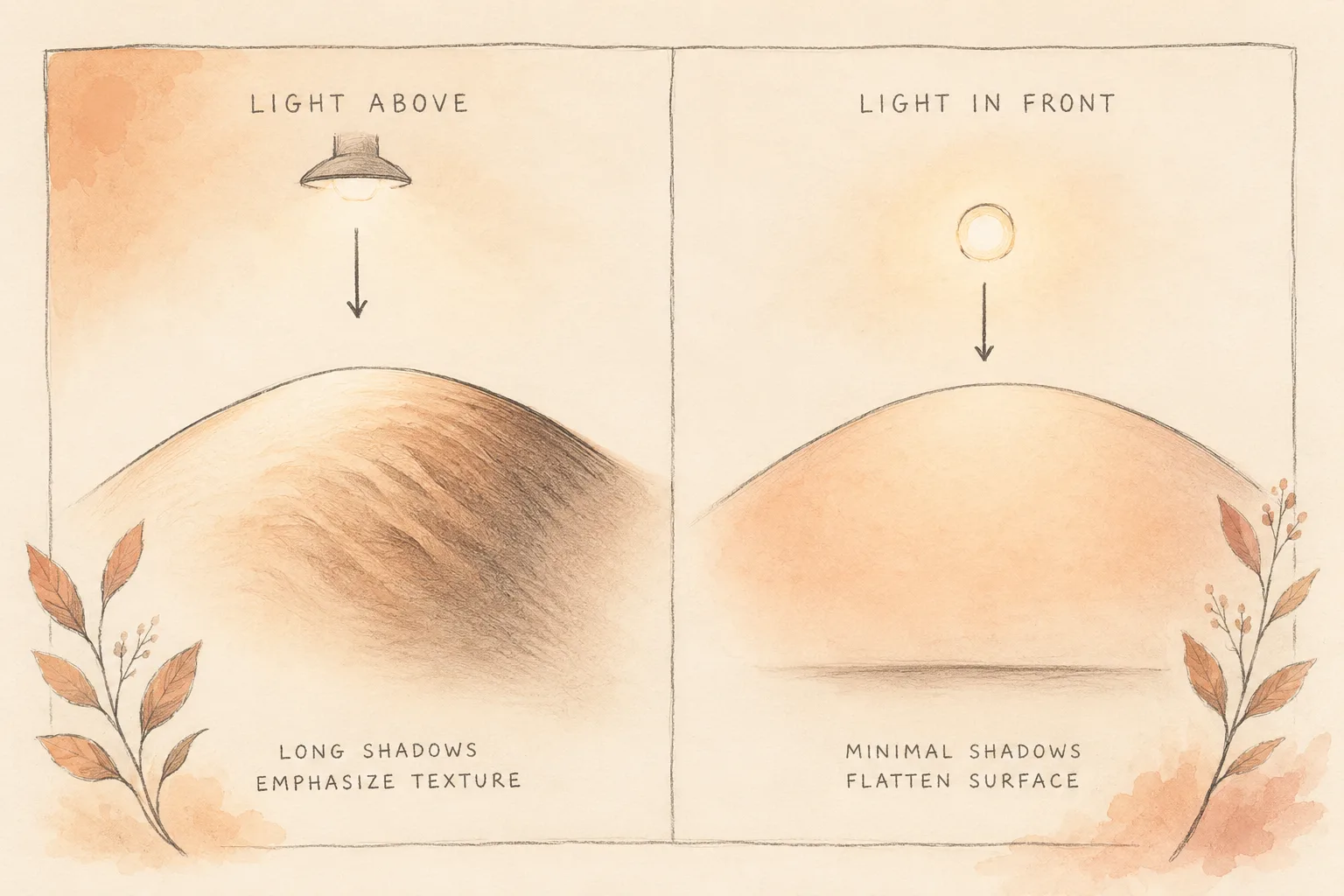
Now describe what you do at your bathroom mirror. You lean in until your face is a few inches from the glass. There's a light fixture above you. Its beam runs down across your face at a shallow angle, catching the edge of every raised thing and throwing a shadow off it.
You've been performing a clinical examination technique on yourself, several times a day, without knowing it had a name.
This is why the face that looked fine in the hallway is suddenly covered in things that need attention. The hallway light is further away and more diffuse, and you're standing further back. Your skin didn't change between rooms. The angle did.
The light
Three things about a light can be changed, in descending order of payoff.
Direction. Get the light off the top of your head and in front of your face. If your fixture sits above the mirror you probably can't move it, and you don't need to. Add a light instead: a small plug-in lamp on the counter, a clip lamp on a shelf, anything at roughly face height that shines forward. Then turn the overhead off. For renters this is the whole intervention, and it needs no tools.
Dimmability. A dimmer removes a decision from the moment you're least able to make it. Smart bulbs earn their price here for one reason, which is that you can schedule the dim. The light drops to 20% at nine in the evening whether or not you feel like being sensible at nine in the evening. Setting it once, calmly, is worth more than deciding it nightly. Sequencing the rest of the evening works on the same principle.
Color. Warm bulbs in the 2700K to 3000K range flatten texture and mute redness. Cool white light at 4000K and above does the opposite, and so does a high color rendering index, the spec sold as CRI 90+ for accurate makeup. That's a genuinely good bulb. It's just a bad bulb for a room you're deliberately making worse at showing you your skin.
| Where the light is | What it does to your face | What to do |
|---|---|---|
| Overhead, above the mirror | Rakes across the surface, shadows every raised spot | Switch it off in the evening, or dim it hard |
| Beside the mirror at face height | Fills from the side, moderate shadowing | Acceptable, better dimmed |
| In front of you at face height | Flattens texture, minimal shadow | The one you want |
| Any of the above at four inches | Becomes a diagnostic instrument | Stand back |
The mirror
Most advice about mirrors is about magnification. The more useful variable is distance.
A magnifying mirror is concave, which means its magnification only holds while your face is close to it. The object is designed to pull you to the exact distance that causes the trouble. It's the highest-value thing in the room to remove, and it doesn't have to be thrown away to stop working. In a box, in a drawer, in a different room is enough. The thirty seconds it takes to retrieve it is often the entire intervention.
For the main mirror, the standard guidance from the BFRB community is a distance rule. Picking Me Foundation puts it plainly: "The closer you get to the mirror, the more detail you can see on your skin, and the more likely you are to locate a real or perceived imperfection." Arm's length or further, and use furniture to block the approach if you have to.
There's a good self-monitoring trick in the same guidance. Hang the mirror slightly higher than is comfortable, then count how often you rise onto your toes to get closer. You now have a number that measures leaning in rather than picking, and it moves earlier than the picking does. What mirror gazing does to people who don't pick at all is covered separately, and the findings are not what most people expect.
Covers, ranked by how well they hold up
Coverings all work on day one. They differ in whether they survive week three.
- Take the mirror down. Highest friction, no daily decision. Works if you have somewhere else for the tasks that genuinely need a mirror.
- Static-cling window privacy film. Frosted or patterned film from a hardware shop, applied to the glass. It peels off cleanly whenever you want, it looks deliberate rather than like a crisis, and visitors don't ask about it. Most likely of the four to still be there in six months.
- A photo or note taped at face height. Leaves the top and edges usable, blocks the part you lean into. Partial, but it survives precisely because it isn't in your way.
- A towel or scarf you lift each time. The most-recommended option and the weakest in practice. Every use is a fresh decision made by someone who wants to look, and by week two the towel is back on the rail.
The room, the tools, and the door
Everything sharp or precise goes in one box in another room. Tweezers, needles, comedone extractors, cuticle nippers, safety pins, the magnifying mirror. Keeping them is fine. Keeping them within reach of a mirror is the problem.
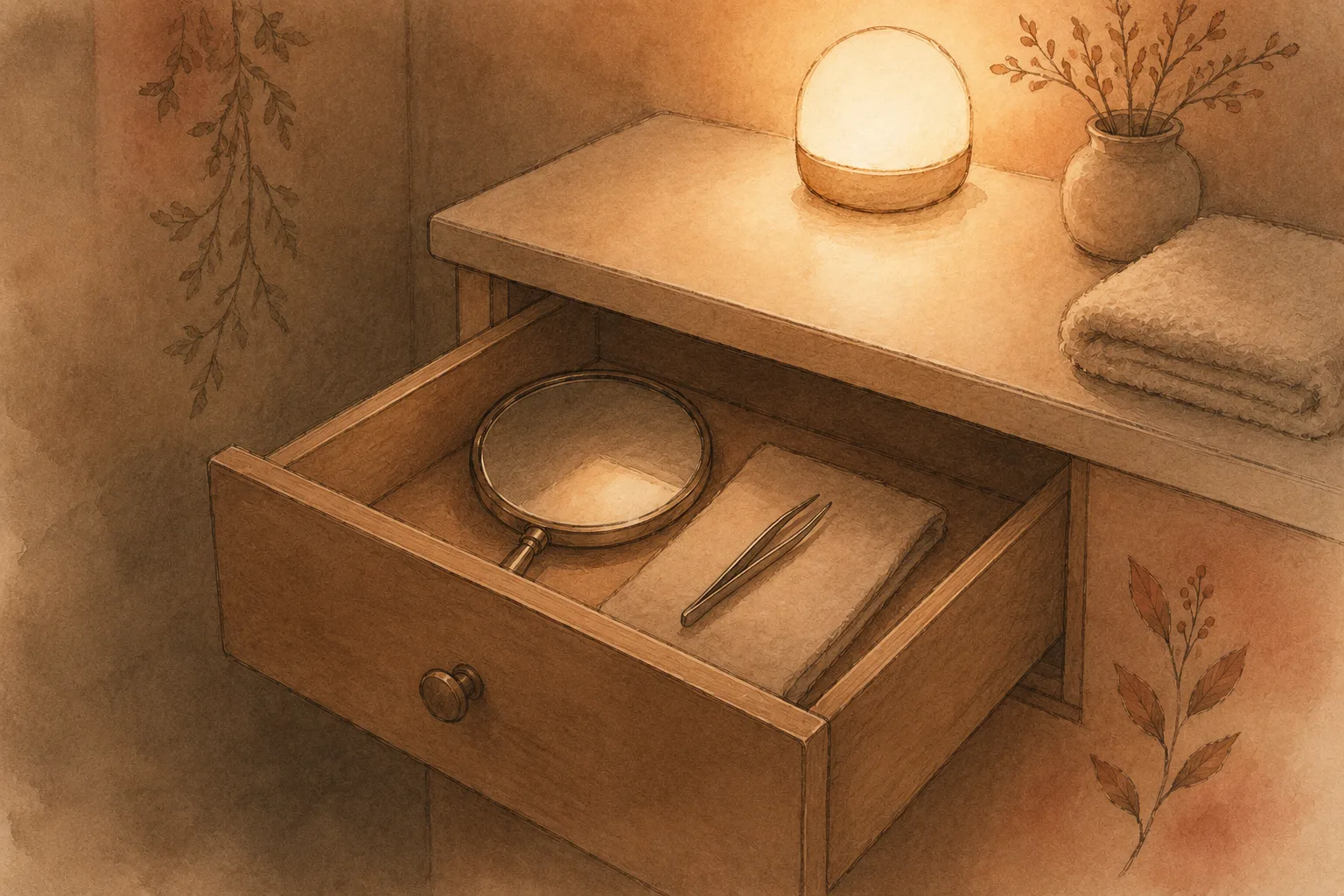
Then there's the door, which nobody writes about and which is doing a surprising amount of work. A closed bathroom door is the one closed door in a shared home that generates no questions. The room supplies privacy and an alibi at the same time.
You don't fix that by removing the lock or asking someone to police you, and please don't build anything that feels like surveillance. What works is giving the room a clock that isn't yours to enforce. A scheduled dim does this quietly. So does an audible timer set as you walk in, five minutes for a normal routine, which tells you how long you've actually been in there.
Keeping the room usable
This is the part most advice skips, and it's why people quietly undo all of it by month two. You've deliberately made a room worse at showing you your skin. You still have to shave, put on makeup, get contact lenses in, and check the mole your doctor asked you to keep an eye on.
Shaving runs more on touch than sight. A pass by hand in the shower, or at the sink with the front light on and nothing magnified, covers it. If you want a mirror, use the fogged window.
Makeup needs accurate color, which is exactly the property you just removed. Move it rather than restoring it. Do makeup near a window in daylight, or in another room with a portable mirror that goes back in a drawer afterwards. Daylight beats any bulb for color accuracy, and the mirror leaving the room afterwards is the whole point.
Contact lenses need proximity, but only to your eye. A small handheld mirror the size of your eye area gives you the working view without giving you the rest of your face. Field of view is a barrier too.
Teeth, floss, tongue, hair need no mirror at all. Doing them at a different sink removes a surprising amount of standing-in-front-of-yourself time from a day.
Real skin checks are the important one, because they're the reason people talk themselves back into the magnifying mirror. Moles, a wound that might be infecting, a dermatologist's follow-up. The rule that keeps this safe: checks happen on a schedule and through a camera, not on impulse with fingers. Photograph the area, put your hands down, look at the photo. A photo has an ending. Standing at a mirror doesn't, which is why one leads to picking and the other doesn't. Comparing this month's photo with last month's is also a much better test of whether something is changing than memory has ever been.
Bring the magnifying mirror out for a specific job with a specific end. Then put it back.
The order to do it in
One evening, roughly in this order, because the payoff isn't evenly distributed.
- Magnifying mirror out of the room.
- Add a front-facing light at face height. Turn the overhead off.
- Sharp and precise tools into a box, in a different room.
- Cover, shrink, or remove the main mirror.
- Move the no-mirror tasks to another sink.
- Schedule the evening dim so you never have to decide it again.
Then change nothing else for two weeks and pay attention. The reason for the pause is that you've just altered five variables at once, and if picking drops you'll want to know which one did it, because that's the one to protect when life gets busy.
Urges matter more than episodes for this particular experiment. A room that's working shows up first as fewer urges, before the episode count moves at all, and if you're only counting episodes you'll conclude nothing happened.
See whether the room change worked
SkinAware logs resisted urges alongside actual episodes, and tags each one with where it happened, so a change to one room shows up in your own data instead of in your memory of the week.
Available on iOS, Android and in your browser.
What this won't fix
Environmental change moves picking before it reduces it. If your picking is mostly automatic, happening in bed, at a desk, in the car, then a redesigned bathroom takes away a location and not much else. That's still worth having, and it isn't a treatment on its own. The awareness and competing-response work is what makes a reduction stick. The full habit reversal protocol shows where this sits in the sequence.
Duration is where most people underestimate. Expect months rather than weeks. One recovery coach who covered her own mirrors kept them covered for around eighteen months, and after moving house reintroduced them partially rather than all at once. Put one surface back at a time, and give each one a few weeks before the next.
Frequently asked questions
A drawer in a different room is enough for most people. The barrier is retrieval time, not ownership. If you find yourself going to get it more than occasionally, that's useful information: the pull is stronger than a drawer, and the mirror should leave the house.
A dimmable warm white bulb, 2700K to 3000K, in a lamp that sits at face height and points forwards. Skip anything advertised as daylight, high-CRI, or makeup lighting for this particular fixture. If you want a smart bulb, the feature worth paying for is scheduling, not color.
For skin picking, the mirror is a means of access to a behavior, so restricting it is closer to removing a substance than to avoiding a feared situation. For body dysmorphic disorder, where the problem is the appraisal rather than the picking, clinicians often do the opposite and use graded mirror retraining. The two overlap often enough that if your distress is mainly about how you look rather than about the picking itself, this is a question for a clinician rather than a blog.
Everything in the highest-payoff tier is portable. A clip lamp, a box of tools kept in your own room, static-cling film that peels off in one piece, and a five-minute timer are all invisible to a flatmate and all removable in ten minutes.
Some people do, and it's worth watching for. Tactile picking still needs something to find, so lower light tends to shorten episodes rather than end them. If your picking is mainly by touch rather than by sight, the lighting changes will do less for you than nail length, coverage, and a competing response you've actually rehearsed.
No, and there's an argument for not doing so. If you make one change and picking drops, you've learned something specific about your own pattern that a six-change rebuild would have hidden. Start with the magnifying mirror and the light angle, since those carry most of the effect.
References
- Mukhtar, M. Uses of tangential lighting for skin examination: A clinical pearl. Journal of Cutaneous and Aesthetic Surgery.
- Picking Me Foundation. Avoiding the triggering effects of mirrors.
- Dupati, A. Get rid of your magnifying mirror. Apollo Dermatology.
- SkinPickingSupport.com. Blockers and barriers.
- Stop Skin Picking Coach. Face picking: tips to stop.