

Written using Marlatt and Gordon's relapse prevention model, a momentary-assessment study of 1,001 lapse episodes, year-long outcome data from 1,071 people in habit reversal training, and research on natural recovery from trichotillomania and skin picking disorder.
A bad week after a good stretch is not evidence that the good stretch was fake. It's the most ordinary thing that happens in this kind of recovery, and the research that follows people over months and years has it built into the curve rather than treating it as a break in one. What decides the next few weeks isn't the bad week. It's the conclusion you draw from it, and there's a specific conclusion that does the damage.
That conclusion has a name, a fifty-year research history, and a fairly precise shape. Getting it named is worth more right now than being told to go easy on yourself.
What just happened has a name
In the late 1970s, psychologists Alan Marlatt and Judith Gordon were studying why people who successfully stopped drinking so often went from one drink to a full return. What they found was that the single drink didn't do it. The story people told themselves about the single drink did.
They called it the abstinence violation effect. It runs roughly like this: you've set a goal of not doing the thing. You do the thing. And in the seconds afterwards you have to explain to yourself why. If the explanation you land on is about the situation, it's survivable. If the explanation is about you, it isn't.
Marlatt's model draws the line precisely. People who attribute a lapse to "stable, global, internal factors beyond their control," his own example being I have no willpower and will never be able to stop, are far more likely to abandon the goal entirely than people who attribute it to having coped badly with one specific difficult situation. Same behavior. Same amount of it. Completely different next month.
The "may as well keep going" thought is that effect doing its work in real time. It isn't a craving and it isn't weakness. It's a piece of arithmetic your brain has already run: if the streak was what mattered and the streak is gone, then there's nothing left to protect between now and whenever you decide to start again. So the rest of the evening is free.
The gap between those two words is where all of your remaining options live. You've had a lapse, possibly several. Whether it becomes a relapse is a decision that is still open, and it will mostly be made by what you do in the next day or two rather than by how much you pick tonight.
What the follow-up data actually shows
Articles about setbacks almost never cite the follow-up research, which is a shame, because it doesn't describe smooth lines either. It describes something much closer to what you're experiencing, and it still ends up in the same place.
The largest real-world dataset we have on behavioral treatment for these conditions tracked 543 people with trichotillomania and 528 with skin picking disorder through habit reversal training delivered by video. At the fourteen-to-sixteen week mark, the median person had cut their symptom severity by a third.
Then the researchers kept measuring for a year. The average improvement at week 52 was larger than at week 16, not smaller. In effect-size terms it went from about 1.0 to about 1.5 for hair pulling, and from 1.16 to 1.56 for skin picking.
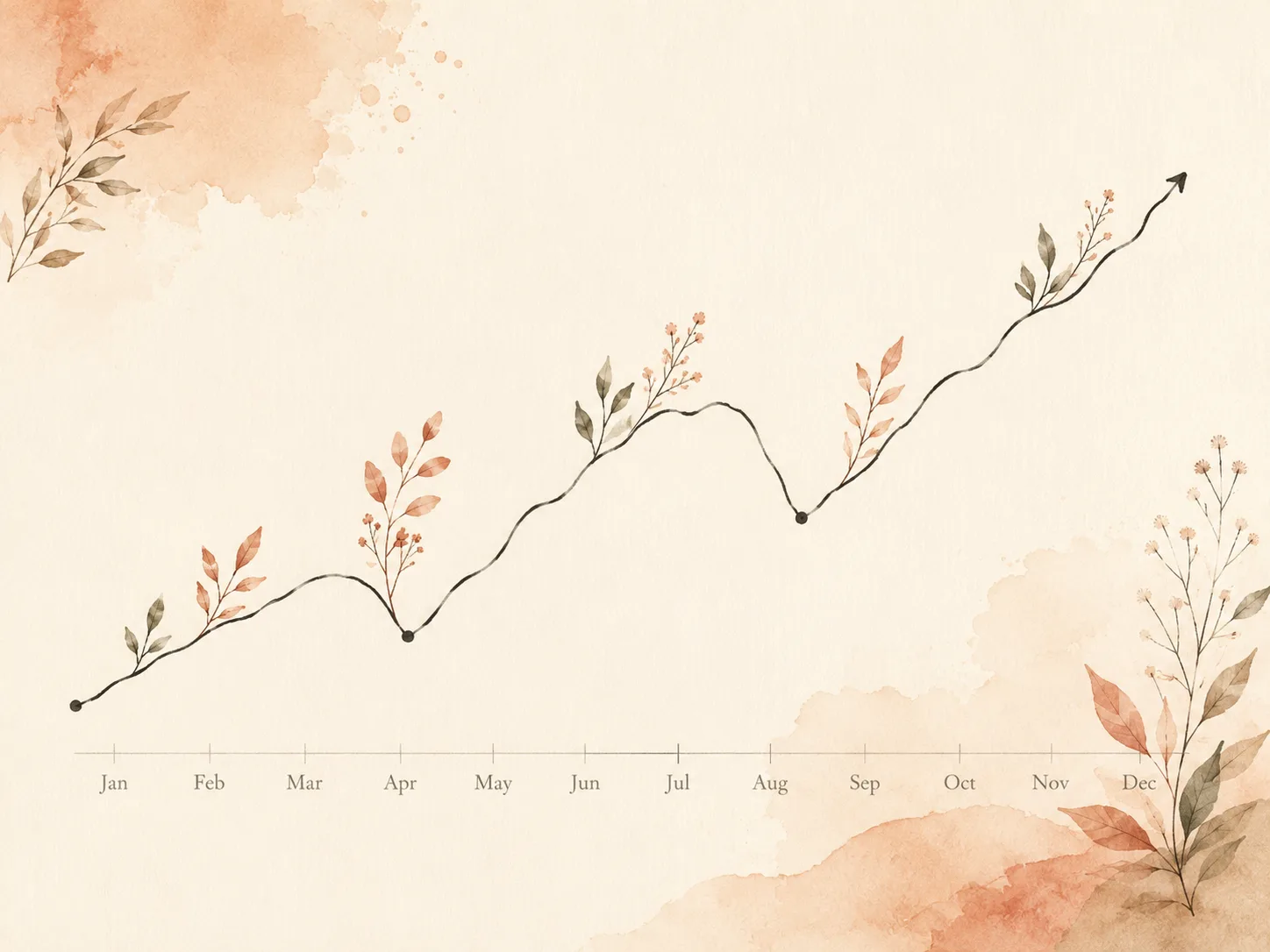
Sit with what that curve has to contain. A thousand people do not improve steadily for twelve consecutive months. Inside that rising average are hundreds of terrible weeks, moves, breakups, deadlines, flus, and stretches where someone was certain the treatment had stopped working. The line goes up anyway, because it's made of the whole year and not of anyone's worst fortnight.
The same study reports two numbers that get left out of the encouraging version. About one in ten patients was measurably worse at the primary endpoint than when they started. And among people who initially respond to this treatment, somewhere between 50 and 67 percent slip back at some point during long-term follow-up. If your private standard has been that a person who's really recovering doesn't have weeks like this, you've been holding yourself to something most successfully treated people don't manage.
"Recovered" doesn't mean zero
There's a small study that ought to be much better known. Researchers found 21 adults who had genuinely come out the other side of trichotillomania or skin picking disorder without formal treatment, and who hadn't met diagnostic criteria for an average of nearly six years. Recovered by any reasonable definition.
That same study found something else worth knowing tonight. When the researchers compared how bad it had been at its worst, the recovered group and the still-struggling group were statistically indistinguishable on days per week and time per day. Severity didn't predict who got out. Whatever this week has been, it isn't a reading of your ceiling.
The guilt isn't the thing to fix
The standard advice at this point is self-compassion, and the reason it's everywhere is that it's not wrong. It's just aimed slightly off-target, and there's a study that shows where the target actually is.
Researchers gave handheld diaries to 203 smokers who had reached abstinence and then lapsed, and captured their reactions in near-real-time across 1,001 separate lapse episodes. They measured the three ingredients of the abstinence violation effect: self-blame, guilt, and how much the person still believed they could do this.
None of the three, measured after the first lapse, predicted whether that person went on to relapse.
What did predict it was the drop in self-efficacy across repeated lapses. Each further erosion of "I can actually do this" measurably accelerated the slide toward the next one. And in a result nobody expected, taking the blame internally turned out to be mildly protective rather than harmful.
That reframes what you're supposed to be doing right now. Not manufacturing kindness toward yourself on demand, which is difficult and rarely convincing at hour three of a bad night. Instead: preventing one specific belief from forming. The belief is this doesn't work for me, and the way you prevent it is by holding onto the evidence that it did, which is why the first step of the restart below is about your records rather than your feelings.
Shame makes this harder in a way that's specific to picking and pulling. A thematic analysis of 100 disclosure posts from an online skin picking forum found that disgust, shame, and psychosocial avoidance dominated the accounts and appeared central to the experience itself. Avoidance is the operative word. Shame's characteristic move is to make you disappear: stop logging, stop posting, skip the appointment, don't mention it to the person who's been asking. Every one of those removes a piece of the scaffolding that was holding the good stretch up, which is how a bad week becomes a bad quarter.
Why streaks make this worse
If you've been counting consecutive days, the setback landed harder than it needed to, and that's a property of the counter rather than of you.
A streak takes something continuous and reports it as a binary. Forty days of picking less, sleeping better, catching your hand earlier and having fewer wounds is a rich and mostly good picture. A streak compresses all of it into one bit of information, and then a single event flips the bit. The number that appears the next morning is zero, and zero is a factually false description of where you are. You are not where you were on day one. You have forty days of practice, a set of triggers you can now name, and a competing response your hands have half-learned. None of that reset.
Worse, the streak arranges the incentives badly at exactly the moment they matter. On day 40 the counter says you have a great deal to lose, so a slip feels catastrophic. On day 0 it says you have nothing to lose, so tonight is free. The abstinence violation effect and the streak counter are telling you the same story, and they reinforce each other.
We'll say plainly that SkinAware keeps a streak too, and it resets when you log a picked day. What we've changed is what else counts: a resisted urge is a positive entry in its own right, so a hard night you got through registers as something rather than as a gap, and the home screen counter can be swapped for a plain daily count. If you want the mechanics of how different trackers handle this, our breakdown of habit tracking apps and the streak problem compares how four mainstream ones do the maths.
The restart
This is designed to be run in the next hour or two, not to become a new regime. The most common mistake after a setback is the total overhaul: new rules, new tools, a fresh start on Monday. Overhauls raise the stakes, which means the next slip breaks something bigger.
1. Log the days you didn't log. Go back and enter the episodes from the bad stretch, as accurately as you can remember them. This is unpleasant and it's the highest-value thing on the list, for two reasons. It restores the record you'd otherwise abandon, and the count is almost always lower than the memory. "I picked constantly all week" is usually four episodes, three of them in two evenings.
2. Write one line of context per episode. Where you were, roughly what time, what happened in the hour before. You're identifying what Marlatt's model calls high-risk situations, and you're doing it while the details are still recoverable. Our guide to what actually starts an episode has the fuller version of this if you want it.
3. Say the specific version of what happened, out loud. Not "I have no self-control." Instead: "I picked on Tuesday and Thursday, both after eleven, both after a bad day at work, both in the bathroom with the overhead light on." This is the single move Marlatt's model identifies as the difference between a lapse and a relapse. Situational explanations keep the goal alive. Character explanations end it.
4. Change one object. Not your whole plan. One physical thing in the situation you just described: the bathroom bulb, where the tweezers live, where your phone charges at night. One change you'll still be doing in three weeks beats five you'll abandon by Friday.
5. Set re-entry as a time, not a condition. "Tomorrow at 8pm I log again" rather than "I'll start again when my skin has calmed down." Condition-based restarts are how a week becomes a season, because the condition is skin healing and skin heals slowly.
6. Tell one person within 24 hours. Social support is the fourth component of habit reversal training and it's the one people quietly drop first. It's also the direct antidote to the avoidance in that shame research. One text saying "bad week, still going" is enough.
7. Count from the beginning, not from the setback. Total days in, not consecutive days. You started when you started.

If you'd rather not do the backfill on paper, this is the part SkinAware is built for. Logging takes a few taps, past-dated entries are normal rather than awkward, and resisted urges are logged the same way episodes are, so the nights you got through show up as entries rather than as blanks. The habit reversal course is there for the rebuild when you're ready for it. It's $5.99 a month or $34.99 a year, with a two-week trial on iOS.
Pick the record back up
SkinAware logs episodes and resisted urges in seconds, backfills the days you missed, and shows you a 28-day picture instead of a streak that resets.
Available on iOS, Android and in your browser.
Frequently Asked Questions
There's no clinical number, partly because setbacks aren't a defined unit. What the treatment literature suggests is that the length matters less than whether the tracking and the support stay in place through it. People whose records go quiet for a month are harder to bring back than people who had a worse month but kept logging. As a rough working rule: a bad fortnight inside a good six months is a dip, and it doesn't need a new plan.
Not on the evidence. Between 50 and 67 percent of people who initially respond to behavioral treatment for these conditions slip back at some point during long-term follow-up, and average gains in the largest real-world dataset kept growing across a full year regardless. A setback tells you a high-risk situation got past your current plan. It doesn't tell you the plan is wrong, and it definitely doesn't tell you that you're one of the people it can't work for.
That's the erosion the smoking-lapse study identified, and it's the thing to take seriously. Repeated drops in belief that you can do this predicted continued slipping far better than guilt after any single lapse did. Two things help. First, look at the aggregate rather than the current state: total picking-free days this year against last year is usually a kinder and more accurate comparison than how this week feels. Second, if you've been doing this alone through several cycles, that's the strongest argument there is for bringing in a therapist who works with BFRBs, because self-efficacy is much harder to rebuild from the inside.
If a reset counter makes you want to stop opening the app, turn it off or ignore it and use a 28-day total instead. A streak is a motivational device, not a measurement, and it's a poorly designed one for a behavior that arrives in waves. The measurement you want is total days and episode counts over a rolling month.
Yes, and it's the finding most people are never told. Among adults who no longer met diagnostic criteria for skin picking disorder or trichotillomania, and hadn't for an average of nearly six years, 61.1% still picked or pulled occasionally. Recovery in the research literature means no longer meeting criteria while minimal symptoms persist. The goalpost you may have set for yourself, never again, is stricter than the one researchers use for people they class as recovered.
Because you have something to compare it against now. Before the good stretch, a bad week was just a week. After it, the same week reads as a loss, and loss is a much sharper feeling than a baseline. That contrast is real, but it's a sign that something changed for the better, not that things have got worse than they were.
Physical healing, partly and temporarily. Skill, no. Awareness of your triggers, the competing response your hands have learned, the knowledge of which situations are dangerous: none of that is stored in the streak counter and none of it went anywhere this week.
Continue Reading
References
- Larimer, M. E., Palmer, R. S., & Marlatt, G. A. (1999). Relapse prevention: An overview of Marlatt's cognitive-behavioral model. Alcohol Research & Health, 23(2), 151–160.
- Shiffman, S., et al. (2012). Relapse dynamics during smoking cessation: Recurrent abstinence violation effects and lapse-relapse progression. Journal of Abnormal Psychology.
- Virtual therapy habit reversal training for body-focused repetitive behaviors: clinical outcomes from a large real-world sample of youth and adults (2025). medRxiv 2025.03.10.25323675.
- Clinical characteristics of natural recovery in trichotillomania and skin picking disorder (2025). PMC12739759.
- Anderson, S., & Clarke, V. (2019). Disgust, shame and the psychosocial impact of skin picking: Evidence from an online support forum. Journal of Health Psychology, 24(13), 1773–1784.