

Reviewed against a randomized controlled trial of self-help habit reversal training for BFRBs (Moritz et al., 334 participants) and 2026 pricing from each vendor's own store listing.
A general habit tracker will faithfully record that you had a bad day. It won't record anything that helps you have fewer of them.
That isn't a knock on the apps. Streaks, Habitica, Loop and Way of Life are well-made products, and the problem they're built for, getting a behavior to happen more often, is close to the inverse of yours. Flossing doesn't fight back. Picking does.
So if you already own one of them and would rather not start over, jump to bending it to fit. If you're choosing fresh, Loop is the least punishing of the four for this particular job and it costs nothing. The reasoning, and the three ways the model breaks, are below.
The four trackers at a glance
| App | Platforms | Cost | Built for | For a BFRB |
|---|---|---|---|---|
| Streaks | iPhone, Apple Watch, Mac | $5.99 one-time | Fast daily check-offs, deep Apple Health integration | Fastest logging of the four, harshest streak model |
| Habitica | iOS, Android, web | Free core; optional subscription (mostly cosmetic) | Turning habits into an RPG with parties and accountability | Real social accountability, but damage-to-your-avatar framing lands badly after a slip |
| Loop | Android only | Free, open source, no ads | Private, offline habit tracking with a forgiving score | The kindest maths of the four, and free. Android only |
| Way of Life | iOS, Android | Free for 3 habits; around $4.99/month for more | Flexible chains, skip days, per-entry journal notes | The journal note is the one field that gets close to real self-monitoring |
Prices are a July 2026 snapshot taken from the vendors' own listings and Zapier's 2026 testing round. Check before you pay.
Three ways the habit-tracker model breaks
Habit trackers ask one question per day: did you do the thing, yes or no. Self-monitoring for a body-focused repetitive behavior is a different kind of record, and the mismatch shows up in three specific places.
A tracker stores events. Half of what you need to capture is a non-event. On a checkbox app, a night where you felt a savage pull for forty minutes and rode it out looks identical to a night where the thought never crossed your mind. Both are an unticked box. Those are the two most different nights in your month, and the one you white-knuckled through is the one worth studying. Nothing in the yes/no model has anywhere to put it.
A tracker stores a boolean. Self-monitoring is a context record. The list clinicians and lived-experience guides converge on runs to seven things: date and time, where you were and what was happening, urge intensity, what you were thinking and feeling before and after, how long it lasted, and which part of your body. Six of those seven have nowhere to live in a habit tracker. And they're not decoration. Habit reversal training takes them as input, because you can't rehearse a competing response without knowing which hand goes where, when, and off the back of what.

A tracker aggregates by day. The signal lives at a finer resolution than that. One tick on Tuesday tells you nothing. Timestamps across three weeks will show you a mid-afternoon cluster and a second one in the hour before sleep, and those are things you can build around: move the phone charger, put something in your hands at the point the slump lands, swap the bathroom bulb for a dimmer.
Awareness training is not a feeling. It's knowing precisely when, where and off what cue. That knowledge has to come from somewhere, and a column of ticks isn't it.
The streak problem
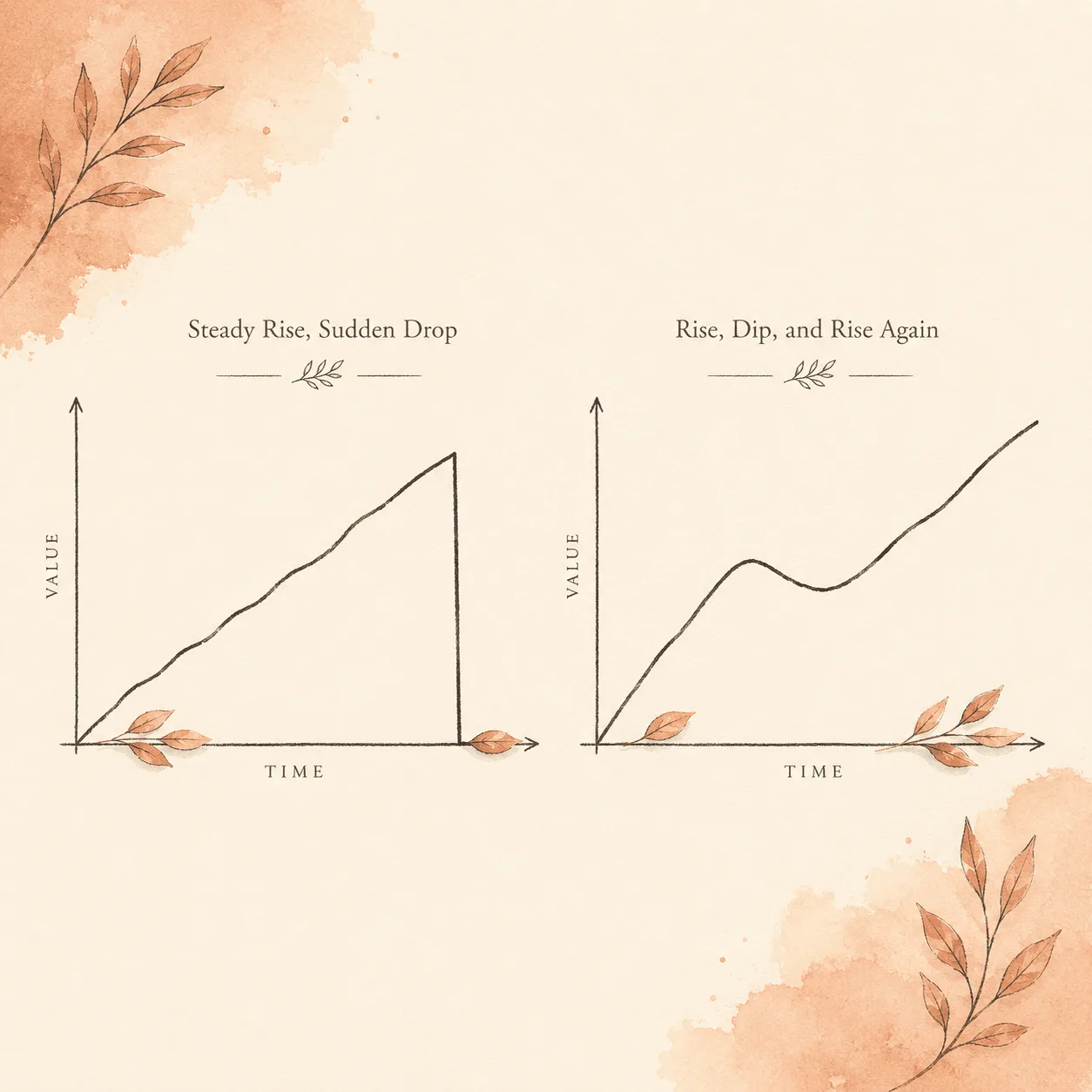
Every app in this category is built around not breaking the chain, and for flossing that's a genuinely good mechanic. For a relapsing behavior it does something specific and unhelpful: it turns one slip into the destruction of a visible asset.
Someone who has gone eleven days without picking, then picks for ten minutes on day twelve, has had an excellent fortnight. Her tracker will show her a zero. The predictable response to watching a number you worked for collapse is not to log tomorrow more carefully. It's to stop opening the app, which ends the only thing that was working.
That's from her explanation of why she moved off timer apps and built a reward chart instead.
Loop is the one general tracker whose developers appear to have noticed the problem. Its own store listing says that "a few missed days after a long streak will not completely destroy your entire progress, unlike other don't-break-the-chain apps." Loop still shows a current streak, but its headline figure is a habit strength score that decays gradually rather than collapsing. For a behavior that arrives in waves, that maths is simply more truthful about what happened.
We should say plainly that SkinAware keeps a streak too, and it resets when you log a picked day. What differs is that a resisted urge is a positive entry in its own right, so a hard night you got through registers as something rather than as an absence, and people tracking hair pulling can swap the home screen counter for a plain daily count. That's a partial answer, not a solved problem.
Streaks
The best-built habit tracker on iPhone, and the one most likely to already be installed on the phone of anyone reading this. Two taps to log. Apple Watch and Mac apps, iCloud sync, Home Screen widgets, and HealthKit integration that ticks some habits off before you touch it. It's $5.99 once rather than a subscription, which in 2026 feels almost eccentric.
For a BFRB it's a mixed bag. The speed genuinely counts, because the tracker you abandon in week three is the one that asked for too much, and Streaks is the fastest thing here. But it's a streak app by name and by philosophy, there's no field for how you felt or what set it off, and the Apple-only footprint rules it out for most Android users.
Verdict for a BFRB: fine for a single crude number, and only if a reset doesn't sting you. Its note-taking is too thin to feed habit reversal.
Habitica
Habitica turns your habits into a role-playing game. You have an avatar, you earn gold and experience for what you complete, and you can join a party with other people who can see whether you showed up. The core app is free and stays free; the optional subscription is largely cosmetic.
The party mechanic is the genuinely valuable part, and none of the other three offer anything like it. Isolation keeps a lot of BFRBs running, and a small group that notices your absence is real accountability without the barrier of a support group. Habitica also handles unwanted habits properly, with a minus button you press when the thing happens, which is a better shape than a daily yes/no box.
The catch is the framing. In an RPG, failure has consequences: your avatar takes damage, and at zero health you can lose a level. For most goals that's fun friction. For a behavior already thickly wrapped in shame, "you have taken damage" is not a neutral message to receive at eleven at night.
Verdict for a BFRB: the accountability is worth having, especially if you'd never walk into a support group. Watch how the damage framing sits with you and drop it fast if it bites.
Loop
Free, open source, no ads, no account, nothing leaving your phone. Android only. Loop is the quiet recommendation of this article, mostly on the strength of the habit score described above, which treats a slip as a dip rather than a demolition.
It handles flexible schedules, so "three times a week" is expressible, and it draws proper charts across the full history. What it has nowhere for is what happened. No journal field, no trigger picker, no mood. You get a number that moves for reasons Loop cannot tell you.
Verdict for a BFRB: the best of the four if what you want is a low-stakes count that won't punish you, and the strongest privacy story here by a distance. Keep your context notes somewhere else.
Way of Life
Way of Life is built for people who want data rather than a scoreboard. Each day is marked yes, no or skipped, which alone puts it ahead of the binary trackers, and every entry can carry a written note. It's free for three habits; unlimited habits and the full statistics sit behind a subscription of roughly $4.99 a month, per Zapier's testing.
That note field is the reason it's on this list. It's the only place among the four where "4pm, work call overran, felt wired, ended up at the bathroom mirror" can be written at the moment it happened. Do that for three weeks and you're holding something a therapist can read and work from.
Verdict for a BFRB: the closest a general tracker gets to real self-monitoring, and the one to choose if you're set on staying in the general category. You're still doing the pattern-finding yourself, by hand, later.
How to bend a general tracker to fit
If you'd rather keep the app you already have, here's the setup that gets most of the way there. It works in all four.
Log the count, not the chain. Where the app allows a countable habit rather than a yes/no, use it and read the weekly total. Twelve last week and eight this week is progress you can see. A chain that snapped on Tuesday tells you nothing about either week.
Put the context in the note field. Time, what was happening, how you felt. Two of the four support this; if yours doesn't, keep a running note in your phone's notes app and pair the two up on Sunday.
Read it once a week, on paper if you can. Data nobody looks at is a chore with no payoff, which is the actual reason most people abandon trackers. Fifteen minutes on a Sunday circling repeated times of day is where the value has been sitting the whole time.
Turn off the shaming notifications. "You've broken your streak" and "you haven't checked in for 3 days" are motivating for a gym habit and corrosive here. Most of these apps let you disable them per habit.
When it's worth moving to something built for this
A general tracker is enough while the job is counting. It stops being enough when the job becomes changing, because at that point you need the method attached to the data rather than the data on its own.
Habit reversal training is the best-evidenced behavioral approach for BFRBs, and it wants specifics as input: which body areas, which times, which cues, and a competing response you've actually practiced. That's the point where a purpose-built tool starts earning its place, ours or anyone's. The head-to-head comparisons already exist, so this article won't repeat them: there's a breakdown of apps for skin picking, one for hair pulling apps, and one for nail biting apps, each with real prices, which matters because several of the best-known ones show a Free badge in the store and cost a great deal more than free.
SkinAware is our attempt at it. A log takes a few seconds and opens with a choice between picked and resisted, so a resisted urge is an entry rather than an empty box. Each one can carry triggers, body areas, feelings, coping mechanisms, urge intensity, duration and where you were. Sitting on top of that is the habit reversal course in short modules, progress tracking, a moderated community and accountability friends. The core is free to use; the full course and the deeper features are $5.99 a month or $34.99 a year, with a two-week trial on iOS.
Read that paragraph with the skepticism a company describing its own app has earned. If a free Android app and a Sunday review get you where you're going, take that instead.
Get support for picking, pulling and biting
SkinAware helps you log episodes, identify patterns, and see real progress over time.
Available on iOS, Android and in your browser.
FAQ
Yes, and it beats tracking nothing. Set it up as two habits, one for urges you noticed and one for episodes, read the weekly totals rather than the streak, and write the context into a note field if the app has one. What you won't get is a structured place for the cue, the mood or the body area, and those are the fields habit reversal training takes as input.
Of the four mainstream ones, Loop if you're on Android, because its habit strength score decays gradually instead of resetting to zero, and it's free with no account. Way of Life if you want a per-day note field, which is the closest a general tracker gets to real self-monitoring. Streaks if speed matters most and a reset genuinely doesn't bother you.
Not on their own. The trouble is the specific moment after a slip, when a counter dropping from eleven to zero reads as "the last two weeks didn't count," and people respond by closing the app rather than logging more carefully. If your tracker's reset leaves you feeling like you've lost something, the mechanic doesn't fit the behavior. It isn't evidence you're recovering wrong.
It's arguably the most useful entry you can make, and almost nobody makes it. What improves in recovery is the distance between noticing the pull and acting on it, and a distance you never recorded is one you can't watch grow. A night you got through is data. An empty box is silence.
Usually the reverse, for the same reason a worry written down at bedtime loses some of its grip. Where tracking does backfire is when the app's scoring turns a slip into a verdict on you. If that's what's happening, change apps rather than giving up on tracking. The scoreboard is the problem, not the noticing.