

Written using published research on disclosure decisions in online dating among adults with mental health conditions, clinician guidance on discussing chronic illness with a new partner from the Global Healthy Living Foundation, and first-person accounts from people dating with skin picking disorder.
Everything written about skin picking and dating is addressed to somebody who doesn't exist yet: your future partner, and what they ought to know. Which is not much help when you're single, three messages into a conversation with someone you like, and trying to work out whether to suggest coffee in daylight.
So this one is for the earlier stage. Whether to mention it at all before you've met, what to do about the distance between your photos and your actual face, the specific dread of a daytime date, the hour before you go out (which is when a lot of picking actually happens), and what to say the first time someone is close enough to see.
If you're already in a relationship, telling an established partner is a different conversation with a different shape, and it has its own guide.
The numbers below come from a 2025 study of adults with mental health conditions rather than BFRBs specifically, but the disclosure decisions are the same ones.
Your Photos and the Gap They Create
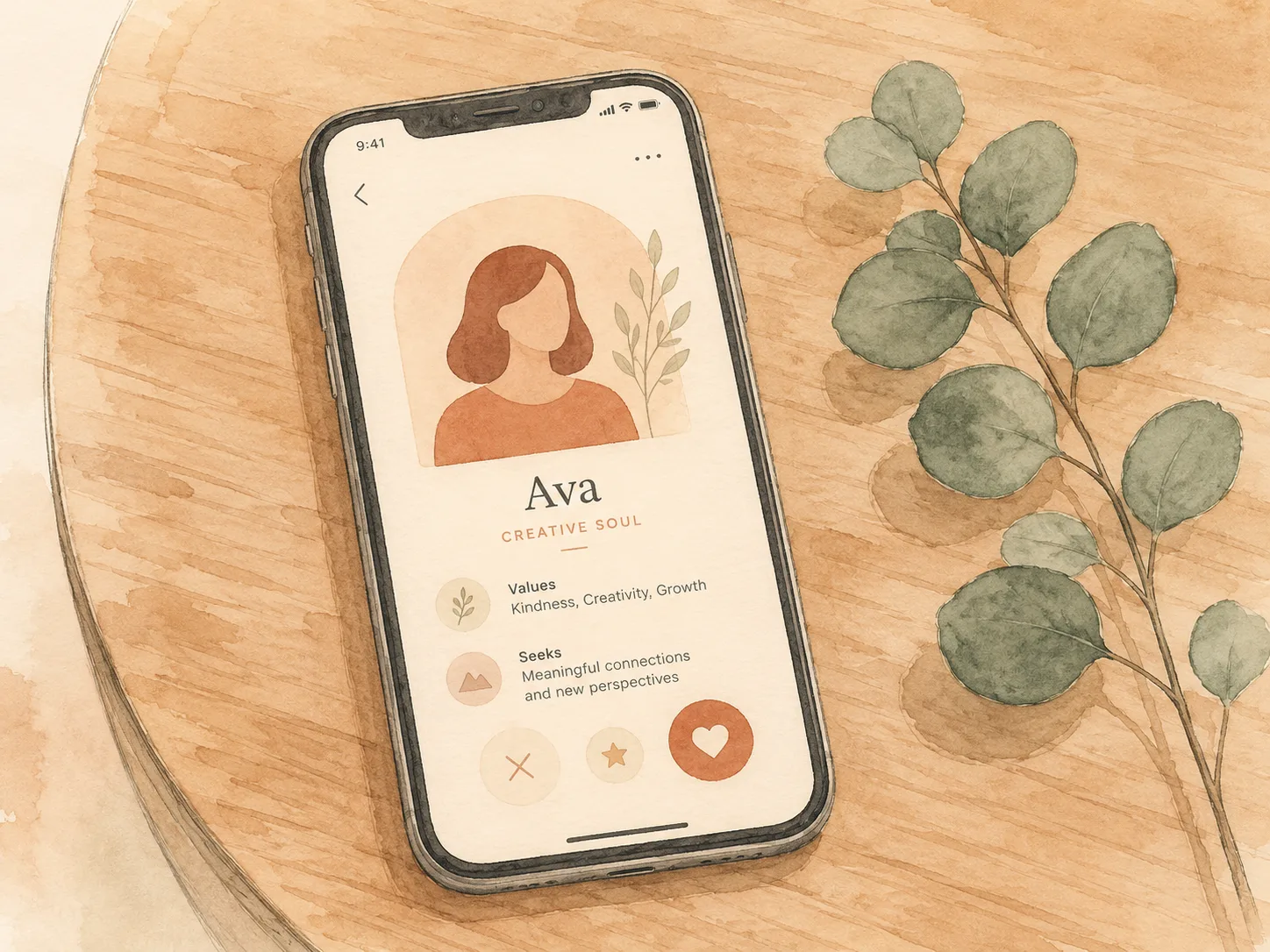
Nobody puts their worst day on a dating profile. That isn't dishonesty, it's how the format works, and holding yourself to a standard of documentary accuracy that nobody else on the app is meeting is just one more way of paying a tax other people don't pay.
The problem isn't ethical. It's practical, and it's this: every layer of smoothing, every photo from the good three months two summers ago, every shot taken from four feet away in a bar, widens a gap that you will personally have to sit inside for the entire first date. You'll spend the coffee monitoring their face for the moment they clock the difference. Whether or not that moment ever comes, you've already had the evening.
The other question is whether it goes in the bio. Most people leave it out, and there's data on that rather than just a feeling.
Of the people in the 2025 disclosure study who made a profile, 60% deliberately left mental health information off it and 40% put it on. Neither group was doing the wrong thing. A profile is a summary, not a medical record, and leaving something out of a summary is not concealment.
Where a bio line does earn its place is if you're tired. Some people include one specifically to filter hard and early, and they're not looking for acceptance, they're looking to spend less energy. "I have dermatillomania (compulsive skin picking), ask me about it or don't" does a lot of screening before anyone gets your time. It also invites a small number of people to be unpleasant about it in your inbox, which is the cost.
When to Say Something
There is no schedule. Not the third date, not before you sleep together, not at three months.
What there is instead is relevance, and it arrives in one of three ways.
They've asked. Someone notices your hands or your arms and says something. That's the moment, and it's the easiest of the three because the topic is already open and you're just answering.
It's about to be visible in a way you can't manage. A beach, a swim, staying over, summer, sleeves coming off. Managing it takes work, and the work gets harder the more time you're spending together.
You're sick of carrying it. This is the most common one and the most legitimate. Not obligation, not fairness to them. Just that keeping a running background process going through every date is tiring, and at some point the tiredness outweighs the risk.
The research on how this actually happens is reassuring, mostly because it shows how rarely it goes the way people rehearse it.
The same study found 86% of participants felt less comfortable with online dating than meeting in person, largely because connection builds slower and there's more time to sit alone with the question.
The Daylight Problem

Evening dates are easier and everyone who picks knows it. Bar lighting, a candle, sitting at an angle. Then at some point there's a brunch, a walk, a Saturday, and you're across a table from someone with the sun coming in sideways.
Two things about that moment are worth knowing in advance.
The second is that you can choose when it happens. Not because you owe anyone a daylight viewing, but because the anticipation is reliably worse than the event, and anticipation compounds every week you postpone. Picking a daytime thing early, on your terms, in a setting you chose, gets it over with while it's still small.
Side by side is easier than face to face. A walk, a market, driving somewhere. There's daylight and there's no sustained eye contact, and most people find that combination much more tolerable than sitting opposite someone at a bright table.
Makeup coming off is its own separate cliff and it's worth not confusing the two. Daylight is a lighting change. A face washed at the end of the night is a different order of exposure, it usually happens at the same time as several other vulnerable things, and it deserves to be planned for separately rather than lumped in. If what you're actually dreading is the marks themselves, most of them fade further and faster than people assume, and knowing which of yours are permanent and which aren't takes some of the weight out of the moment.
The Hour Before the Date
This is the part no dating advice covers and it's where a lot of the actual damage gets done.
Getting ready is a picking trigger with almost every ingredient in one place. A bathroom, a mirror, bright light, your face two inches away, a reason to look closely, and a low-level anxiety that has to go somewhere. The intention is fifteen minutes of makeup. What happens is forty minutes at the mirror and skin that's worse than when you started, and then the choice between going out looking like that or cancelling.
A few things genuinely help, and they're all about the setup rather than about willpower in the moment.
Start earlier than you need to. Ninety minutes, not twenty. Most getting-ready picking is done under time pressure, and the pressure is what makes the "just this one, quickly" bargain sound reasonable.
Get out of the bathroom. Do the part that needs the mirror, then physically leave and finish in another room. Hair, clothes, shoes, phone, keys, all of it somewhere that isn't in front of your reflection. The room is doing more of the work than you think, and mirrors have their own set of fixes worth setting up once rather than fighting every time.
No magnifying mirror on a date day. Not moved. Not turned around. Put away somewhere that takes effort to reach.
If you've already picked and you're due out in an hour, the practical order is: stop, cold water, a hydrocolloid patch if it's the kind of spot that suits one, and no layering more foundation over broken skin (it doesn't cover it, it sits on it and looks worse in two hours). Then go anyway if you can bear to. The version of the evening where you go with a bad patch of skin is almost always better than the version where you don't go.
Find out how often the pre-date hour is the problem
SkinAware lets you log an episode in about ten seconds, including where it happened and what came before it. Log the urges you don't act on too. After a few weeks the getting-ready pattern is visible instead of theoretical.
Available on iOS, Android and in your browser.
Lines Short Enough for a Date
A relationship conversation about this can take twenty minutes. A date can't. What you need on a fourth date is not a script, it's one sentence that answers the question and then closes the topic, because you're at dinner and you'd like to go back to being at dinner.
The shape that works is: name it, one plain line about what it is, then change the subject yourself.
If they've asked directly:
"It's a skin picking thing. It's compulsive, it's got an actual name, it's basically nail biting's more annoying cousin. Anyway, you were saying about your sister."
If it comes up while you're undressing:
"You'll see some marks. I pick my skin, it's a compulsive thing, and I'd genuinely rather not get into it right now."
If you want to raise it yourself, cold:
"Random thing I'd rather you heard from me than worked out: I pick at my skin. It's a real diagnosable thing, it's not self-harm, it's not contagious, and it's mostly just irritating. That's the whole thing."
You do not have to name where, how long, how bad it gets, what it looked like in 2019, or what you've tried. Those are separate pieces of information and none of them are due on a date. If they want to understand it properly, send them a plain explanation of what dermatillomania is afterwards and let them be confused in their own time.
The one thing worth answering before they ask it is whether it's self-harm, because a lot of people quietly assume it is and are far too polite to check. "It's not me trying to hurt myself, it's closer to picking a scab that never runs out" handles it in one line, and it stops someone spending three weeks worrying about the wrong thing. The distinction is a real clinical one, not a reassuring line you're inventing to make them feel better.
The First Time Someone Sees You

Two practical things, and one thing not to do.
The touch ask, said before rather than during. Mid-moment, "not there" lands as rejection and gets read as being about them. Said calmly in advance it's just information, and it takes one sentence:
"There's a couple of places I'd rather you didn't touch. It's a skin thing, not a you thing, and it changes week to week, so I'll tell you."
Worth knowing: darkness solves less than people expect. Hands find texture that eyes would have missed, and someone running a palm over your back or through your hair gets more information than a lamp would have given them.
Healing skin genuinely hurts. If somewhere is sore, say it's sore. That's a physical fact, it needs no framing, and "that one's tender, go round it" is a normal sentence people say about bruises and sunburn without any of this weight attached.
Don't narrate your own body. The pull is enormous: to pre-apologise, to point things out before they can, to explain each mark, to say something self-deprecating and get in first. It doesn't protect you. It hands someone your worst reading of yourself and asks them to respond to that rather than to you, and it turns a moment they might have moved through in silence into a subject. Appearance distress and picking feed each other, and a bedroom is one of the places that loop runs loudest.
Saying nothing is allowed. So is one sentence and then nothing.
Reading What They Do Next
"The right person won't mind" is true and it is not information. Here is what to actually watch, because reactions come in three grades and only one of them is a verdict.
Signs it landed fine. They ask one or two questions and let you finish answering. They don't touch it or lean in for a look. They follow your lead when you move on.
Signs to give one correction to. They go quiet and stay slightly odd for a couple of days. They start offering dermatologists, supplements and someone's cousin's routine. They ask if you're self-harming, and then ask again after you've said no. They make it about how it affects them.
None of these makes someone a bad person. Most of them have never heard of this, they've just been told something that sounds alarming, and shock is not disgust. Give one plain correction and see what happens: "I don't need it fixed, I've been at this for years. I just need you to not make it a project." Someone who adjusts after being told once is fine. Someone who needs telling four times is telling you something.
Signs that are a verdict. Repeating it back to you during an argument. Telling other people after you asked them not to. Commenting on how your skin looks after you've asked them to stop, in either direction, including the compliments. Holding it over you, or making continuing the relationship conditional on you stopping.
That last category isn't a communication problem and no better wording fixes it. Finding it out on a fourth date is genuinely better than finding it out on a fourth anniversary, though that is very cold comfort at the time.
FAQs
Most people don't, and the research bears that out: 60% of the people in the 2025 disclosure study had deliberately kept mental health information off their profile. A profile is a summary, not a disclosure form. The reason to include it isn't honesty, it's energy. If you're worn out from having the same conversation over and over, a line in the bio does the filtering before anyone reaches you. The trade-off is that it also invites a handful of unpleasant messages you'd otherwise never have received.
Not as a disclosure, no. There's no obligation and no clock. The one thing genuinely worth saying in advance is the touch boundary, because "not there" said in the moment gets heard as rejection, and the same words said an hour earlier are just a fact about your skin.
Usually that they're being polite and waiting for permission, not that they haven't seen. Long silence about something visible is nearly always politeness that set hard. Naming it yourself tends to be a relief for both of you, and you're allowed to say exactly that: "you've probably noticed, and you've been very polite about it."
No, and this isn't the question that affects your evening. Everyone's photos are their better days. What matters is whether someone would recognise you when you walk in. One recent photo in ordinary light, unfiltered, from normal distance, and the gap stops being something you have to manage while trying to have a conversation.
Answer it plainly, because if you don't, a lot of people carry the suspicion silently for months. For most people who pick, it isn't self-injury, and the short version is that the damage is a side effect rather than the point. If there is a punishing edge to it for you sometimes, that's worth raising with a clinician rather than sorting out over dinner, and it doesn't make the short answer you gave a lie.
Treat the cancelling as the thing to work on, not the skin. Cancelled plans are the most expensive symptom most people have and the least tracked, because each one has a completely reasonable individual explanation. Start counting them for a month. Then go after the getting-ready hour, which is where most of the damage that causes the cancellations actually happens.
Less badly than people rehearse, and the most common bad outcome isn't rejection, it's fumbling: someone says something clumsy, panics about having said it, then goes a bit odd for a few days. That's repairable, and it's usually fixed by one follow-up conversation and one link they can read on their own. Real rejection over this happens, but it's rarer than the anticipation implies.
Continue Reading
References
- Online dating and disclosure experiences of adults with mental illness in long-term romantic relationships. PMC12494174 (2025).
- Ferguson L, Gorgens K, Willard Virant K, quoted in CreakyJoints, "How to Talk to a New Dating Partner About Your Chronic Illness and Disabilities, According to Health Psychologists."
- Psychology Today. "Dating With a Chronic Illness" (March 2025).
- The Mighty. "5 Things I Want My Future Partner to Know About My Skin Picking Disorder."
- Skin Picking Support. FAQ for Relationships, on ultimatums in relationships affected by picking.
- TLC Foundation for BFRBs. Skin Picking (Excoriation Disorder). bfrb.org
Last updated: July 2026