
Written using peer-reviewed research on skin picking disorder in university students, plus 2023–24 survey data from the Association for University and College Counseling Center Directors.
Moving into halls changes the mechanics of picking before it changes anything about how you feel.
At home you probably had a bathroom door that closed, a bedroom nobody walked into, and a day that ran on roughly the same clock all year. University takes all three away in one afternoon and hands back a bathroom shared with the corridor, a room with someone else's bed in it, and a timetable that gets rebuilt every term.
What follows almost always gets filed under stress, because stress is the obvious new variable and there is plenty of it. Stress is real and it's part of this. The larger part is that nearly every condition that used to govern when and where you picked has just been swapped out, and the behavior is quietly finding new ones.
That's a more workable problem than it sounds. Conditions can be changed, including the ones inside a room you're not allowed to paint.
What actually changed when you moved in
The best available data on this population comes from a survey emailed to 6,000 students at a large US university, of whom 1,916 answered in full.
The researchers put part of that gap down to age. Young adulthood stacks up transitions, deadlines and new responsibilities, and stress feeds acne, which supplies targets. Picking that started at 13 or 14 doesn't tend to disappear at 18. It gets rehoused. If you want the underlying condition explained properly, our guide to what dermatillomania is covers it.
The shared bathroom is the opposite problem
At home the bathroom was probably the picking room, because it had the three things focused picking wants: a lock, a mirror, and a reason to be in there. A corridor bathroom keeps the mirror and removes the other two. Someone could walk in. Someone usually does.
That sounds like an improvement, and occasionally it is. More often the behavior relocates rather than stops, and it goes in one of two directions.
It moves to the hours when the bathroom is empty. Eleven in the morning when the corridor is in lectures, or one in the morning when it's asleep. If your skincare has drifted to odd times and you've been telling yourself it's about avoiding the queue, it's worth being straight with yourself about what else is different at those hours.
It moves into your room. This is the one that gets misread as progress. If bathroom picking dropped and bed picking rose, nothing improved. The postcode changed.
The shower is worth its own paragraph. It's the only place in the building with a lock, a socially complete reason to be in there for ten minutes, and nobody asking anything. Hot water also softens skin until edges lift that wouldn't have lifted dry. If your longest episodes are happening in there, shorter and cooler is a genuine change, and so is going straight from the water to a towel to the door rather than stopping at the mirror on the way out.
If you have an en-suite, none of the privacy was taken away, and the next section matters more rather than less.
What you can change in a room you don't own
Almost every piece of advice written about picking assumes you can rearrange your home. Halls contracts tend to disagree. The changes worth making are small, cheap, and come off the wall in June without leaving a mark.
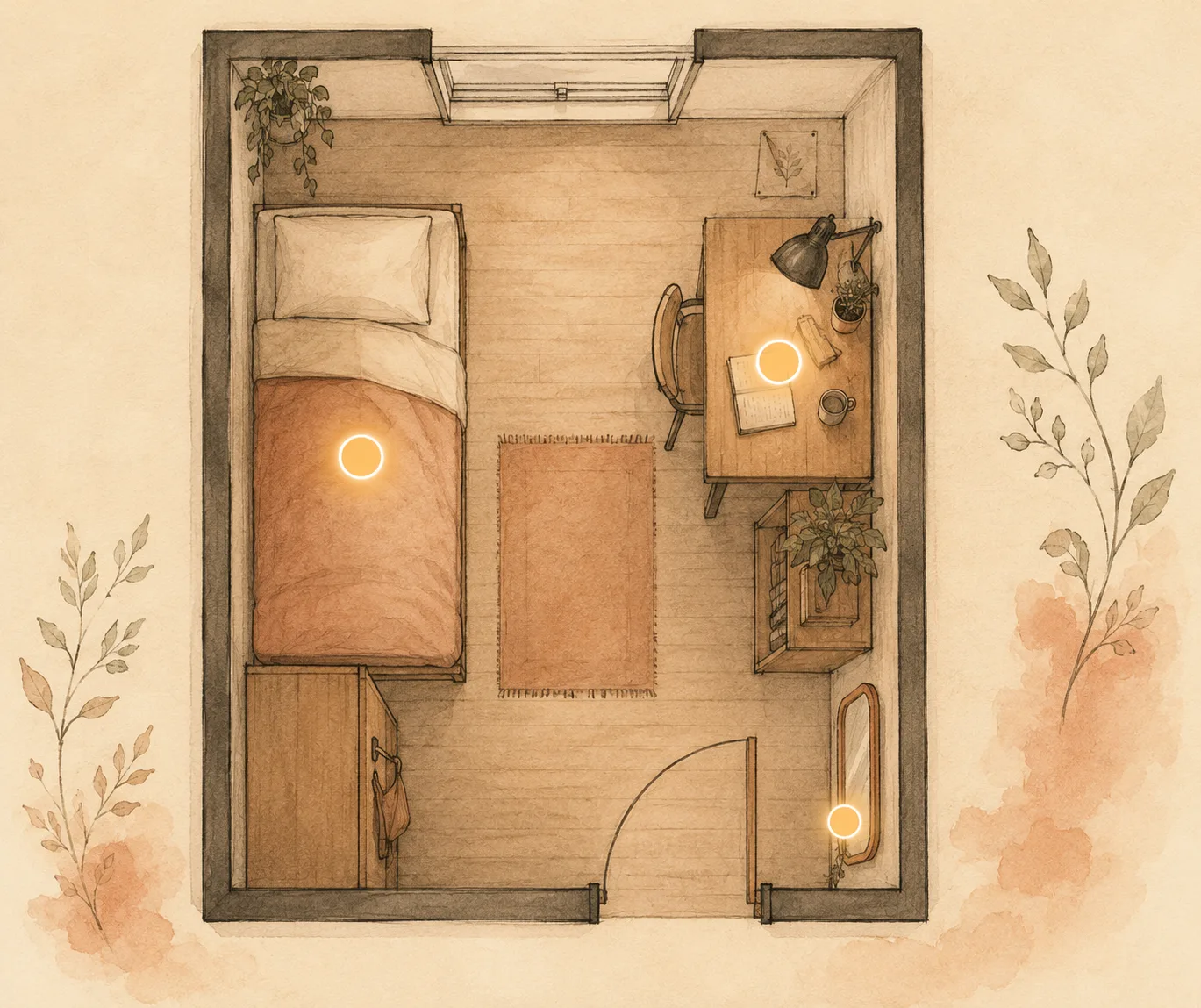
Change the light before you change anything else. Halls lighting is overhead, unshaded and bright, which is the exact condition under which skin becomes readable at close range. A warm desk lamp, plus the ceiling light staying off in the evening, is the highest-value item on this list and costs about the price of two coffees.
Cover the fixed mirror, or stop walking past it. You usually can't take it down. A scarf, a tea towel or a poster over the top edge works, and if you'd rather not cover it, moving your chargers and your keys away from it removes the reason you stand there. Check what your accommodation allows for fixings first, since most halls charge for wall damage and removable strips are normally fine.
Put the tools somewhere annoying. Nail scissors, tweezers, needles, safety pins. In a shared room "hidden" isn't a realistic goal, but "twenty seconds further away" is, and twenty seconds is often the whole margin. A friend's room down the corridor beats your own drawer.
Treat the skin, not just the picking. New water, communal showers, a term of short sleep and worse food, and skin that was fine in July starts flaking in October. Dry, lifting skin supplies targets that didn't exist a month ago. A plain moisturiser and a cleanser that doesn't strip is dull advice, and it removes raw material.
Give the resting hand a job. The picking hand is almost never the busy one, and the object has to live where the hand actually parks. Our guide to choosing a fidget covers matching the texture to the sensation you're chasing.
Halls beds are frequently lofted over the desk, which puts your phone, your lamp and your only genuinely private hour in the same square metre. If the worst of it happens after lights out, night picking has its own set of fixes.
The roommate will notice, and what you say next matters more
They'll notice. Not because you're careless about it, but because they sleep four feet away: the lamp on at two in the morning, the plasters, the bin, the mornings you don't want the big light on.
You don't owe anyone a diagnosis. What's worth deciding before the conversation is what you want from them, because there are three possible answers and they need three different conversations.
If you want nothing. Most people want this one. The aim is short, factual, and closes the topic without turning it into a secret:
"I pick at my skin. It's a thing I have and I'm dealing with it. It's not self-harm and it's not catching. If you notice, you can just ignore it."
That last sentence is doing most of the work. Without it, decent people assume the kind response is to check in, and being checked in on daily is its own weight.
If you want one specific thing. Ask for the thing rather than for the understanding. "Can we keep the big light off after ten" and "if the mirror's covered, leave it covered" are requests a near-stranger can agree to in week one without needing any of the backstory.
If you want actual help. Be careful with this one. "Tell me when you see me doing it" is the most commonly requested and the most reliably counterproductive arrangement in this condition. Being watched turns into being policed, policing turns into hiding it better, and you end up with the same picking plus a living situation you're managing. If you do want an interruption, agree its exact form in advance and keep it neutral. A single word, a knock on the door frame, "making tea, want one." Nothing that names the behavior in the moment.
If they've already said something clumsy, it was probably clumsy rather than cruel, and one line resets it: "I know you meant well. It helps more if you don't mention it." Most people take that gratefully, because they didn't know what to do either.
Telling somebody closer, a partner or a good friend, is a different conversation with different stakes. Our guide to telling a partner covers that version.
Your picking runs on a term timetable
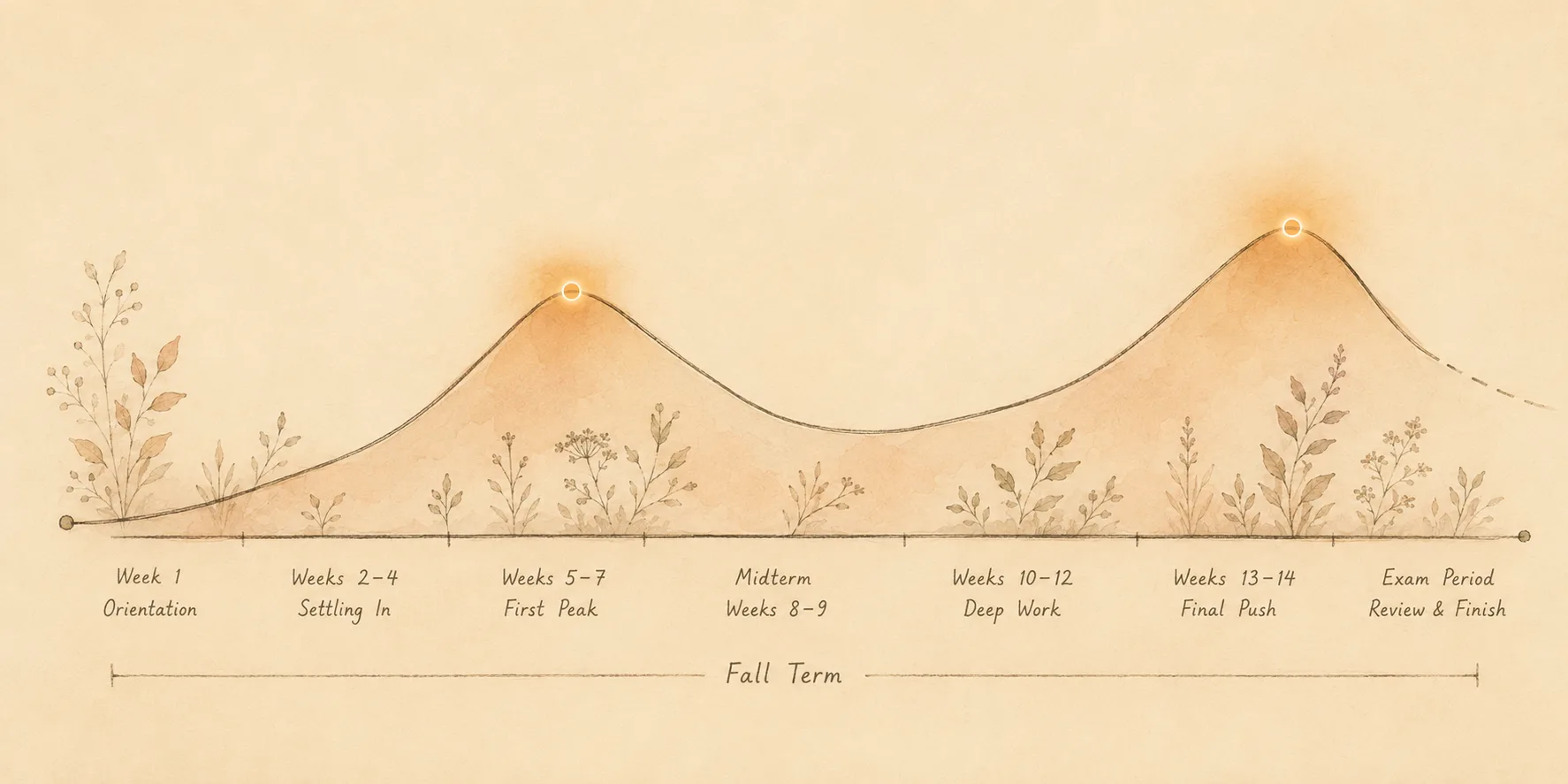
Picking tracks the academic calendar more reliably than it tracks mood, and it does it through two opposite mechanisms that get confused with each other constantly.
The pressure weeks. Deadlines cluster, then finals arrive. Reading is close to a perfect picking activity: one hand free, eyes somewhere else, hours of sustained low-grade attention, nobody watching. Most students' worst study picking happens while reading rather than while writing, because writing occupies both hands. A library desk is a free intervention here, and it works for an unglamorous reason. Being visible does most of the job willpower is supposed to do.
The empty weeks. Reading week, the fortnight after a big hand-in, the flat Sunday in February. Understimulation drives a different kind of episode and needs the opposite response: something for your hands and somewhere to be, not more concentration.
Sleep is the multiplier under all of it. Late nights and an alarm that moves by four hours between Tuesday and Sunday worsen both ends of the day: the two-in-the-morning bed episode and the groggy mirror stop before a nine o'clock lecture. Holding one consistent wake time, including after a bad night, does more for this than any single object in the room. If the pressure side is where your picking lives, anxiety and skin picking goes deeper on that link.
One term is enough data to see all of this. You're tracking three things and nothing else: which week, which place, and whether you noticed it starting. That last one separates the automatic episodes from the deliberate ones, and the two need almost opposite tactics.
This is the part SkinAware is built for. Logging an episode takes a few taps and records where, how long, and whether you caught it starting, and urges you resisted get logged the same way, so your pattern assembles as the term goes rather than in hindsight. The habit reversal course inside the app teaches the behavioral work that turns that pattern into a plan. It's $5.99 a month or $34.99 a year, with a two-week trial on iOS.
See one term's pattern instead of guessing at it
SkinAware logs episodes and resisted urges in seconds, notes whether you caught it starting, and its habit reversal course turns that record into something you can act on.
Available on iOS, Android and in your browser.
Campus counselling: what it's good at, and how to ask for more
Two caveats, both worth knowing before you book.
Campus services are usually built for short-term work. In the 2023–24 survey of 367 US counselling center directors, 43% of institutions limited the number of sessions a student could have in a year, 55% had no formal limit, and only 0.6% ran a hard cap with no exceptions. So the "you only get six sessions" line students pass around is often wrong, and where limits do exist they usually flex. Ask yours rather than assuming.
Most campus counsellors have never been trained to treat BFRBs. That isn't a criticism of them. Skin picking and hair pulling get very little coverage in general clinical training, and a service seeing hundreds of students a term is staffed for anxiety, depression and crisis, which is genuinely most of the caseload. A counsellor who hasn't run habit reversal training will tend to work on the stress instead, and working on stress is not a treatment for picking. Habit reversal training is, and it's specific enough that you want somebody who knows it.
So use the service for what it does well, and be direct about the rest.
If a referral out is where you end up, our guide to finding a BFRB therapist covers what to ask a private clinician and how to check they've actually done this work. The International OCD Foundation (iocdf.org) keeps a provider directory and now hosts the TLC Foundation's BFRB resources; bfrb.org itself is only online through Summer 2026.
Your student health center or GP is a separate and useful door. They deal with the skin itself, with spots that look infected, and with the medication conversation if that becomes relevant.
Frequently Asked Questions
You don't have to, and plenty of people never do. What's worth thinking about is what you'd get from it. If the answer is 'not having to be careful in my own room', that's a good reason. If it's 'so they'll stop me', reconsider, because being monitored by someone you live with tends to move picking into private rather than reduce it. A short, factual line with no request attached works better than a disclosure that comes with a job for them.
It's very common, and the research supports it. Skin picking disorder runs at roughly 4% in university samples against 1.2% to 1.4% in general adult community samples. The move supplies most of the ingredients at once: broken routine, less sleep, more stress, a new bathroom, and years of independence arriving in a single week.
At most universities it's included in fees you've already paid rather than free in a strict sense, but there's nothing extra to pay at the point of use. Models differ hugely by country and institution, so check what yours offers, whether it caps sessions, and what happens when you need more than it provides.
It's a common outcome and not a dead end. Ask directly whether anyone in the service has worked with body-focused repetitive behaviors, and if not, ask to be referred out. Referral is a normal request and often somebody's specific job. In the meantime the service can still help with the anxiety, depression and sleep side, all of which feed picking.
One line, no explanation: 'I know you mean well, it helps more if you don't mention it.' Most people are relieved to be told, because they've been guessing. If it continues after that, it's stopped being awkwardness and become a living-situation problem, and your accommodation office deals with those routinely.
Not necessarily in grades. The university study found no GPA difference between students with skin picking disorder and everyone else. What it did find was higher stress and worse depression scores, and a separate survey found close to half of people in education struggled to study because of picking at some point in the year. The academic cost tends to land in hours and energy rather than in results, which is exactly why it goes unflagged.
No. Counselling services take self-referrals for whatever you bring them. If you eventually want academic adjustments, the requirements are set by your institution and by the law where you study, so ask the disability or student support office what evidence they need rather than assuming a diagnosis is or isn't required.
Continue Reading
References
- Odlaug, B. L., Lust, K., Schreiber, L. R. N., Christenson, G., Derbyshire, K., & Grant, J. E. (2013). Skin picking disorder in university students: health correlates and gender differences. General Hospital Psychiatry, 35(2), 168–173.
- Tucker, B. T., Woods, D. W., Flessner, C. A., Franklin, S. A., & Franklin, M. E. (2011). The Skin Picking Impact Project: phenomenology, interference, and treatment utilization of pathological skin picking in a population-based sample. Journal of Anxiety Disorders, 25(1), 88–95.
- Association for University and College Counseling Center Directors (AUCCCD). Annual Survey, 2023–24 reporting period, published February 2025; figures as reported by Inside Higher Ed, 11 March 2025.