
Written using peer-reviewed research including Odlaug & Grant (2008, General Hospital Psychiatry), Clark & Drake (2015, American Family Physician) and Meunier et al. (2021, Eplasty), alongside guidance from the American Academy of Dermatology and the Cleveland Clinic.
Your scalp holds roughly a hundred thousand hair follicles and one of the densest concentrations of oil glands anywhere on your body, and all of it sits under a layer of hair that keeps the air off and the light out. Skin in that state produces flakes, bumps, and rough patches at a rate very little other skin on you can match.
You also don't find them by looking. You find them by feel, with a fingertip that can register a raised edge a fraction of a millimetre high, in a meeting, in the car, in bed, in the dark, with no mirror involved at any point.
That's what makes this site its own problem, and it's why a lot of skin picking advice lands wrong here. Cover the mirrors, change the bathroom lighting, put the magnifying mirror in a drawer: none of it reaches a behavior you run blind, under hair, with both hands already resting where they'd naturally rest.
What the scalp does differently
Start with the fact that you read this site by touch rather than sight. The search that precedes a pick needs no mirror, no bright room, and no spare moment, which means it can run underneath almost any other activity. Most people who pick their scalp describe arriving mid-episode with no memory of starting. That isn't a character flaw. It's what happens when a behavior requires no setup.
Then there's the cover. Damage to a face gets noticed, by you and by other people, and that feedback puts a ceiling on how far it goes. Scalp damage stays private for months. Nobody comments. You often can't see it yourself without a phone camera and an awkward angle, so most of what you know about the state of your scalp comes from the same fingertips that made the mess. That's an unreliable narrator.
And then the part that matters most for stopping: the supply. Hair traps sebum, sweat, and product against the skin, and a warm covered surface is exactly what flaking, itching, and inflamed follicles need. Where a forearm eventually runs out of things to pick, a scalp restocks itself.
Picking, or pulling?
Worth sorting out before anything else, because on the scalp the line is genuinely blurred and the answer changes what you do next.
A fingertip moving through hair meets two kinds of target: a rough or raised patch of skin, and a hair that feels coarse, wiry, or out of line with the rest. Plenty of people find both in the same pass and have never separated them in their own account of what they do.
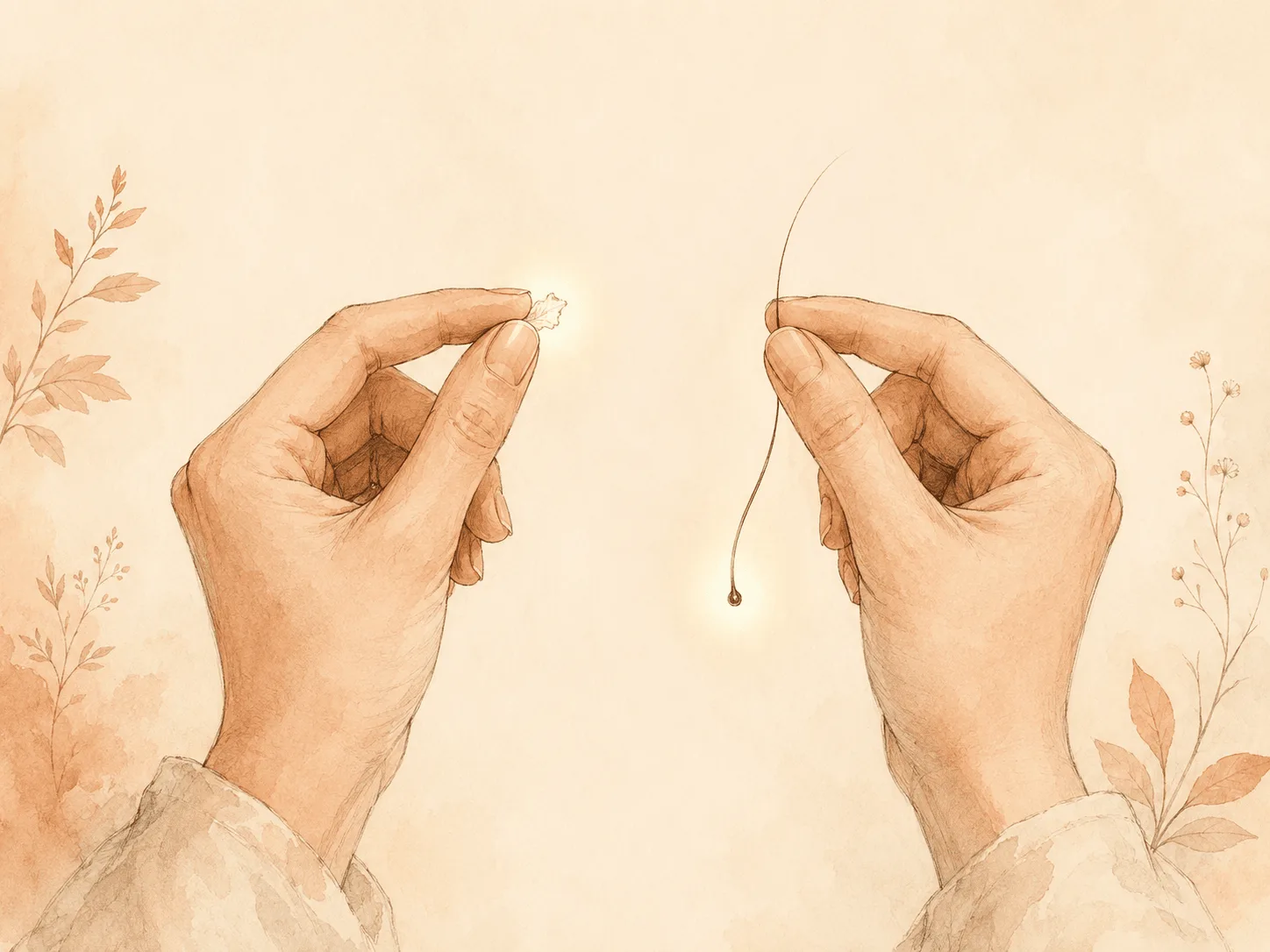
The test is what ends up between your fingers, and what you do with it afterwards. Skin, flakes, or scab material is picking. A hair with the root bulb attached is pulling, and the giveaway is usually what comes next: checking the root, rolling it, running it along your lip, lining them up. Those rituals belong to pulling and almost never attach themselves to a scab.
If it's pulling, or partly pulling, the full picture of what trichotillomania is is worth reading, because the competing responses, the regrowth timeline, and the environment changes all differ. Doing both is common and it isn't a complication. It just means logging them separately, or the pattern disappears into an average.
What keeps restocking the supply
Two things generate the targets, and most people are only aware of one.
The first is an underlying scalp condition, frequently undiagnosed. Seborrhoeic dermatitis is the usual candidate: greasy, flaking, itchy patches driven by an inflammatory response to a yeast that lives on everyone's skin.
That second peak lands in the same window in which skin picking usually starts, and the condition flares under stress, which is also when picking flares. Two problems arriving in the same years, worsened by the same things, feeding each other.
Scalp psoriasis, folliculitis, ingrown hairs along the hairline and nape, contact reactions to dye or dry shampoo, and plain product buildup all do the same job. They put texture on the scalp that a searching fingertip will find.
The second source is the picking itself, and this is the loop that keeps people stuck long after the original cause has been treated.
Treating the scalp, not just the habit
This is the highest-yield thing available to most people reading this, and it's usually the one that's never been done properly.
Medicated shampoo works, and it fails for boring mechanical reasons far more often than it fails pharmacologically. The actives worth knowing over the counter are ketoconazole, zinc pyrithione, selenium sulfide, coal tar, and salicylic acid. Two things determine whether any of them do anything.
Frequency is the other, and it depends on your hair rather than being universal. Dermatologists commonly suggest a dandruff shampoo two to three times a week for straight or wavy hair, and about once a week for curly or tightly coiled hair, where washing more often costs more than the flaking does. If a shampoo that used to work stops working, rotating to one with a different active is standard practice rather than a sign of failure.
If four weeks of that changes nothing, that's a dermatologist appointment rather than a reason to abandon the approach. Prescription options are meaningfully stronger: in two clinical trials of prescription ciclopirox shampoo, 58% and 26% of patients had little or no seborrhoeic dermatitis left after four weeks. It also matters because thick silvery plaques, pustules, or a scaly patch with broken-off hairs are different conditions with different treatments, and no shampoo aisle sorts that out for you.
Two things to raise in that appointment:
- Tell them you pick. Otherwise they're reading damage you caused as a symptom of the disease, and they'll treat the wrong thing. It's a common presentation and it won't surprise them.
- Ask whether the treatment will flake or crust on the way to working. Plenty do. A treatment that temporarily adds texture temporarily adds targets, and knowing that in advance is the difference between expecting a rough fortnight and quitting during one.
The limit of all of this is worth stating plainly. Clearing your scalp reduces what your hands find. It doesn't stop your hands going up. Picking that started with a real skin condition routinely outlives it, which is why the behavior persisting after the trigger is gone is such a common and such a demoralising experience. Treat the scalp because it lowers the difficulty. Treat the behavior because that's the part that's actually a behavior.
Folliculitis, scarring, and hair
The question sitting under most scalp picking searches is whether this is causing hair loss. The answer has two halves, and the first is more reassuring than people expect.
Hair follicles are durable. Picking at the skin around them, even for years, usually leaves the follicle itself intact, and intact follicles keep producing hair. What changes the answer is scarring. Repeated deep damage in one spot lays down scar tissue, and scar tissue contains no follicles. That loss is permanent, and it's often visible: the area looks smooth and slightly shiny, with no pores in it.
The route from the first to the second usually runs through infection. An open spot on a hairy surface gives bacteria a way into the follicle, which is folliculitis: small red or pus-filled bumps that look like acne and itch enough to get picked themselves. Most cases settle. Repeated or deep ones can destroy the follicle, and that's the mechanism by which picking turns into hair loss rather than just soreness.
That principle scales all the way down. A scab, a graft, and everything in between only heal in the time you leave them alone.
Tactics for a site you can't see
Everything below is hands, texture, or setting, because there's no mirror to cover here and no visual check to interrupt. The behavioral core is the same wherever you pick, and the full treatment ladder is covered separately. This is the scalp layer on top of it.
File your nails short and smooth. The most direct intervention available and the most underrated. Scalp picking is largely a nail-edge behavior, because you need a hard edge to get under a flake or a scab. A short, filed nail physically can't, and unlike resolve it keeps working while your attention is elsewhere. Do it weekly, on a schedule, rather than when you remember.
Put a layer between fingertip and skin. A soft cotton cap, a headband, hair up in a bun, a satin bonnet in the evening. This isn't symbolic. A covered scalp means the search has to get through something first, and that gap is where awareness arrives.
Wash more often, not less. This runs against most current hair advice, and for people who pick it's usually still the right call. A cleaner scalp flakes less and offers less. If daily shampooing dries out your lengths, wash the scalp and leave the ends alone.
Match the texture you're actually chasing. The sensation being sought is a hard edge catching under a nail, and a smooth stress ball is nowhere near it. Closer: a fine-tooth comb dragged across the fingertips, a stiff-bristled brush against the palm, a fiber fidget, or a silicone scalp massager used with firm pressure. The massager is particularly useful here because it gives the scalp the pressure it's asking for with no nail involved.
Move your elbow. The hand goes to the head because the head is where a raised hand comfortably rests. Notice where your elbow lives when you pick, on the desk, on the arm of the sofa, against the car door, and change that one thing. It's a smaller ask than changing the habit, and it removes the starting position.
Count the hand, not the pick. The pick is link four or five in the chain. What you can actually catch is your hand arriving at your head, including every time nothing gets picked. Logging that number for two weeks is the first move in habit reversal training, and it's what makes everything after it possible.
Where to start
Run two things in parallel for four weeks, because each one makes the other easier.
The first is a medicated shampoo used correctly: the right active for your scalp, left on long enough to work, at a frequency that suits your hair type. The second is a log of every time your hand goes to your head, with what you found when it got there and what you were doing at the time.
At the end of that month you'll know two things you almost certainly don't know now. Whether an untreated skin condition has been supplying most of your targets. And whether you're picking, pulling, or both.
That second job is what SkinAware was built for. Logging a pick or a resisted urge takes a few taps with the body area and trigger attached, hair pulling is a first-class condition rather than an afterthought so scalp picking and scalp pulling stay separate in the data, and the habit reversal course runs in short modules. It's $5.99 a month or $34.99 a year, with a two-week trial on iOS.
If your hands also find their way to your face, that site has its own mechanics and its own set of changes.
FAQ
Usually, yes. Picking damages the skin around follicles far more often than it destroys the follicles themselves, and an intact follicle keeps producing hair once the area is left alone to heal. What doesn't come back is hair from scarred skin, which looks smooth and shiny with no visible pores. A dermatologist can tell the difference in a few minutes with a handheld magnifier, and the answer is usually less final than people assume.
Because healing skin genuinely itches. Histamine release and the regrowth of small nerve fibers both produce that signal, so it's real rather than imagined, which is why willpower alone tends to lose to it. Give the sensation an answer instead: a medicated or soothing shampoo, a cool rinse, or firm pressure from a scalp massager, which settles the feeling without a nail getting involved.
More often a body-focused repetitive behavior than an OCD compulsion, though the two can coexist. The practical difference is treatment: BFRBs respond to habit reversal training and the comprehensive behavioral (ComB) model, while OCD is treated with exposure and response prevention, and they aren't interchangeable. If your picking follows a specific intrusive thought rather than an urge or a physical sensation, that's worth raising with a clinician.
Look at what's between your fingers afterwards. Skin, flakes, and scab material mean picking. A hair with the root attached means pulling, especially if a ritual follows: inspecting the root, rolling it, running it across your lips. Doing both is common, and worth logging separately, because the responses differ.
If your scalp is flaking, itching, or has bumps or pustules on it, start with the dermatologist. Treating that lowers the number of targets your hands can find, and it's often the faster win. The behavior still needs behavioral treatment either way. Look for someone who names BFRBs, dermatillomania, or habit reversal training specifically. The International OCD Foundation (iocdf.org), which now hosts the TLC Foundation's BFRB resources, keeps a therapist directory.
For most people who pick, more often helps. A cleaner scalp flakes less and offers less texture to find, and the widespread advice to wash minimally is aimed at hair condition rather than scalp skin. The exception is curly or tightly coiled hair, where dermatologists commonly recommend medicated shampoo about once a week. If dryness is the concern, wash the scalp and leave the lengths alone.