
Written using a 23-laboratory preregistered replication of the ego-depletion effect, a meta-analysis of 31 thought-suppression studies, a randomized trial of 334 adults with body-focused repetitive behaviors, and a randomized comparison of cognitive and behavioral therapy for hair pulling.
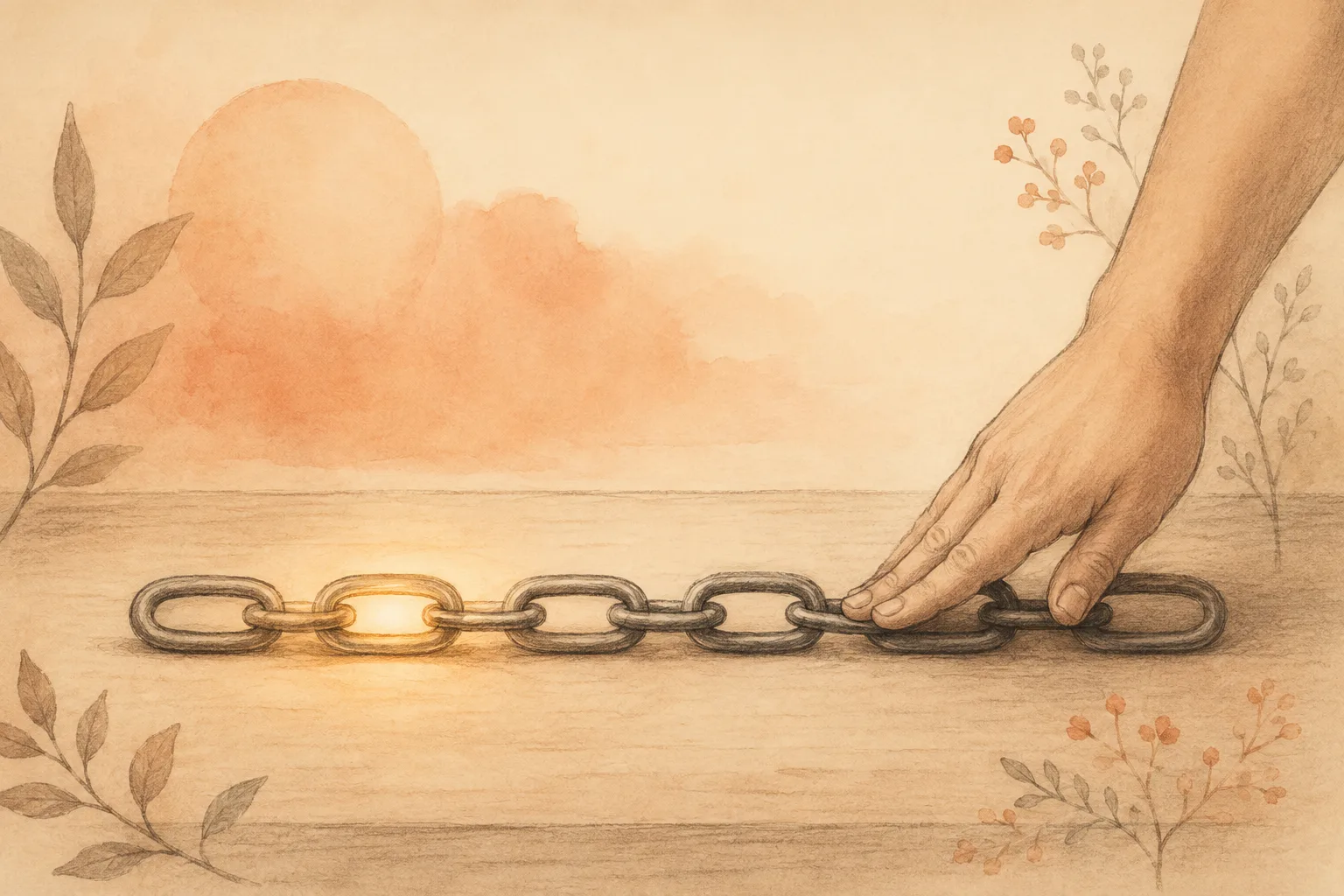
"Just stop" names a moment. It's the one where your fingers are already on your skin, you already know it, and you're already three or four links into a sequence that started somewhere else. That moment is the worst place in the whole chain to spend effort, and it's the only place the instruction points at.
Effort isn't the missing ingredient. Most people who pick have spent more effort on this than on anything else they've ever tried to change. What's missing is placement. Take the same effort and move it thirty seconds earlier, or onto the room you're standing in, or into a movement you rehearsed on a calm Tuesday, and it starts converting into something. Leave it where "just stop" puts it and it dissipates, reliably, and every time it does you collect more evidence for a conclusion about your own character that isn't true.
So this is the mechanical version. Which links absorb effort, which links convert it, and what the research says about each.
Where the instruction aims
A picking episode is a sequence, not an event. It runs roughly like this:
- The setup. The room, the light, the mirror, whether the tweezers are in reach, and the state you arrived in.
- The approach. A hand sweeping an area to see what's there. A glance caught on the way past. The sentence, which for most people is a version of "I'll just check one thing."
- The urge. Rising, specific, attached to a location.
- First contact. A nail under an edge.
- The episode.
- The aftermath. Shame, cover-up, and the promise that this was the last one.
"Just stop" is aimed at four and five. Every treatment with evidence behind it is aimed at one, two and three.
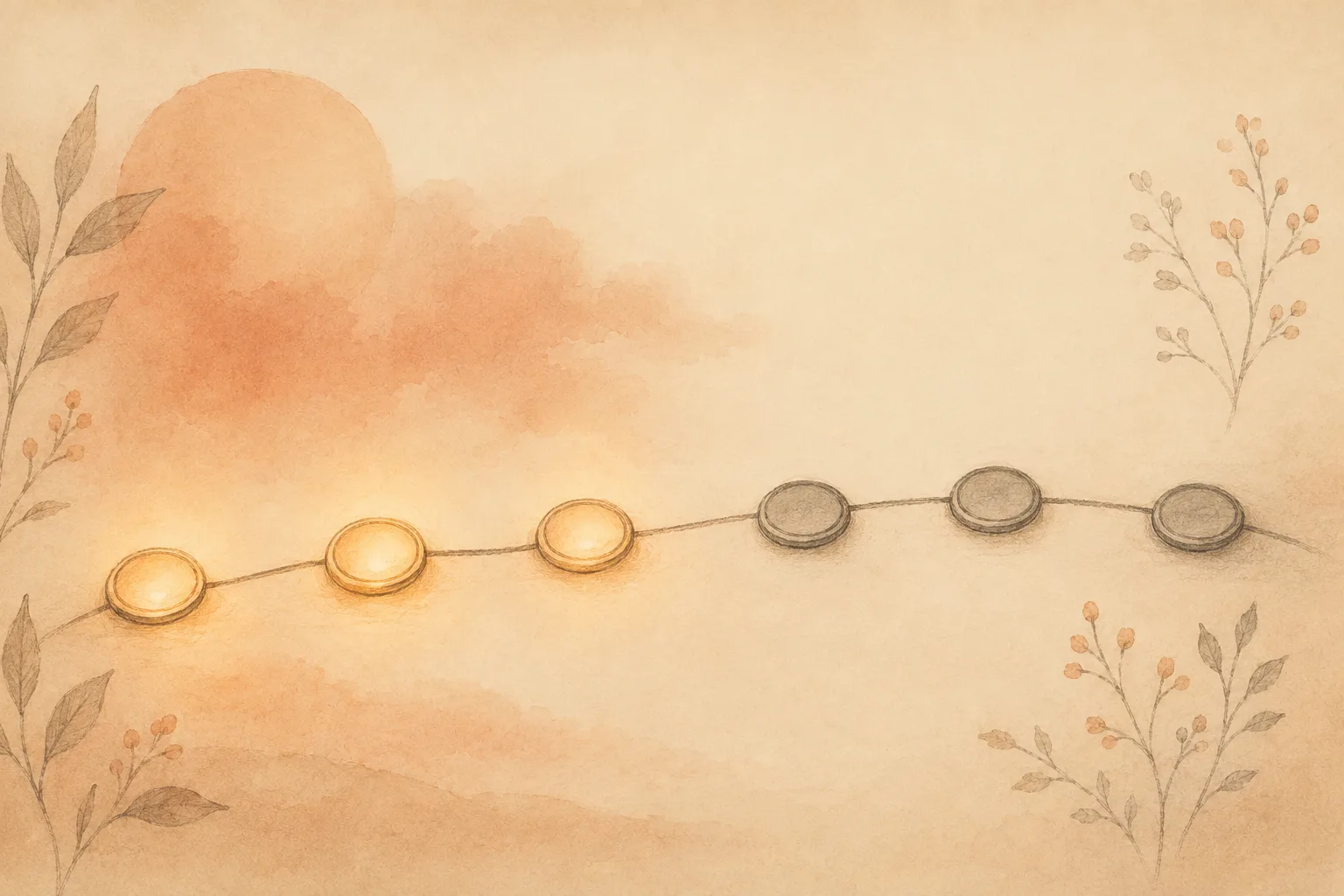
That isn't a coincidence or a technicality. Link four is the strongest link in the chain by construction. It's the most rehearsed, the most reinforced, and the one your nervous system has been optimising for years.
When there's no decision to make
Willpower needs a decision point. It's a mechanism for choosing between options, and it requires you to be present when the options appear.
A large share of picking episodes don't offer one. You find out about the episode afterwards, from a sting or a fingertip or somebody looking at you. There was no moment where a choice was tabled and you chose badly. There was no moment at all. Which episodes you walk into and which you discover is worth getting straight, because it decides what can reach you, and our guide to automatic versus focused picking maps the split properly.
You can't decline an invitation you never received. That rules out willpower for a substantial fraction of episodes before any question of strength comes up.
It's also why awareness training is the first component of habit reversal training rather than a warm-up for the real work. In 1985, Miltenberger, Fuqua and McKinley took the habit reversal package apart and tested the pieces separately on muscle tics. Awareness training and competing response training used together were as effective as the entire program. The parts that look like preparation are the parts doing the work.
Deciding harder doesn't reach the urge
One trial tested the willpower theory more directly than anything else in this literature, and it almost never gets quoted.
Fifty-six people with trichotillomania were randomized to cognitive therapy or behavior therapy, with forty-eight completing. The cognitive arm went after self-control beliefs specifically: that giving in is rewarding, and that the urge is uncontrollable. Socratic dialogue, behavioral experiments, the full apparatus for changing what someone believes about their own capacity to resist. The behavior arm did none of that. It did self-monitoring, stimulus control, interrupting the chain, and self-reward.
Changing what you believe about your urges did exactly as much as rearranging your bathroom. Not less, which is what people miss when they dismiss cognitive work. Not more, which is what people miss when they assume the fight is fundamentally about resolve.
The practical version: you aren't waiting for your urges to become resistible before recovery can start. Behavior changes while urges are still arriving at full strength. That's the normal shape of it, not a compromised version of it.
Suppression without a replacement has a track record, and it isn't good
There's a specific failure mode for the instruction "don't touch it," and it's been studied for forty years outside this field.
Trying not to think about something requires a background process that checks whether you're thinking about it. The check is the problem. In 2020, Wang, Hagger and Chatzisarantis pooled thirty-one studies using Wegner's original suppression paradigm and found rebound effects after suppression regardless of whether people were under cognitive load, with immediate enhancement appearing when load was present.
Applied to skin, the mechanism gets concrete and slightly grim. Not thinking about the spot on your jaw requires repeatedly verifying that you aren't thinking about the spot on your jaw. Each verification is an attention pass over that exact patch of skin, sometimes a fingertip pass. Which is link two. The instruction to leave it alone generates inspections, and inspection is how episodes start.
The duration data makes the same point from another angle. Twohig and Woods compared competing responses held for five seconds, one minute and three minutes in people who bit their nails. The one-minute and three-minute versions produced increases in nail length that held over time. Five seconds produced an immediate change that didn't last.
If the active ingredient were the decision, five seconds would be plenty; a decision takes under a second. It isn't the decision. It's the occupation of the hands across the window where the urge crests.
The popular explanation is wrong too
Most writing on this question explains willpower's failure with a fuel tank. Self-control is a limited resource, every act of resistance draws from the same pool, and by evening you're running on fumes. It's called ego depletion, and several of the highest-ranking pages on this exact search are built on it.
It didn't replicate.
This matters more than an academic correction, because the fuel-tank story produces two moves that don't help. It tells you to conserve willpower for the hard hours, which is a budgeting exercise for a resource that may not work the way you were told it does. And it hands you a ready-made reading of every evening lapse: you were tired, so of course you failed.
Both keep the effort parked at link four, where quantity was never the issue. If you want the neurological account of why the deciding part of your brain isn't the part running the behavior, this piece goes through it.
You didn't run out. You were pushing on the wrong link all day.
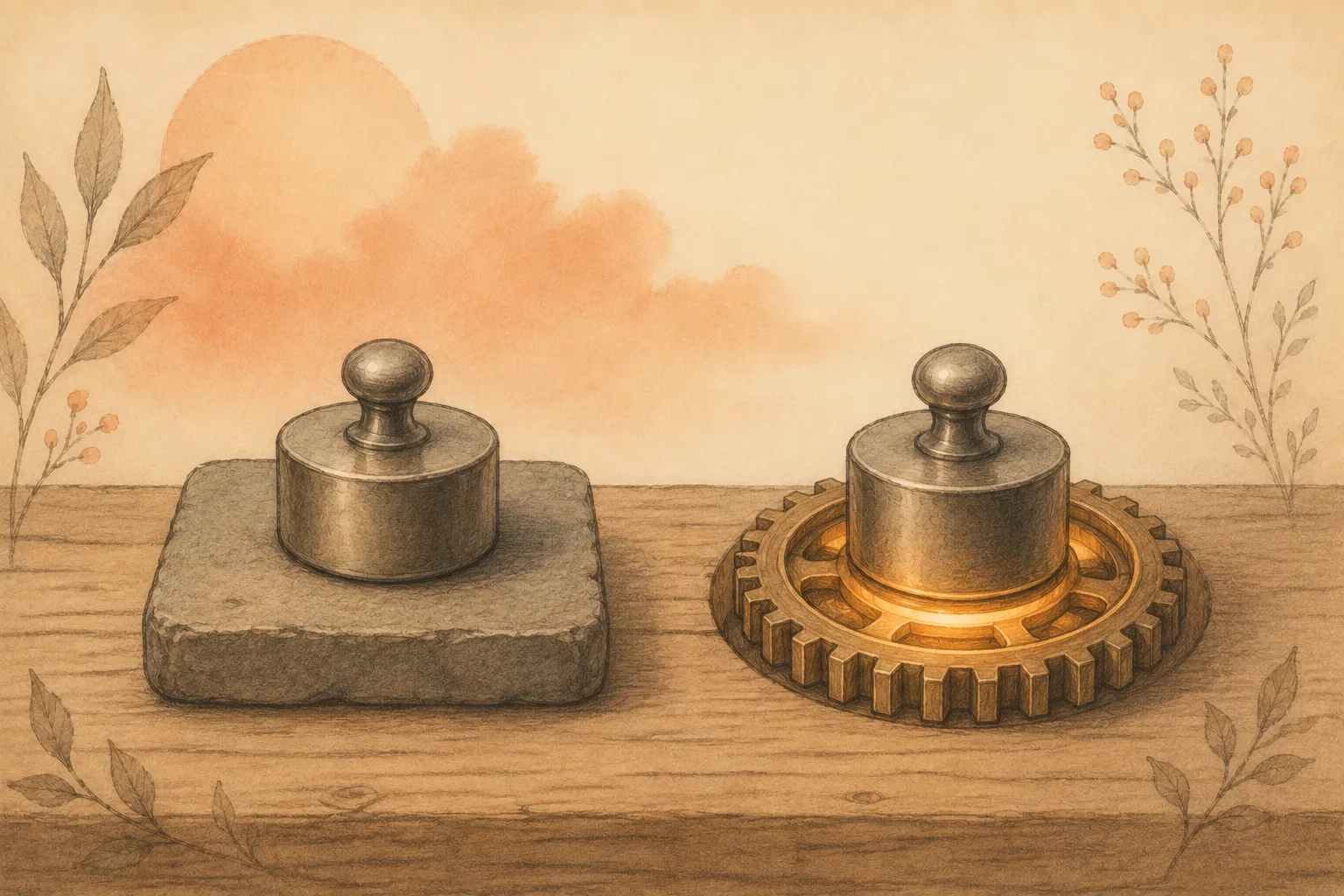
Where the same effort converts
Three placements. The detail for each lives elsewhere on this site rather than getting compressed into a paragraph here.
The setup. Bulb, mirror, tweezers, where you sit, what's within arm's reach. This is stimulus control, and it's the only component that keeps working while you're not thinking about it.
The approach. Catching the scan rather than the pick. That's awareness training, and it's a skill with a learning curve rather than a disposition you have or lack.
The contact point, occupied rather than refused. A rehearsed two-handed position that makes the picking movement mechanically impossible, held for a minute. Habit reversal training covers the four conditions a competing response has to meet and the four ways it fails.
Then the finding that settles the question this article is actually about.
Not "practiced longer." Used more of them at once.
Effort scales. It scales when it's channelled through structure. The same effort at link four is the one place it produces nothing measurable, which is exactly where "just stop" puts it, and exactly why you've concluded what you've concluded about yourself.
That's the shape SkinAware is built around. An episode and a resisted urge log the same way in a few taps, so the times you caught it early become data instead of forgettable non-events, and the habit reversal course opens with a lesson called "Why Awareness Comes First" for the reason described above. It's $5.99 a month or $34.99 a year, with a two-week trial on iOS, and it covers skin picking, hair pulling and nail biting.
Find out where your effort is landing
SkinAware logs an episode or a resisted urge in seconds, and turns a fortnight of them into the pattern underneath.
Available on iOS, Android and in your browser.
What this does not mean
It would be easy to read all of the above as a permission slip, and it isn't one.
Nothing here says the behavior is outside your influence. It says influence has a location. The claim isn't that trying is pointless; it's that trying is a thing you can aim, and where you aim it is the difference between fourteen years of failed attempts and a measurable change in three months. People who get somewhere with this are working hard. They're working somewhere else.
It also isn't a reason for anyone around you to lower what they expect of you, and it isn't a reason for you to. Recovery from this involves real, sustained, unglamorous effort. Logging on nights you don't want to. Rehearsing a hand position twenty times when there's no urge in sight. Changing a bathroom you liked the way it was.
That's not less work than white-knuckling. It's often more. It's work that compounds.
When someone says it to you
The people who say "just stop" are usually not being cruel. They're working from the only model they have, which is their own experience of a habit that responded to deciding.
Two things tend to land better than a defence:
"It's a recognised condition, not a habit. The treatment for it is a specific behavioral protocol, and I'm doing it."
"When you say that, what it changes is how much I hide it from you. It doesn't change the picking."
The second one is worth having ready, because shame reliably increases the behavior and secrecy is what shame produces. If the conversation is with somebody who wants to help and keeps getting it wrong, there's a guide to what to say instead. And if you want the wider set of claims about picking that the evidence contradicts, ten of them are collected here.
Frequently Asked Questions
It plays a part, in the way steering plays a part in driving. Necessary, not the engine. Willpower gets you to open the app on a bad night, to hold a rehearsed position for the full sixty seconds, to keep going after a lapse. What it can't do is out-muscle an episode at the moment of contact, which is the one job it keeps getting assigned.
No, and pages implying that are overcorrecting. What's true is narrower: you have very little control at the moment of contact, and considerably more earlier in the sequence. Those are different claims, and the second one is the useful one.
Two reasons. Suppression produces rebound, so a week of pure not-touching is a week of building pressure rather than a week of change. And gains in this area erode when practice stops, which the trials show consistently. A week of white-knuckling followed by a collapse isn't a personal failure pattern. It's the expected output of that method.
Fewer episodes and less damage, with urges still showing up. In the trials above, that's what improvement looks like. Waiting to feel differently before counting something as progress means missing most of your progress.
Not much on its own, and the cognitive-therapy trial is the evidence for that: changing beliefs helped, and no more than changing the environment did. Read this, then do one structural thing.
Possibly, and the most common version is deploying the competing response at contact rather than at the scan, which turns it into a tug of war you lose. It's also true that around 30% of completers in the 2022 trial hit the 35% improvement threshold, which means most people needed more than one round, more techniques, or a different combination. Not working first time is common, and it isn't the same as not working.
For a habit, yes. Plenty of nail biting and skin picking really does respond to deciding, and stays that way. The disorder is the version that has already survived every attempt you've made to decide your way out of it. If you've tried and it came back, that's not evidence you tried badly.
Continue Reading
References
- Hagger, M. S., Chatzisarantis, N. L. D., et al. (2016). A multilab preregistered replication of the ego-depletion effect. Perspectives on Psychological Science, 11(4), 546–573.
- Wang, D., Hagger, M. S., & Chatzisarantis, N. L. D. (2020). Ironic effects of thought suppression: A meta-analysis. Perspectives on Psychological Science, 15(3), 778–793.
- Moritz, S., et al. (2022). Habit reversal training and variants of decoupling for use in body-focused repetitive behaviors: A randomized controlled trial. Journal of Clinical Medicine, 11(21).
- Addressing self-control cognitions in the treatment of trichotillomania: A randomized controlled trial comparing cognitive therapy to behaviour therapy. Cognitive Therapy and Research (2016).
- Twohig, M. P., & Woods, D. W. (2001). Evaluating the duration of the competing response in habit reversal: A parametric analysis. Journal of Applied Behavior Analysis, 34(4), 517–520.
- Miltenberger, R. G., Fuqua, R. W., & McKinley, T. (1985). Habit reversal with muscle tics: Replication and component analysis. Behavior Therapy, 16(1), 39–50.
- Azrin, N. H., & Nunn, R. G. (1973). Habit-reversal: A method of eliminating nervous habits and tics. Behaviour Research and Therapy, 11(4), 619–628.