
Written using guidance from the American Academy of Dermatology, a 2025 scoping review of UV/LED nail lamp exposure, Steunebrink et al. (2024, Contact Dermatitis), Cohen (2022, Cureus) and Zhivagui et al. (2023, Nature Communications).
For some people, yes, and for reasons that hold up. The American Academy of Dermatology lists it in its own nail-biting advice: "Paint or cover your nails. You are less likely to bite your nails if they look nice, or you spend money to get them done in a salon." A capped nail has no rough edge to catch on your teeth, nothing to peel, and a price tag attached to ruining it.
For other people it goes wrong in a specific and well-documented way: the enhancement itself becomes the new thing to pick at, and the nail underneath ends up worse than when they started.
Which group you land in isn't luck. It's largely predictable from what you actually put in your mouth, and you can work that out in about ten seconds.
The ten-second test
Watch what your hand does next time, and note where it lands.
The nail plate and free edge. You're biting the nail itself: the white tip, a corner that's grown past level, a split you're evening out with your teeth. Your teeth are looking for something to shear off.
The skin. You're going after the rim of skin at the base of the nail, hangnails, the sides, the bit of loose skin near the corner. Your fingers find a snag and your mouth finishes it.
Neither, exactly. Your hand goes up during a work call or a film and you notice ten minutes later. The specific target is almost incidental. What you're getting is pressure and something to do.
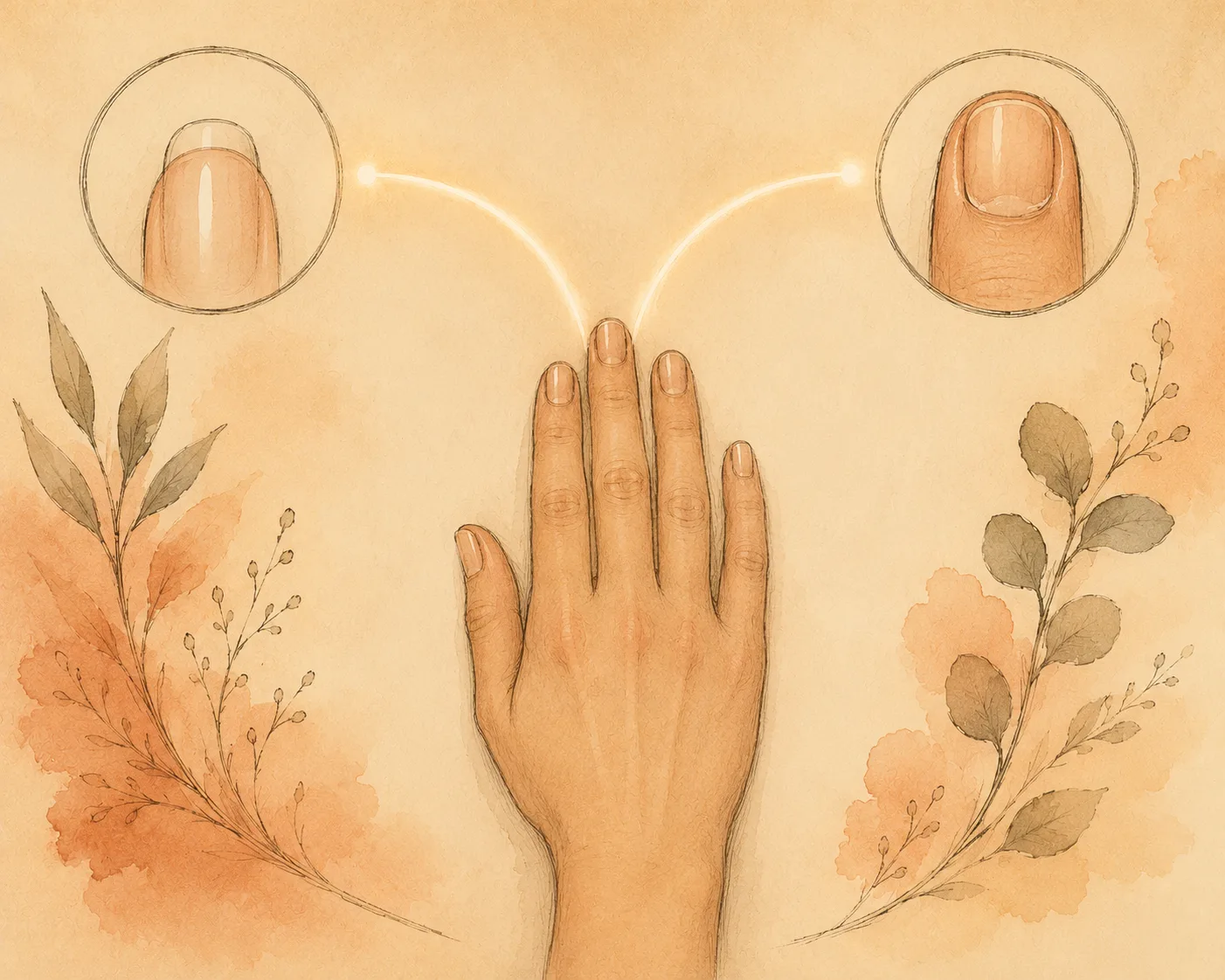
That's the whole diagnostic, and it maps cleanly onto the outcome.
If you bite the nail plate, an enhancement covers your target completely. There is no free edge left to work on, because the gel is capping it. This is the group that reports gels working, and their reports are credible.
If you bite the skin, an enhancement covers none of your target. Gel goes on the nail, and the skin around it stays exactly as exposed as it was. Worse, acetone removal dries out that same rim of skin, and dry skin around the nail is where hangnails come from in the first place. The skin-focused version of this behavior has its own set of problems, covered properly in the guide to cuticle picking.
If you're in the third group, an enhancement changes the texture your hand finds, but not the reason it went there. Sometimes the unfamiliar surface is enough of an interruption to break the loop. Often the hand just adapts, and adapts toward whatever edge appears first.
What each option actually does
The four things people mean by "getting my nails done" behave very differently on a biter's hands.
| What it is | Typical wear | What it does for biting | Main risk | |
|---|---|---|---|---|
| Gel polish | Acrylate polish cured hard under a lamp | 2–3 weeks | Caps the free edge, smooths splits, no chip to worry at | Brittleness and peeling; picking it off takes nail with it |
| Structured gel | Thicker gel built over the natural nail | 3–4 weeks | Adds strength to a short bitten nail without extending length | Same as gel, plus more product to lift |
| Acrylic | Powdered and liquid methacrylate sculpted on | 2–3 weeks before infill | Hard, and hard to bite through | Nail is filed rough first, which thins it |
| Press-ons | Preformed tips on adhesive | Days to about a week | Cheapest way to test the idea; instant, reversible | Pulling them off causes nail shedding and pitting |
Press-ons are worth a paragraph of their own, because they're the option most people try first and the one most often oversold. They're designed for short-term use, usually under a week, and they attach with a methacrylate-based adhesive. Removing them traumatically, which is what happens when you pop one off with your thumbnail rather than soaking it, produces horizontal shedding of the nail plate and visible pitting.
Used properly, though, a set of press-ons is a genuinely sensible experiment. It costs very little and it answers the target question in a week: if you spend that week not biting, the cap is doing something and a longer-lasting version is worth the money. If you spend it biting the press-on, you've learned that cheaply.
The failure mode nobody selling these mentions
Anything glued to a growing nail eventually lifts. Your nail grows out from under it, the bond at the edge gives, and suddenly there's a raised lip where there wasn't one before.
For a lot of people, that lip is more interesting than any nail they've ever had.
There's a case report of a woman who had never picked at her nails until she started having acrylics applied. Over the fifteen years that followed, she picked every set off as it began to detach, went back to the salon, and did it again. Her natural nails ended up pitted and shedding. The authors who described her noted they couldn't find other reports of the same thing and suspected it was far more common than the literature showed.
That's the pattern to watch for, and it's an easy one to miss in yourself, because from the outside it looks like nail care. You're not biting. You're tidying an edge. Two months later there's an edge to tidy every single day.
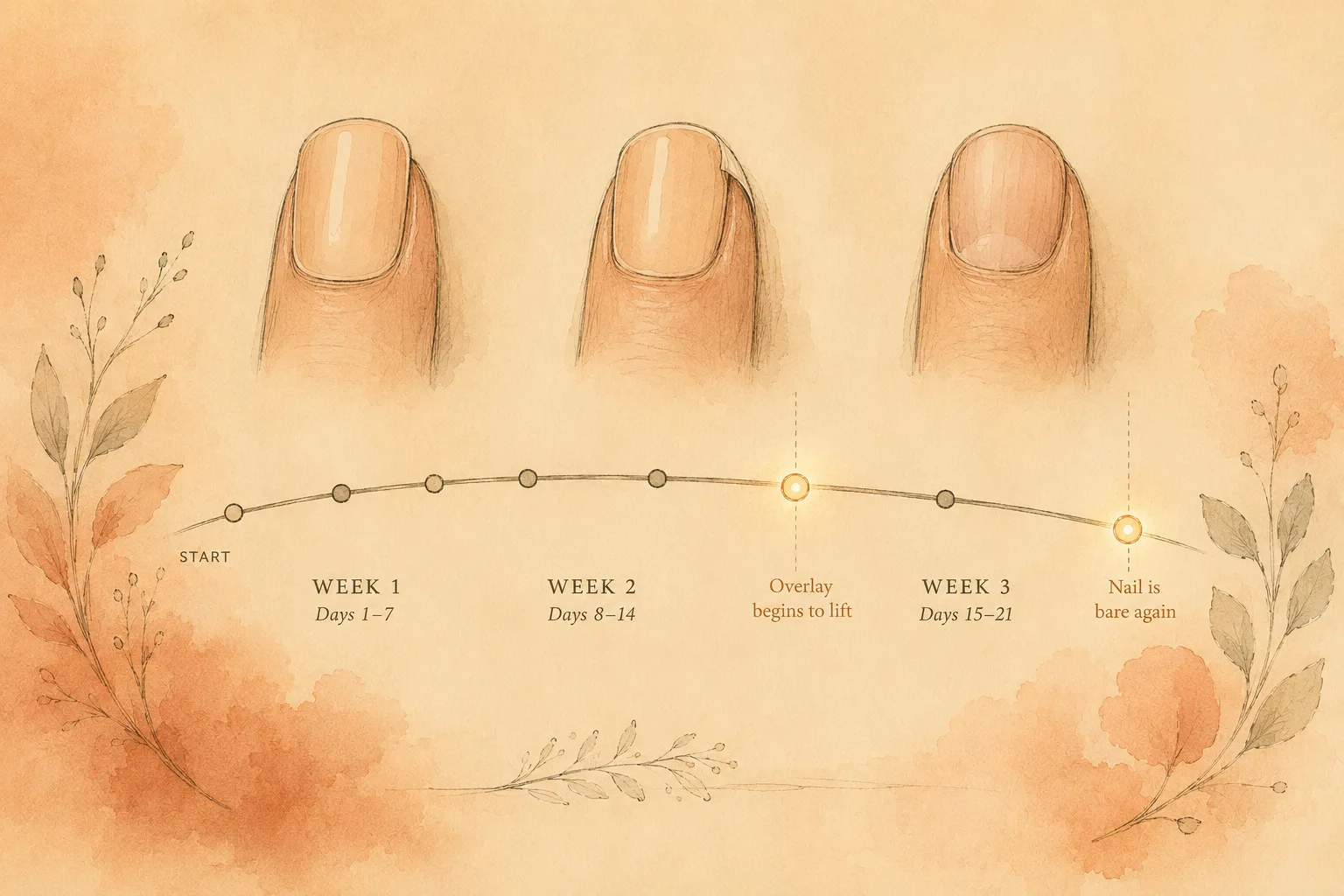
The second risk window is removal. Gel that gets picked or filed off rather than soaked off takes layers of nail plate with it, which is why dermatologists are so firm about this one. Shari Lipner, the dermatologist behind the AAD's own removal guidance, warns that picking or filing gel off can significantly damage your nails, and that prying at it with an orange stick leaves white spots.
The removal week is also the week the barrier is gone and the nail underneath looks thin and ridged. If you're going to relapse, that's when. It's better planned for than discovered.
What it does to the nail underneath
The AAD's position on gels is not that they're dangerous, it's that they're hard on nails. Their wording: gel manicures can cause nail brittleness, peeling and cracking.
Acrylics are harder still. To get them to bond, the surface of the natural nail is filed until it feels rough, which thins it and leaves it weaker. Add infills every two to three weeks and removal by acetone soak or filing, and the AAD's summary is blunt: artificial nails can leave your nails thin, brittle and parched.
There's also an allergy question, and it's not a rare one.
That's a number to have before you start, especially if you're planning to wear them continuously rather than for a wedding.
If you do go ahead, the AAD's damage-reduction list is short and specific: choose soak-off gel over acrylic, since gel is more flexible and your own nail is less likely to crack under it. Go to a salon using an LED lamp rather than a UV one. Ask them not to trim your cuticles, because that seal is what keeps bacteria out. Take a polish holiday of a week or two between sets and put petroleum jelly on the nails and nail folds several times a day while you do.
That last one matters more for a biter than for anyone else. The holiday is when your nails rebuild, and it's also the week you're most exposed. Schedule it somewhere calm rather than during finals or a deadline.
The UV lamp question, answered properly
This one has been reported badly in both directions, alarmist in some places and dismissive in others. The evidence sits somewhere neither camp describes.
Nail lamps emit mostly UVA, in the 340 to 395 nanometre range. In 2023 a team published cell-culture work in Nature Communications showing that irradiating human and mouse cells with a nail-polish dryer produced reactive oxygen species, oxidative DNA damage, mitochondrial dysfunction, and a dose-dependent rise in mutations matching the patterns reactive oxygen species leave behind. That's a real finding and it's why the headlines happened.
What it isn't is a measurement of your risk. Cells in a dish are not hands.
Two other numbers put a floor and a ceiling on it. One team measured lamps emitting up to 4.2 times the sun's output in part of the UVA range, meaning ten minutes under some of them delivers roughly an outdoor worker's recommended daily limit. And in a keratinocyte study, four minutes of exposure, which is about what a real manicure involves, didn't significantly affect cell viability, while twenty minutes cut it by 35%.
So: the exposure is real, brief, repeated, and not currently linked to a measurable increase in cancer at the doses a normal customer receives. The AAD still recommends broad-spectrum SPF 30 on the hands beforehand, or dark opaque gloves with the fingertips cut off, and prefers LED lamps to UV ones.
Follow that, not because the risk is established but because the cost of following it is thirty seconds and a pea of sunscreen. If you're weighing gels against biting, UV exposure shouldn't be the deciding factor. Nail thinning and the substitution risk should be.
What it actually costs
The beauty press tends to describe this as the price of a coffee. Over a year it isn't.
US pricing guides put manicures in a $20 to $55 range with a median around $37, and gel sits at the upper end of that because of the product and the removal. Run the arithmetic on a maintenance schedule rather than a one-off:
- Every three weeks at $40 plus a 20% tip: about 17 visits, roughly $820 a year
- Every two weeks at $50 plus tip: 26 visits, roughly $1,560 a year
Neither of those is unreasonable if it works. Both are numbers to have in front of you before you frame this as a small experiment, because the deterrent effect people describe depends on the enhancement staying on, which makes it an ongoing cost rather than a one-time fix. Stop paying, and for many people the nails go back.
That's not an argument against spending the money. It's an argument for spending it on top of something that keeps working after you stop.
Who this tends to work for
It tends to work if: you bite the nail plate rather than the skin, your biting is more automatic than distress-driven, you can keep to the maintenance schedule so nothing gets a chance to lift, and you actually like how they look. That last one isn't vanity. The deterrent in the AAD's advice runs on wanting to preserve them.
It tends to backfire if: your target is the skin around the nail, you've picked at scabs or nail edges elsewhere on your body, your biting spikes with stress and anxiety rather than boredom, or you know from experience that you fidget with anything textured within reach. If loose threads and phone-case edges don't survive you, a lifting gel edge won't either.
Get advice first if you've reacted to nail products before, or you have eczema on your hands. Ask about HEMA-free formulations and get patch tested if you've reacted once.
That's a fair description of the best-case outcome, and it repays a close read: it's a person who found the barrier held for both targets, and who budgeted for a standing monthly appointment to keep it there. It works, and it works as an ongoing arrangement.
How to run it so it's an intervention, not a hope
If you're going to do this, the difference between money well spent and an expensive detour comes down to a handful of decisions.
Test with press-ons for a week first. Cheap, fast, and it answers the only question that matters.
Book the next appointment before anything lifts. Every day a set spends detaching is a day with a new target on your hand. Two to three weeks, not "when I get round to it."
Never pick them off. Soak-off removal only, or back to the salon. This is the single rule with the most downside attached to breaking it.
Plan the removal week. Have your competing response ready before the barrier comes off, not after.
Keep a file on you anyway. A rough edge on a gel nail is still a rough edge, and smoothing it with a file is the same competing response that works on natural nails.
Put something underneath it. The barrier buys you a window where the behavior is interrupted. That window is when awareness training actually sticks, because you're no longer starting from ten damaged nails. The step-by-step behavioral method is in the guide to stopping nail biting, and it's built to run alongside a barrier rather than instead of one. If you want the background on the condition itself, onychophagia covers what chronic biting is and why it isn't a discipline problem.
Everything an enhancement does, it does by removing a cue. Awareness training and a competing response change what happens when the urge arrives, which is the part that keeps working once the gel is off and the appointment money goes elsewhere.
Track what your hands are doing
SkinAware logs biting episodes and the urges you resist, so you can see whether the barrier is changing the behavior or just hiding it. It includes a guided habit reversal course written for nail biting, plus a community of people working on the same thing.
Available on iOS, Android and in your browser.
FAQ
They'll protect them, which is most of it. Nails grow roughly 3mm a month, so a badly bitten nail takes a few months to reach a normal free edge, and a cap over the top prevents the re-damage that usually resets that clock. What gel doesn't do is heal the nail plate itself, and repeated gel wear makes nails more brittle rather than less. The growing-out happens because you stopped biting, not because of the product.
In principle yes, since there's no filing and no acetone. In practice it depends entirely on how they come off. Pulled off, they take layers of nail plate with them and leave shedding and pitting. Soaked off properly, they're the gentlest option available. The catch for a biter is that press-ons are also the easiest to remove impulsively, which is exactly the failure mode.
The exposure is real and it's mostly UVA. Cell studies show DNA damage. Modelling studies estimate you'd need thousands of sessions to produce an additional skin cancer case, and reviewers concluded a direct causal link hasn't been established. Case reports of squamous cell carcinoma on the hands in long-term users do exist. The sensible position is the AAD's: use SPF 30 or fingerless gloves, prefer LED lamps, and don't let this be the factor that decides whether you get the manicure.
Not directly, and it can make it slightly worse, because acetone removal dries out exactly the skin that produces hangnails. Some people still find an indirect benefit: smooth capped nails give you nothing to catch a snag with. If skin is your main target, cuticle oil and a proper hangnail routine will do more for you than a gel appointment.
Usually yes. Structured or builder gel is applied over short nails specifically to add strength while they grow, and a good technician will work with what's there rather than trying to extend it. Say up front that you're trying to stop biting. It changes what they recommend.
The nail underneath will be thinner and more brittle than usual for a while, and the urge will still be there if nothing else changed. That's the argument for treating the barrier as cover for behavioral work rather than as the work itself. Take a two-week polish holiday with petroleum jelly on the nails and folds, and have a competing response ready for the first week.
No, and it's worth taking seriously. Allergic contact dermatitis to acrylates, most often HEMA, is common enough that one clinic diagnosed it in 2.3% of the women they patch tested. It shows up as itching, redness and scaling on the fingertips, sometimes nail lifting and dystrophy, and sometimes on the face. It clears in most people once acrylates are avoided. See a dermatologist and ask about patch testing rather than switching brands and hoping.