
Written using peer-reviewed research including Twohig, Hayes & Masuda (2006) in Behaviour Research and Therapy, Flessner et al. (2008) in Behavior Modification, Lee et al. (2020) in Behavior Modification, Bowers et al. (2024) in the Journal of Obsessive-Compulsive and Related Disorders, and a 2025 review in Psychiatric Clinics of North America, alongside the AAQ-TTM validation study by Houghton and colleagues.
Acceptance and commitment therapy sets a target for skin picking that sounds backwards the first time you hear it. It does not try to make you want to pick less. It trains you to have the urge at full volume and leave your hands where they are, then spends the rest of the course on what you do with the hours picking used to take.
That distinction reads like a technicality until you look at what happened when researchers measured urges and picking as separate things.
The swap ACT asks you to make
Every other behavioral approach to picking is aimed, in the end, at the behavior or at the thought that precedes it. Habit reversal makes picking physically harder at the moment your hand moves. The cognitive parts of CBT go after the sentence in your head that licenses it. Both are useful and both share a premise: something about the urge or its trigger needs to be smaller.
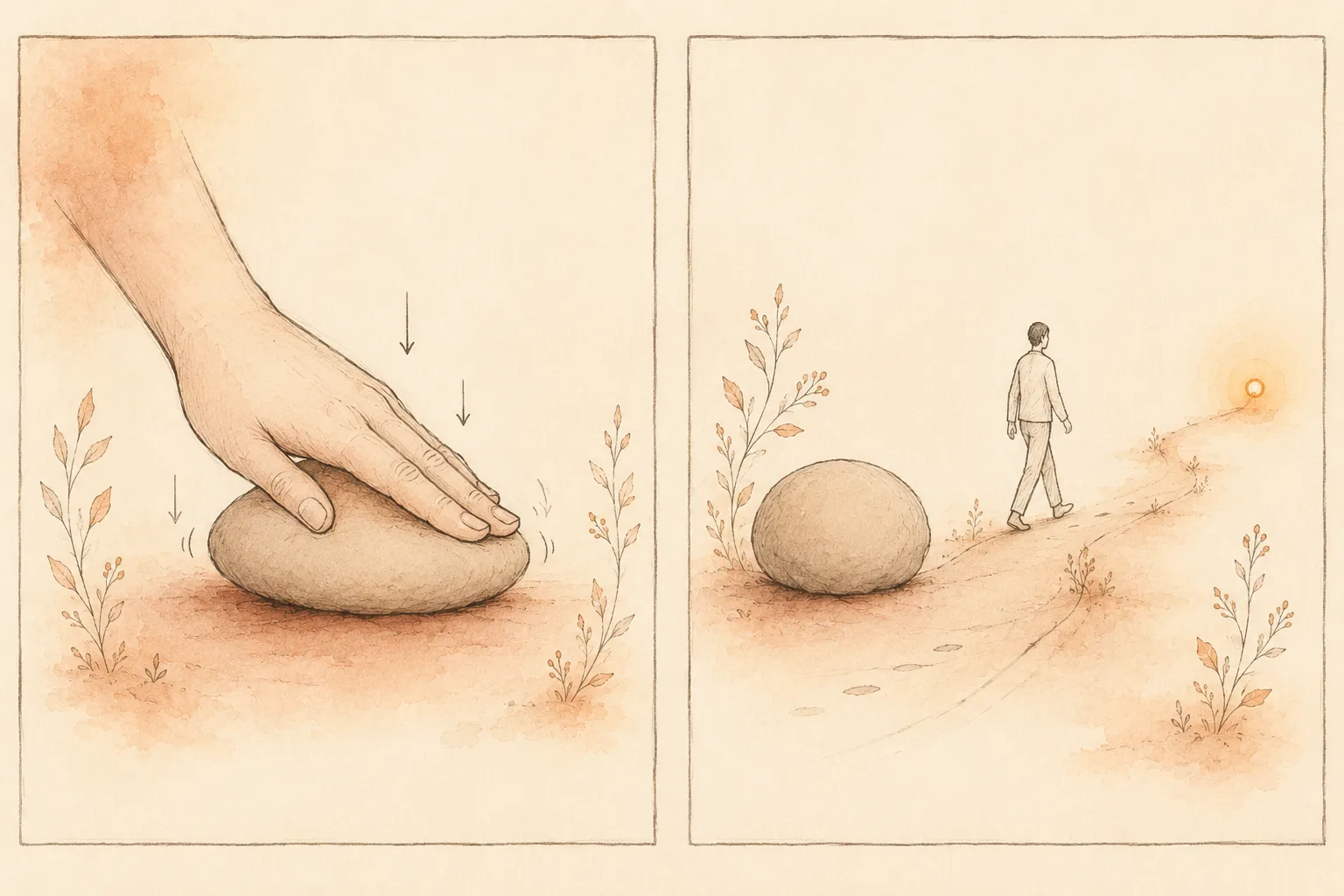
ACT drops that premise. The urge is left exactly as it is. What changes is whether the urge gets to decide, and what you do with the twenty minutes it was going to take.
In practice you notice the swap in what your therapist asks you. The question stops being how strong was it and becomes what did you do while it was there. Those are different measurements, and only the second one is under your control on a bad week.
Why trying not to want it tends to make it worse
Picking is doing a job. For most people it is discharging something: restlessness, tension, a half-formed feeling that hasn't got a name yet. ACT calls the strategy of getting rid of unwanted internal experiences experiential avoidance, and its central claim is that the strategy costs more than the experience does.
Watch what the fight itself requires. To not want to pick, you have to keep checking whether you want to pick. That check is a scan. It puts attention on skin, and attention on skin is the first link of the chain. People who have spent a year trying not to want it often report the strangest version of this: the urge is now louder than it was before they started managing it.
The first move in an ACT course is uncomfortable and takes about ten minutes. You inventory every strategy you have used to make the urge go away, and beside each one you write how long it worked.
Gloves. Nails cut short. The mirror turned to the wall. Promising yourself. Punishing yourself afterwards. Deciding that tomorrow would be different. Some of those bought you an evening, some bought you a fortnight, and none of them bought you a life without the urge in it, because the urge is not the sort of thing that can be removed by an act of will.
The point is not to make you feel defeated. It is to establish, from your own data rather than a therapist's claim, that the control strategy has been tried thoroughly and has a ceiling. That clears the ground for a different question, which is what you would do with the urge present.
If you want the mechanics of why the urge overrides intention in the first place, why picking overrides what you decided covers that separately.
What the trials actually found
The evidence sits in an awkward place, and pages that sell ACT programmes tend not to say so. The 2025 review in Psychiatric Clinics of North America puts it plainly: ACT-enhanced behavior therapy is "the most empirically supported treatment of trichotillomania," and support for the same treatment in skin picking is "budding." Seventeen studies exist across both conditions, spread over individual, group, telehealth and web-based delivery. Most of the strong ones are about hair.
| What was tested | Who | What happened |
|---|---|---|
| ACT alone, deliberately limited protocol | Skin picking, n=5 | 4 of 5 near zero at post-treatment; gains not held for 3 of 4 at follow-up |
| AEBT, HRT-first vs ACT-first sequencing | Hair pulling and skin picking, n=5 | Large reductions for all five; order made little or no difference |
| ACT alone, 10 sessions vs waitlist | Hair pulling, n=39 | Severity and hairs pulled improved; daily urges did not change |
| Fully automated 8-week online A-EBT vs waitlist | Skin picking, n=84 | Symptoms SMD 0.90; picking-related psychological flexibility SMD −0.82 |
| Therapist-guided internet AEBT, 10 weeks vs waitlist | Skin picking, n=70 | Large effect; symptoms had crept back up by six-month follow-up |
Two caveats belong with that table. The samples of five are case series rather than trials, and they are the studies most often cited as proof that ACT works for picking. And the largest skin picking result on the list came from a programme with no therapist in it at all, which is encouraging for access and means the effect is not evidence for what happens in a room with a specialist.
That erosion at follow-up recurs everywhere in this literature and is worth planning around rather than being surprised by. These are skills that hold while practised, not a course you complete.
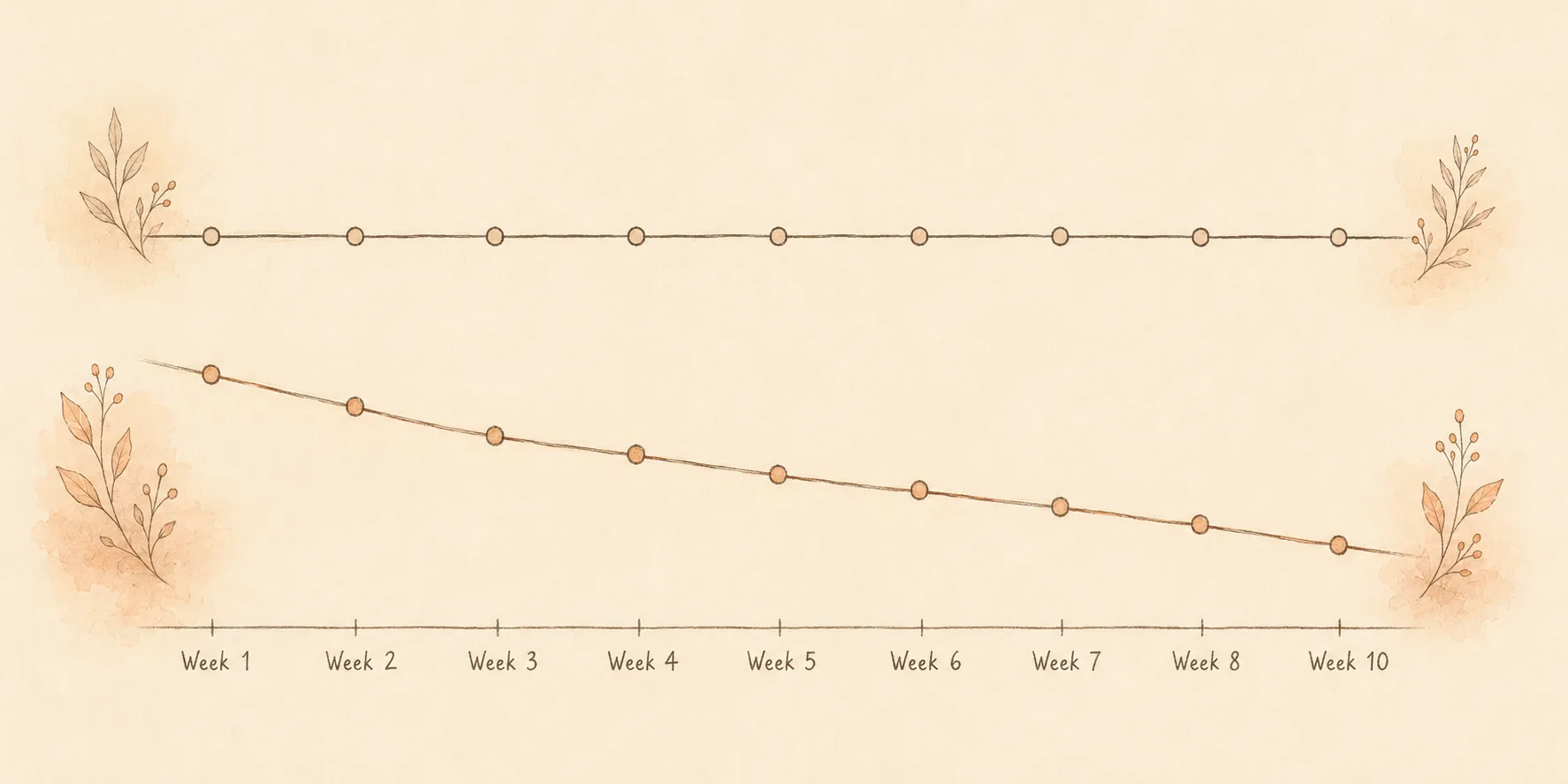
Picking fell. Urges didn't.
This is the finding the whole model rests on, and it has shown up more than once.
In a 2020 randomized trial, 39 adults and adolescents with hair pulling were assigned to ten sessions of ACT or a waitlist. Symptom severity dropped. Daily hairs pulled dropped. Daily urges experienced did not move at all.
Put that alongside what the other studies measured. In the 2006 skin picking series, experiential avoidance fell as picking fell. In the 2024 online trial of 84 adults, picking-related psychological flexibility improved by a standardised 0.82 while symptoms improved by 0.90, the two moving almost in step.
So the pattern across the set is consistent. What shifts is your relationship to the urge, and the urge itself carries on arriving at roughly the same rate. If the treatment worked by reducing urges, urge counts would fall. They don't.
For the moment-to-moment practice of staying still while an urge is loud, our guide to mindfulness and urge work for skin picking has the sequence built for skin, including where to look for the urge in your body rather than on it.
Which kind of picking this reaches
Whether ACT belongs at the front of your plan or halfway down it turns on one distinction.
When researchers validated a hair-pulling version of the psychological inflexibility questionnaire on 90 people, they checked it against the two styles of pulling. Inflexibility correlated −0.46 with focused pulling, the deliberate kind you go and do. It correlated −0.03 with automatic pulling, which is no relationship at all.
Read across to picking and the implication is direct. If your picking mostly happens with intent, with a reason attached and a feeling underneath it, that is the picking psychological inflexibility tracks, and it is what ACT is aimed at. If most of your picking happens while you read, drive, or watch something, and you find out afterwards from the state of your fingers, acceptance work has very little to grip. You cannot willingly sit with an urge you never registered.

That is not a reason to skip ACT. It is a reason to sequence it. Automatic picking needs awareness training first, the drill that teaches you to catch the scan before the pick. Our habit reversal training protocol for skin picking covers that component and how to build it.
AEBT: what the combined protocol looks like
Almost nobody delivers ACT for a BFRB on its own. What clinicians run is acceptance-enhanced behavior therapy, usually shortened to AEBT or A-EBT, which is habit reversal and stimulus control with the ACT work built around them.
The division of labour is clean. The behavioral half handles the automatic episodes and the physical mechanics: catching the scan, a competing response that occupies both hands, the tools out of the bathroom. The acceptance half handles the focused episodes and everything a competing response cannot touch, which is the feeling that was going to be discharged and the reason to tolerate it.
A reasonable question is which order to do them in, and it has been asked directly. A 2008 pilot ran five people through AEBT for hair pulling and skin picking, three receiving habit reversal first and two receiving ACT first. All five improved substantially, and the sequence made little or no difference to the short-term result. Which is useful practically: if a therapist starts you on either half, they aren't doing it wrong.
Course length in the trials runs eight to ten sessions. If you want the shape of a full course of behavioral treatment, including what the between-session tasks look like and what it costs, our guide to CBT for skin picking walks through a published eight-session protocol.
The values half, done properly
Every page about ACT defines values and then moves on. The definition is the least useful part of it, so here is the work.
Values in ACT are directions, not achievements. "Being someone my sister can call" is a direction, because there's no day on which you finish it. "Clear skin by August" is a goal, and goals in this condition tend to become one more surface to fail on.
The exercise that does the work has two steps and takes an evening.
Write what picking has actually cost, in units. Not "confidence." Not "my social life." Concrete, countable things. I haven't swum in four years. I do the school run in the dark in winter and I book the late slot in summer. I turn my head to the left in photographs. I cancelled twice in March. Vague costs produce vague motivation, and vague motivation loses to a mirror at eleven at night.
Then write one action per cost, sized small enough to be slightly embarrassing. Not "go swimming." Find where my costume is. Not "stop cancelling." Say yes to the next one and put it in the calendar before I can think about it. The size matters because the point of the action isn't the achievement. It's establishing that the direction can be moved in while your skin is exactly as it is today.
That last clause is the whole intervention. Almost everyone with this condition is running an unspoken rule that life resumes once the skin clears. Committed action is the deliberate breaking of that rule, and it's why ACT protocols spend session time on swimming pools and photographs rather than on skin.
Willingness is a dial, not a switch
The failure mode of acceptance work is turning it into gritted teeth, which is the control agenda wearing a different coat.
Willingness in ACT is set as a quantity and a duration, in advance, rather than declared forever. For the next ten minutes, in this bathroom, I am willing to have this feeling at full strength without doing anything about it. Ten minutes at full willingness is a real skill being practised. "I will never pick again" is a promise that will be broken and then used as evidence against you.
The companion move is defusion, which is hearing a thought as a thought rather than as an instruction. Where the willingness dial is set in advance, defusion happens live and takes half a second. What it buys you is separation: the sentence carries on being produced, and it stops arriving as a verdict about your skin.
When ACT is the wrong first tool
Four situations where reaching for acceptance work first will cost you months.
Picking you never notice. Awareness training comes first. There's nothing to be willing about until you can catch it.
Picking inside an absorbed state. If you lose twenty minutes and surface with damage done, no in-the-moment skill can reach you mid-episode, because the faculty you'd use to notice is the one that narrowed. The picking trance covers what works at the entrance to that state instead.
Picking that functions as self-punishment. Acceptance skills layered on top of that tend to become one more thing to fail at. The self-compassion work goes underneath, not after. Dealing with setbacks covers that loop.
Wounds that need a doctor. Infection, hours a day, deep or spreading damage. Start with a clinician.
Starting without a therapist
Trained BFRB clinicians are scarce almost everywhere, and ACT-trained ones more so, which makes self-directed work the realistic route rather than the consolation prize.
The most useful thing in this whole area is also the least visible. Michael Twohig's research group at Utah State University built ACT Guide for Skin Picking, a self-guided online programme of eight modules of roughly thirty minutes, designed to be worked through about one a week over two months. It includes the habit reversal component alongside the acceptance work. It costs $25 for six months of access, and it's the programme tested in that 84-person randomized trial. We don't sell it and have no relationship with it. It is simply the best value in this space by a wide margin, and it sits inside a university web page where almost nobody searching for treatment will find it.
If you're looking for a therapist instead, the question that sorts specialists from generalists quickly is what model they work from. "ACT-enhanced behavior therapy," "AEBT," or "HRT with acceptance work" are the answers you want. A clinician who names one is working from a protocol.
SkinAware sits alongside either of those rather than replacing them. What it gives you is the daily half. You can log episodes and log urges you resisted in the same two taps, which turns the number ACT actually moves into something visible instead of invisible. The behavioral course runs as four modules and includes a lesson called Your Personal Why, which is the values piece at a starting size, plus a guided urge surfing practice for sitting with an urge without acting on it, and a module on setbacks and self-compassion. You can add an accountability friend, and there's a moderated community inside the app. It's $5.99 a month or $34.99 a year, with a two-week trial on iOS.
Track the number ACT is designed to move
Log resisted urges in the same two taps as episodes, work the behavioral course in four modules, and sit with an urge in a guided practice rather than from memory.
Frequently Asked Questions
Better than nothing, and on thinner evidence than the hair pulling version of the same treatment. A 2025 review calls ACT-enhanced behavior therapy the most empirically supported treatment for trichotillomania and describes the support in excoriation disorder as budding. The largest skin picking result is a randomized trial of 84 adults using a fully automated online programme, which produced a standardised effect of 0.90 on symptoms. The two most-cited skin picking studies before that had five participants each.
The goal, not the techniques. CBT and habit reversal aim to reduce picking by making it harder or by changing the thought that precedes it. ACT leaves the urge and the thought alone and works on whether they get to determine what you do, then attaches the behavior change to something you value. Most clinicians combine them, which is what acceptance-enhanced behavior therapy is.
They aren't supposed to. In a 2020 randomized trial of ACT for hair pulling, symptom severity and daily hairs pulled both improved while daily urges experienced did not change at all. Urge frequency is the wrong progress measure for this treatment. Track how many urges you got through with your hands off instead.
It appears not to matter much. A pilot study ran five people through both halves in opposite orders and found the sequence made little or no difference to the short-term outcome. The exception is if most of your picking happens without you noticing, in which case awareness training first will get you further, because acceptance work needs an urge you can register.
Yes. ACT Guide for Skin Picking, from the research group at Utah State University, is eight self-guided online modules of about thirty minutes each, costing $25 for six months of access. It's the programme used in the 84-person randomized trial, and it includes habit reversal alongside the acceptance work.
Indirectly, and that's the part people tend to report first. Defusion and willingness work reduce how much authority self-critical thoughts have, and the values work interrupts the rule that life resumes once your skin clears. In the 2006 skin picking series, anxiety, depression and experiential avoidance measures all improved alongside the picking.
Yes, and for hair pulling the evidence is stronger than it is for skin picking. Most of the ACT trials in this family were run on trichotillomania. The model transfers directly. What changes is the physical component sitting alongside it.
A common first reaction, and worth taking seriously rather than talking yourself out of. Acceptance in ACT is about the internal experience, never the behavior. You're accepting that the urge is present. You aren't accepting the picking, and the committed action half exists precisely so the willingness has somewhere to point. If it feels like resignation, the values work is usually the piece that's missing.
Continue Reading
References
- Twohig, M. P., Hayes, S. C., & Masuda, A. (2006). A preliminary investigation of acceptance and commitment therapy as a treatment for chronic skin picking. Behaviour Research and Therapy, 44(10), 1513–1522.
- Flessner, C. A., Busch, A. M., Heideman, P. W., & Woods, D. W. (2008). Acceptance-enhanced behavior therapy (AEBT) for trichotillomania and chronic skin picking: exploring the effects of component sequencing. Behavior Modification, 32(5), 579–594.
- Lee, E. B., Homan, K. J., Morrison, K. L., Ong, C. W., Levin, M. E., & Twohig, M. P. (2020). Acceptance and commitment therapy for trichotillomania: A randomized controlled trial of adults and adolescents. Behavior Modification, 44(1), 70–91.
- Bowers, E. M., Capel, L. K., Woolley, M. G., Barnes, A., Twohig, M. P., & Levin, M. E. (2024). Efficacy and feasibility of web-based ACT-enhanced behavioral treatment for skin picking in adults: A randomized waitlist-controlled trial. Journal of Obsessive-Compulsive and Related Disorders, 43, 100909.
- Asplund, M., Lenhard, F., Rück, C., Andersson, E., Grimlund, T., Nilsson, M., Sarachu-Nilsson, M., Sundh, L., & Ivanov, V. Z. (2025). Therapist-guided internet-delivered acceptance-enhanced behavior therapy for skin-picking disorder: A randomized controlled trial. Behavior Therapy, 56(1).
- Twohig, M. P., & Capel, L. K. (2025). Acceptance and commitment therapy-enhanced behavior therapy as an intervention for trichotillomania and excoriation disorder (skin picking): A review. Psychiatric Clinics of North America, 48(3), 505–519.
- Houghton, D. C., Compton, S. N., Twohig, M. P., Saunders, S. M., Franklin, M. E., Neal-Barnett, A. M., Ely, L., Capriotti, M. R., & Woods, D. W. (2014). Measuring the role of psychological inflexibility in trichotillomania. Psychiatry Research, 220(1–2), 356–361.