

Written using peer-reviewed research including Xavier et al. (2020) in the Brazilian Journal of Psychiatry and Tucker et al. (2011) in the Journal of Anxiety Disorders, alongside clinical guidance from the International OCD Foundation, the TLC Foundation for BFRBs, and the Manhattan Center for Cognitive-Behavioral Therapy.
A course of cognitive behavioral therapy for skin picking usually runs eight to twelve weekly appointments of forty-five to sixty minutes, with a tracking task to complete between every one of them. The appointment is where you review what happened and decide what to test next. The work itself happens in the six days in between.
That is a more specific answer than most pages will give you, and it can be specific because a full protocol has been published. In 2020 a team in Porto Alegre adapted Barbara Rothbaum's trichotillomania protocol to skin picking, ran it as a randomized trial with 54 people, and printed the contents of all eight sessions in the paper. What follows is that map, plus the parts the paper leaves out: what a course costs, how insurance treats it, and how to tell whether the therapist you are about to call has ever actually treated this.
What CBT for skin picking actually is
CBT is a family of treatments, not one thing, and the version used for skin picking looks different from the version used for depression. There is far less talking about your childhood and far more counting.
The behavioral half does most of the lifting. You learn to notice the behavior earlier than you currently do, then you learn a physical response that makes picking impossible for as long as you hold it, then you change your surroundings so the behavior is harder to start. That package is habit reversal training, and it sits inside CBT rather than beside it.
The cognitive half is smaller and more targeted than the name suggests. It goes after specific sentences: that one is ready, it will heal faster if it's out, my skin has to be smooth before I can leave. Not your self-worth, not your relationship with your mother. The thoughts that show up in the ninety seconds before your hand moves.
The first session
Almost nothing happens in the first session that will feel like treatment, and that is the correct design.
You will be asked what you pick, where on your body, with what, how long you have been doing it, and what happens to what comes off. Expect the questions to be more granular than feels dignified. Whether you use fingernails, tweezers, or pins. Whether you inspect first or find your hand already there. Whether you look at it, roll it, or eat it. A clinician who asks that last question is not being strange. Oral behaviors are common enough in skin picking that leaving them out gets the assessment wrong.
Then comes psychoeducation, which is the part where you get told what this is. For most people that is the first time anyone has framed it as a recognized condition with a diagnostic code rather than a bad habit. It sounds like the least useful part of a treatment and it lands harder than expected. If you want that piece in advance, the full diagnostic picture is here, and the mechanics behind the urges themselves are worth reading before you go.
You will leave with a self-monitoring sheet, and you will be asked to fill it in for a week.
The eight-session map
This is the structure of the protocol that was tested, session by session, with the homework attached to each. Individual sessions ran forty-five minutes. Group sessions ran ninety.
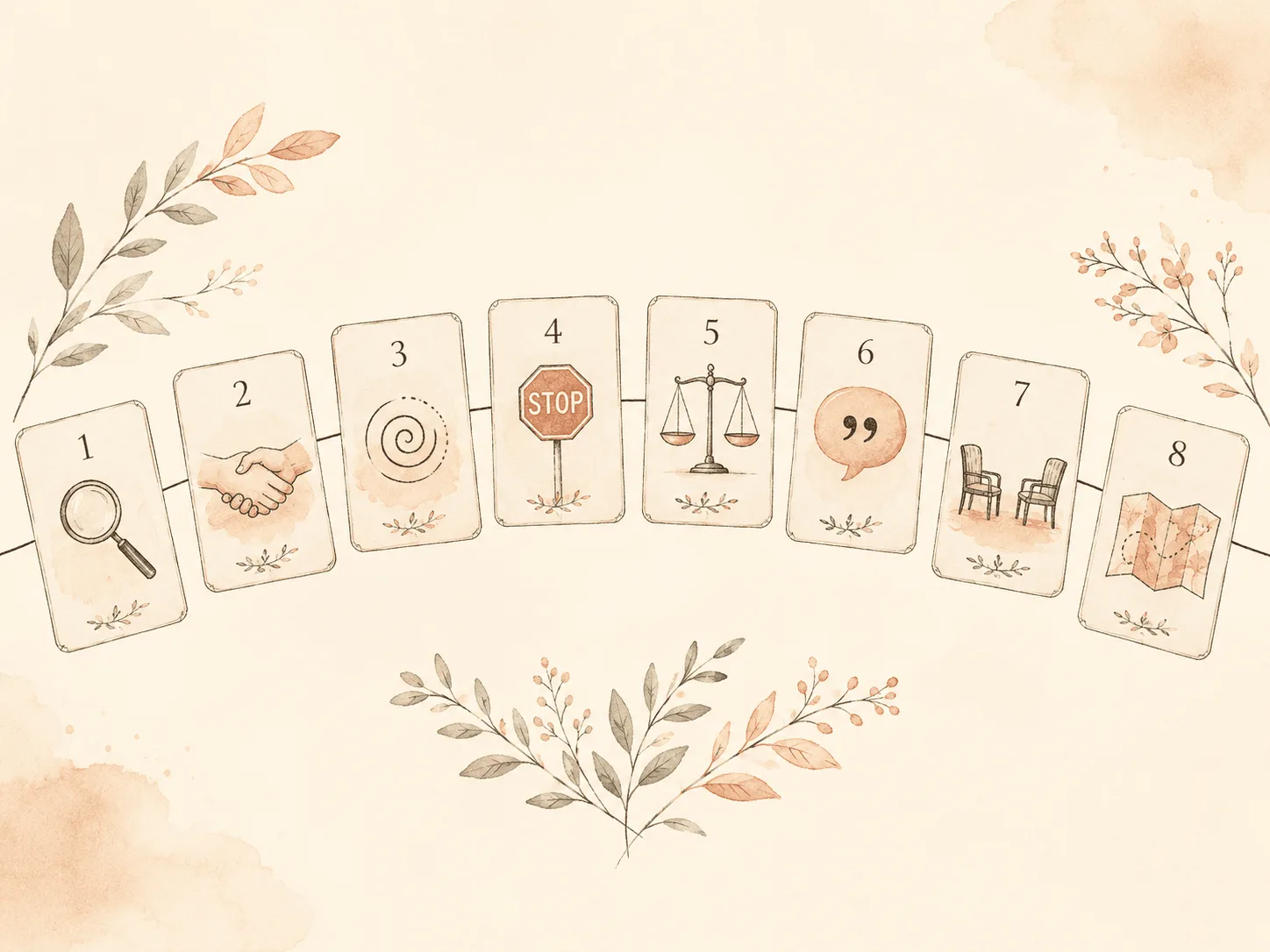
Session 1: Information gathering. Psychoeducation about skin picking disorder. Describing the touching habit in detail. Identifying trigger situations. Starting self-monitoring. Homework: self-monitoring, and collecting scabs.
Session 2: Habit change strategies. Azrin and Nunn's habit reversal techniques applied to picking. Practicing a competing response. Rehearsing the impulse with hands held above the site instead of on it. Wearing rings as a physical interrupt. Writing a list of the drawbacks of picking. Homework: self-monitoring using the habit reversal techniques and checking whether they worked, plus collecting scabs to show the therapist.
Session 3: Coping skills. Diaphragmatic breathing. Progressive muscle relaxation. Homework: self-monitoring, reading your drawbacks list, practicing the coping skills.
Session 4: Thought stopping. The A-B-C cognitive model, meaning the chain from the situation to the belief to the consequence. Thought stopping and distraction. Homework: self-monitoring and thought stopping practice.
Session 5: Cognitive restructuring. Weighing the evidence for a belief inside the A-B-C model. Decatastrophizing using a severity scale. A responsibility pie chart. Homework: self-monitoring and practice with all three techniques.
Session 6: Targeted internal dialogue. Preparing what you will say to yourself before a known stressor. Practicing positive reinforcement. Homework: self-monitoring and internal dialogue practice.
Session 7: Role reversal. You take the therapist's chair and they take yours, and you talk them through the techniques. Review of what has been learned and what still needs work. Homework: self-monitoring and review.
Session 8: Relapse prevention. Building your written relapse prevention guide, which is the document you keep after therapy ends.
Two things stand out. The first is that self-monitoring appears in every single session's homework, from week one to week eight. The second is that the picking-specific behavioral work is finished by session three. Sessions four through six are about the thoughts and the emotional load underneath, and sessions seven and eight are about making it survive without the therapist.
The homework is the treatment
Weekly appointments account for roughly eight hours across a two-month course. The behavior happens the other 1,400.
That ratio is why the between-session tasks are not optional extras, and why therapists who work with BFRBs will spend a chunk of the appointment reviewing your log rather than talking. It is also the most common reason a course of therapy underdelivers: people arrive having done nothing, the session gets spent reconstructing the week from memory, and the pattern data never accumulates.
Expect the tasks to look like this:
- A log, every day, for the whole course. Time, place, what you were doing beforehand, which site, whether you inspected first, what you were looking for in your own words, and whether you noticed at the time or afterwards.
- Practicing the competing response cold. Twenty or thirty repetitions a day with no urge present. Motor patterns do not get built during a crisis.
- Reading your own drawbacks list. Written in session two, read most days after that.
- Breathing and muscle relaxation practice. Ten minutes, most days.
- Rehearsing what you will say to yourself. Written down in advance of a situation you already know is coming.
How CBT, HRT and ComB fit together
These three names get used as though they compete. They nest.
CBT is the outer container. Any structured, present-focused, skills-based therapy for this belongs inside it.
HRT is a specific technique inside CBT, developed by Azrin and Nunn in the 1970s. Awareness training, a competing response, stimulus control, social support, generalization. It is the component with the most evidence behind it, and it is what session two of the protocol above is entirely made of. If you want the components taught properly, the full habit reversal protocol for skin picking covers each one and the ways they fail.
ComB, short for Comprehensive Behavioral treatment, is a broader framework that contains HRT and adds a structured assessment around it. The International OCD Foundation describes four phases: assessment, selecting which domains to target, running interventions against those targets, then evaluation and relapse prevention. The assessment sorts your triggers into five domains under the acronym SCAMP: sensory, cognitive, affective, motor and place. Each domain is matched to a different kind of strategy, so sensory triggers get sensory substitutes rather than another competing response.
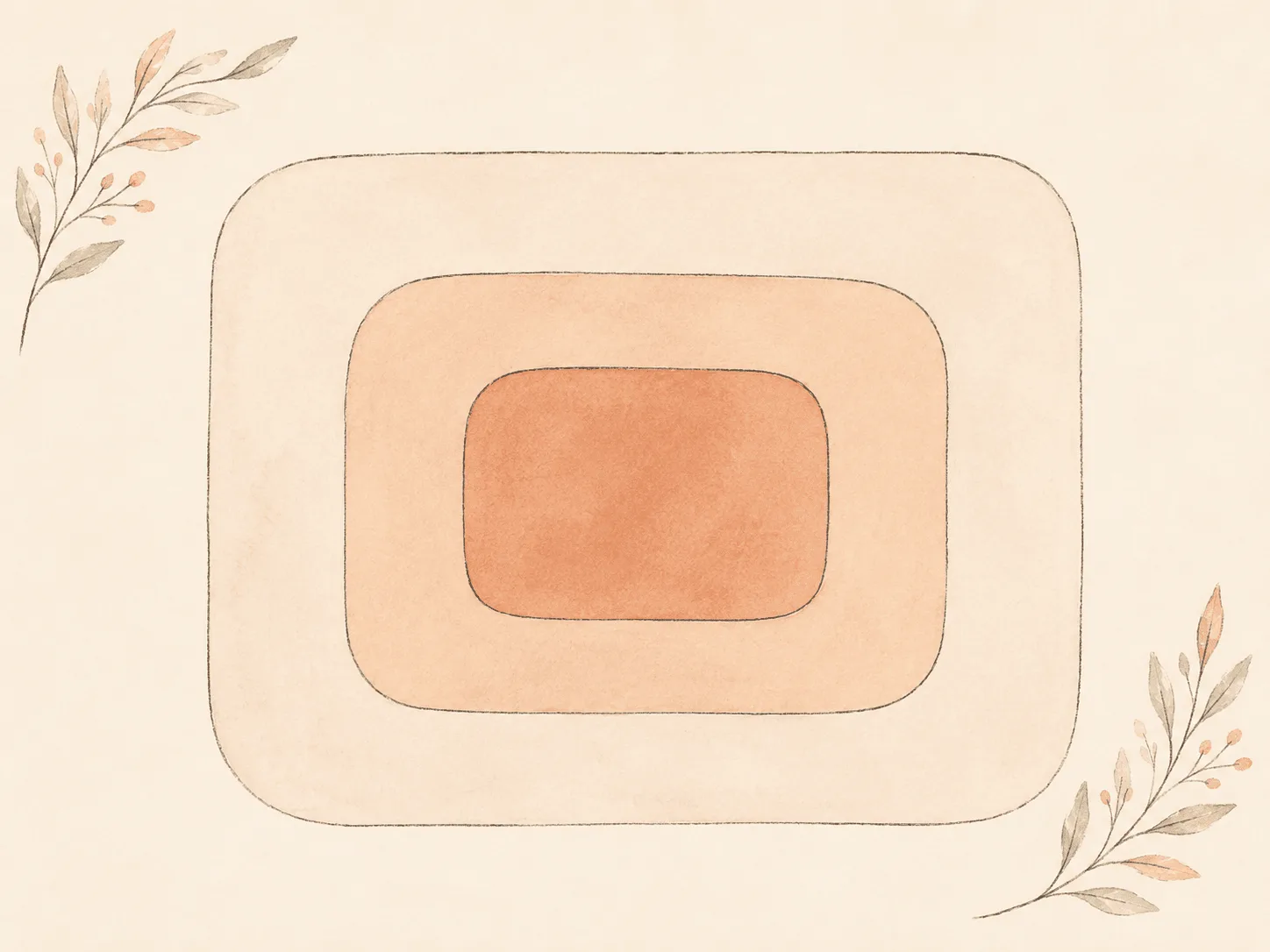
The practical difference is where the effort goes. Plain HRT loads most of the work onto the competing response. ComB spends longer working out what the picking is for before choosing a tool, which suits people whose picking is doing an emotional or sensory job rather than a purely automatic one.
A therapist who knows the field will usually say something like "I work from ComB" or "I use HRT with acceptance work added." That answer is itself a good sign.
How many sessions, and when things move
Short. Shorter than people expect from the word "therapy."
The tested protocol above was eight sessions. An earlier randomized study by Schuck and colleagues used four. The Rothbaum original for hair pulling was nine. In practice most BFRB clinicians run somewhere between eight and sixteen weekly appointments, then taper to monthly check-ins.
Those last two caveats matter. The remission figures describe the people who stayed, and without follow-up the trial cannot tell you how the results looked six months later. The authors say so themselves.
As for when you will feel something: most people notice the awareness shift within two to three weeks, well before the picking count drops. Catching yourself mid-reach is the first thing that changes, and it can feel like getting worse, because you are suddenly seeing episodes that used to pass unrecorded.
The equally useful finding is the group format holding its own. Group runs cheaper and is easier to staff, and if a BFRB group exists anywhere near you, the trial suggests it is not the consolation prize.
What it costs, and how insurance handles it
Almost nobody publishes this, so what follows is what is knowable.
Per session. National cost guides put private-pay therapy at roughly $100 to $250 an hour in the US, rising to $200 to $300 or more in New York, San Francisco and Los Angeles. BFRB specialists sit at the upper end, because there are very few of them and they are rarely in-network.
Per course. Eight to sixteen sessions at those rates is roughly $800 to $4,000. HabitAware, writing about the cost of treating these conditions, puts a full course at "upwards of $1,500," which is consistent with the lower half of that range.
The billing codes, which matter more than they sound. Skin picking disorder has its own ICD-10 diagnosis code, F42.4, sitting in the same block as obsessive-compulsive disorder. Sessions are billed under standard psychotherapy codes: 90832 for 30 minutes, 90834 for 45, 90837 for 60. There is nothing unusual or hard to code about this condition, which is the good news for coverage.
In-network. Mental health parity rules require most US plans to cover mental health comparably to physical health, and F42.4 is a recognized, billable diagnosis. If you find a specialist who takes your insurance, you pay a copay. The catch is that BFRB specialists frequently do not take insurance at all.
Out-of-network, which is the realistic path for most people. You pay the full fee up front and ask for a superbill, an itemized receipt carrying the provider's name and NPI, the date and length of the session, the CPT code, the ICD-10 code, the charge, and their signature. You submit it to your insurer. After your out-of-network deductible is met, plans typically reimburse 50% to 70% of what they consider a usual and customary rate for your area, which is often less than your therapist actually charges. Reimbursement usually lands in two to four weeks.
How to tell if a therapist actually knows BFRBs
This is the part that decides whether the money is well spent, and the part no clinic page will help you with.
So screen before you book. Five questions, on a first phone call or in an email:

1. "How many people with excoriation disorder have you treated?" Not "do you treat skin picking," because almost everyone says yes to that. A number is the tell. Someone who says "a handful" and means it is a better bet than someone who says "oh, plenty" and then cannot describe a protocol.
2. "What model do you work from?" You want to hear "habit reversal training," "ComB," or "HRT with ACT added." A trained clinician names a framework without hesitating. Vague answers about working on underlying anxiety are the ones to worry about.
3. "What will you ask me to do between sessions?" The right answer starts with self-monitoring, from the first week. If between-session work sounds optional, that is a therapist who does not know how this treatment works.
4. "How do you handle picking I do without noticing?" Automatic and focused picking need different handling, and the distinction is basic in this field. Someone who has treated BFRBs will have an answer ready. Someone who has not may not know there are two kinds.
5. "Roughly how long do you expect this to take?" A bounded answer, in weeks or a number of sessions, means they are working from a protocol. Open-ended usually means they are not.
Three answers that should end the call: any version of "you just need to stop touching your skin," treating this as self-harm without asking why you pick, and proposing to treat only the anxiety on the theory that the picking will resolve on its own. Anxiety treatment is often a genuinely useful part of the plan. On its own it leaves the behavior untouched.
If therapy isn't reachable right now
For a lot of people it is not, and the reason is supply, not motivation. Trained BFRB therapists are scarce almost everywhere. The trial authors name low therapist availability as the central obstacle in this field, and tested a group format specifically to work around it.
Self-directed work is a real option rather than a consolation prize. Two things decide whether it holds.
The first is a logging habit that survives past week one. The protocol assigns self-monitoring in all eight sessions for a reason. If you build nothing else, build that.
The second is structure, because the failure mode of doing this alone is finishing the awareness piece, feeling better, and stopping before anything else gets built. Awareness alone buys a fortnight.
SkinAware has the behavioral course built in as four modules: understanding the habit loop and the two types of episode, mapping your own triggers with the SCAMP framework, building competing responses and urge management, then setbacks and long-term maintenance. You can log episodes and log urges you resisted, which is the self-monitoring task above in a form you will actually open at eleven at night. You can add an accountability friend, which is the social support component, and there's a moderated community in the app, which for many people is a more realistic version of a support person than anyone in their house. If you do get into therapy later, arriving with two months of logs shortens the assessment considerably.
If you want to compare the options first, we've reviewed the apps in this space, including the ones that cost more per month than a therapy session.
Build the logging habit first
SkinAware runs the behavioral course in four modules and lets you log episodes and resisted urges, which is the one task every session of the clinical protocol assigns.
Frequently Asked Questions
The evidence is positive and thinner than confident marketing suggests. In the randomized trial of the adapted Rothbaum protocol, 63% of people in individual treatment and 52% in group treatment were in remission after eight weeks, with a large effect size in both formats. That trial had no control group and no follow-up assessment, so it tells you the protocol produces change, not how long the change lasts. Across the wider literature, behavioral treatment reliably beats doing nothing and nothing else has beaten it.
It is far more behavioral. You spend most of the course counting episodes, rehearsing a physical response, and changing your surroundings, rather than talking. The cognitive work that does appear targets specific pre-picking thoughts rather than broad beliefs about yourself.
The tested protocol is eight weekly sessions. An earlier randomized study used four. Most BFRB clinicians run eight to sixteen and then taper to monthly check-ins. Expect the awareness shift within two to three weeks and the episode count to follow later.
It can. Excoriation disorder is a recognized diagnosis with its own ICD-10 code, F42.4, and parity rules require most US plans to cover mental health comparably to physical health. The practical difficulty is that many BFRB specialists do not take insurance, so the usual route is paying up front, getting a superbill, and claiming out-of-network reimbursement, typically 50% to 70% of the insurer's usual and customary rate after your deductible is met.
No trial has settled it. ComB includes the HRT components and adds a structured assessment across sensory, cognitive, affective, motor and place triggers, which tends to suit people whose picking is doing an emotional or sensory job. The head-to-head comparison is the final stage of the ComB research programme and has not reported.
Ask what model that therapist used. A large share of people with this condition are treated by someone who has never run a BFRB protocol, and generic talk therapy is not the same intervention. In the Skin Picking Impact Project survey, 57% of people who received treatment did not improve, and 85% believed professionals were not trained for this. A failed course with a generalist says very little about whether a protocol-based course would work.
Where it is available, yes. In the trial, group treatment produced a 52% remission rate against 63% for individual, a difference that was not statistically significant, with a large effect size in both. Group costs less and is easier to find slots in. One caveat from the trial: no participants with social anxiety ended up in the group arm, so the finding may not extend to people for whom the group setting is itself the problem.
Some protocols include photographic assessment of lesion severity, and the trial above used it as an outcome measure. It is a reasonable thing to decline. Say so in the first session. The behavioral work does not depend on it.