

Written using a 2016 meta-analysis of skin picking treatments, a 2025 randomized trial of acceptance-enhanced behavior therapy for skin picking, a 2020 randomized trial of ACT for hair pulling, and a 2024 study that sampled urges seven times a day for ten days.
Mindfulness in BFRB treatment isn't meditation. It's a set of skills that sit inside behavioral treatment, and they have one job: to widen the gap between the moment an urge arrives and the moment your hand moves. Not to calm you down, and not to dissolve the urge. To buy you seconds you didn't previously have.
That distinction matters because of the most useful finding in this literature, and the one nobody writing about mindfulness and picking seems to mention.
Mindfulness doesn't reduce urges, and that isn't a failure
Two studies, in different populations, landed on the same result.
In a 2020 randomized trial of acceptance and commitment therapy for hair pulling, 39 adults and adolescents were assigned to ten sessions of ACT or a waitlist. Symptom severity dropped. Daily hairs pulled dropped. Daily urges experienced did not change.
In 2009, 123 undergraduate smokers went through a cue-exposure procedure designed to make them want a cigarette. Half were given a brief set of urge-surfing instructions first. Both groups reported the same urge intensity. Over the following week, the urge-surfing group smoked significantly fewer cigarettes.
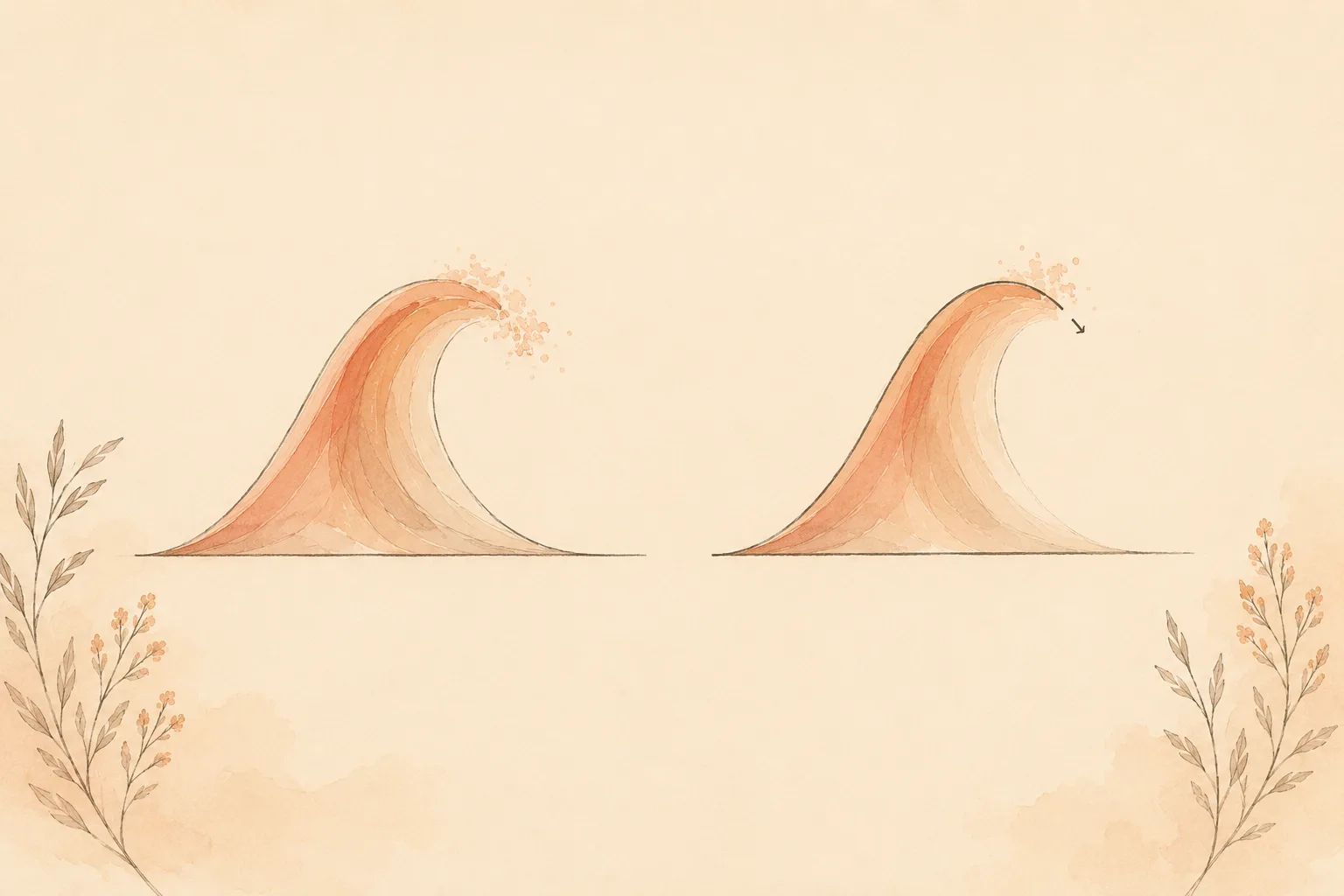
If you've tried this and concluded you were doing it wrong because the urge stayed loud, you were doing it correctly. The urge staying loud while your hand stays still is the whole skill. Every page promising the wave will dissolve if you breathe at it properly is setting you up to decide you failed at mindfulness, which is an efficient way to add shame to a condition that already runs on it.
What the evidence actually supports
Mindfulness has never been tested on its own for skin picking. There's no trial of meditation for dermatillomania, no trial of a mindfulness app for it, and nothing resembling one underway. What exists is evidence for treatment packages that contain acceptance and awareness components alongside behavioral ones.
That's a real distinction, and worth holding onto when someone suggests you download a meditation app for your picking.
| What was tested | Who | What happened |
|---|---|---|
| Behavioral treatment (CBT / HRT) vs inactive control, meta-analysis of 3 RCTs | Skin picking | Moderate benefit, SMD 0.69 (95% CI 0.32–1.05) |
| Internet-delivered acceptance-enhanced behavior therapy, 10 weeks vs waitlist | Skin picking, n=70 | Large effect, d=1.3; 43% responders, 31% in remission, vs 0% and 3% |
| ACT alone, 10 sessions vs waitlist | Hair pulling, n=39 | Severity and hairs pulled improved; urges didn't |
| ACT, deliberately limited protocol | Skin picking, n=5 | 4 of 5 near zero at post-treatment; gains not held for 3 of 4 at follow-up |
| ComB (individualised behavioral model) vs minimal attention | Hair pulling, n=36 | d=−0.78 self-reported; not significant on interviewer ratings |
| DBT-enhanced habit reversal, open trial | Hair pulling, n=10 | 5 full and 4 partial responders at 6 months |
Two things about that table deserve more weight than the numbers do.
The Swedish internet trial is the strongest result on the list, and its six-month follow-up showed symptoms creeping back up. The improvement from baseline held; the peak didn't. That pattern recurs across BFRB treatment, and it isn't an argument against treatment. It's an argument for treating these skills as maintenance rather than a course you complete.
The acceptance components also don't stand alone in any of these protocols. They arrive bolted onto habit reversal training, which supplies the awareness drills and the competing responses. If you want the full picture of what a course of treatment involves, our guide to CBT for skin picking walks through the session structure.
Urge surfing, done for picking specifically
Urge surfing came out of Alan Marlatt's relapse-prevention work in the 1980s, built for alcohol and drugs. It transfers to picking, but two things need adjusting.
The first is the timeline. You'll find it stated confidently on BFRB sites that an unfed urge lasts no more than about thirty minutes. No study in the BFRB literature has measured that. Nobody has recorded the decay curve of an unacted-on urge to pick. The figure is borrowed from addiction folklore and repeated until it took on the shape of a fact.
What has been measured is more useful anyway. In a study that pinged 57 adults with skin-picking disorder seven times a day for ten days, urges behaved like background weather. Average urge intensity in sampled moments where no picking had happened was 1.89 on a five-point scale. In moments where an episode had occurred, it was 2.84. Across the whole day, the average moved only between 2.53 in the morning and 3.02 in the evening.
The second adjustment is what you attend to. A craving for a cigarette is diffuse. An urge to pick is usually attached to a specific place, and it arrives with a visual or tactile hook: an edge you can feel, a bump you can see. Generic "notice your breath" instructions leave the hook untouched.
The sequence below is aimed at skin.
Name it out loud if you can. "I'm having an urge to pick at my jaw." Naming isn't a formality. It moves you from inside the urge to being the thing observing it, which is the only position from which anything else is possible.
Find where the urge lives in your body, not on your skin. This is the step most people skip. The urge isn't in the bump. It's a set of sensations somewhere else: tightness across the chest, a charge in the fingertips, heat in the jaw, restlessness in the forearms. Locate it. Most people, asked for the first time, are surprised it has an address at all.
Describe its texture, then watch whether it changes. Sharp or dull, steady or pulsing, spreading or contained. You're not doing this to feel better. You're doing it because describing a sensation and obeying it draw on the same attention, and it can't do both at once.
Keep your hands occupied and out of range. Sit on them. Hold something with a texture to it. This isn't cheating at mindfulness; acceptance work never asked you to leave your hands free. A fidget object with the right texture does the job better than willpower.
Wait past the point where you decide it isn't working. That point arrives reliably, around ninety seconds in.
Then note what the urge did. Rose, held, dropped, stayed level. No judgement attached to any of those. Over a fortnight this hands you your own decay curve, which is worth considerably more than anyone's borrowed thirty-minute average.
We built a guided version of this into SkinAware, because running it from memory mid-urge asks a lot of a mind that's currently busy. It talks you through settling, one breath cue, then locating the urge in your body, naming the sensation, and watching whether it holds or moves. Then it goes quiet for twenty seconds, and you can add thirty seconds at a time for as long as you want to keep sitting there. It closes by asking whether the urge peaked and faded, which is where you start collecting your own numbers. The habit reversal course teaches the same technique as a five-step drill with a timer, and resisted urges log in the same two taps as episodes, so a month of not picking becomes visible instead of invisible. It's $5.99 a month or $34.99 a year, with a two-week trial on iOS.
Sit with one urge, guided
A voice-guided urge surfing session that locates the urge in your body, holds a silence you can extend as long as you need, and logs the urges you rode out.
Body-scan work, aimed at the reach
The other skill worth learning has nothing to do with urges. It's aimed at the moment your hand starts moving, which for a large share of picking happens before any conscious urge shows up at all.
Standard body-scan meditation walks attention slowly through the entire body. That's fine practice, and it isn't what you need. What you need is a short version, rehearsed at neutral moments, covering the four or five places where your reach begins.
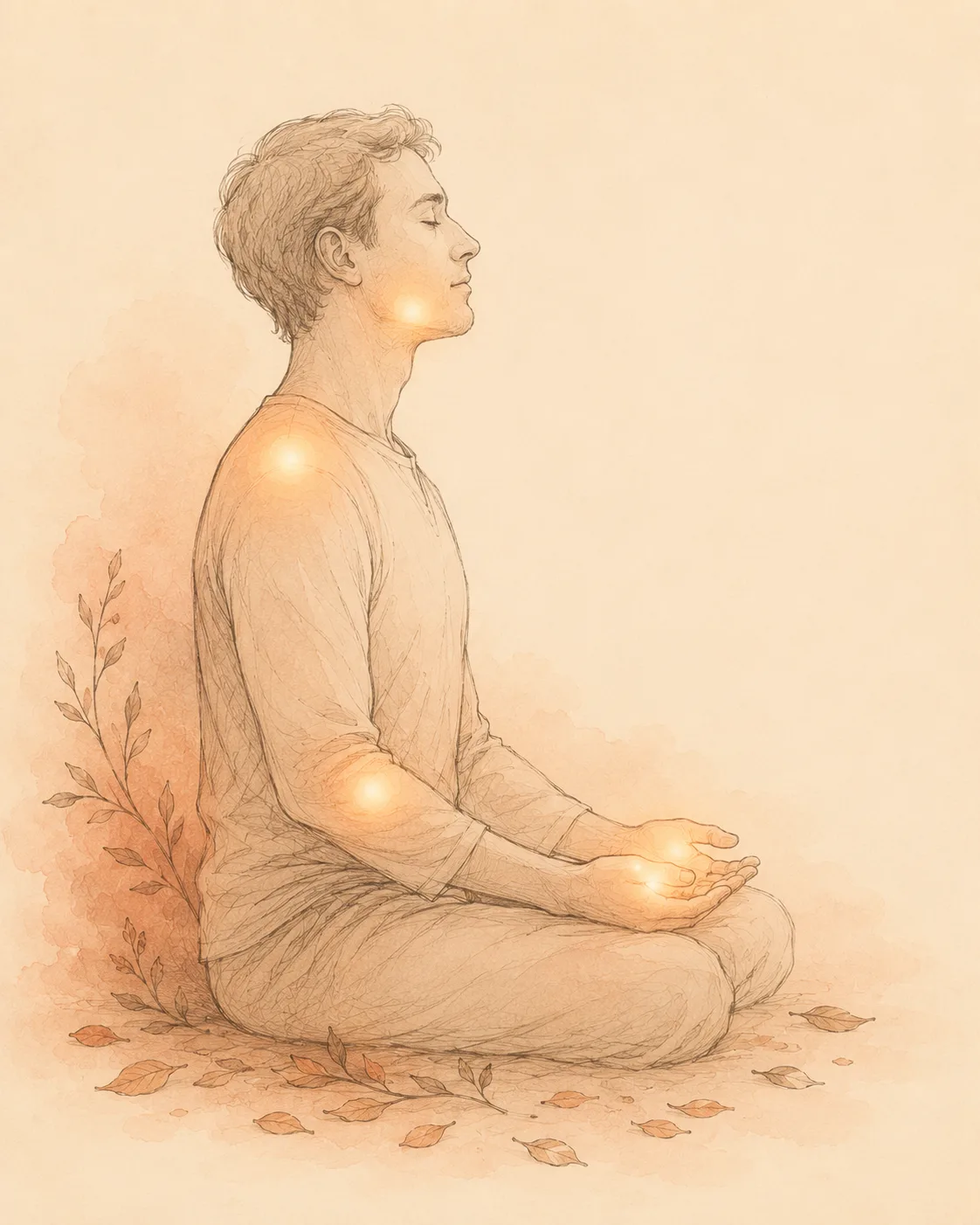
Sit somewhere ordinary. Ninety seconds is plenty. Move attention to your hands, then your forearms, then your jaw, then your shoulders. At each one, ask a single question: what is this doing right now? Not "relax it." Just register whether it's loose, braced, hovering, or already moving.
The point is repetition until noticing your hand's position becomes a background process rather than a deliberate check. That's what awareness training in habit reversal is actually building, and it's the component the research keeps identifying as the one everything else depends on.
Practice it when you aren't picking and aren't close to it. Rehearsing a skill only in the situation where you need it is the least effective way to acquire it.
Where this stops working
If your episodes involve losing twenty minutes, or an hour, and surfacing with damage done and no memory of the middle, mindfulness aimed at the middle of that state cannot reach you.
That state is absorption. Attention has narrowed onto one square inch of skin so completely that time, pain and the rest of the room stop registering. Telling someone inside it to observe their thoughts non-judgementally asks the narrowed attention to notice itself, using the exact faculty that narrowed. People in that state usually report knowing perfectly well that they should stop, and finding the knowledge doesn't reach their hands.
Mindfulness still helps there. It just has to be spent at the entrance rather than the middle: catching the approach, the standing up, the "I'll just check one thing." Our guide to the picking trance covers what does and doesn't work once you're already inside one.
The acceptance half, which carries more than the breathing
Everything above is the awareness half. The half that carries more of the treatment effect in ACT-based protocols is duller to describe and harder to do.
Defusion. "I need to get this one" is a thought your mind produced, not an instruction you received. The standard exercise is to prefix it: "I'm having the thought that I need to get this one." It sounds trivial. It reliably drops the thought's authority by a notch, and a notch is sometimes the entire margin.
Values, checked in the moment. Not "picking is bad." A specific question: is what I'm about to do taking me toward what I care about, or away from it? This is the piece that stops the skill collapsing into white-knuckling, because it supplies a reason to tolerate the discomfort that isn't just avoidance of guilt.
Self-compassion, treated as a technique rather than a nicety. In a 2023 study that interviewed seventeen UK adults about their picking, shame about how the damage would look to other people was one of the three dominant themes, and participants described it feeding straight back into more picking. How you speak to yourself in the ten minutes after a lapse is part of the work, not a soft add-on to it. Our guide to handling setbacks goes further into that loop.
What a real practice looks like
Ninety seconds of body scan, twice a day, at fixed times. One guided urge-surfing session while calm, before you ever attempt one under pressure. Then attempts during real urges, expecting the first several to be hard.
Log what happens. Not how bad the episode was, but what the urge did and how long you stayed with it. Two weeks of that produces something no article can hand you: your own numbers, on your own urges.
Keep the scale in view, too. In the strongest trial on this list, 43% of people responded and 31% reached remission over ten weeks. Those are good numbers, and they also mean most people needed more than that. Mindfulness is one component of a treatment, layered onto habit reversal and stimulus control. It is not the treatment.
Which is fine. Nobody is asking you to be present. They're asking you to be slow.
Frequently Asked Questions
As a component of behavioral treatment, the evidence is reasonable. Acceptance-enhanced behavior therapy delivered online produced a large effect in a 2025 randomized trial of 70 adults, with 43% classed as responders. As a standalone practice, there's no evidence either way, because it has never been tested that way for skin picking.
Nobody knows. No BFRB study has measured the decay of an unacted-on urge, and the thirty-minute figure that circulates online has no source behind it. What has been measured is that urge intensity in daily life sits around 2 out of 5 most of the time, rising to about 3 in moments when picking happens. Your own log over two weeks will tell you more than any published average.
Because reducing the urge was never the mechanism. A 2020 trial of ACT for hair pulling found symptom severity and daily hairs pulled both improved while daily urges experienced didn't change at all. The technique changes what you do with an urge, not how often you get one or how strong it is.
Not for the picking itself. Generic meditation builds attentional control, which is useful raw material, but it contains no urge-specific practice, no awareness training aimed at your reach, and no behavioral component. The trials that show results pair acceptance work with habit reversal, and it's the pairing that was tested.
Common, and not a problem to solve on your first attempt. Start with the coarse version: warm or cool, still or moving, one place or several. Interoception improves with practice. If nothing registers at all after a few weeks, the body-scan drill at neutral times is the better place to spend your effort.
The acceptance-based evidence is actually stronger for hair pulling than for skin picking, since that's where most of the ACT trials were run. The urge-surfing sequence is the same. What changes is the hook: pulling urges more often attach to a particular hair texture, and nail biting to an edge or a snag.
That's a normal early effect and usually a sign the awareness training is working, not backfiring. Urges you were previously not registering were still driving your hands. If the increase in awareness comes with a genuine rise in distress that lasts beyond a few weeks, raise it with a therapist rather than pushing through it.
No, and the difference matters. Distraction moves your attention off the urge, which works briefly and tends to bring the urge back intact. Urge surfing points attention directly at it while withholding the behavior. Both have a place, but only one of them teaches you anything about the urge.
Continue Reading
References
- Schumer, M. C., Bartley, C. A., & Bloch, M. H. (2016). Systematic review of pharmacological and behavioral treatments for skin picking disorder. Journal of Clinical Psychopharmacology, 36(2), 147–152.
- Asplund, M., Lenhard, F., Rück, C., Andersson, E., Grimlund, T., Nilsson, M., Sarachu-Nilsson, M., Sundh, L., & Ivanov, V. Z. (2025). Therapist-guided internet-delivered acceptance-enhanced behavior therapy for skin-picking disorder: A randomized controlled trial. Behavior Therapy, 56(1).
- Lee, E. B., Homan, K. J., Morrison, K. L., Ong, C. W., Levin, M. E., & Twohig, M. P. (2020). Acceptance and commitment therapy for trichotillomania: A randomized controlled trial of adults and adolescents. Behavior Modification, 44(1), 70–91.
- Bowen, S., & Marlatt, A. (2009). Surfing the urge: Brief mindfulness-based intervention for college student smokers. Psychology of Addictive Behaviors, 23(4), 666–671.
- Twohig, M. P., Hayes, S. C., & Masuda, A. (2006). A preliminary investigation of acceptance and commitment therapy as a treatment for chronic skin picking. Behaviour Research and Therapy, 44(10), 1513–1522.
- Carlson, E. J., Malloy, E. J., Brauer, L., Golomb, R. G., Grant, J. E., Mansueto, C. S., Mouton-Odum, S., Nelson, S., Redden, S. A., & Haaga, D. A. F. (2021). Comprehensive behavioral (ComB) treatment of trichotillomania: A randomized clinical trial. Behavior Therapy, 52(6), 1543–1557.
- Keuthen, N. J., Rothbaum, B. O., Fama, J., Altenburger, E., Falkenstein, M. J., Sprich, S. E., Kearns, M., Meunier, S., Jenike, M. A., & Welch, S. S. (2011). DBT-enhanced habit reversal treatment for trichotillomania: 3- and 6-month follow-up results. Depression and Anxiety, 28(4), 310–313.
- Gallinat, C., Moessner, M., Wilhelm, M., Keuthen, N. J., & Bauer, S. (2024). Patterns of skin picking in skin picking disorder: Ecological momentary assessment study. Interactive Journal of Medical Research, 13, e53831.
- Anderson, S., Clarke, V., & Thomas, Z. (2023). The problem with picking: Permittance, escape and shame in problematic skin picking. Psychology and Psychotherapy: Theory, Research and Practice, 96(1), 83–100.