
Written using peer-reviewed research including Yeo & Lee (2017, Asian Journal of Psychiatry) and a 2021 review in the International Journal of Dermatology on excoriation disorder in adolescents with acne-induced hyperpigmentation, alongside clinical guidance from the Child Mind Institute, the UC Davis MIND Institute, and the TLC Foundation for BFRBs.
Picking that starts at thirteen isn't the same thing as picking that starts at thirty, and the difference isn't severity. It's timing. Skin picking disorder tends to emerge at puberty, which is also when acne arrives, which is also when almost everyone starts caring intensely about how their face looks to other people. Three things landing in the same eighteen months, feeding each other.
That overlap is why teenage picking gets misread so often. It looks like a phase, or vanity, or acne behaving badly, and it gets treated as all three before anyone considers that it might be its own thing with its own name.
This article is written for two people. If you're the teenager, your sections come first, and they're about what you can do without anyone's permission. If you're the parent, your sections start further down, and the short version is that most of your instincts here will be wrong in a specific and fixable way.
Why It Starts at This Age
Skin picking disorder, also called dermatillomania or excoriation disorder, means repeated picking that damages your skin, that you've tried and failed to stop, and that's causing you distress. It's a recognized condition related to OCD, and it isn't a personality trait. There's a fuller explanation in the guide to what dermatillomania actually is.
Clinicians who work with young people describe two versions, and most teenagers do both.
The first is picking to fix something. You feel a bump, or see one, and you go after it because it shouldn't be there. Your skin was smooth and now it isn't. That's the version that hooks into acne, and it feels rational the whole time it's happening.
The second is picking to feel calmer. Your hands find your face while you're reading, scrolling, sitting through a lesson, lying in bed. You're not looking for anything. Afterwards you realize twenty minutes went past and you don't have a clear memory of them.
That's the pattern most teenagers recognize before anyone explains it to them. Exam week, worse. Holidays, better.
The Acne Loop
One mechanism makes teenage picking different from adult picking, and most articles about it skip straight past it.
Acne gives picking a renewable supply of targets. Not a one-off temptation. A new one every few days, in the mirror, on your own face, with a genuine reason to touch it. Almost nothing else in adult life produces that.
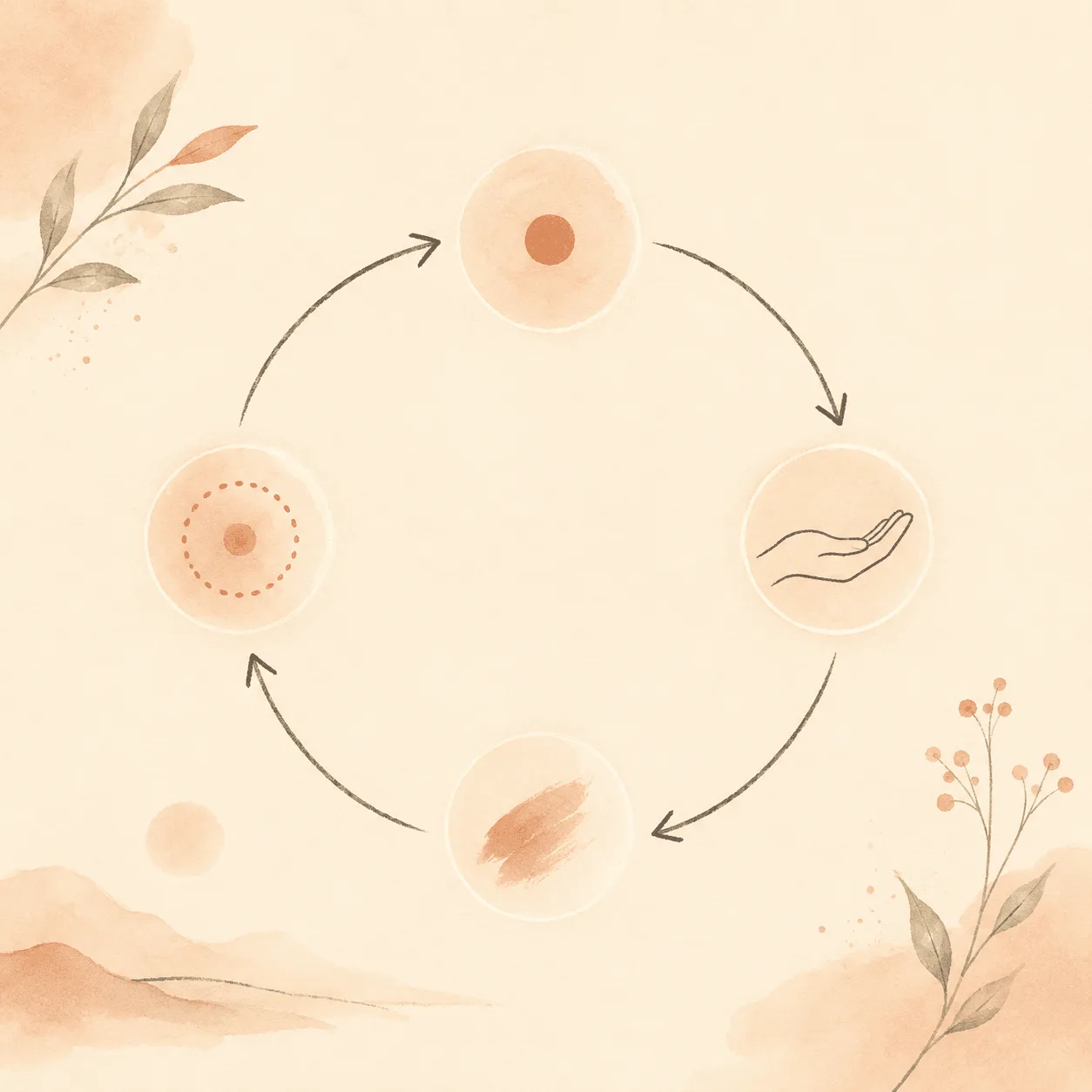
Then picking makes the acne worse in a way that produces more targets. An inflamed spot that's been picked heals into a dark or red mark called post-inflammatory hyperpigmentation. That mark can sit there for months. It isn't a spot, but it reads as one, and it gives your eye somewhere to go on days when there's nothing new. Picking the same area repeatedly is also how a spot that would have healed flat turns into a scar with texture, which doesn't fade on its own and picks up shadow in bathroom lighting. Which marks fade and which don't is covered properly in the piece on picking marks and scars.
So the loop runs: spot appears, spot gets picked, spot leaves a mark, mark keeps the picking going after the acne itself has calmed down. Plenty of people arrive in their twenties still picking, years after the acne stopped.
Translated: if you keep going back with marks that don't quite fit the acne, the picking is the thing to treat, and hardly anyone says so out loud.
The practical consequence is that this needs two treatments running at once. Treating the acne properly removes targets. Treating the picking stops new ones being made. Doing one without the other is why so many teenagers cycle through skincare routines for years without much changing.
For Teens: What Actually Helps
Nothing in this section requires telling a parent, buying anything expensive, or having a diagnosis.
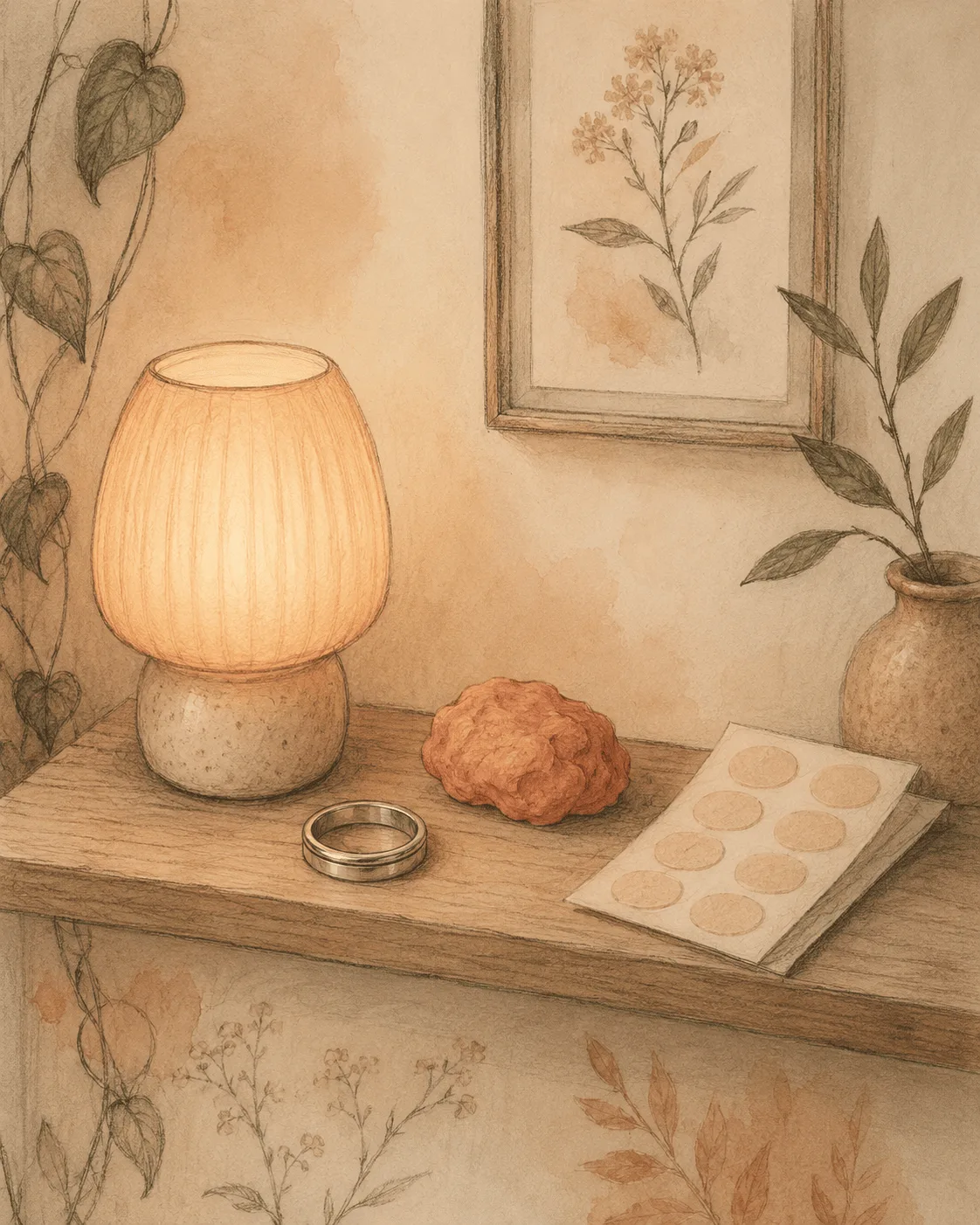
Start with the bathroom, not with willpower. The highest-yield change is making the mirror less useful. Most sessions start with a check, not with a decision. Overhead bathroom light plus a close mirror turns skin texture into a landscape. Switch to a lamp and keep the overhead off. Get rid of the magnifying mirror if there's one in the house. If the mirror is fixed in place, a strip of tape at eye height, or a towel over it during the worst hour, will do.
Make the check itself the thing you notice, not the picking. By the time you're picking, the decision was made a couple of minutes earlier, when your hand went up to scan. That scan is what you're trying to catch. For the first week, don't try to stop anything at all. Just count how many times a day your hand goes to your face for no reason. Most people are startled by the number, and the counting on its own tends to bring it down, which is a documented effect rather than a motivational trick.
Give your hands the same sensation somewhere harmless. A competing response has to genuinely compete. If what you like is the specific feeling of a rough edge coming away, a stress ball won't cut it. Textured putty, a spinner ring, a rough patch of fabric in your pocket, silicone with raised bumps. Something your fingers can hunt in. The point isn't distraction, it's substitution.
Hydrocolloid patches on the spots you'd go for. They're a physical barrier and they speed up healing, and unlike gloves or plasters, nobody at school reads them as strange. Put them on before the high-risk window, not after you've started.
Pick your three worst windows and defend those. Almost nobody picks evenly through a day. For most teenagers it's getting ready in the morning, the hour after school, and the stretch in bed before sleep. Covering three predictable windows well beats trying to police the whole day and giving up by Tuesday.
Keep your nails short. Unglamorous, immediately effective, and it changes what's physically possible rather than what you intend.
All of this comes from a protocol called habit reversal training, which has the best evidence of any treatment for skin picking at any age. The face-specific version, including what the mirror is doing, is in the guide to face picking.
For Teens: School
School is where picking gets social, and the social part usually does more damage than the skin does.
Boredom is a trigger and lessons are long. Sitting still with nothing for your hands is the exact condition automatic picking likes. Something in your pocket you can work at under the desk solves more of this than any amount of resolve, and most teachers won't notice or care.
Bathrooms between lessons are the risk. A locked cubicle with a mirror, five minutes, nobody watching. If that's your pattern, the fix is boring and it works: use a different bathroom, one without a mirror, or go with someone.
Have one line ready for questions. Not an explanation, a closer. "It's a skin thing I'm dealing with," said flatly, once, ends almost every conversation. The goal isn't to educate anyone. It's to stop the question being frightening.
Watch what you're cancelling. Skipping PE, dodging photos, turning down plans on bad skin days. That avoidance is usually a better measure of what this is costing you than the state of your skin is, and it's the part that quietly grows.
For Teens: Your Phone Is Part of This
Front-facing cameras are a newer trigger than most advice accounts for, and they deserve the same treatment as the bathroom mirror.
A phone held at arm's length shows your face at a distance nobody in real life ever stands at. Ten inches. Nobody talks to you from ten inches. What looks like an obvious flaw in a selfie is frequently invisible at the distance an actual conversation happens.
Three specific things worth changing:
Video calls with self-view on. An hour of a lesson or a call with your own face in the corner is an hour of low-level skin checking. Most apps let you hide self-view. Do it.
Pimple-popping and extraction content. It's satisfying to watch for the same reason picking is satisfying to do, and it primes the urge. If your feed serves you a lot of it, that isn't neutral background.
Skincare content that inspects. The genre where someone zooms to pore level and narrates texture trains you to look at your own face the same way. Filtered and edited images are the widely discussed problem. Extreme-close-up unfiltered content is the less discussed one, and for someone who picks it's arguably worse, because it makes ordinary skin look like a problem waiting to be solved.
For Teens: Talking to a Dermatologist
Most teenagers who pick see a dermatologist about the acne at some point, and most never mention the picking. It's the biggest missed opportunity in this whole condition, because a dermatologist who knows can change what they prescribe.
Say it in the first two minutes. Not at the door on the way out. Something like: "I want to sort out the acne, and I should also say I pick at it, which I think is making the marks worse."
What that changes. A dermatologist who knows you pick may push to clear the acne quickly rather than gradually, because fewer active spots means fewer targets. They'll treat the marks as post-inflammatory pigmentation rather than as active acne, which calls for something different. And they can tell you which marks will fade on their own, which is genuinely reassuring information most people never get.
Three things to ask. How long will these marks take to fade if I leave them alone? Is anything I'm using making my skin rougher or more tempting to pick? Can you refer me to someone for the picking itself?
If they brush it off. Some will. The clinical literature is explicit that this gets under-recognized. Use the words "excoriation disorder" or "skin picking disorder," because they land differently from "I pick at my spots," and ask for a referral to a therapist rather than another cream.
Track it before you try to stop it
SkinAware logs episodes in a few taps, lets you record the urges you didn't act on, and walks through habit reversal one module at a time. Two-week free trial on iOS.
For Parents: What Helps and What Backfires
Two things are true at once. Your teenager is doing something that damages them, and almost every intervention that feels natural to you will make it worse. That's not a criticism of your instincts. It's the specific mechanics of this condition.
Picking is fuelled by shame and hidden because of it. Anything that adds shame, or increases surveillance, pushes the behavior somewhere you can't see without reducing it at all.
Stop the skin checks
This is the big one, and the one parents defend hardest.
Inspecting your teenager's face, asking to see their arms, commenting on how it's looking today: all of it makes their skin a subject of assessment between the two of you. That's already the frame the picking lives in. Every check confirms that their skin is being evaluated, which raises the pressure and sends the next session to a bathroom with the door locked.
Compliments count too. "Your skin looks so much better this week" ties your approval to an outcome they can't control, and it guarantees that a bad week feels like letting you down. That's a straight line to hiding it.
Stop the running commentary
"Your hand's on your face again," fifteen times a day, turns you into a monitoring system. Teenagers respond to monitoring by relocating, not by stopping.
Don't punish it, and don't pay for clean weeks
Punishment produces shame, and shame produces hiding. That one is stated plainly across pediatric guidance for families.
Rewards look kinder and fail differently. Paying for a clean week turns an ordinary slip into a financial and moral failure, and makes the whole thing about your approval rather than their body. Reward the strategy, never the skin.
What to say the first time
You get roughly one shot at making this feel safe. Lead with the fact that nothing has changed in how you see them, not with the picking.
"I've noticed you pick at your skin sometimes. You're not in trouble and I'm not annoyed. It's a real thing with a name and loads of people have it. I just wanted you to know I know, and I'm on your side."
Then stop talking. Whatever comes back, including nothing, is fine.
If they deny it:
"Okay, maybe I read that wrong. Either way, if it ever is a thing, you can say so and it won't be a problem."
Denial usually softens over weeks, once they've watched a few calm responses and worked out that admitting it costs them nothing.
Change the environment instead of the person
You can do all of this without their cooperation and without announcing it.
Swap the bathroom bulb for something softer, or add a lamp. Remove the magnifying mirror. Keep tweezers and pins somewhere less convenient. Put a bowl of fidget objects where they actually sit in the evening. Book the dermatology appointment and get the acne treated properly, because that's the target supply. None of it requires a conversation, and none of it reads as policing.
The teenager has to want it
Treatment for picking leans heavily on the young person's own motivation. Clinicians who treat this say the same thing repeatedly: a teenager dragged in insisting they're fine is a hard case, and one who arrives distressed by their own skin is a much easier one.
That reframes your job. You're not trying to make them stop. You're making sure that when they decide they want to, help is available and asking for it isn't embarrassing. Those are very different projects, and the second one is achievable.
For Parents: When It Needs More Than Home Strategies
Behavior therapy, specifically habit reversal training delivered inside CBT, has the best evidence for skin picking. Ask for it by name. A general counselor who has never worked with body-focused repetitive behaviors is not the same appointment, and it's a fair question to put to a prospective therapist directly.
Worth moving faster if you're seeing any of these:
- Wounds that keep getting infected, or picking deep enough to leave open sores
- School avoidance, dropped activities, or refusal to be photographed
- Picking that got noticeably worse alongside a change in mood or sleep
- Signs of depression or anxiety beyond what the skin explains
Picking overlaps heavily with anxiety, depression, OCD and ADHD, and treating only the picking when something else is driving it tends to disappoint everyone. If your teenager has ADHD, that link is well documented and worth raising with whoever prescribes; there's more in the piece on ADHD and skin picking.
No medication is approved specifically for skin picking. A few options have research behind them in adults, and a prescriber may treat co-occurring anxiety or depression on its own merits, but that's a conversation with a clinician rather than a first step.
Frequently Asked Questions
Sometimes, and often not. Picking that emerges at puberty frequently continues into adulthood, and most people go years before anyone names it. The behavior resembles a compulsion far more than a habit, which is why "they'll grow out of it" is a bet rather than a plan. The teenage window is a good one to act in, mostly because the shame hasn't had a decade to set.
No. The intent isn't to hurt or punish, and the mechanism sits much closer to grooming gone into overdrive. It's classified alongside OCD-related conditions rather than with self-injury. Some young people experience both, and both deserve support, but they're different things and they're treated differently.
It helps a lot and it rarely finishes the job. Clearing the acne removes targets, which is the reason to treat it properly and quickly. But once picking is established it's its own condition, and marks, texture and completely normal skin all become targets in the absence of spots. Treat both at once.
Believe them, and change the environment anyway. Some genuinely aren't bothered yet, and some are in denial because admitting it feels worse than hiding it. Either way, pushing drives it further out of sight. Lighting, mirrors, fidget objects and getting the acne treated all work without their agreement.
Neither, quite. Making them stop doesn't work and adds shame. Leaving it entirely alone misses the things you can genuinely change: the environment, the acne treatment, and whether asking for help is easy. Aim for neutral about the behavior and active about everything around it.
Most do. Flat red or brown marks left after a picked spot are post-inflammatory pigmentation, and they fade over months, faster with sun protection. Indented or raised scars don't resolve on their own, though dermatological treatments exist. What most determines how the skin looks in two years is how much picking happens between now and then.
Not as a monitoring tool. Tracking works because the person doing it is being straight with themselves, and that disappears when someone else is reading the log. If your teenager wants to track, it has to be theirs.
Ask specifically for habit reversal training for excoriation disorder, and ask any therapist directly whether they've treated body-focused repetitive behaviors before. The International OCD Foundation (iocdf.org), which now hosts the TLC Foundation's BFRB resources, keeps a therapist directory, and a GP, pediatrician or dermatologist can refer. For teenagers, look for someone who works with the young person directly rather than through the parent.
The most useful thing on this page isn't a technique. For a teenager, it's the first week of counting checks instead of trying to quit. For a parent, it's a fortnight of saying nothing at all about their skin, which is harder than it sounds and shifts the temperature in a house more than anything else here.
And for most teenagers reading this, the genuinely new information is that it's a named condition with a real treatment, and that a lot of people their age do it too. Being wrong about being the only one is usually the first relief.