

Written using peer-reviewed research including the 2026 Journal of Clinical Psychiatry analysis of video-delivered habit reversal training, Lee et al. (2018) in the Journal of Obsessive-Compulsive and Related Disorders, Capel et al. (2023) and Wiese et al. (2023) in Cognitive Therapy and Research, and Norwood et al. (2018) in Clinical Psychology & Psychotherapy. Platform pricing verified July 2026.
For most people with a body-focused repetitive behavior, online. Not because video beats a room, but because the thing that decides your outcome is whether your therapist has ever treated skin picking before, and going remote is usually the only way to reach one who has.
That's a different answer than you'd get for depression or grief, where a competent generalist really is a competent generalist and the choice comes down to preference. For picking and pulling, the pool of people trained in the treatment is small enough that geography quietly decides quality. Staying local often means choosing someone who has never run this protocol. Going online means choosing from everyone in your state who has.
There are real trade-offs, and they aren't the ones the practice pages mention.
The choice underneath the choice
A 2023 survey put numbers on how thin the ground is. Every licensed mental health provider in Utah was emailed, and 329 responded.
That's one state, and Utah houses one of the better-known BFRB research groups in the country, which if anything should push the numbers the other way.
So when you choose "in-person, twenty minutes away," you're usually not choosing a format. You're choosing whoever happens to be within twenty minutes, with roughly a coin-flip chance they've never seen this condition. When you choose "online," you're choosing from everyone licensed in your state, which for most people is the first time the shortlist contains anyone with real BFRB training.
The medium matters less than that. It isn't nothing, though, so the rest of this page is what's actually known about it.
What the remote evidence shows
More than you'd expect for a condition this under-researched, and it's specific to picking and pulling rather than borrowed from anxiety trials.
That course length is worth pausing on. It's the same shape as the in-person protocols, so remote delivery didn't stretch the treatment out.
Two caveats, and they matter. There was no control group and no randomisation, so the analysis can't tell you the treatment caused the change. And it was written by people with financial ties to the platform whose data it uses. That combination doesn't make it worthless. It makes it evidence of what happens in practice rather than proof of efficacy.
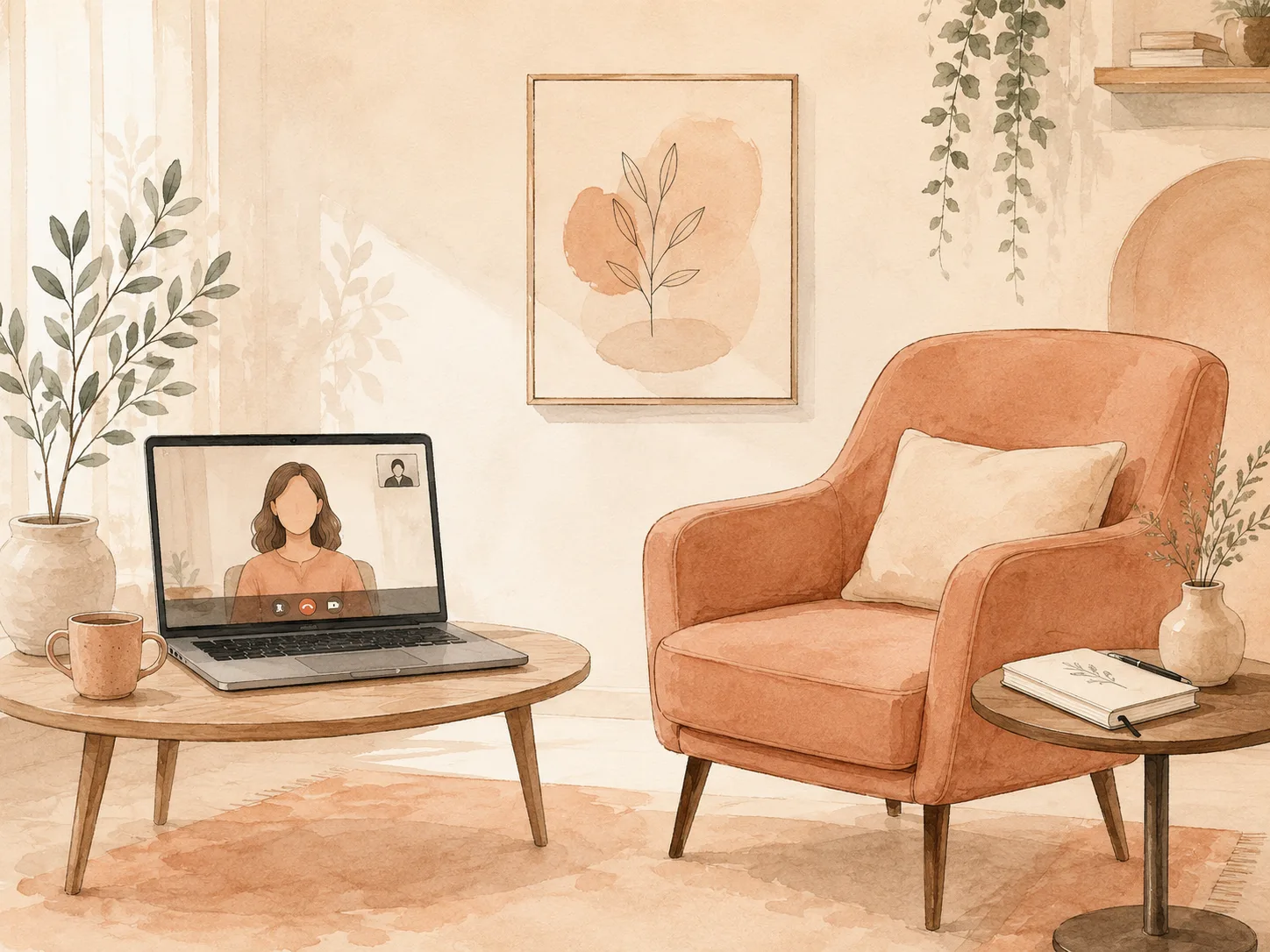
For randomised evidence you have to go much smaller. In 2018 a team at Utah State delivered acceptance-enhanced behavior therapy for trichotillomania entirely over video, 12 people treated against 10 on a waitlist. Pulling severity dropped significantly and held at follow-up, psychological flexibility improved, shame improved, and quality of life didn't move at all. Twenty-two people is a small trial, and it remains the randomised evidence that exists for delivering this treatment remotely.
The wider psychotherapy literature points the same way. A 2018 systematic review and non-inferiority meta-analysis found the therapeutic alliance over videoconference was not significantly worse than face to face. Alliance is the thing everyone assumes video destroys, and it has held up better than almost anyone predicted.
The state line is the real ceiling
The constraint nobody's practice page mentions: a therapist must be licensed where your body is sitting during the session. Not where they are. Not where you're registered to vote. Sit in a different state for the afternoon and technically you've moved outside your therapist's licence.
Interstate compacts have loosened this considerably for psychologists and are slowly doing the same for counselors and social workers, and the details shift with every legislative session. The practical version is to ask one specific question before you get attached to anyone: are you licensed, or do you hold a practice privilege, in the state I'll physically be in during sessions? Which compact applies to which profession is covered in the therapist-finding guide, because it's the question that wastes the most people's time.
Across national borders it's stricter. Cross-border teletherapy is generally not permitted, so a reader in the UK can't book the American specialist whose name keeps appearing in the research, and the reverse holds too. The training pipeline for BFRBs is concentrated in the US, which makes that rule bite harder here than in most areas of mental health.

What's genuinely harder over video
Your therapist can't see your hands.
That sounds minor until you think about what a session involves. A camera framed on your face crops out everything below your collarbone. During awareness training, a clinician in the room notices your hand drift to your jaw while you're talking about something else, and says so, and that moment of being caught is half the technique. On video they see a face and a background.
Assessing skin damage is the other genuine loss. Some protocols use photographs of lesion severity as an outcome measure, and lighting and camera quality make that harder remotely. Most clinicians will simply ask you to hold the site up to the camera, which works fine, and which some people find more exposing than showing someone across a room.
Two groups where the format leans in-person. When 172 habit reversal providers were surveyed in 2023, they rated every component of the treatment as feasible either way, but rated telehealth more feasible for people over 13 and for less severe presentations. Read backwards, that says younger children and more severe cases are where being in the room earns its keep. With young children it's partly attention and partly parents, since a parent in the waiting room ends up part of the session in a way they don't over video.
What's genuinely easier over video
You're sitting in the room where it happens.
Stimulus control is a real component of the treatment, not a footnote. It means changing the environment so the behavior is harder to start: moving tweezers out of the bathroom, dimming the light over the mirror, covering the magnifying mirror, changing where you sit to read. Clinicians who work this way online make the point that a video session lets them see the actual bathroom, the actual desk, the actual lighting, rather than working from your description. You can carry the laptop and show them the shelf.
Anyone who has tried to describe their own bathroom to a therapist knows how much gets lost. "There's a mirror" doesn't convey the mirror.
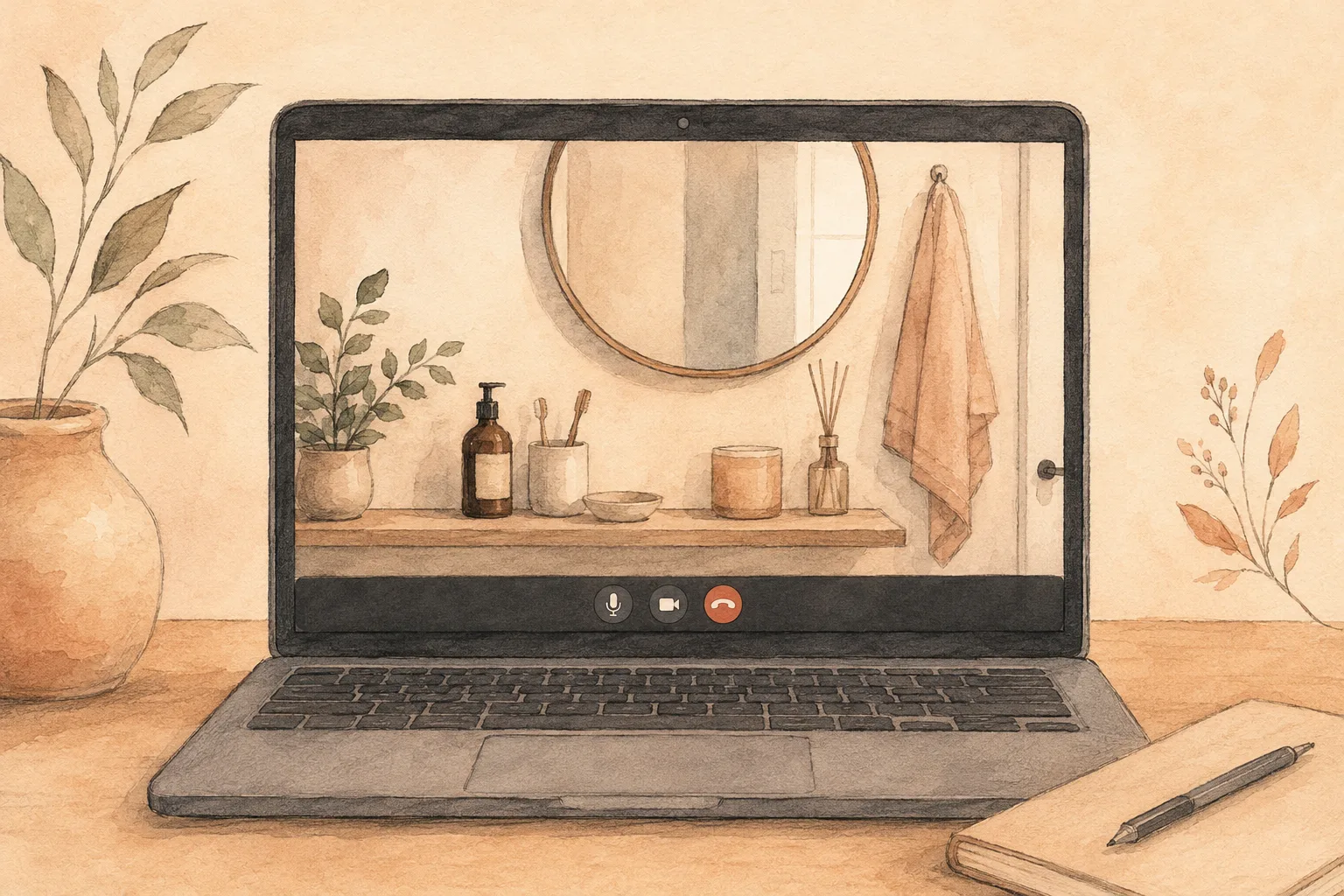
The same logic covers the competing response. You rehearse it where you'll need it, in the chair you actually pick in, at roughly the hour you actually pick. Generalising from the therapy room into real life is a known weak point in behavioral treatment, and remote sessions skip a chunk of that gap by never leaving real life to begin with. The components of habit reversal training and the ways each one fails are worth knowing before you start, whichever format you choose.
Then the unglamorous advantages. No commute, which matters more than it sounds when the protocol opens at twice a week. No waiting room, which matters if your face or scalp is the thing you'd rather not have strangers reading. No getting dressed to a standard. Sessions from home fit around a job in a way a 4pm appointment across town doesn't, and people who don't have to leave the house tend to still be in treatment at week twelve.
Side by side
| Online | In-person | |
|---|---|---|
| Chance of a BFRB-trained clinician | High. Your whole state is the pool | Low outside major metros, and unknowable in advance |
| Evidence for this specific condition | Large real-world video HRT sample plus one small randomised trial | The protocols were developed and tested this way |
| Therapist can see your hands | Only what the camera frames | Yes, continuously, including what you don't notice |
| Assessing skin damage | Workable, held up to the camera | Straightforward |
| Stimulus control work | Done in the actual environment | Done from your description of it |
| Under-13s, or severe presentations | Providers rate it less feasible | Preferred |
| Geographic limit | The state or country you're sitting in | Driving distance |
| Privacy at your end | Yours to solve | Handled by leaving the house |
| Typical course | ~8 sessions over ~14 weeks | 8 to 16 weekly sessions |
Note which row isn't there. There's no row for "works better," because no study has randomised people with a BFRB to one format against the other. Anyone telling you online is just as effective, or that it's a watered-down version, is filling that gap with an opinion.
The platforms, and what they cost
We publish this site and SkinAware is an app in the same space as some of what follows, so read this section with that in mind. These aren't the same product as each other, and the prices don't compare cleanly without knowing what you get for them.
Specialist video therapy platforms. NOCD is the largest that treats BFRBs, delivering habit reversal training over video with therapists trained in it, plus messaging between sessions. It takes most major US insurers, which for many people makes it cheaper than any local private-pay specialist. Its published outcomes are the analysis described above, with the conflict of interest that implies.
Messaging-based programmes. SkinPick and TrichStop, run by the same operator, are built around asynchronous text and voice messaging with a therapist who replies within 24 hours on weekdays, rather than scheduled video sessions. SkinPick lists $65 to $90 per week, TrichStop $60 to $90, both billed every four weeks. Neither accepts insurance and both accept FSA and HSA cards.
Generalist marketplaces. BetterHelp and its equivalents charge in the region of €70 to €100 per week billed every four weeks, and match you on availability rather than on training. You can find someone good on them. You can also draw the therapist from the survey at the top of this page who thinks hypnosis is the answer, and you won't know which you've got until session three. If you use one, screen hard before you settle in.
A specialist's own private practice, over video. Frequently overlooked, often the best of both. Plenty of BFRB clinicians run video sessions for clients across their whole state at their usual rate, with the same protocol they'd use in the room. Directories list them without labelling them as online, so you'll only find them by asking.
If you're doing that search now, what a proper course of CBT for skin picking looks like from the inside makes it much easier to tell within one session whether the person you booked knows the model.
Whichever route you pick, start logging now
Every version of this treatment, in either format, opens with self-monitoring and keeps assigning it every week until the end. Arriving at a first session with six weeks of records already in hand shortens the assessment and gives a good clinician something to work from immediately.
SkinAware covers that side: episode and urge logging for picking, pulling and nail biting, and a habit reversal course in four modules. It isn't therapy and doesn't replace either column of that table. It's a way to arrive already holding the data, and something to hold onto while you wait, which for most people is the longest part of this.
Arrive with the data already collected
Log episodes and resisted urges, and work through habit reversal in four modules, while you're finding someone to work with.
Available on iOS, Android and in your browser.
Frequently Asked Questions
No trial has directly compared the two formats in people with a BFRB, so nobody can answer this properly. What exists: video-delivered habit reversal training produced a median one-third reduction in symptom severity across more than a thousand people in a real-world analysis, and a small randomised trial of remote treatment for hair pulling beat a waitlist. The therapist's training in the model is a far bigger variable than the medium.
Only what the camera frames, which is usually your face and shoulders. This is the clearest disadvantage of the format. A therapist who works with BFRBs will ask you to reposition the camera during awareness training, and it is worth raising in the first session rather than assuming they will think of it.
Only if they are licensed, or hold a practice privilege, in the state you are physically in during the session. Interstate compacts have made this easier for psychologists and are slowly expanding for counselors and social workers. Ask before the first appointment rather than after.
It works for some people, and it is not the format the protocols were built in. Habit reversal training involves demonstrating and rehearsing a physical response, which is hard to correct over text. If you choose a messaging platform, look for one that includes some live contact.
It varies and it is worth checking before committing. NOCD takes most major US insurers. SkinPick and TrichStop take none, though both accept FSA and HSA cards. A specialist in private practice may or may not, and out-of-network reimbursement via a superbill is the usual route when they do not.
Look at what the treatment actually was before blaming the format. Generic talk therapy about stress, delivered over video, is not a failed trial of habit reversal training. It is a different intervention. Switching to an untrained therapist in a room is unlikely to fix that.
Not reliably. A specialist running video sessions usually charges their standard rate. Where online saves money is through insurance coverage on the larger platforms, through removing travel and time off work, and through messaging-based programmes that cost less per month than weekly private-pay sessions while delivering something different from them.