
Written using peer-reviewed research including Franklin et al. (2011, Journal of the American Academy of Child & Adolescent Psychiatry), Schumer et al. (2015, Depression & Anxiety), Franklin et al. (2008, Journal of Developmental & Behavioral Pediatrics), Grant & Odlaug (2008), and Mayerson, Mackay & Waite (2026, JCPP Advances), alongside guidance from the American Academy of Child and Adolescent Psychiatry, the TLC Foundation for BFRBs, and the UC Davis MIND Institute.
Your child's age tells you more about what you're looking at than almost anything else.
Hair pulling that starts before about six years old is usually a short-term habit, sitting in the same family as thumb sucking and nail biting. It tends to show up alongside those behaviors, tends to be linked to something stressful rather than to anything deeper, and in most children it fades. Clinical descriptions of this group are consistently optimistic, and the phrase used is closer to "habit disorder" than to a diagnosis.
Hair pulling that starts in late childhood or early adolescence, roughly eight and up, behaves differently. It's more likely to persist, more likely to come with shame, and much less likely to resolve on its own. That's the version with a name: trichotillomania, often shortened to trich.
Both groups deserve a response. They just don't deserve the same one. What follows is written for you, not for your child, and it includes the actual words you can use.
Where Ordinary Hair Fiddling Ends
Lots of children twist, twirl, stroke and tug their hair. Most of it means nothing. The line worth watching isn't how odd the behavior looks. It's whether hair is coming out and staying out.
Signs that tend to matter:
- A patch that's thinner than the rest, often on one side, often reachable by the dominant hand
- Hair on the pillow, on the floor by the bed, behind the headboard, in the sofa
- Eyelashes or eyebrows thinning or gone, which is harder to hide and harder to explain away
- Hands drifting to the head during TV, reading, homework, car journeys
- Hats, hoods, or a new insistence on a particular parting
- Denial that seems out of proportion to the question you asked
That last one catches parents off guard. It isn't lying in the way you'd normally think about it. Children hide this specifically to avoid being told off or being embarrassed, and that pattern is documented plainly in clinical guidance for families.
In very young children the picture is different again. In one study of 110 children aged up to ten, the preschoolers pulled only from the scalp, while over half of the five-to-tens had spread to other sites. Younger children also tend to be genuinely less aware they're doing it, which matters when you're deciding whether to ask them about it at all.
The First Conversation
Most parents get one shot at making this feel safe, and the instinct to lead with the hair is the wrong one.
Two things need to land: that you already know, and that nothing about how you see them has changed. Everything else can wait for a second conversation.
Something like this works:
"I've noticed you've been pulling your hair sometimes. You're not in trouble, and I'm not upset with you. There's actually a name for it and it happens to loads of people. I just wanted you to know I know, and I'm on your side."
Then stop talking. Let the silence sit. Whatever comes back, including nothing, is fine.
If they deny it, don't push:
"Okay. I might have got that wrong. Either way, if it ever does happen, you can tell me and it won't be a problem."
That leaves the door open without forcing them through it. Denial usually softens over days or weeks, once a child works out that admitting it doesn't cost them anything.
If they're upset or ashamed:
"This isn't something you're doing wrong. It's a thing your body does when it wants something, a bit like biting nails. There are people who help kids with exactly this, and we're going to find one."
Why Pressure Makes This Worse
Every parent tries the obvious thing first, and the obvious thing is asking them to stop. It doesn't work, and the reason it doesn't work is worth understanding before you spend six months on it.
The urge to pull isn't a decision your child is making badly. It builds like a physical itch and it resolves when the hair comes out. Telling a child to stop doesn't remove the urge. It adds guilt on top of an urge that's still there.
The American Academy of Child and Adolescent Psychiatry is unusually direct about this: punishing children for pulling hair is unlikely to reduce the behavior, and it can damage their self-esteem. The same guidance notes that children commonly hide or deny pulling precisely to avoid punishment or embarrassment. Pressure doesn't reduce pulling. It relocates it somewhere you can't see.
Research has started putting numbers on what that costs. A 2026 study of adolescents who pull, by Talia Mayerson, Clare Mackay and Polly Waite at Oxford, found that shame carried almost the whole link between hair pulling and mental health: it fully accounted for the connection to anxiety symptoms, and partly accounted for the connection to low mood. The pulling by itself wasn't what predicted how a teenager felt. The shame around it was. Anything you add that increases shame is working against the outcome you want.
Four specific things to stop doing:
Running commentary. "Your hand's in your hair again" fifteen times a day turns you into a monitoring system, and children learn to pull where you aren't.
Bargaining and rewards for not pulling. Paying for clean weeks makes a slip into a financial and moral failure. Reward the strategy instead, which is covered further down.
Naming sites they haven't touched. Saying "at least you're not doing your eyelashes" can hand your child an idea they didn't have. Keep specific body parts out of your mouth.
Removing all privacy. Bathroom-door rules and bedroom searches escalate fast and buy you nothing. The pulling isn't happening because they had a moment alone.
Will They Grow Out of It?
For preschoolers, often yes. For school-age children and teenagers, the evidence says don't count on it.
Researchers at the Yale Child Study Center went back to thirty children with trichotillomania an average of 2.8 years after they'd taken part in a treatment trial, to see what had happened in the meantime.
Read the last sentence again, because it's the part that changes what you do this month. The pulling mostly stayed flat. The mood around it deteriorated. The authors concluded that few children improve much when effective behavioral treatment is unavailable or hasn't worked.
A separate survey of 133 young people aged ten to seventeen found the same shape from another angle: moderate impairment in social and academic functioning, and elevated anxiety and depression that tracked with how severe the pulling was. Over 45% reported depressive symptoms and 40% anxiety symptoms above the normal range for their age, with older children reporting more than younger ones.
None of that means your child is heading somewhere bad. It means the window where this is easiest to treat is now, and that "let's see if it settles" is a decision with a cost attached rather than a neutral option.
If Your Child Eats the Hair
This is the part most parent guides mention in half a sentence and then drop, and it's the only part of hair pulling that can end up in surgery. It matters more in children than in adults, so it's worth reading properly and worth not panicking about.
Eating pulled hair is called trichophagia. It's more common than older textbooks suggested: in one study of 68 people with trichotillomania, 20.6% currently ate their hair or the roots, with a further 13% doing it occasionally. Plenty of children also mouth, chew, or run the hair between their teeth without swallowing, which is not the same thing.
Human stomachs can't break hair down. Swallowed over months or years, it can gather into a mass called a trichobezoar. These are rare, and most children who eat some hair will never develop one. They have been documented in children as young as four, and when they do form they usually need surgery to remove.
How to ask without making it a crisis. Flat tone, no reaction, in the middle of doing something else:
"When you pull one out, what happens to it after? Some people put it in their mouth or swallow it. Do you ever do that?"
If the answer is yes, don't recoil. What you say next is roughly:
"That's okay, and it's not weird. It's really common. I do want to tell the doctor about it though, because hair is one of the few things a stomach can't deal with. That's the only reason."
A child who gets a calm response the first time will tell you the truth the second time. A child who gets a horrified one won't.
Getting Actual Help
The treatment with the best evidence for children is behavior therapy, specifically habit reversal training, usually delivered inside a course of CBT. It isn't the same as general counseling, and asking for it by name matters.
That last detail is the argument for treating this in childhood rather than waiting. Adults who respond to behavior therapy frequently relapse. In this trial, the children didn't.
What to ask for. Book with your GP or pediatrician and use the words: "I'd like a referral to someone who does habit reversal training for trichotillomania." Ask any prospective therapist directly whether they've treated body-focused repetitive behaviors before. A skilled general CBT therapist who has never worked with pulling is not the same appointment.
What good treatment looks like from the outside. Your child learns to catch the behavior earlier, including the automatic kind they don't notice. They practice something physically incompatible with pulling, like clenching a fist, for the sixty seconds an urge takes to pass. The environment gets adjusted so pulling is a bit harder to start. And you get involved, because in this age group parents are taught the home half of the work rather than sitting in the waiting room. The full walkthrough of habit reversal training covers the mechanics if you want to know what's coming.
On medication. No drug is approved for hair pulling, and it isn't first-line for children. N-acetylcysteine, the supplement that has real trial support in adults, was tested in children and adolescents and showed no benefit. Medication may still be appropriate if your child has anxiety, depression, or ADHD that needs treating in its own right. If your child has ADHD and the pulling started close to a medication change, that timing is worth telling the prescriber about. There's more on that in the piece on ADHD and hair pulling.
If there's a wait. There usually is. The home strategies below aren't a substitute for therapy, but they're the same ingredients, and starting them now beats starting them in November.
What You Do at Home
The tactics that work are unglamorous and specific. Vague advice about managing stress won't survive a Tuesday evening.
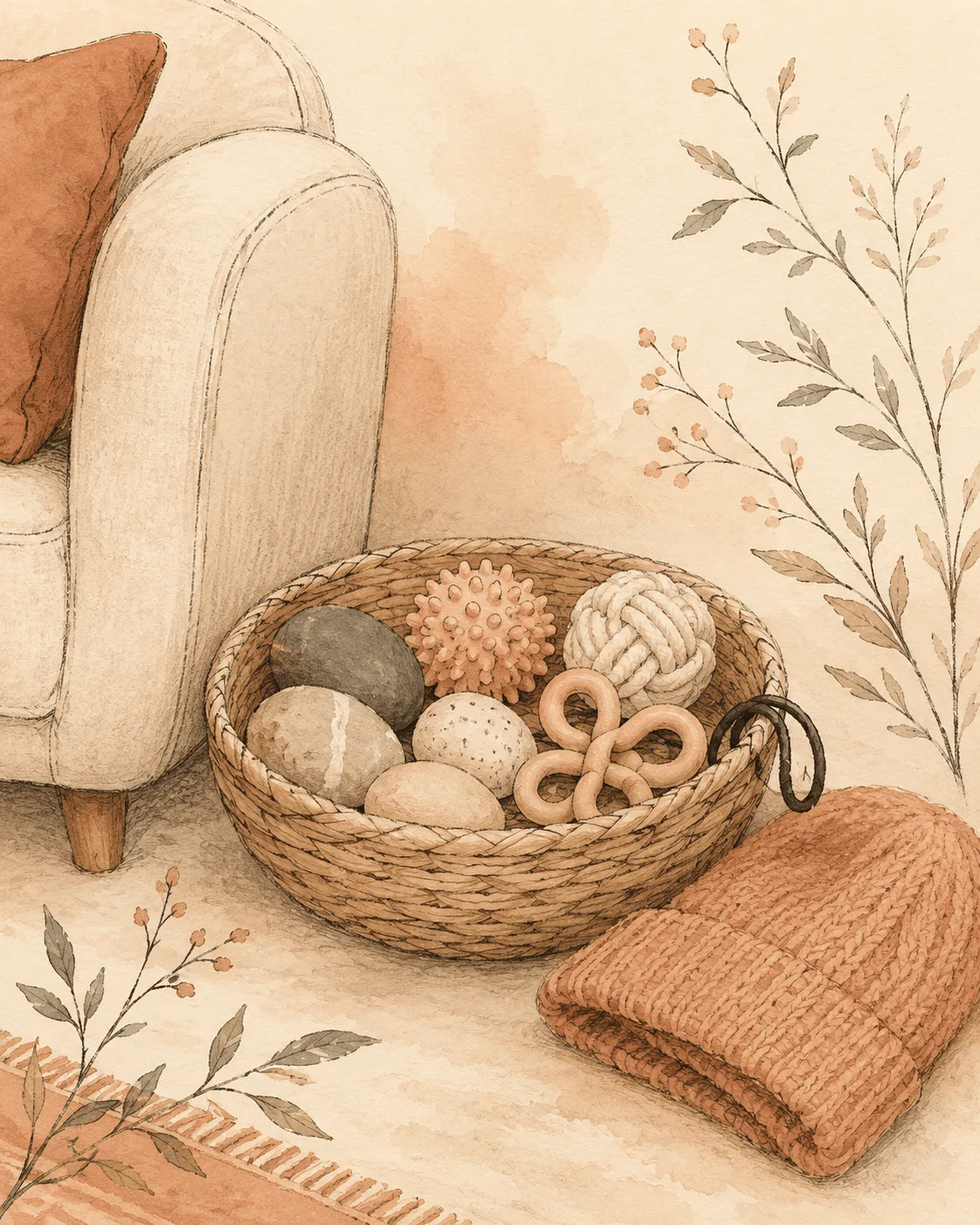
Set the fidget up before the trigger, not during it. If the pulling happens during TV, the basket of fidget objects lives by the sofa and your child picks one up before the program starts. Reaching for a fidget after the hand is already in the hair is too late.
Give the hand a substitute the body accepts. A hair tie on the wrist to pick at, textured putty, a smooth stone. Some children want the sensation, not just the distraction, and a substitute that ignores that gets abandoned within a week.
Block the route during known high-risk times. A hat during homework. Adhesive bandages on the thumb and index finger. One clinician describes a girl who pulled her eyelashes wearing non-prescription glasses, purely because they got in the way of her hand. These are speed bumps rather than cures, and they buy the half-second of awareness that everything else depends on.
Find the two or three worst windows and defend those. Almost nobody pulls evenly across a day. Bedtime, homework, the car, and screen time are the usual suspects. You'll get more from covering three predictable windows well than from trying to cover everything.
Praise the strategy, never the scalp. "I saw you grab the putty when the film started" is the sentence that changes behavior. "Your hair looks better" ties your approval to an outcome your child can't control, and it makes a bad week feel like letting you down.
Two questions parents ask early and deserve straight answers. Hair usually does grow back where pulling stops, though repeated pulling at the same spot over years can damage follicles permanently. There's more detail in what happens to hair after pulling stops. And no, this isn't self-harm. The intent isn't to hurt themselves, and the mechanism is much closer to grooming than to injury.
School
School is where hair loss becomes social, and most of the damage in this condition is social.
Tell one adult, not the staffroom. A class teacher, a form tutor, or the school nurse. What they need is short: your child has a hair-pulling condition, it isn't a habit they can decide to stop, please don't draw attention to it in front of the class, and please let us know if you notice teasing.
Ask for the specific thing, not sympathy. A hat or head covering allowed during lessons. Permission to hold a small fidget object at the desk. A quiet exit route if your child gets upset. If pulling is significantly affecting school life, ask what formal support is available, because a documented plan outlasts a sympathetic teacher who moves on at the end of the year.
Head off the teasing question before it arrives. Rehearse a one-line answer your child can use without explaining anything:
"It's a thing I'm dealing with. It's nothing anyone can catch."
Practice it until it's boring. The goal is that the question stops being frightening, not that your child educates their classmates.
Watch for the avoidance rather than the pulling. Swimming skipped. Excuses to sit out gym. Sleepovers turned down. Windy days that suddenly require a hood. Those cancellations are usually the clearest signal of how much this is costing, and they show up long before a child will say anything out loud.
Frequently Asked Questions
Usually not. Hair pulling that begins before about six often behaves like a self-soothing habit, turns up alongside thumb sucking or nail biting, and tends to fade. It's frequently linked to something stressful going on rather than to anything deeper. Two things still warrant a call: if your child eats the hair, or if a patch is being pulled bare. Otherwise, calm attention and gentle redirection are usually enough at this age.
No. The American Academy of Child and Adolescent Psychiatry states plainly that neither parents nor children are to blame for hair pulling. Stress can make pulling worse, and family tension is one of the things that can raise it, but stress isn't the cause and no parenting decision creates this condition.
The label matters far less than the message underneath it. What your child needs to hear is that it's common, that it isn't their fault, and that it can be treated. Use whatever words get that across. For older children and teenagers, having a real name for it is often a relief rather than a shock, because it replaces the belief that they're the only person who does this.
Ask specifically for habit reversal training, and ask any therapist directly whether they've treated body-focused repetitive behaviors before. A general CBT therapist who hasn't worked with pulling is not the same appointment. The International OCD Foundation (iocdf.org), which now hosts the TLC Foundation's BFRB resources, keeps a therapist directory, and your GP or pediatrician can refer. For children, good therapists involve parents in the work rather than treating the child alone.
No medication is approved for hair pulling, and it isn't first-line for children. N-acetylcysteine, which has genuine trial support in adults, was tested in children and adolescents and did not show a benefit. Medication may still be appropriate for co-occurring anxiety, depression, or ADHD, which is a separate conversation with a prescriber.
Denial is usually fear of judgement rather than dishonesty, and pushing tends to drive the behavior further out of sight. Say once that you know, that they're not in trouble, and that the door is open, then leave it. Meanwhile you can change the environment without their cooperation: fidget objects where they sit, a hat available during high-risk times, and less commenting. Many children come round once they've seen a few weeks of calm responses.
Usually, where pulling stops. Repeated pulling from the same spot over years can permanently damage hair growth and hair quality in some people, so regrowth isn't guaranteed. The single most useful thing anyone can do for regrowth is reduce the ongoing pulling.
No. The intent isn't to injure or punish, and the mechanism is much closer to grooming gone into overdrive than to self-injury. Some young people experience both, and both deserve support, but they're different things and they're treated differently.
The thing that changes outcomes here isn't finding the perfect fidget or the perfect sentence. It's that a child who pulls has an adult who knows, doesn't flinch, and keeps the appointment.
So the next step is small and specific. Book the GP appointment this week and use the words "habit reversal training for trichotillomania." Pick one high-risk window in your house, the one you already know about, and put something in your child's hands before it starts. Say the first-conversation line, or a version of it in your own voice, and then let it go for a few days.
Your child is very likely convinced they're the only person in the world who does this. Being wrong about that is often the first relief they feel.